Systemize Content Production: 7-Step Playbook to Build Authority

Most teams treat content like a treadmill. Turn it up. Run faster. Publish more. I’ve done that. At Steamfeed we scaled to 120K monthly uniques by pairing depth with volume and a lot of contributors. But when I moved into SaaS leadership, I saw the other side: traffic doesn’t equal authority, and authority doesn’t automatically create pipeline.
Here’s the thing. Publishing velocity isn’t the lever you think it is. Authority comes from coverage discipline, enforced originality, and structure designed to be cited. When those are missing, speed creates rework, cannibalization, and a long trail of “pretty good” pieces that never earn trust. You don’t need more articles. You need a system.
Key Takeaways:
- Authority compounds when coverage, originality, and structure are enforced upstream
- Fragmented workflows create rework, delays, and duplicated ideas that fight each other
- Simple rules, cooldowns, information gain, snippet-ready openers, cut waste fast
- Deterministic links and programmatic schema eliminate publish-time correctness issues
- Visuals should be governed by rules so designers don’t have to babysit articles
- A QA gate with pass/fail thresholds shifts effort from “fixing” to “designing rules”
Why Publishing More Still Fails To Build Authority
Publishing more doesn’t create authority because most teams repeat coverage, miss differentiation, and lack structure that’s easy to cite. Authority forms when coverage gaps drive topics, originality is measured before drafting, and sections open with direct, snippet-ready answers. Think of a cluster where each article adds new signal, not just more words.

The Metrics That Actually Matter For Authority
If you can’t answer “What did we cover too much?”, “What’s genuinely new here?”, and “Which sections are snippet-ready?” in under ten minutes, you’re not running a system, you’re running a calendar. Authority is about compounding signal. That requires measuring coverage, enforcing new information, and structuring answers so both humans and machines can reference them.
I tend to audit three dials: coverage saturation by cluster, information gain at the brief level, and section-level snippet readiness. When those are visible and governed, teams publish fewer, stronger pieces and stop tripping over their own archives. Use planning, not postmortems, to enforce them. That’s the shift.
If you want a more traditional view as context, review how a content plan maps from goals to execution in HubSpot’s content marketing plan overview. Then add the missing enforcement layer.
What Is “Content As A System” And Why Does It Matter?
Content works when it has inputs, constraints, tests, and outputs, every time. Not occasionally. Map your path from topic selection to publish. Label where rules decide and where taste decides. If you find any step that depends on “ask Sarah,” codify it. Systems compound because they’re repeatable. Projects decay because they reset.
In practice, this looks like a Topic Universe that prioritizes coverage gaps, briefs that score uniqueness before writing, snippet-ready H2 openers baked into structure, and code-based correctness for links and schema. The subtle benefit? Everyone debates strategy, not syntax. And that’s where judgment actually matters.
Why Speed Alone Creates Waste
I’m not anti-speed. I’m anti-blind speed. Faster drafting without upstream gates simply accelerates duplication and generic takes. You can’t edit your way to authority. Put the brakes where they count: prioritize by coverage, require information gain in every brief, and standardize H2 openers. You’ll publish less but win more.
The side effect is real. When differentiation is enforced before writing, approvals unblock, designers aren’t scrambling for images, and publishing stops breaking on “small” issues like links and schema. Speed returns where it belongs, after the rules exist.
Ready to skip theory and see the system end to end? Try Generating 3 Free Test Articles Now.
Fragmentation, Not Writing, Is Your Real Bottleneck
The real problem isn’t your writers. It’s that strategy, differentiation, structure, visuals, and publishing live in separate tools with separate owners. That fragmentation kills feedback loops and makes quality optional. Unify the pipeline with rules where correctness matters, then give writers room to add signal within those bounds.

What Traditional Workflows Miss
Siloed tools mean SEO in spreadsheets, drafts in prompts, visuals tacked on at the end, and schema attached in CMS afterthoughts. Each step “works,” but together they don’t produce authority. You can’t enforce uniqueness or structure if every handoff resets the rules. Fragmentation is treated as normal. It shouldn’t be.
The fix is upstream and systemic: codify coverage rules, enforce information gain at the brief, standardize snippet-ready openers, and make links and schema deterministic. When those are governed, creative energy stops leaking into avoidable fixes and starts shaping better arguments.
How Do You Replace Handoffs With Deterministic Rules?
Start simple. Define coverage labels and a cooldown policy in your Topic Universe. Require information gain scoring in every brief. Standardize H2 openers with a three-sentence pattern. Then bolt in code-based internal links and JSON-LD at publish. Each rule removes a debate later. You’re not removing creativity. You’re removing chaos.
If you need a playbook structure to align contributors, use a shared reference like Content Marketing Institute’s playbook guidance as a baseline, then add enforcement, your actual edge. That’s the difference between “best practices” and outcomes.
The Costs You Do Not See Until It Is Too Late
The bill for fragmentation shows up as rework hours, cannibalized rankings, and “popular” content that doesn’t move pipeline. These are avoidable with upstream gates and deterministic publishing. When I see teams plateau, it’s almost always because they’re paying these silent taxes month after month.
Engineering Hours Lost To Manual Fixes
Let’s pretend you publish 25 posts a month. Two hours per post go to images, links, and schema patches. That’s 50 hours a month, 600 hours a year. At a modest $70/hour loaded cost, you’re burning $42,000 on avoidable rework. Not counting the opportunity cost of shipping higher-signal work instead.
Most of that vanishes when visuals follow rules, internal links pull from verified sitemaps with exact-match anchors, and Article/FAQ/Breadcrumb JSON-LD is generated and validated at publish. Want a sanity check on where process stalls today? Map your current steps against a basic content workflow like Teamwork’s content creation workflow and mark the manual fixes. Then cut them.
What Happens When Articles Repeat Each Other?
Duplicate ideas split crawl equity, confuse readers, and sometimes turn into classic cannibalization. It’s subtle at first. “We’re thorough.” Then three posts chase the same intent and nobody clearly wins. A simple saturation score per cluster plus a 90-day cooldown drastically reduces this. You publish to fill gaps, not to stay busy.
When clusters stop competing with themselves, intent paths get crisp. Your “pillar” feels like a pillar again. Authority starts to show up in the places you wanted in the first place.
When Your Best Story Ships Without Product Relevance
I’ve seen high-traffic pieces that never moved pipeline. At Proposify we ranked for plenty of topics, but some narratives drifted too far from proposals and e-signature. Looked successful in analytics. Didn’t sell. Tie clusters to product-relevant problems and place screenshots where decisions happen. Traffic is a means. Relevance earns revenue.
This doesn’t require turning every article into a feature pitch. It does require that problem-solution threads point back to the world your product serves. Gently, consistently, unmistakably.
What It Feels Like When The Pipeline Finally Clicks
A governed pipeline feels different. Drafts don’t meander. Visuals show up already on-brand. Schema and links don’t break at publish. You review outcomes, not patch errors. The bottleneck moves to strategy, and the team has hours back to deepen coverage instead of cleaning up.
The Day You Stop Babysitting Drafts
Writers aren’t chasing approvals on voice and structure. Editors stop line-editing commas and start refining rules. Designers aren’t asked to “find something good” for an abstract idea at the last minute. Links and schema are already correct. It’s calmer. Predictable. You can actually plan.
A side effect I love: the review meeting becomes a strategy session, not a triage call. You talk about what to cover next and why, not whether an H2 needs to be rewritten. That shift signals the system is working.
Who Benefits Most From A Systemized Flow?
Teams shipping 8 to 50 posts monthly. Product-led brands where relevance matters. Multi-site organizations juggling contributors. Solo marketers doing the work of five people. Governance multiplies for all of them. I’ve watched a single strategic operator outperform a mid-tier agency, because the system carried the load.
If you’ve been burned by process overhead before, that’s fair. Keep it lean. Start with three rules, coverage labels, information gain in briefs, snippet-ready openers, and expand only when the bottleneck shifts.
A Quick Story From The Trenches
We once shipped founder-led content by transcribing video riffs. Fast, and it got words on the page. But it missed structure, snippets, and intent match. The fix wasn’t more writing time. It was a system: Topic Universe to plan, information-gain briefs to differentiate, snippet-ready openers to structure, visuals mapped to the right sections, and a hard QA gate. Night and day.
If that’s the outcome you’re after, don’t wait for capacity. Systemize first. Then scale.
Still stuck in approval loops and patchwork fixes? It might be time to let an engine handle the boring parts. Try Using An Autonomous Content Engine For Always-On Publishing.
The 7-Step Playbook To Systemize Content Production
A reliable content system runs on seven moves: map coverage, enforce uniqueness, structure for snippets, codify links and schema, automate visuals, add a QA gate, and publish predictably. These steps remove debates that clog your calendar and focus your team on signal. Apply them in sequence. Keep them simple.
Step 1: Run A Topic Universe Audit
Inventory your current posts, cluster them by intent, and assign saturation labels: underserved, healthy, well-covered, saturated. Mark cannibalization in clusters and set a 90-day cooldown per topic. This creates a simple map that tells you what to write next and what to pause.
Two points of discipline matter. First, treat the labels as policy, not vibes. Second, use the map to drive the calendar, not the other way around. When coverage leads, authority follows.
Step 2: Build Information-Gain Brief Templates
Create a brief format that scores uniqueness before writing. Require a quick competitive scan, “what’s missing” notes, and a minimum information gain threshold. Include section objectives, reader questions, and product relevance triggers. The brief becomes a contract.
Flag low-gain drafts early and recycle their angles or spikes into future outlines. If the brief doesn’t add new signal, the draft will struggle to, too. That’s the point of the gate.
Step 3: Install Snippet-Ready Section Templates
Standardize H2 openers with a three-sentence pattern: direct answer, essential context, practical example. Cap them at 40-60 words. Make each section stand alone and anchorable. This micro-structure increases eligibility for featured snippets and makes sections easier for LLMs to cite accurately.
Teach it once and enforce it in QA. Writers keep their voice. Readers get clarity fast. Machines get clean references. Win, win, win.
Step 4: Define Deterministic Internal Linking And Schema Rules
Codify anchor text patterns, placement boundaries, and target page eligibility. Pull only verified URLs from your sitemap. Prohibit fabricated paths. Generate JSON-LD for Article, FAQ, and BreadcrumbList and attach it at publish after validation. Treat correctness as code, not a suggestion.
This is where most publishing breaks. Not because the team is sloppy, but because the rules weren’t written down. Write them down. Then automate them.
Step 5: Automate Brand-Consistent Visuals
Create a brand asset library with colors, logos, style references, and tagged product screenshots. Generate a hero and 2-3 inline images with rules for aspect ratios, alt text, filenames, and section matching. Prioritize solution sections for screenshots so visuals reinforce decisions, not decorate text.
Interjection. Screenshots convert when they are placed where decisions happen.
Placement rules matter as much as generation. If visuals are governed, designers stop firefighting and credibility goes up.
Step 6: Implement A QA Gate With Pass/Fail Thresholds
Build an automated checklist across structure, information gain, brand voice, snippet readiness, visuals, links, and schema. Set a minimum passing score and hard-stop anything below it. Route failures into specific remediation loops so fixes are targeted, not random.
QA is not a meeting. It’s a gate. Your editors become rule designers, not fixers. That’s a happier job for everyone involved.
Step 7: Set Publishing Workflow And Cooldowns
Map CMS fields once, enforce idempotent publishing, and prevent duplicates. Push live or as staged drafts with version history. Configure a 90-day re-coverage rule per topic so refreshes are intentional, not reactive. Add notifications for draft-ready, publish success, and delivery failures.
Publishing should be boring. Reliability is the goal. When publish is predictable, strategy gets your attention back.
How Oleno Operationalizes This Playbook End To End
Oleno turns those seven moves into a single, continuous system that runs daily. Strategy drives generation, originality is scored upfront, sections are snippet-ready by design, visuals follow brand rules, and correctness (links, schema, fields) is deterministic. The outcome is authority that compounds over time without manual coordination.
Topic Universe Prioritization With Cooldowns
Oleno’s Topic Universe maps your landscape, labels saturation by cluster, and enforces a 90-day cooldown before re-covering a topic. That prioritization prevents cannibalization and over-publishing, turning “What should we write next?” into a clear queue instead of a guessing game.
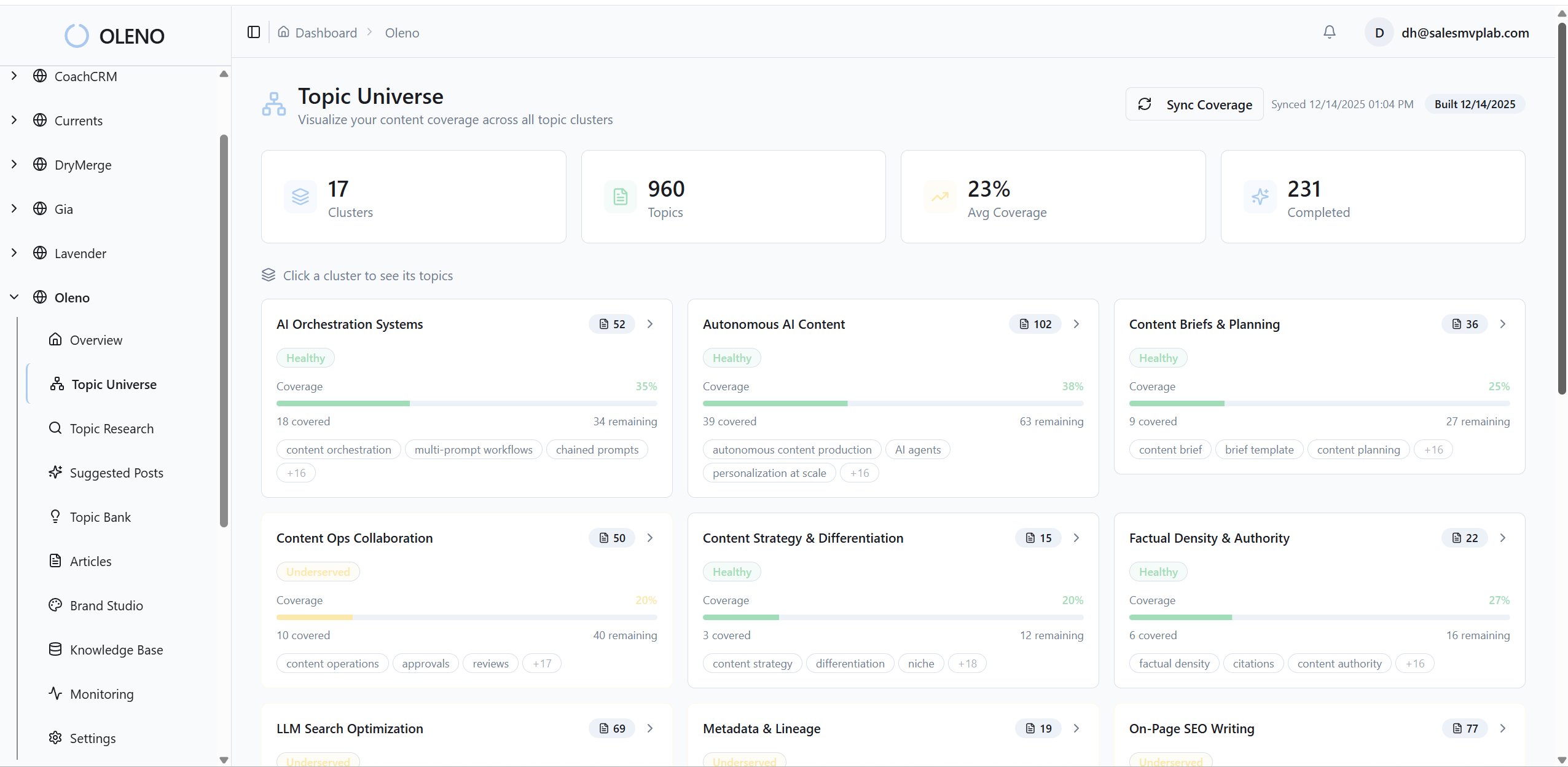
Because coverage is tracked continuously, you get intentional re-coverage when it’s actually useful. Not because the calendar is empty, but because the cluster needs depth. That’s how teams escape the busywork trap.
Deterministic Links And Programmatic Schema
Internal links in Oleno are injected from verified sitemaps with exact-match anchors, placed at natural sentence boundaries. JSON-LD for Article, FAQ, and BreadcrumbList is generated, validated, and attached at delivery. No fabricated URLs. No broken rich results. No late-night patching.
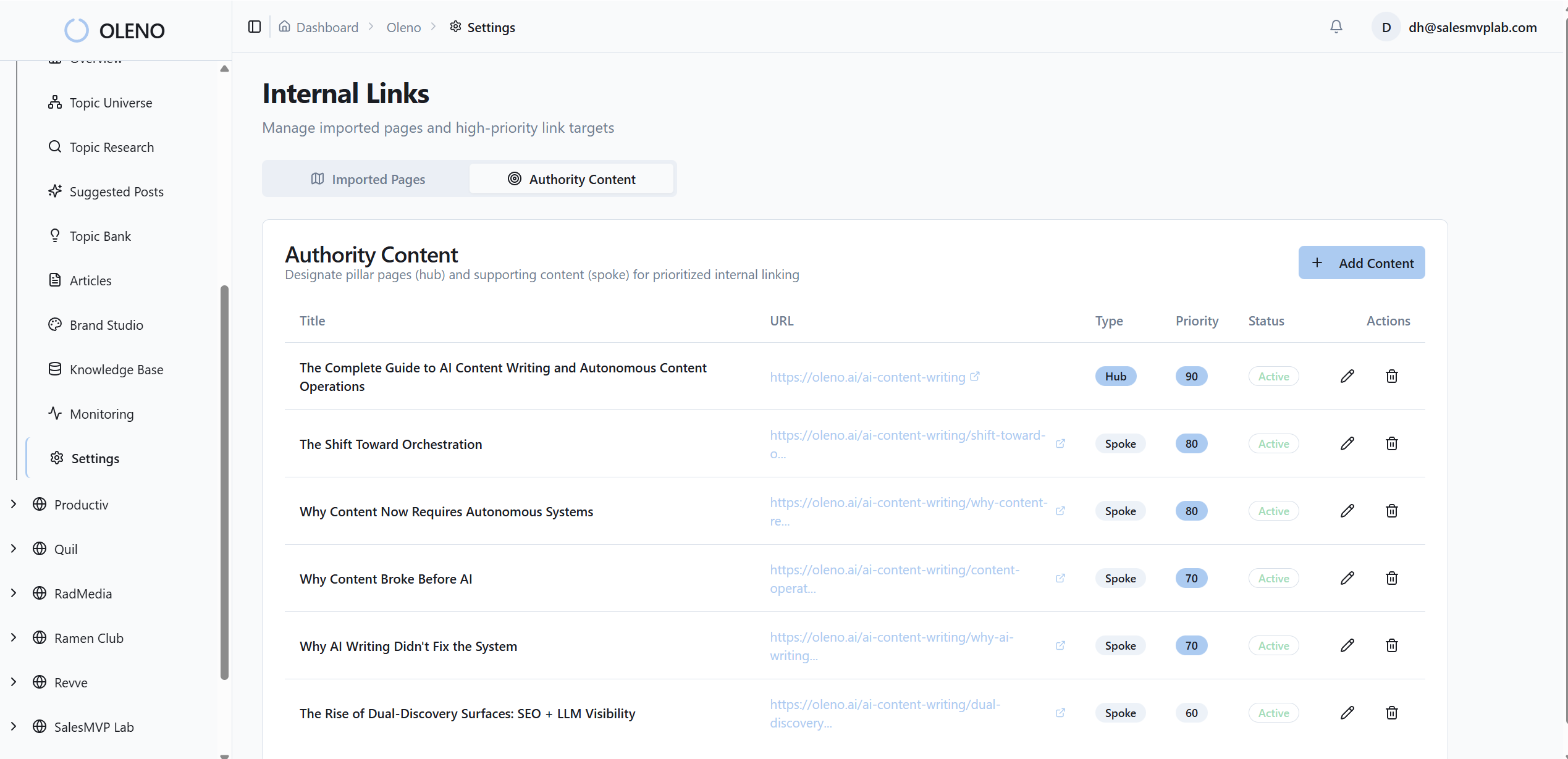
This directly reduces the rework costs we quantified earlier. Fewer manual fixes. Fewer publish failures. More time on narrative and coverage.
QA Gate And Publishing Connectors
Oleno evaluates drafts against 80+ criteria, including structure, clarity, brand alignment, information gain, snippet readiness, and visual placement, then runs refinement loops until thresholds are met. When it passes, Oleno ships CMS-ready HTML to WordPress, Webflow, HubSpot, or through Sheets for custom flows. Duplicate publishing is prevented by design.
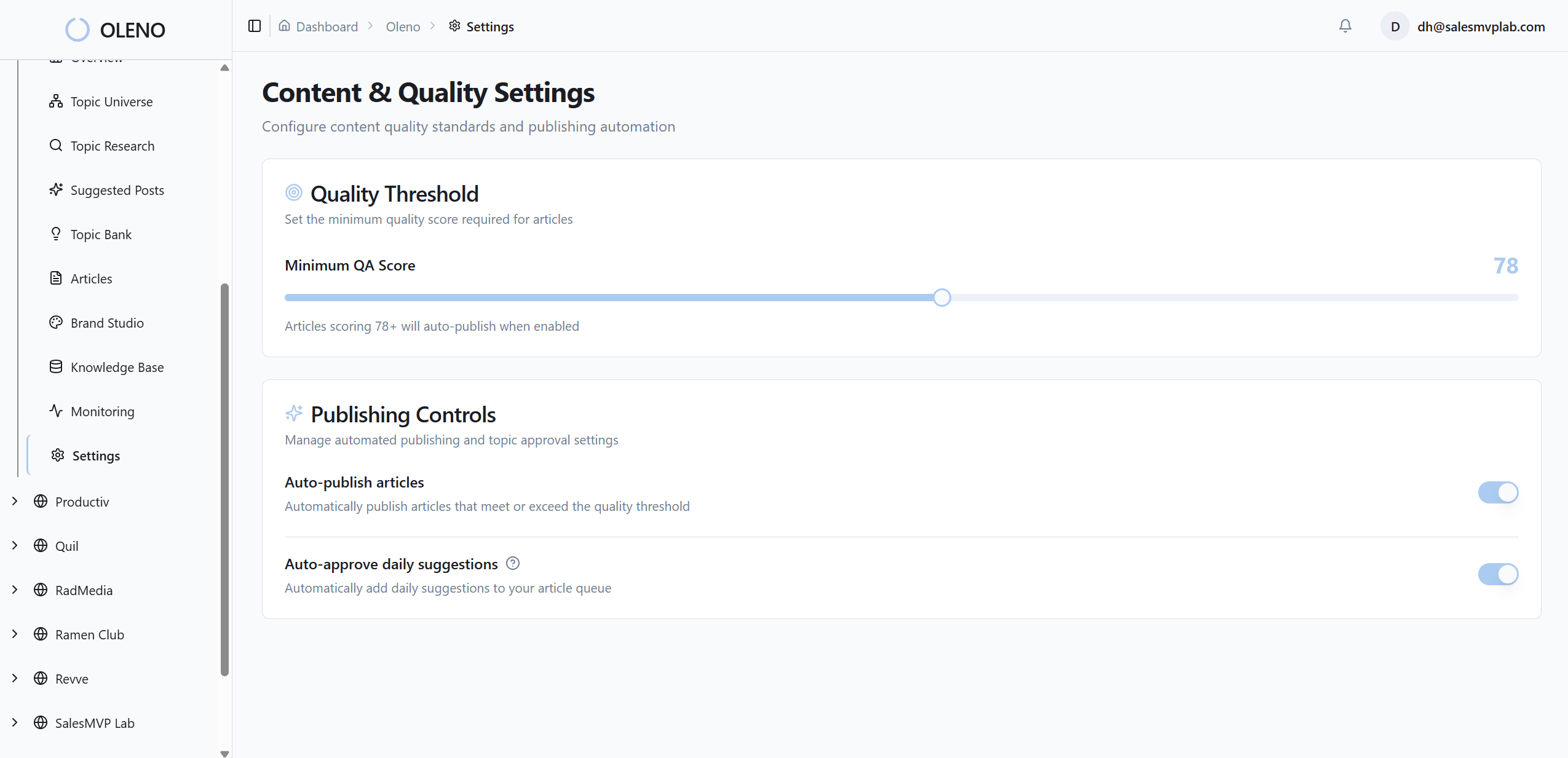
The benefit is simple: fewer frustrating reworks, fewer delivery surprises, and fewer “why did this break?” moments. If you want that operating rhythm, let the system handle structure and correctness so your team can focus on story, not commas.
You can see how this feels in practice in minutes. Try Oleno For Free.
Conclusion
You don’t need more content. You need a content system. Map coverage, enforce originality, design for citation, and make correctness deterministic. When those rules live upstream, teams publish stronger work with less drama. Authority stops being an accident and starts becoming the plan. That’s the job, ship signal that compounds, week after week.
About Daniel Hebert
I'm the founder of Oleno, SalesMVP Lab, and yourLumira. Been working in B2B SaaS in both sales and marketing leadership for 13+ years. I specialize in building revenue engines from the ground up. Over the years, I've codified writing frameworks, which are now powering Oleno.
Frequently Asked Questions