The Five Stages of Product Marketing Content Consistency

Most teams working on the five stages of product marketing content consistency think they have a writing problem. Usually, they don't. Demand-generation execution software is a governed marketing system that turns brand narrative, product truth, audience context, and distribution planning into consistent demand-generation execution across content, search, and LLM-driven discovery. Not a writing tool. Not an SEO plugin. A system for keeping the whole thing aligned so your message doesn't drift every time a new brief, writer, or deadline shows up.
This category showed up because GEO changed what good marketing looks like. It used to be enough to write decent content and rank a few pages. Now LLMs are deciding which brands get surfaced, quoted, and remembered. And that puts a spotlight on something a lot of teams have quietly lived with for years: inconsistency. The real enemy is Fragmented Demand Generation, a patchwork of tools, prompts, docs, and people that makes every content cycle feel new again.
Key Takeaways:
- Product marketing content usually breaks from fragmented execution, not weak writing talent
- Consistency compounds across search, LLM visibility, and pipeline impact
- The five stages of product marketing content consistency are a maturity path, not a checklist
- Strong rankings can still hide weak demand generation if content drifts away from product truth
- Teams scale faster when context lives in a system instead of in one marketer's head
Why Most Five Stages Of Product Marketing Efforts Break Early
Most five stages of product marketing content consistency conversations start too late. People notice the bad draft, the missed deadline, the review mess. They don't notice the broken operating model underneath it. That's why teams keep trying to fix execution with more effort instead of fixing the system that keeps producing drift.

Product Marketing Inconsistency Starts As A System Problem
Product marketing inconsistency is a systems failure, not a talent failure. Most teams assume the writer needs a better brief, or the PMM needs to review earlier, or the AI prompt needs more detail. But that diagnosis is usually wrong. The deeper problem is that positioning lives in one doc, product truth lives somewhere else, audience nuance lives in a sales call nobody wrote down, and the final article gets stitched together under deadline pressure.
I've seen this play out a bunch of times. When I was the only marketer, I could move fast because the context lived in my head. Once more people got involved, output didn't automatically improve. It often got slower. And weirdly, it got less clear too, because every extra handoff created one more place for the message to bend.
That is Fragmented Demand Generation. And most teams are doing it right now without calling it that. They have content happening. They don't really have a content system.
More Output Does Not Create More Trust
More content doesn't create more market trust on its own. That's the trap. A lot of teams hear "publish more" and turn it into a factory model, like the answer is just more assets, more calendars, more motion. But if the message shifts every time you publish, you're not building trust. You're building confusion at scale.
You can publish every week and still train your market to misunderstand you. That sounds harsh, but it's true. If one article frames your problem one way, your landing page frames it another way, and your product launch email sounds like it came from a different company, buyers don't get a stronger signal. They get noise.
Back in 2012-2016 I ran a website called Steamfeed. At our peak, we hit 120k unique visitors a month. Volume mattered a lot. But volume only worked because it was paired with depth, coverage, and a clear enough standard that the catalog compounded over time. Most pages got less than 100 visits a month. Still worked. Breadth plus quality created the lift.
A lot of SaaS teams copy only the volume part. They crank out assets. They miss the compounding part. And compounding only happens when the market keeps hearing the same clear signal from different angles.
GEO Punishes Drift Faster Than SEO Did
GEO exposes every crack in fragmented execution. SEO used to let you get away with more. You could rank a page on a decent keyword, patch up a few on-page issues, and get traffic even if your broader story was kind of muddy. LLM-driven discovery is less forgiving because it tries to synthesize who you are, what you believe, what your product does, and where you fit.
So if your content is inconsistent, your visibility often gets hit in a quieter way. You don't always see one big drop. You just don't get surfaced as often. You don't get cited. You don't become the brand that the model seems confident about.
That's why the five stages of product marketing content consistency matter. They show how teams move from scattered outputs to repeatable market signal. And for a growth-stage SaaS team, that's usually the difference between feeling busy and actually building demand.
Why The Market Rewards Signal More Than More Assets
The market does not reward effort evenly. It rewards signal. That's the thing a lot of teams miss. You can do a ton of work and still make yourself harder to understand if every asset starts over from scratch and says the same thing slightly differently.
Fragmented Workflows Force Every Asset To Start Over
Most product marketing teams think they're building on prior work. They're not. They're starting from zero over and over again. The brief gets rewritten. The product context gets re-explained. The audience gets guessed at again. Then review starts, and someone says the draft doesn't sound like us.
Sound familiar?
Prompting made this easier to hide. You can generate text very quickly now, so the workflow looks productive on the surface. But fast drafting isn't the same thing as consistent execution. If each output is treated like a one-off event, all you've done is speed up the reset cycle.
Consistency Is An Execution Advantage
Consistency is an execution advantage, not a style preference. People hear "consistency" and think brand tone, house style, word choice. Sure, that stuff matters. But the bigger issue is whether your team can repeat product truth, point of view, and audience fit across dozens of assets without needing a fresh alignment meeting every time.
When I was at PostBeyond, I could write 3-4 high quality posts a week because I had a structured framework and all the context. As the team grew, the content writer didn't have the same context, so they took longer and the output got worse. Not because they weren't good. Because the system wasn't carrying enough of the truth. I was. And once you're the bottleneck, growth gets painful fast.
That's the hidden shift. Mature teams don't just write better. They store context better, transfer it better, and publish from it more reliably.
Demand-Generation Execution Software Is A Different Category
Demand-generation execution software is not another content tool. It isn't a nicer editor. It isn't just AI writing with a better wrapper. And it isn't an agency replacement in the narrow sense either. It is the category for teams that need planning, messaging, product truth, audience targeting, creation, QA, and publishing to hold together as one system.
Not more prompts but more governance. Not more assets but more signal. Not faster drafting but steadier execution.
For a Head of Marketing at a 20-150 person SaaS company, that's the real problem. You don't need one more place to draft. You need a way to stop losing the plot between strategy and execution. You need your product launch content, SEO pages, use case articles, and category content to reinforce each other instead of drifting apart.
That shift matters because markets remember patterns. LLMs do too. Repeated clarity beats isolated quality.
Where The Cost Shows Up Before Anyone Calls It A Problem
The cost of inconsistency rarely announces itself in a dramatic way at first. It sneaks in. A little more review. A little more rewrite time. A little less confidence in what should ship. Then one day the team is busy all the time and nobody can explain why output still feels fragile.
Rework Tax Grows Faster Than Output
The first cost of inconsistency is rework tax. And it usually shows up long before leadership notices. One article needs two rounds of review. Then three. Then PMM has to rewrite the positioning section because it's too generic. Then legal or product needs to verify a claim. Then the publish date slips again.
Let's pretend you publish four product marketing pieces a month. Each one needs three stakeholders. Each stakeholder spends 20 minutes correcting context that should've been there from the start. That's four hours right there, and that's a conservative number. Add the writer's time to rework sections, the meeting to resolve feedback, and the delay cost on campaigns waiting for those assets. Now you're not dealing with a writing issue. You're dealing with a system cost.
And it gets worse as you add volume. That's the part most people miss.
Strong Traffic Can Still Hide Weak Demand Gen
Strong traffic can make a weak system look healthy for a while. That's dangerous because it buys you false confidence. The numbers look good enough, so nobody asks whether the content is actually building demand, reinforcing the category, or making the product easier to understand.
I learned this one the hard way at Proposify. We had a great content team. Great writers, lots of personality, strong design, strong rankings. We ranked really well for a lot of topics. But a lot of that content was too detached from the solution, so there was no real path from traffic to demand. We were getting attention without enough narrative pull back to the product, especially when evaluating five stages of product.
That can fool you for a while. Traffic looks good. The dashboard looks healthy enough. But if the content isn't reinforcing your market frame and product relevance, you're not building much memory in the market. You're just renting visits.
Some teams don't like hearing that, and fair enough, because traffic still matters. But traffic without a consistent story can turn into a very expensive vanity metric.
LLM Visibility Drops When Truth Keeps Moving
LLM visibility drops when product truth and narrative drift apart. This is a big one for product marketing teams because your work sits right at the intersection of category, product, proof, and buyer understanding. If those elements aren't steady across assets, the model has less reason to trust your brand as a clear source.
You see it in little ways first. Product pages say one thing. A comparison article frames the value differently. A launch post uses loose language that product would never approve. A use case page talks to the wrong buyer. Nobody meant to create that mess. It just happened because truth was scattered.
| Dimension | Old Way | Category Way |
|---|---|---|
| Narrative control | Messaging lives in docs, heads, and scattered briefs | Messaging is defined centrally and reused consistently |
| Product accuracy | Product truth gets re-explained in every workflow | Product truth is set once and carried into each asset |
| Content production | Each asset is its own prompt and review cycle | Content runs through a repeatable system |
| Team coordination | More contributors create more handoffs and rework | Shared context cuts review debt and context gaps |
| GEO readiness | Mixed signals weaken LLM confidence and citation | Consistent signals strengthen authority over time |
| Output over time | Work resets quarterly and drifts by contributor | Execution compounds with each cycle |
If nothing stays aligned, nothing compounds. That's really the issue.
Why This Feels So Frustrating For Small Marketing Teams for Five stages of product
For small teams, this problem feels personal even when it isn't. People start thinking they're the problem. That they're too slow, too messy, too reactive. Usually it's not that. Usually it's Fragmented Demand Generation making smart people operate with missing context and too many manual handoffs.
Reset Cycles Make Good Teams Feel Disorganized
Inconsistency feels like working harder for less return because that's exactly what it is. You're not imagining it. If you're the Head of Marketing, or the solo marketer, you're probably carrying positioning, reviews, campaign planning, launch support, and publishing all at once. Every new piece asks you to explain the product again, restate the audience again, fix the message again, and catch one more thing that shouldn't have slipped.
We ran into a version of this in founder-led content too. At LevelJump, we recorded videos with the CEO and turned them into written content. Faster, yes. But the SEO structure wasn't there, and topic discovery wasn't tight enough, so the content didn't pull enough search intent. Good raw material. Weak system around it. That gap matters more than people think.
Review Debt Pulls Marketers Out Of Their Real Job
Review debt steals time from actual strategy. You should be thinking about positioning, launches, segments, and pipeline. Instead, you're stuck cleaning up phrasing, checking claims, and pulling context out of Slack threads from two months ago.
I felt this myself when I built a B2C app and started doing SEO and GEO around it. I had a bunch of GPTs going, and I kept prompting, copy-pasting, fixing, and manually loading things into my CMS. It was taking 3-4 hours a day. Total waste. Useful output, sure. But terrible operating model.
That's the emotional cost of Fragmented Demand Generation. Capable people start feeling like they're failing, when really they're carrying too much system load by hand.
The Five Stages Of Product Marketing Content Consistency
The five stages of product marketing content consistency are a maturity path. Not a checklist. Teams move through them unevenly, and some bounce between stages for a while. Still, the pattern is pretty reliable. If you understand the stages, you can usually spot where your team is stuck and what has to change next.
Category leaders tend to build around three things first:
- Governed Truth: Product marketing stays consistent when product facts, positioning, and voice are defined clearly and carried through briefs, drafts, and QA.
- Orchestrated Execution: Planning, creation, review, and publishing work better when they share the same governance instead of operating as disconnected tasks.
- Compounding Coverage: Repeated clarity across assets, audiences, and channels builds a more coherent market presence over time.
Stage 1 Means Motion Without Memory
Stage 1 is ad hoc content. You publish when something urgent comes up. A launch. A feature. A campaign gap. A quarter-end push. Content gets made, but there isn't much carryover from one piece to the next. Every article is a fresh event.
At this stage, the team usually believes more activity will solve the problem. Write more. Brief faster. Use AI more often. Push the freelancer harder. But the market doesn't remember disconnected bursts. Search engines don't get much depth. And internally, nobody can really explain why one piece worked and another one didn't.
This stage creates motion. It doesn't create memory.
Stage 2 Speeds Things Up But Truth Still Drifts
Stage 2 usually introduces templates. That's progress. You get better speed, more repeatability, cleaner formatting, and fewer blank-page moments. But templates don't solve the deeper issue if the underlying truth is still scattered, especially when evaluating five stages of product.
Your team can now produce more content that sounds vaguely similar. But product claims still vary. Audience framing still changes by writer. POV gets softened by review cycles. And your launch content may still feel disconnected from your SEO content.
A lot of teams stay here longer than they should because things look more organized. Honestly, this stage fools people. It feels mature. It isn't.
Stage 3 Turns Scattered Knowledge Into Shared Context
Stage 3 is where the shift gets real. The team starts defining what is true, who the audience is, how the product should be framed, what language fits, and what doesn't. Instead of hoping contributors remember the right message, you make that message explicit.
This is where product marketing starts to get more reliable. Product truth stops living in one PMM's head. Positioning stops being whatever version made it into the latest brief. Audience nuance stops getting flattened into generic buyer language.
For growth-stage teams, that's usually the turning point. One person can't hold all that context forever. Tools like Product Studio, Marketing Studio, and Brand Studio exist for exactly this reason: to centralize approved product truth, category framing, and voice rules so Oleno can apply them during brief, draft, and QA.
See how teams turn scattered product context into consistent execution with Oleno's system: request a demo
Stage 4 Connects Planning To Publishing
Stage 4 connects planning, messaging, and publishing into a more usable system. At this point, the team is no longer just storing the right context. They're using it in a repeatable flow. Topics are prioritized with more intention. Asset types make more sense for the funnel. Product content, search content, and category content stop acting like separate departments.
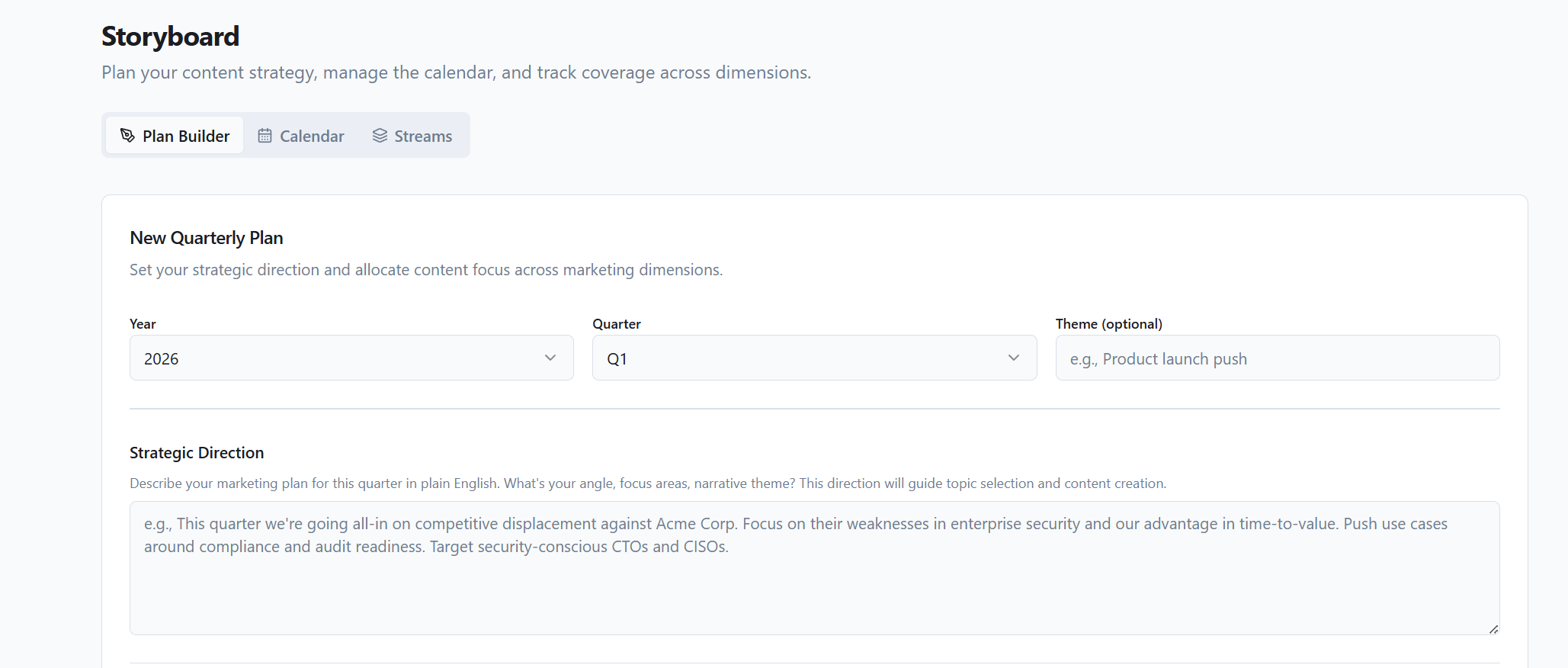
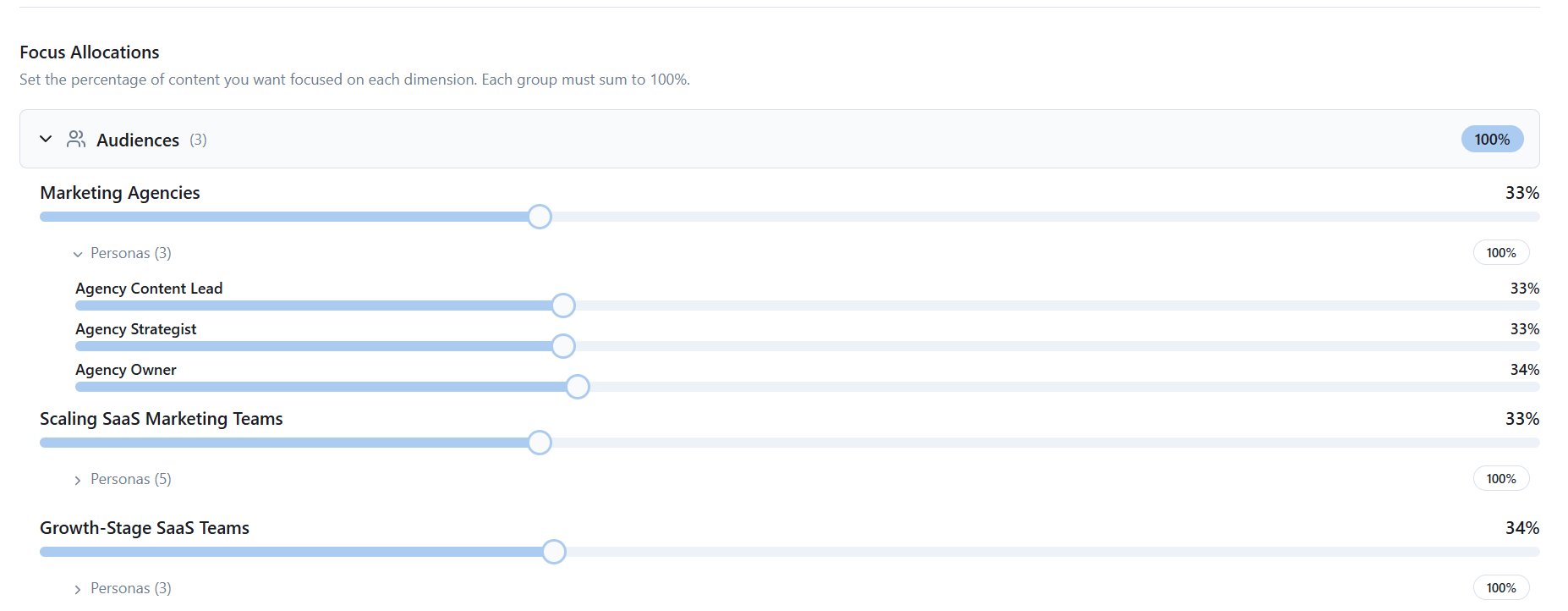
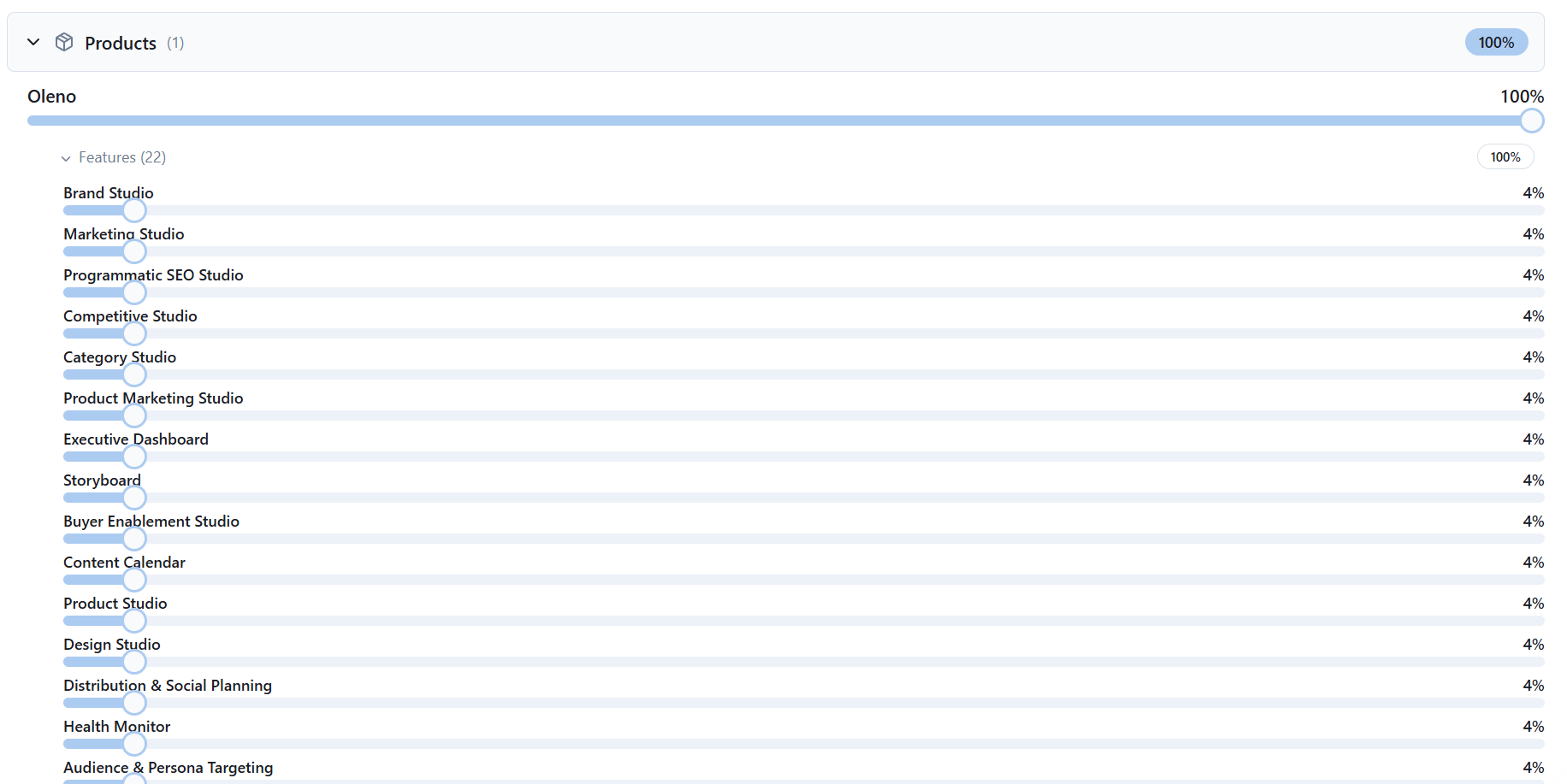
With Storyboard, teams can allocate content across audiences, personas, products, and use cases based on coverage gaps. With the Orchestrator, approved topics can move through a defined production flow. And with CMS Publishing, finished content can be pushed directly into the CMS without the usual copy-paste mess.
You also start to get clearer operational visibility here. Oleno's Executive Dashboard and Health Monitor can show output cadence, quality trends, coverage gaps, and pipeline health, which makes it easier to see whether your content mix reflects your actual priorities.
What changes here is simple. The system starts carrying more of the work. Humans still make judgment calls. But they aren't rebuilding the foundation every week.
Stage 5 Is When Consistency Starts To Compound
Stage 5 is compounding consistency. This is when the market keeps hearing the same clear story from multiple angles, over time, across formats. Product launches reinforce category framing. SEO content supports product understanding. Competitive pages follow the same market logic. Social distribution extends approved ideas instead of inventing new ones.
Back in the Steamfeed days, we saw traffic spikes at 500 pages, then 1000, then 2500, then 5000, then 10000. Most pages individually didn't look impressive. The compounding came from breadth, depth, and consistency. Product marketing works in a similar way. One feature article won't change market perception much. Fifty aligned assets might.
This is where you stop publishing isolated content and start building a coherent content system with Oleno.
Want to see how a small team can move from Stage 2 or 3 into a system that actually compounds? request a demo
What Consistency Looks Like When A System Carries The Context
This is the point where the category stops being theoretical. If the first half of this article is the diagnosis, this section is the operating model. What does consistency actually look like when it isn't dependent on one marketer remembering everything? It looks like the system carrying the context.
Oleno Puts Consistency Into The Workflow
Oleno is what demand-generation execution software looks like when consistency is operationalized for a small marketing team. Instead of leaving product marketing quality to memory, prompts, and endless review loops, Oleno encodes the core context up front and carries it through execution.
Marketing studio stores your category framing, key messages, and point of view so each asset argues from the same market position. Product studio centralizes approved product descriptions, boundaries, use cases, pricing guidance, and related source material so product-led content stays accurate. Audience & persona targeting makes sure the same topic can be framed differently for the right buyer instead of talking to a generic reader.
That changes the job. You stop re-explaining the basics every time a draft gets made.
Oleno Reduces Drift By Connecting The Moving Parts
The value isn't one feature. It's the way the system holds together. Programmatic seo studio handles acquisition content through a structured pipeline. Product marketing studio supports feature deep dives, workflow guides, and launches grounded in product truth. Category studio creates long-form category content that keeps the market frame consistent. Stories studio brings in founder stories, customer anecdotes, and sales insight so thought leadership sounds lived-in rather than generic.
Then the orchestrator runs the flow across topic selection, drafting, QA, and publishing cadence, while quality gate blocks work that misses objective standards. Cms publishing closes the loop by pushing approved content into your CMS instead of forcing another manual step at the end.
From a Head of Marketing perspective, that's the important part. The system carries more context, so the team carries less review debt.
Product Marketing Gets Better When The System Stops Resetting
Oleno doesn't matter because it writes text. Plenty of tools can produce text. It matters because it gives product marketing a repeatable operating model. One where message, product truth, audience context, and publishing cadence stop living in separate places.
For a growth-stage SaaS team, that can mean fewer rewrites, less prompt variance, and a cleaner path from strategy to published asset. It can also mean getting more out of a small team without adding another layer of coordination overhead, which is usually the real headache.
Oleno's product marketing studio, product studio, and marketing studio handle this together automatically. book a demo
From Five Stages Of Product Drift To Compounding Market Signal
The five stages of product marketing content consistency aren't really about content. They're about whether your market keeps hearing a clear, repeated, trustworthy signal from your company. Fragmented Demand Generation breaks that signal. It creates resets, review debt, weak GEO visibility, and a lot of work that feels productive without compounding.
The teams that get ahead usually make one shift. They stop treating each asset like a standalone task and start treating execution like a system. That's when product marketing gets clearer. That's when content starts pulling its weight. And that's when consistency stops feeling like discipline and starts acting like leverage.
About Daniel Hebert
I'm the founder of Oleno, SalesMVP Lab, and yourLumira. Been working in B2B SaaS in both sales and marketing leadership for 13+ years. I specialize in building revenue engines from the ground up. Over the years, I've codified writing frameworks, which are now powering Oleno.
Frequently Asked Questions