The GEO Readiness Ladder for B2B Content Teams

92% of teams say they’ll increase content investment, but more publishing still won’t make them GEO-ready on its own according to the Content Marketing Institute. If you’re a Head of Marketing at a lean SaaS company, you probably felt this already this week: more drafts, more reviews, more noise, not more signal.
The geo readiness ladder for B2B content teams is useful only if it measures the thing that actually breaks. And that thing usually isn’t effort. It’s Fragmented Demand Generation.
Demand-generation content execution software is a governed operating system for B2B marketing teams that turns strategy, positioning, product truth, and audience context into consistent multi-format content execution across channels and funnel stages. Unlike a content tool or SEO platform, demand-generation content execution software is built to preserve strategic consistency across humans, search engines, and LLMs at the same time.
This category emerged because GEO raised the bar on what content has to do. It no longer just has to rank or read well. It has to make your company legible to systems that synthesize, compare, and cite.
Key Takeaways:
- GEO usually breaks at the execution layer, not the draft layer
- The geo readiness ladder for B2B content teams is really a coherence model, not a publishing model
- Teams stuck in prompt-led work often confuse motion with readiness
- Rungs 1 through 3 create hidden tax: rewrites, resets, drift, and weak pipeline connection
- Higher-rung teams define truth first, then scale execution
- The category shift is from fragmented content ops to demand-generation content execution software
Why GEO Visibility Usually Breaks at the Execution Layer
GEO punishes inconsistency harder than it rewards volume. That’s the first thing most teams get wrong. They assume visibility in AI-generated discovery is mostly about writing more pages, using better prompts, or cleaning up on-page SEO. Those things matter. But they’re downstream. If your narrative, product truth, audience language, and publishing flow live in different places, LLMs don’t see authority. They see mixed signals.

Back when I was scaling content in different SaaS environments, this showed up the same way over and over. One team had strong thought leadership but weak search structure. Another team ranked well but couldn’t connect content back to pipeline. A third team had decent people and solid effort, but every new contributor introduced more drift. Different symptoms. Same root problem.
GEO Punishes Inconsistency More Than It Rewards Volume
LLMs synthesize patterns. That’s why this matters. A search engine can reward a page. An LLM is more likely to reward a body of evidence. If your site has 50 articles that frame the market 12 different ways, define your product inconsistently, and talk to no one in particular, you’re training the model to stay uncertain.
That’s why the geo readiness ladder for B2B content teams should start with one question: can your team repeat the same useful truth across dozens or hundreds of assets without it drifting? If the answer is no, you’re lower on the ladder than your traffic report suggests.
A lot of teams resist that idea because volume feels visible. It gives you a dashboard number. It gives leadership something to point at. Fair point. Publishing cadence does matter. But cadence without coherence is like hiring more reps before you’ve fixed the pitch. You get more activity. You also get more inconsistency.
Prompt Speed Hides The System Failure Underneath
Prompting feels productive because it compresses the first draft. That’s real. I’ve used it. Most of us have. But draft speed is a vanity metric if humans still have to carry the whole system on their backs.
You still need someone to decide what should get written. Someone to inject the right point of view. Someone to catch product errors. Someone to make sure the article actually sounds like the company. Someone to publish and distribute it. So what happened? Writing got faster, but coordination stayed expensive.
That’s the trap. Prompt-led content often looks like leverage in week one and feels like debt by month three. The hidden rule is simple: if every additional draft creates another round of human interpretation, your system isn’t scaling. It’s multiplying review.
A lot of teams don’t need another prompt library. They need a different operating model. If you want to see what that looks like in practice, you can request a demo.
The Busiest Teams Are Often The Least Ready
The teams struggling most are often the ones shipping the most. Not always. But often enough that it’s worth saying clearly.
At one company, we had a really strong content team. Great writers. Lots of personality. Strong design. We ranked well for a lot of topics. But the content sat too far away from the solution, so there was no tight path from traffic to demand. We had pages. We even had visibility. What we didn’t have was a compounding narrative.
That’s why I’d argue the geo readiness ladder for B2B content teams shouldn’t be read like a maturity model for output. It should be read like a stress test for whether your system can hold its shape as more content gets added. More publishing can expose the cracks faster. It doesn’t fix them.
The real question is what your output is teaching the market to remember about you.
The Ladder Measures Coherence, Not Just Content Maturity
Most content maturity models ask how much you publish, how often you measure, or how advanced your SEO process is. That’s not useless. It’s just incomplete now. GEO changed what maturity means.
The ladder is not about whether your team can create content. It’s about whether your team can express one market truth, with one point of view, in ways that stay accurate and specific across channels, contributors, and stages of the funnel. That’s a different bar.
This Isn’t A Publishing Ladder. It’s A Coherence Ladder
Content used to have one audience: people. Then it had two: people and search engines. Now there’s a third audience sitting in the middle of discovery: LLMs. And LLMs don’t just look for words on a page. They look for stable patterns across pages.
So the geo readiness ladder for B2B content teams is not another SEO maturity chart. It’s a coherence ladder for teams that need to become citable, recognizable, and strategically legible across repeated touchpoints.
That changes what you measure. You don’t just ask, “Did we ship 12 articles this month?” You ask, “Did those 12 articles reinforce the same category frame, same buyer pain, same product truth, and same perspective?” If not, the content may still perform in isolated spots. It just won’t compound very well.
There’s a case to be made that some smaller teams can get away with looser systems early on. I think that’s true. When you’re publishing 2 strong pieces a month and one person holds everything in their head, you can fake coherence for a while. The problem starts when you try to scale past founder memory.
GEO Readiness Does Not Happen By Accident
You don’t wake up one day and discover that your company has become easy for AI systems to cite. Readiness is built. Usually awkwardly at first.
When I was at smaller SaaS companies, this was the recurring headache. The founder had the sharpest insight. Product had the factual truth. Marketing had the campaign pressure. Sales had the language buyers used. None of it lived in one place. So every article became a mini alignment project. That’s expensive when you’re a three-person team. It gets worse when you grow.
If your quarterly reset keeps erasing your context, you’re not building readiness. You’re renting momentum. Same if every freelancer, agency, PMM, and writer has to be rebriefed from scratch. That’s not a content engine. That’s human memory pretending to be process.
Readiness Starts When Channels Stop Acting Like Separate Jobs
Fragmented Demand Generation survives because the work is split up in ways that feel reasonable. SEO owns keyword research. PMM owns messaging. Content owns drafts. Leadership owns thought leadership. Sales owns objections. Social owns distribution. Each piece looks sensible on its own. Put together, it creates drift.
That’s why the ladder starts to move only when marketing stops treating channels as separate jobs and starts treating demand gen like one connected system. The same market POV should shape your category article, comparison page, feature deep dive, FAQ, and social post. If it changes every time the format changes, you’re teaching the market five different stories.
And a market that gets five different stories rarely buys the sixth.
Where Most Teams Actually Sit On The GEO Readiness Ladder
Most teams are stuck on the first three rungs longer than they think. Not because they’re lazy. Not because they’re bad at content. Usually because lower rungs can still produce enough surface-level success to hide the structural problem.
The useful version of the geo readiness ladder for B2B content teams has five rungs:
- Reactive Output: content gets made when someone needs a campaign, launch, or traffic bump
- Prompt-Led Production: drafts happen faster, but people still carry judgment, quality, and coordination
- Managed Workflow: calendars, briefs, and approvals exist, but strategic truth still lives in scattered places
- Governed Execution: point of view, audience context, product truth, and brand rules are defined once and enforced repeatedly
- Compounding Demand System: every asset strengthens the same market understanding across the funnel
Honestly, most teams overrate themselves by one rung.
Reactive Teams Mistake Motion For Readiness
Reactive Output feels productive because things are always happening. Launch this page. Write this comparison. Fix this nurture sequence. Ship this blog post because pipeline feels soft. It’s responsive. It’s also unstable.
The giveaway is reset frequency. If your team has to rebuild its topic list, retell its positioning, and re-decide what matters every quarter, you’re on rung 1. If a founder or Head of Marketing disappears for two weeks and content quality falls off a cliff, same story.
Let’s pretend you publish eight pieces in a month. If four need rewrites, two miss the right audience, and the other two don’t connect to a broader market story, you didn’t really create eight assets. You created maybe two useful signals and six expensive drafts.
Workflow Maturity Without Shared Truth Still Creates Drift
Rung 3 is where a lot of decent teams get trapped. They’ve got briefs. They’ve got approvals. They’ve got a workflow in Asana or ClickUp or Notion. People are busy. It looks mature from the outside.
But workflow maturity isn’t the same as strategic maturity. A process can move bad assumptions faster. A queue can organize drift just as efficiently as it organizes good work.
I saw this firsthand when adding a writer actually slowed things down. I could write 3 to 4 high-quality posts a week because I had the full context in my head and used a structured framework. As the team grew, the writer had less context than I did, took longer, and the output was weaker. The problem wasn’t the person. The context transfer was broken.
That’s a strong concession to make, because yes, workflow does help. You do need stages, owners, and deadlines. But if the system doesn’t define truth before work begins, workflow just gives inconsistency a nicer wrapper.
Compounding Starts Only When Each Asset Strengthens The Last
At one point I ran a contributor-heavy site that got to 120k unique visitors a month. We saw traffic spikes at 500 pages, then 1000, then 2500, then 5000, then 10000. Most pages got fewer than 100 visits a month. Still, the whole thing compounded because we had breadth, depth, and enough quality to keep reinforcing coverage over time.
That story matters because compounding has a threshold effect. Below the threshold, content feels isolated. Above it, each new piece improves the odds that your company gets understood for something specific. My rule of thumb is this: if a new article can stand alone but also strengthens at least three existing assets or topic clusters, you’re entering rung 5 behavior. If every article feels like a fresh start, you’re not there yet.
Here’s the old way versus the category way more plainly:
| Dimension | Old Way | Category Way |
|---|---|---|
| Strategic source of truth | Positioning, voice, and product facts live in docs, heads, and scattered tools | Strategy, product truth, audience context, and rules live in one operating layer |
| Content creation model | Prompt-by-prompt output with manual coordination and review | Systematic execution driven by governed inputs and repeatable workflows |
| Consistency across scale | Drift rises as more people and tools get involved | Consistency improves because work stays inside defined boundaries |
| GEO visibility | LLMs encounter mixed signals and weak authority | Repeated, coherent signals make the brand easier to surface and cite |
| Team economics | Coordination cost rises faster than output | Output scales without matching growth in handoffs and review load |
| Demand generation impact | Assets perform as isolated pieces | Content reinforces category, positioning, and pipeline across the funnel |
This is the section where most readers realize they don’t have a volume problem. They have a system problem.
The Weekly Tax Of Fragmented Demand Generation
Fragmented Demand Generation creates a tax your team feels before you can fully measure it. You feel it in the rewrite. In the Slack message asking if a claim is accurate. In the PMM edit that changes the framing again. In the meeting where leadership asks why output is up but pipeline still feels fuzzy.
You Can Feel Fragmentation Before You Can Measure It
You know the week. Monday starts with a brief. By Tuesday the brief changed because the angle felt too generic. Wednesday the draft comes back and it sounds off. Thursday someone catches a product claim that isn’t quite right. Friday you’re rewriting the CTA and wondering why this took six people to produce one article.
That’s not a talent issue. It’s a system issue. And it’s frustrating rework because the people involved often are good. They’re just operating with partial context.
I think this is where a lot of solo marketers and heads of marketing feel a bit crazy. The company says content matters. Demand gen matters. Category matters. But the working model says, “please reconstruct all strategic context from scratch every week.”
High Review Load Usually Signals A Deeper Break
Review load gets misdiagnosed all the time. People say the writer missed the brief, or AI isn’t good enough, or product is picky, or leadership keeps changing its mind. Sometimes those are all partly true.
But high review load usually means truth wasn’t encoded upstream. If the system relies on reviewers to inject brand voice, category framing, audience nuance, and factual accuracy after the draft exists, review becomes the real production process. Drafting is just pre-work.
Humans still carry the system. That’s the hidden cost. And when humans carry the system, strategy loses to urgent edits.
How Teams Actually Climb The Ladder
The move up the ladder is not “publish more.” It’s “define more before you publish.” That sounds less exciting. It also works better.
Category leaders climb the ladder by governing truth before they scale output. They don’t start with prompts. They start with clarity. Then they build repeatable execution around that clarity.
- Governed Inputs: GEO readiness starts when positioning, product truth, audience context, and brand rules are defined once and enforced everywhere.
- Orchestrated Execution: Teams climb by replacing prompt-led, human-carried coordination with repeatable workflows that preserve consistency across scale.
- Compounding Signal: The top rung is reached when every new asset strengthens market understanding, LLM visibility, and demand generation instead of resetting the system.
That three-part model is a better operating framework than a scorecard because it tells you what to fix next.
Start With Market Truth, Not Draft Production
The first move is centralizing the truths that shouldn’t change every week. Your point of view. Your category frame. Your enemy. Your product definitions. Your audience-specific pain points. The words you use. The words you avoid.
If those live in five docs and two people’s heads, you are not ready to scale. Full stop. My threshold is simple: if a new writer, PMM, or agency partner can’t produce a viable first draft inside 30 minutes of onboarding to your system, your truth is still too tribal.
This is where a lot of AI content experiments go wrong. The tools optimize the channel and ignore the marketing plan. They can draft. Sure. But they don’t know your market POV, your enemy, your buyer language, your feature boundaries, or why one use case matters more than another. So humans end up arguing with the output after the fact.
That’s backwards.
Design Repetition So It Builds Signal Instead Of Drift
Repetition sounds boring to marketers because we’re taught to chase novelty. GEO changes that a bit. The market does not need a new opinion from you every Tuesday. It needs a stable, differentiated point of view repeated across useful formats long enough to stick.
At LevelJump, we recorded videos with the CEO and transcribed them to create content faster. It helped with speed, no question. But it lacked the structure and topic discovery needed for search intent. So we had thought leadership without enough discoverability. That’s the trap of partial systems. One part works. Another part is missing. The whole thing underperforms.
The rule I’d use here is conditional: if your founder-led content sounds sharp but doesn’t map to clear search demand, add structure and topic discipline; if your SEO content ranks but doesn’t connect to your category and product truth, add narrative discipline. Most teams need both.
A useful next step, if this is the problem you’re trying to solve, is to request a demo and see how governed execution is set up in practice.
Tie Execution Back To Strategy Every Single Week
The top rung happens when execution reinforces strategy instead of bypassing it. That means every article should do at least two jobs. It should answer a buyer need now, and it should strengthen your market position over time.
That’s why I prefer a simple weekly check over bloated scorecards. Ask five questions:
- Did this asset reinforce our core category frame?
- Did it speak to a defined audience and use case?
- Did it stay inside approved product truth?
- Did it connect to existing assets in the same narrative system?
- Did it reduce future work by making the next piece easier to create?
If you miss 3 or more, you’re likely below rung 4 no matter how busy the calendar looks.
And if you hit 4 or 5 consistently for eight straight weeks, you’re usually climbing fast.
What The Top Rung Looks Like In Practice With Oleno
Oleno shows what the top rung looks like when the system is actually operational. Not just described in a doc. Operational.
Oleno Turns Governed Inputs Into Repeatable Output
Oleno starts with the stuff most teams skip because it feels slower at first. brand studio defines voice rules and examples. marketing studio encodes category framing, messages, and point of view. product studio centralizes approved product descriptions, feature boundaries, use cases, pricing, and support content. audience & persona targeting and use case studio add the context that makes the same topic land differently for different buyers.
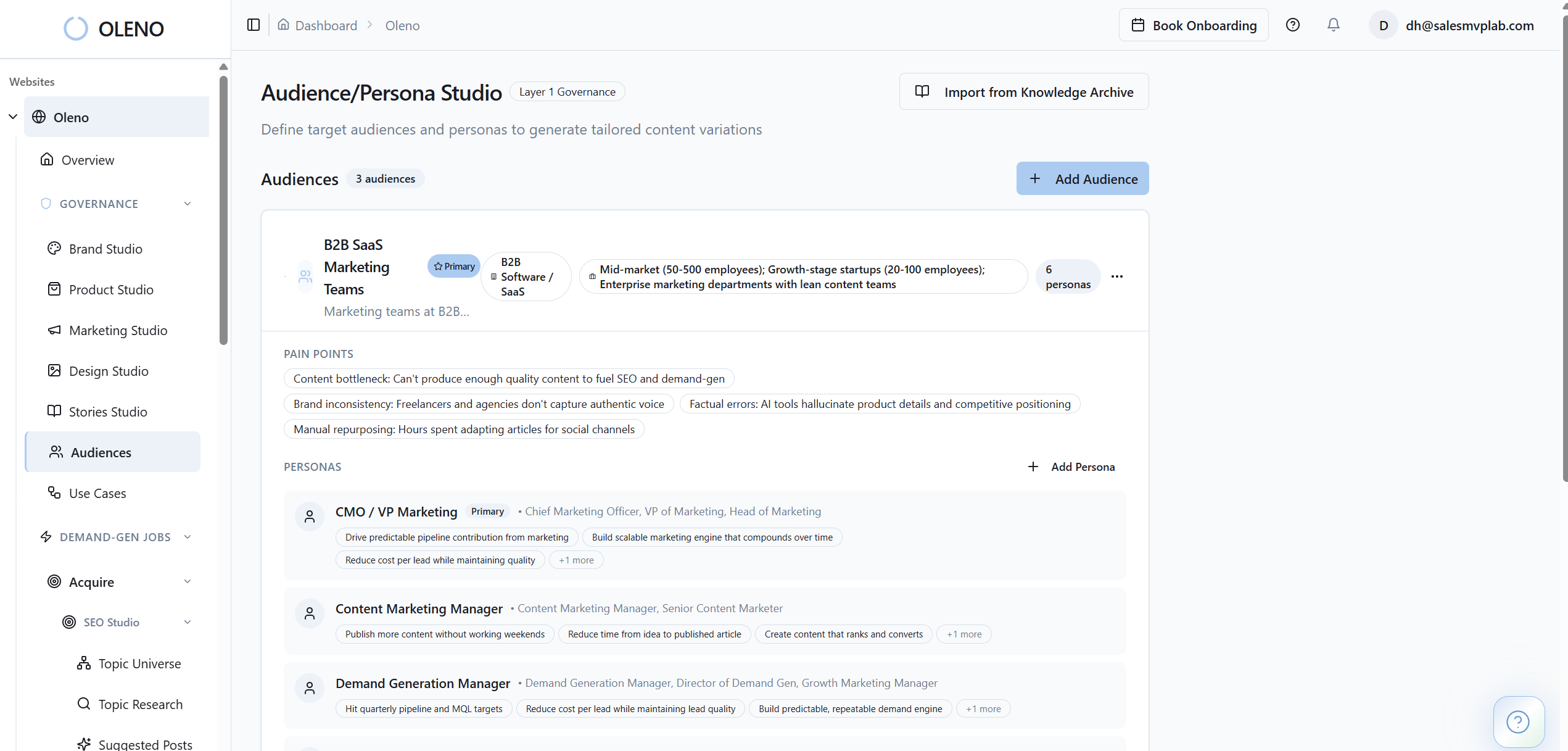
That matters because rung 4 is not “we have guidelines somewhere.” Rung 4 is “the rules show up in the work every time.” Oleno turns those governed inputs into repeatable execution so your team isn’t rebriefing the same truths on every asset. The quality gate then checks content against those standards before it moves forward.
Strategy, Planning, And Measurement Stop Living In Separate Places
The second half is what keeps the system running weekly. storyboard turns strategy into a prioritized plan across audiences, personas, products, and use cases. orchestrator runs the pipeline across content types and pacing. category studio, product marketing studio, buyer enablement studio, and programmatic seo studio map the work to different jobs instead of forcing one generic workflow onto everything. executive dashboard gives leadership visibility into output, quality trends, and coverage gaps.
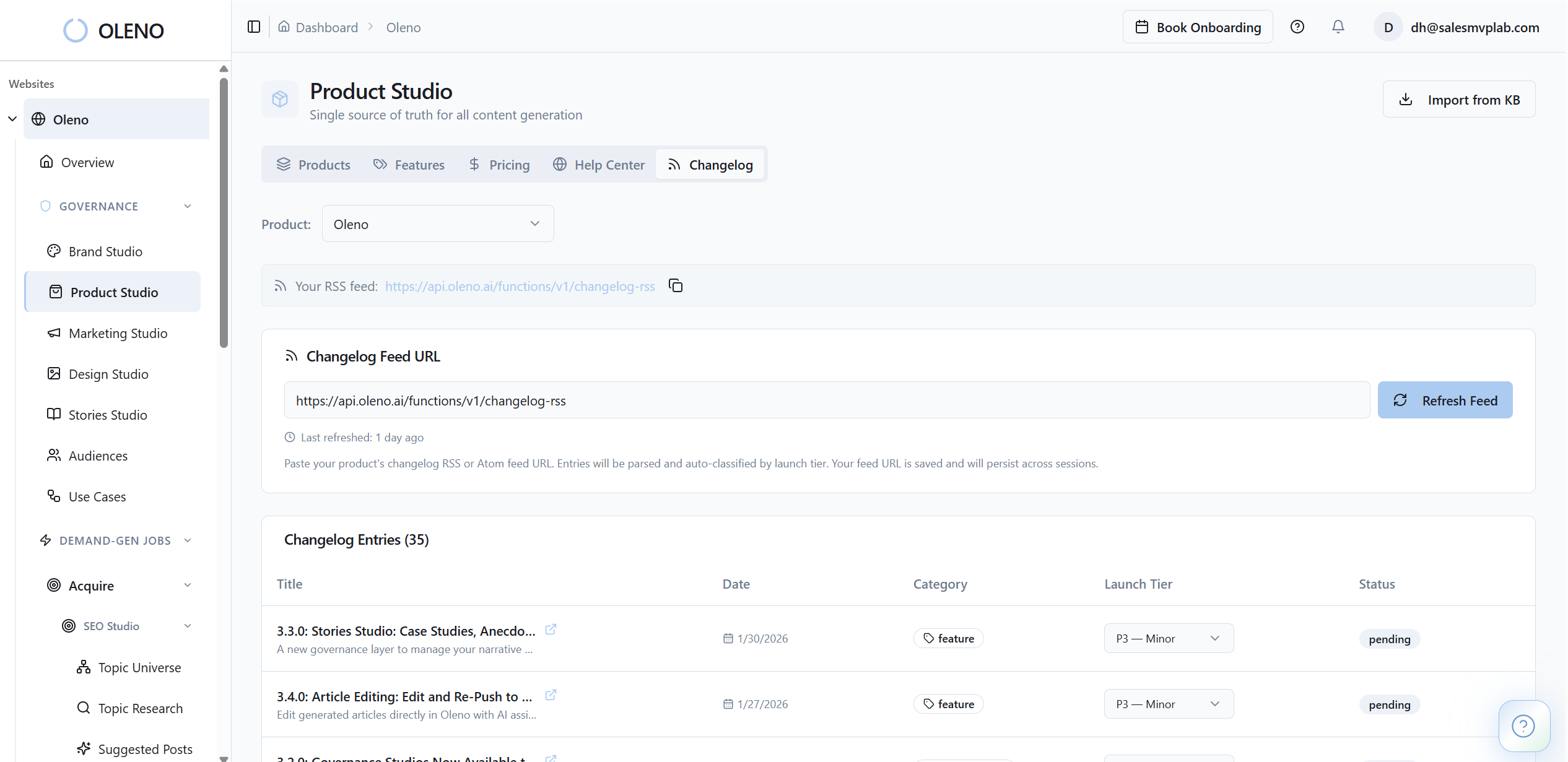
So the ladder becomes practical. You move from scattered docs and ad hoc prompts to one connected system where planning, truth, execution, and measurement reinforce each other. That’s a very different operating model than “let’s spin up another draft and hope the review catches it.”
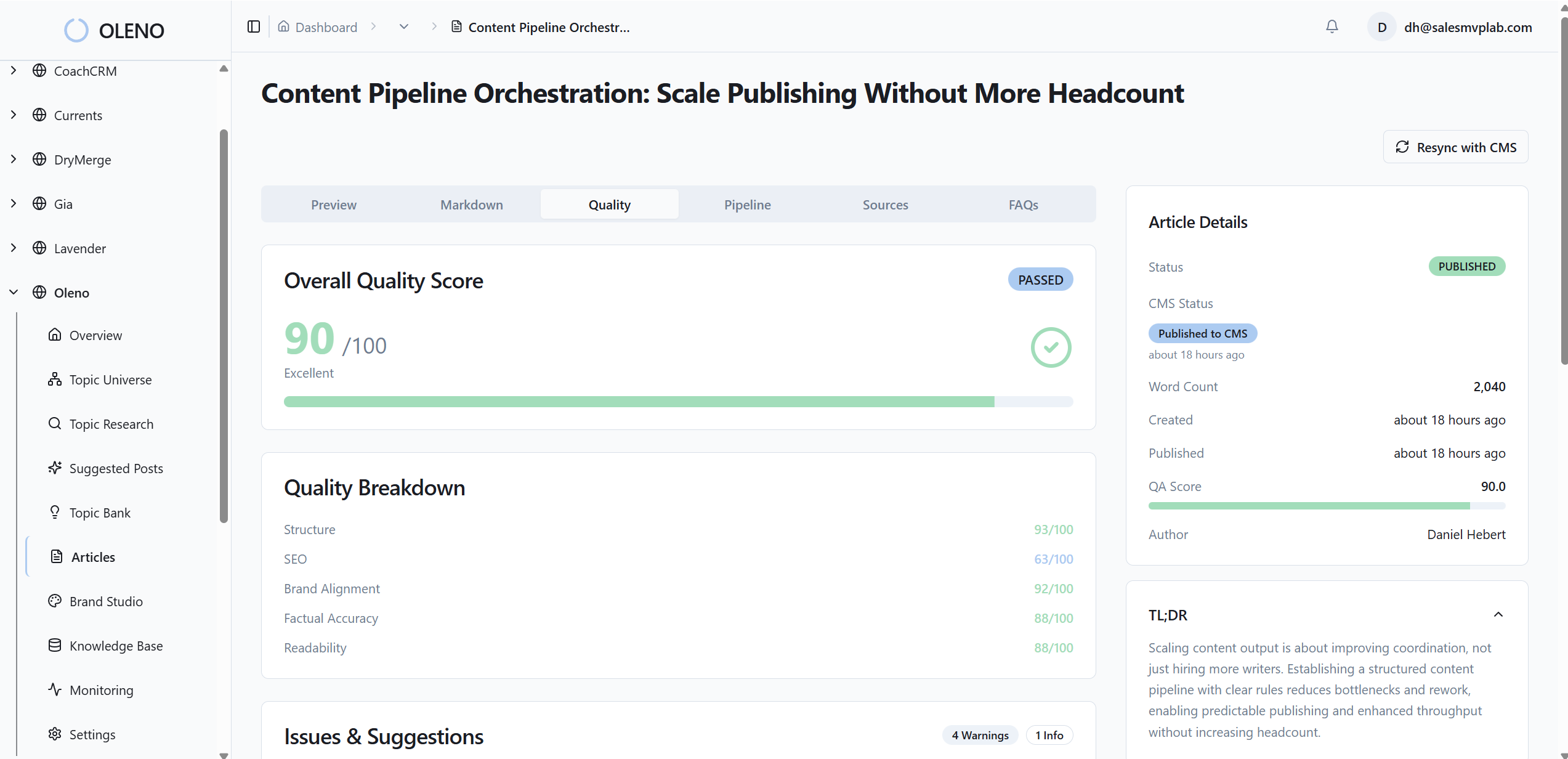
If you want to see that top rung more concretely, book a demo.
The Ladder Is Really A Choice About How You Want Marketing To Run
The geo readiness ladder for B2B content teams is useful because it tells the truth about where the break actually is. Not in effort. Not in headcount alone. Usually not even in writing ability. The break is in whether your company can express the same strategic truth consistently enough for the market, search engines, and LLMs to trust it.
That’s why Fragmented Demand Generation is the enemy. It turns good people into expensive translators of scattered context. The better path is to define truth once, execute from it repeatedly, and let every asset reinforce the next. The teams that do that won’t just publish more. They’ll become easier to find, easier to understand, and harder to ignore.
About Daniel Hebert
I'm the founder of Oleno, SalesMVP Lab, and yourLumira. Been working in B2B SaaS in both sales and marketing leadership for 13+ years. I specialize in building revenue engines from the ground up. Over the years, I've codified writing frameworks, which are now powering Oleno.
Frequently Asked Questions