Prompting Won’t Save Your Pipeline. Demand-Gen Execution Software Will.
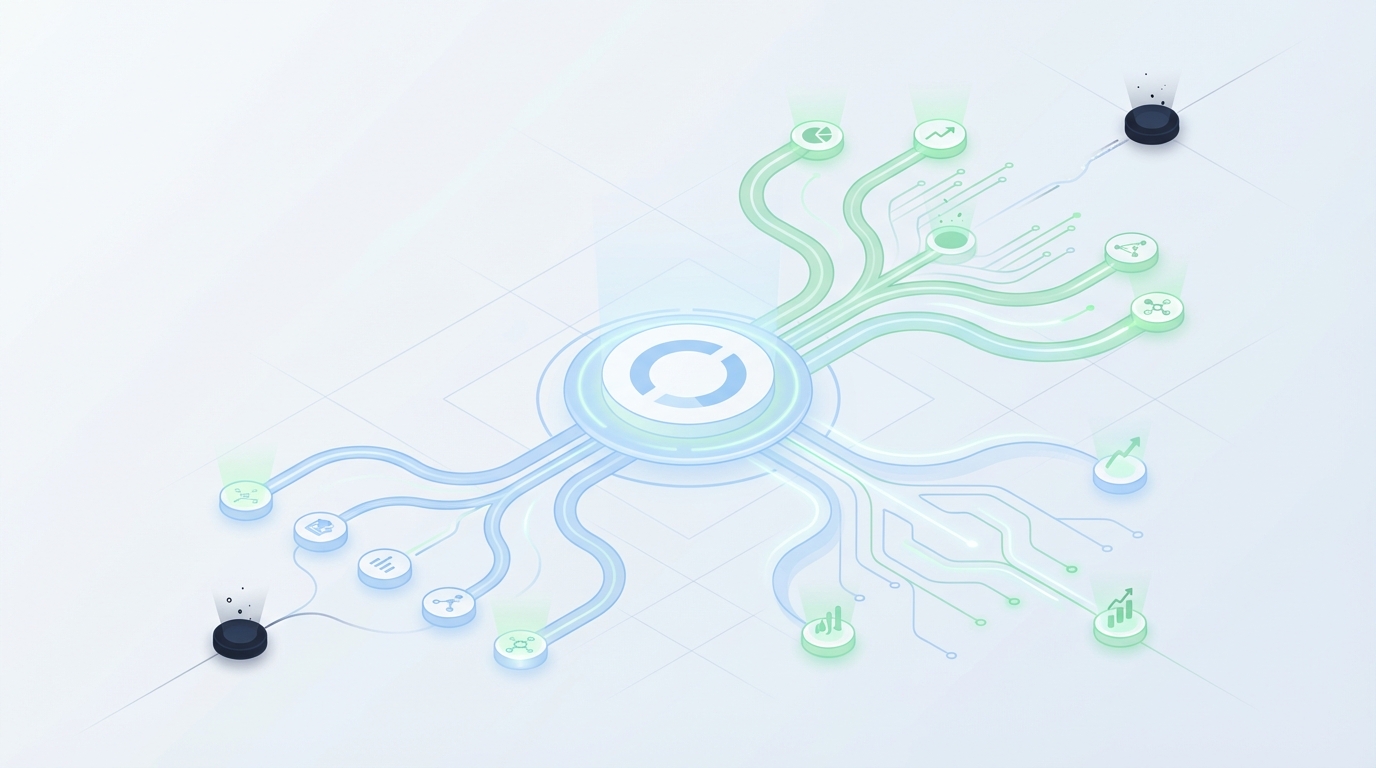
If you’re relying on ChatGPT prompts to “fix marketing,” prompting won’t save your pipeline. Demand-generation execution software is a marketing operations system that runs continuous, governed pipeline creation end to end by encoding narrative and product truth, orchestrating planning-to-publishing workflows, and maintaining cadence and consistency across the funnel so small teams compound results without adding headcount.
Unlike a content tool or AI writing assistant, demand-generation execution software doesn’t just spit out drafts faster. It runs the system that turns strategy into shipped assets, week after week, without your team becoming full-time prompt writers, editors, and traffic cops.
And yeah, I get why fragmented, prompt-based demand-gen execution became the default. Prompting feels productive. Agencies feel like you’re “adding capacity.” SEO platforms feel like you’re being data-driven. But if every quarter feels like a reset, that’s not a motivation problem. It’s a system problem.
Key Takeaways:
- Prompting increases output, but it also increases volatility, voice drift, and review overhead if you don’t have a governed system behind it.
- Fragmented, prompt-based demand-gen execution fails because humans end up carrying judgment, coordination, and publishing decisions for every single asset.
- The category shift is from “tools that help you create” to “software that runs execution”: governance, orchestration, cadence, funnel coverage, and measurement.
- You can start acting like a category leader without buying anything by codifying governance, committing to a metronome, and tracking reliability metrics, not vanity metrics.
The Output Illusion: Why Prompting Won’t Save Your Pipeline
Prompting won’t save your pipeline because demand gen doesn’t fail at the draft stage. It fails when execution is fragmented, manual, and inconsistent, so nothing compounds and you keep paying the “reset tax” every quarter. That quiet tax is the gap between “lots of activity” and “where’s pipeline?”, and it compounds the wrong way.
You can feel it when you’re in it. You ship a few decent pieces. People get excited. Then the next week someone changes the angle, your voice slips, a claim gets questioned, distribution gets skipped, and suddenly you’re back to herding cats in Slack.
That’s the enemy: fragmented, prompt-based demand-gen execution. Not “bad prompts.” Not “lack of ideas.” The whole behavior of treating demand gen like a pile of one-off tasks that you can brute force with a tool stack and some willpower.
More Output Isn’t More Demand
More drafts isn’t more pipeline. It’s more surface area for things to break.
Prompting is great for a single task. Rewrite this. Summarize that. Give me ten hooks. I still do that stuff. But when you try to run demand gen that way, the output becomes volatile because every asset is basically a new negotiation with your own standards.
Tone drifts. Narrative drifts. Even facts drift, especially once you’ve got freelancers involved and they don’t have the same context you do. Then what happens? You add review. You add editing. You add meetings.
Now your “AI speed” is sitting in a Google Doc waiting for approval.
Fragmentation, Not Ideas, Is The Failure Mode
Most teams don’t have an idea problem. They’ve got a coordination problem.
Here’s the standard setup I see all the time: content tool for drafts, SEO platform for keywords, prompts in a doc somewhere, agency for “more output,” designer in a separate queue, someone manually posting to the CMS, and then another person trying to repurpose it into social. Every part is owned by a different person or tool.
So nobody owns the system.
And because nobody owns the system, your demand gen resets every quarter. New campaign. New angle. New priorities. Same messy execution underneath.
If You’re Stitching Tools, You Don’t Have Leverage
If you’re stitching tools together, your team becomes the glue. That’s the cost nobody budgets for.
You pay in:
- Writing and re-writing briefs
- Prompt wrangling
- “Can you review this” loops
- Calendar churn
- Publishing checklists
- Distribution getting skipped because the week got busy
It gets worse as volume increases. Not linearly either. Every extra asset adds more opportunities for review bottlenecks, misalignment, and a subtle kind of quality decay that’s hard to point at but easy to feel.
That’s why prompting won’t save your pipeline. It speeds up the part that was never the bottleneck.
Demand Gen Isn’t A Content Tool Problem, It’s An Execution System Problem
Demand gen fails because you don’t have a reliable system to turn strategy into shipped, on-message, on-time assets across the funnel. Draft speed is a small part of the equation, and most teams overweight it because it’s the easiest thing to buy. The real constraint is orchestration and governance, where demand-generation execution software shines.
This is where the “genus” matters. If you shop like this is a content tool category, you’ll keep buying tools that optimize parts. You’ll keep asking humans to do the connective tissue work. Then you’ll be confused when the board asks why all this activity isn’t showing up as pipeline.
I’ve lived versions of this.
Back in 2012-2016 I ran a digital marketing site called Steamfeed. At our peak we hit 120k unique visitors a month. We got there because we had volume plus quality, and we kept shipping consistently. When that consistency breaks, traffic breaks. Pipeline breaks. Compounding breaks.
Same thing on smaller teams. At PostBeyond I could crank out 3-4 solid posts a week because I had a structured framework in my head. As the team grew, output slowed down, quality dipped, and I had less time to write because I was in exec meetings and managing everything else. Hiring didn’t fix it because the system wasn’t encoded. It was in my brain.
That’s the whole game.
What You’re Buying Is Reliability, Not Drafts
Reliability is the thing you actually want to buy, even if you don’t say it that way.
Reliability looks like:
- A consistent POV, not mood-based content
- Voice that doesn’t change week to week
- Product truth that doesn’t get “creative”
- Cadence you can defend to leadership
- Coverage across Acquire, Educate, Convert, Retain, Reinforce
- Measurement loops that tell you if the system is healthy
Prompt-to-draft workflows don’t give you reliability. They give you drafts.
And drafts don’t compound on their own.
Content Tools Optimize Parts, Execution Software Runs The System
Content tools help you write and edit. SEO platforms help you analyze. Agencies help you push volume. AI assistants help you generate text.
All useful. None of them run demand gen end to end.
Demand-generation execution software is the missing layer. It’s the thing that owns the workflow and enforces the rules, so you don’t need humans to re-decide your standards every time you create something.
If that sounds like splitting hairs, it’s not. It changes how you budget and what you expect. Tools give you output. Execution software gives you a system you can operate.
Fragmentation Taxes Scale And Resets Kill Compounding
Fragmented, prompt-based demand-gen execution costs you time, money, and narrative cohesion, and the bill gets bigger as you try to publish more. The painful part is that it doesn’t look like one big failure, it looks like a thousand small delays and “good enough” compromises that quietly sand down your edge.
Let’s talk about the math for a second, because this is where people get surprised.
You can “save time” on drafting and still end up slower overall, because the coordination and review work expands to fill the gap. It’s like pushing down on a balloon.
Resets Erase Momentum Faster Than Any Algorithm Change
Quarterly resets are brutal because they wipe out the compounding effects you were building, and you don’t get that time back, especially when evaluating prompting won’t save your pipeline.
Let’s pretend you publish 2 solid pieces a week. That’s roughly 24 a quarter. If you do that for four quarters, you’ve got close to 100 assets that reinforce the same POV, cover the funnel, and can be repurposed.
Now imagine you reset every quarter. New themes. New angles. New “campaign.” Half your energy goes into re-briefing, re-aligning, and re-explaining. You still publish, but the library doesn’t stack. It splinters.
That’s why you can be “busy” for a year and still feel like you’re starting from zero.
Also, discovery isn’t just Google anymore. Your content shows up in search, in LLM answers, in social feeds, in internal forwards. When you reset constantly, you keep cold-starting your own distribution.
Coordination Cost Scales Nonlinearly With Output
Coordination cost isn’t just annoying. It becomes the limiter.
Let’s pretend each asset needs:
- 1 brief
- 2 review rounds
- 1 stakeholder check for product accuracy
- 1 pass for tone
- 1 step to publish
- 1 step to repurpose
If each step takes only 15 minutes, that’s already hours per asset. And most of the time it’s not the work, it’s the waiting. “Can you review this today?” “Who has the latest product messaging?” “Did we already cover this topic?” “Which version is the final?”
As output goes up, the calendar fills with coordination. Your creators turn into coordinators. Your strategy turns into project management.
One more thing. This is where the 10x cost shows up.
A manual, headcount-heavy approach might need a writer, an editor, a PMM reviewer, someone on SEO, someone on distribution, plus agency spend on top. An orchestrated system can look more like one strategic owner plus AI doing the repeatable parts, and you’re paying a fraction of the cost to keep the engine running. Not because the work disappears, but because the system stops asking humans to make the same judgment calls over and over.
The Part Nobody Puts In The Deck: Living In Reset Land
Living in reset land feels like you’re always behind, because you are. You walk into the Monday standup and it’s the same conversation again, the backlog is weirdly full but nothing is ready to ship, and by Friday you’re staring at half-approved drafts while leadership asks for “more content” like you can just crank a lever. It drains momentum, and then it drains belief.
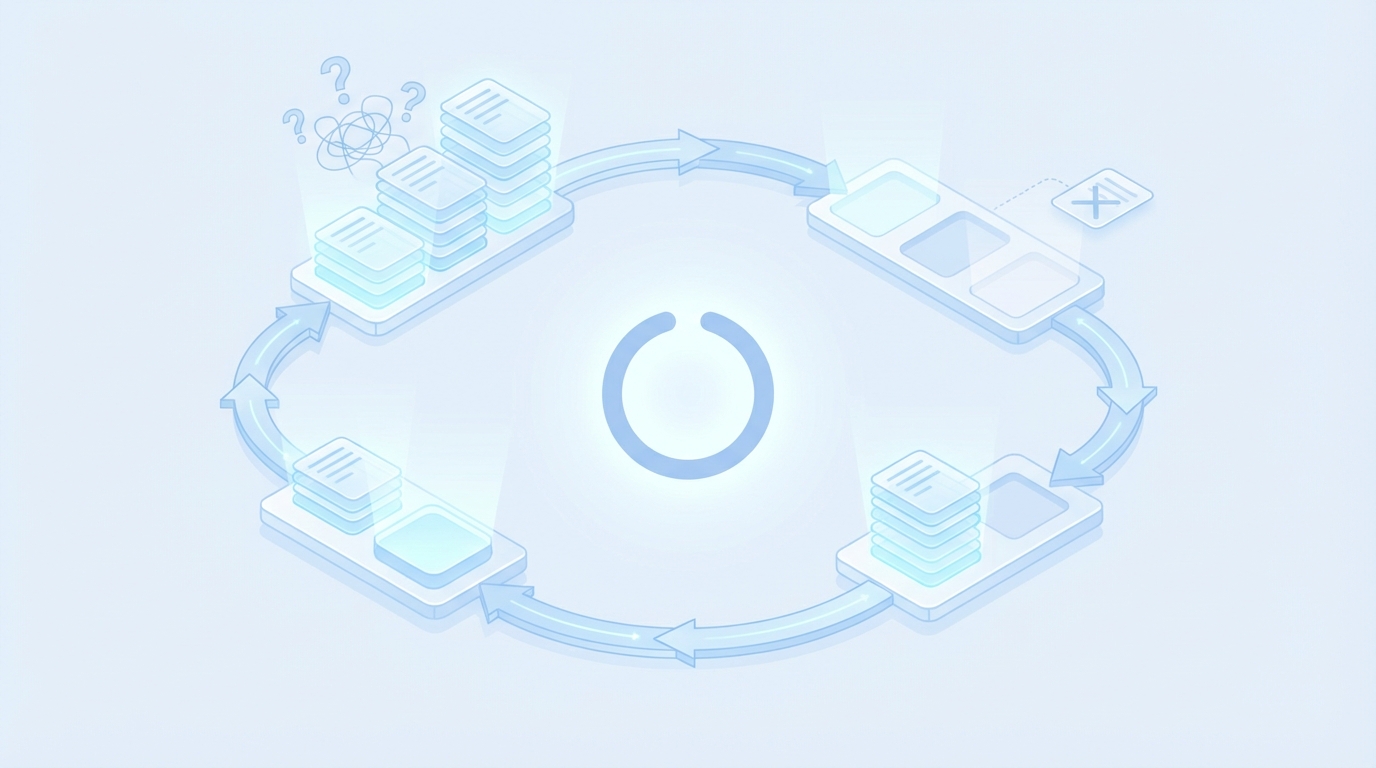
When Every Week Starts Over, Morale Follows
When every week starts over, people stop believing the work matters.
You can feel your team get cautious. They pitch safer ideas. They stop taking a stand because it’s too hard to maintain a POV when everything keeps shifting. And when tone drifts or messaging gets questioned late in the process, you get that headache moment where you realize the work you did on Tuesday doesn’t matter anymore.
It’s frustrating rework. The worst kind too, because it looks like progress until it doesn’t ship.
Review Purgatory Turns Creators Into Coordinators
Review purgatory is where demand gen goes to die.
You end up with creators waiting on approvals, stakeholders reacting to drafts instead of shaping inputs, and a bunch of meetings that exist only because nothing is encoded. Even the best people start to phone it in because they’re spending their brain on logistics, not ideas.
And when you’re worried about quality, you add more review. So the bottleneck gets tighter.
That loop is hard to break without changing the system.
How Category Leaders Run Governed, Continuous Demand Gen for Prompting won’t save your pipeline
Category leaders run demand gen like an operating system: they define truth and voice once, they ship on a metronome, they cover the funnel on purpose, and they measure system health so they can fix problems before the quarter ends. It’s boring in the best way, and it prints compounding results.

This is the behavior that demand-generation execution software is built around. You can implement a lot of it without buying anything, but you do have to be willing to stop treating content like a pile of tasks.
And yeah, it takes discipline. But it’s way cheaper than hiring your way out.
- Governed Narrative: Encode brand voice, POV, and product truth so every asset aligns without manual policing.
- End-To-End Orchestration: Plan, produce, QA, and publish across the funnel in one continuous, metronomic system.
- Compounding Cadence: Maintain reliable output and systematic reuse so results stack instead of resetting each quarter.
Define Once, Enforce Everywhere
Write down what “good” looks like, in a way that can be applied repeatedly.
Not a brand book that nobody opens. A living governance doc your team actually uses when creating assets, especially when evaluating prompting won’t save your pipeline.
At minimum, you want to encode:
- Brand voice rules (tone, structure, what you never say)
- Your POV (what you believe, what you disagree with, what you keep repeating)
- Product truth (what you can claim, what you can’t, what’s supported, what’s not)
- Audience specifics (who you’re talking to, what they care about, what words they use)
Most teams skip this because it feels like overhead. Then they pay for it in editing cycles forever.
One trick that works: take 3 pieces you love, pull out the patterns, and make those patterns the default. Sentence rhythm. CTA style. Headings. The stuff people argue about in review. Encode it upfront so it stops being subjective.
Ship On A Metronome And Measure Reliability
Cadence is a strategy, not a calendar.
Pick a realistic metronome. Weekly or biweekly. Then commit to shipping specific “job types” in specific slots. For example:
- 1 acquisition piece (search intent)
- 1 category POV piece (education)
- 1 evaluation asset (comparison, alternatives)
- 3 to 10 social repurposes from what shipped
You don’t need to do all of that at once, but you do need a repeatable pattern.
Then measure reliability, not vibes.
A few operational KPIs that matter more than most teams admit:
- Planned vs shipped (did you hit the schedule)
- On-time rate (how often do approvals slip)
- Time-to-publish (draft to live)
- Repurpose ratio (how many downstream assets per core asset)
- Content decay rate (how fast older assets lose relevance and need refresh)
- QA sampling rate (how often you check if quality is drifting as volume rises)
If you track that stuff for two quarters, you’ll see the system. You’ll see where it’s breaking. That’s when you can actually fix it.
Want to see what this looks like when it’s implemented as a real operating system, not a spreadsheet and good intentions? request a demo
Cover The Full Funnel And Compound Through Reuse
A lot of teams accidentally run “Acquire only” marketing. Blog posts. Maybe some distribution. Then they wonder why pipeline is shaky.
A simple coverage model you can steal:
- Acquire: SEO content, problem pages, alternatives content
- Educate: category POV, frameworks, thought leadership
- Convert: comparisons, evaluation guides, product education
- Retain and expand: onboarding content, use case education, customer proof
- Reinforce: refreshes, repurposes, “best of” collections, updated angles
The compounding part comes from reuse. Not lazy reposting. Real repurposing.
Take one strong POV piece. Turn it into:
- An email series
- A sales enablement doc
- 5 LinkedIn posts
- 1 short internal training for the team
- A comparison page that captures bottom-of-funnel intent
Same truth. Same POV. Different packaging.
That’s how you stop resetting.
What Demand-Gen Execution Software Looks Like In Practice
Demand-generation execution software looks like governance studios, deterministic pipelines, quality gates, and operational visibility that keep your output steady without turning your team into full-time coordinators. It’s basically the “missing middle” between strategy and publishing, where standards become assets and workflows become predictable.
Before I get into the product side, one quick sanity check. If you’re still living in docs, prompts, and Slack approvals, you’re not alone. Most teams are. It’s just expensive.
From Governance To Shipped Assets Without The Coordination Tax
This is where Oleno fits. It’s built as demand-generation execution software for small B2B marketing teams, and the goal is simple: take the standards you care about and enforce them at the point of creation, not in the fifth round of edits.
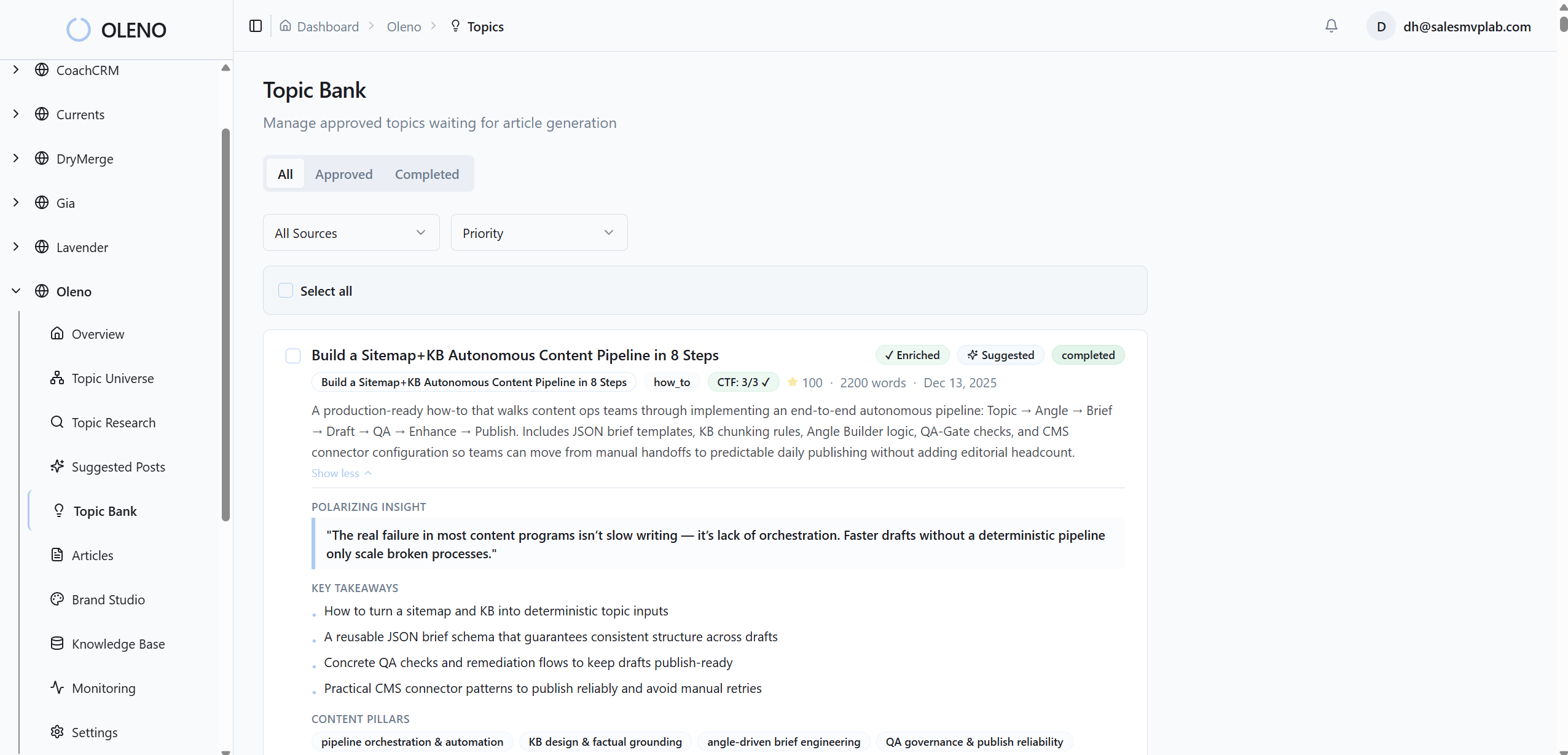
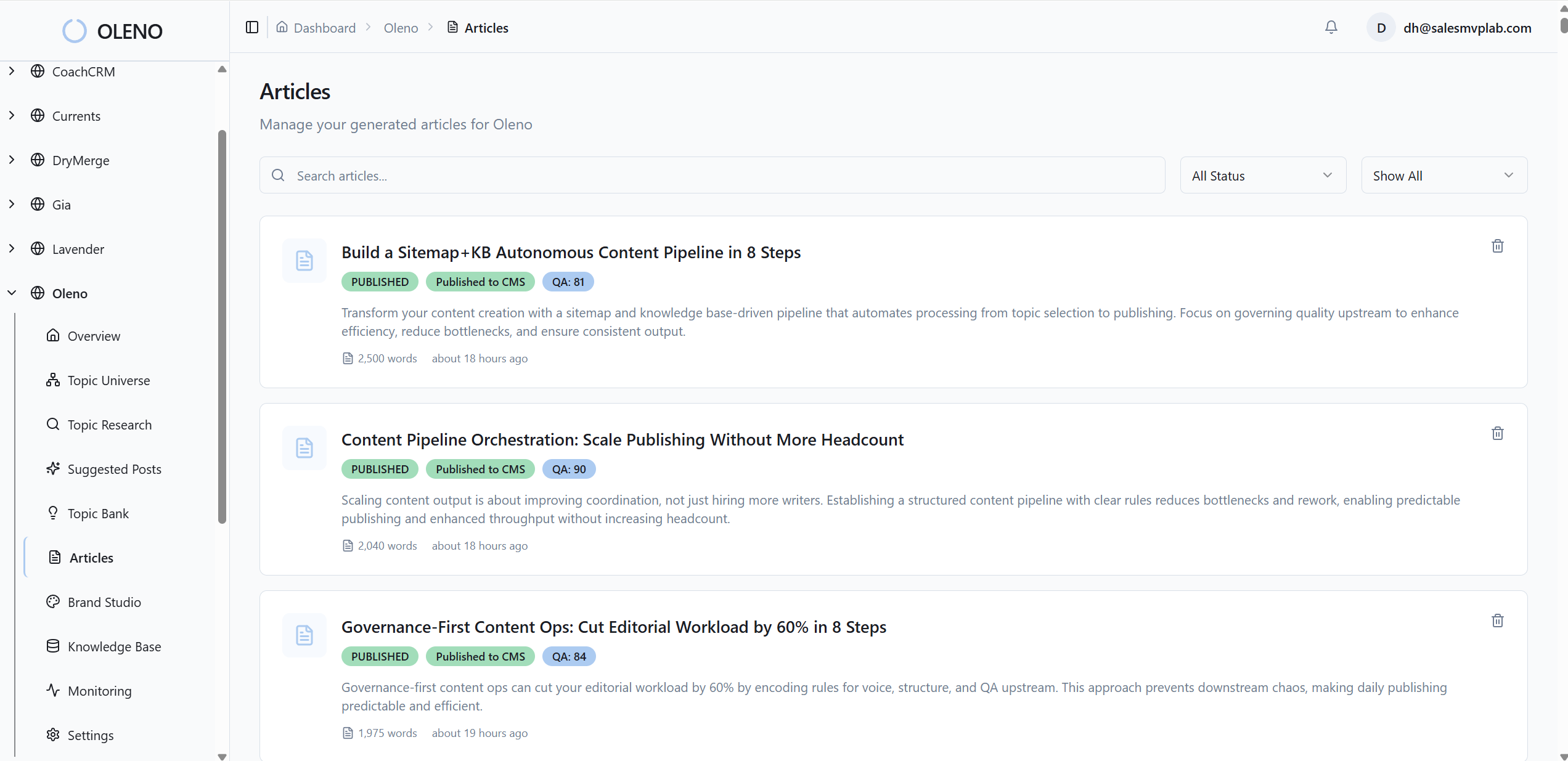
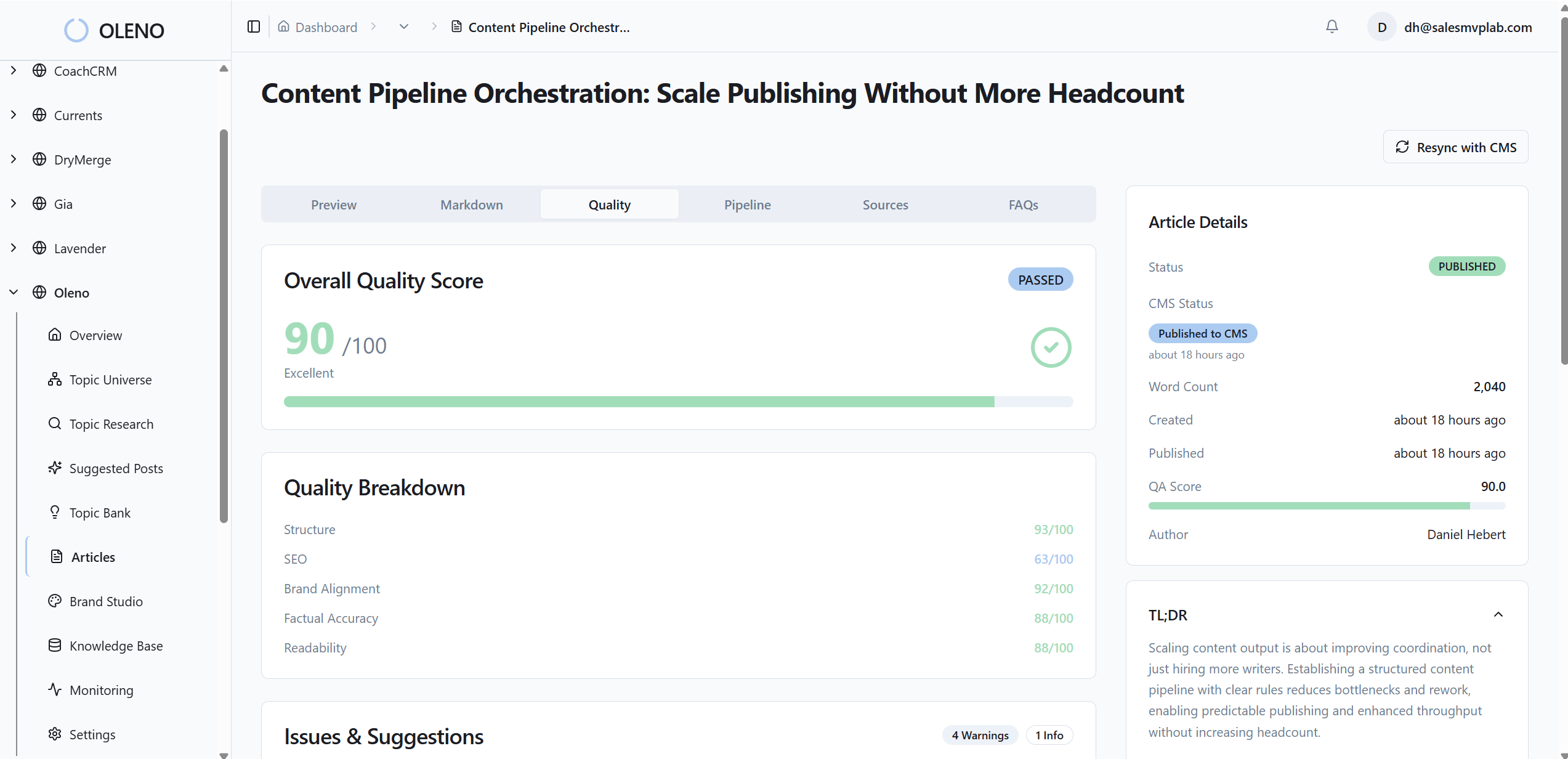
Oleno starts with governance, using brand studio, marketing studio, and product studio to encode how you sound, what you believe, and what’s actually true about your product so you don’t keep re-litigating tone, POV, and claims in every review cycle. Then it runs a deterministic pipeline (Discover to Publish) with quality control (qa gate before publishing), so assets don’t ship until they meet the bar.
And because demand gen isn’t just long-form blogs, you also have the variation layer & topic universe to keep a runway of topics and adapt each asset to specific segments, plus cms publishing, brand-consistent images, and distribution so shipping doesn’t rely on “who has time today.”
If you want to see the workflow end to end, request a demo
The Metrics Leaders Actually Watch
An execution platform is only useful if it makes the system visible, not mysterious.
A few metrics that matter in practice, and that you can actually manage quarter over quarter:
- Cadence adherence (did we ship what we said we would)
- Funnel coverage balance (are we only doing top-of-funnel)
- Repurpose ratio (are we getting 5 to 10 downstream assets per core piece)
- Narrative cohesion (are we repeating the same truth, or drifting)
- Time-to-publish (where the work stalls)
- QA pass rate (how often outputs meet standards without heavy edits)
- Measurement & system health signals (is the engine stable, or degrading)
Not every team needs all of these on day one. But if you’re serious about compounding, you need to treat this like an operating system. Not a collection of drafts.
The Shift From Prompt Chaos To Compounding Execution
Prompting won’t save your pipeline, because it doesn’t solve the real problem, which is fragmented, prompt-based demand-gen execution that forces humans to carry coordination, judgment, and consistency at scale. That’s the drag on compounding outcomes, not the lack of ideas or a missing “perfect prompt.”
Demand-generation execution software is the category that fixes that. Not by “writing better,” but by running the whole system: governed narrative, end-to-end workflows, quality gates, publishing, distribution, and operational measurement.
If you want to see how Oleno implements that category in practice, and whether it fits your team’s setup, book a demo
| Dimension | Old Way | Category Way |
|---|---|---|
| Ownership | Humans stitch tools and carry judgment | A defined system owns workflow; humans guide strategy |
| Consistency | Week-to-week tone and narrative drift | Governance enforces uniform voice and POV |
| Cadence | Irregular, slips due to review bottlenecks | Metronomic publishing with built-in quality gates |
| Cost to scale | Headcount and coordination rise nonlinearly | One strategic owner scales via governed automation |
| Funnel coverage | Ad hoc assets, gaps across stages | Programmed coverage across Acquire through Reinforce |
| Compounding | Quarterly resets erase gains | Assets and insights accumulate and improve ROI |
About Daniel Hebert
I'm the founder of Oleno, SalesMVP Lab, and yourLumira. Been working in B2B SaaS in both sales and marketing leadership for 13+ years. I specialize in building revenue engines from the ground up. Over the years, I've codified writing frameworks, which are now powering Oleno.
Frequently Asked Questions