Top 10 Alternatives to Frase.io in 2026

Back when I was cranking out SEO content by hand, the most annoying part wasn’t writing. It was everything around writing. The SERP research, the brief, the copy-paste dance between tools, the “did we already publish this?” paranoia, then pushing it into the CMS and fixing formatting for the tenth time.
Frase.io is built for that first half of the job, the research and the brief. Oleno is built for the whole assembly line, including the part where content actually gets published without someone babysitting it.
Quick comparison: Frase.io vs. Oleno for SEO content
Frase.io is a strong choice if you want SERP-driven research, content briefs, and an editor that nudges writers toward what’s already ranking. Oleno is a better fit when you’re trying to ship lots of pages consistently, with brand rules, QA gates, and direct CMS publishing baked in. A simple example is “alternatives” pages: Frase helps you research and draft them, Oleno is designed to produce and publish them at scale.
| Feature | Frase.io | Oleno |
|---|---|---|
| Primary focus | SERP research, content briefs, content optimization (Skywork review) | Automated end-to-end content engine for programmatic SEO (first-party) |
| Best for | SEO teams and agencies writing fewer, higher-touch pieces (G2 reviews) | B2B SaaS teams scaling high-volume acquisition content (first-party) |
| Publishing workflow | Integrates with WordPress, plus other workflows depending on setup (Software Finder) | Direct, idempotent publishing to WordPress, Webflow, Storyblok, HubSpot (first-party) |
| Optimization approach | Uses SERP analysis and content scoring to guide what to include (Rankability list) | Governance plus QA gate before publish, designed for consistent output (first-party) |
| Reviews | Ratings and commentary available on review sites (Capterra) | First-party positioning (no third-party review links provided here) |
Key Takeaways:
- Frase.io is a good pick when your workflow starts with SERP research and ends with a human writer polishing in an editor (Skywork review).
- If you’re publishing lots of “alternatives” and comparison pages, you’ll care more about throughput, governance, and publish automation than editor scoring.
- Frase.io has clear signals of SEO-first positioning via its SERP analysis and AEO and GEO educational content (Frase on GEO).
- Oleno is built around a deterministic pipeline that can queue, write, QA, and publish content with less manual glue work (first-party).
What “alternative to Frase.io” usually means in real life
Most people searching for a Frase alternative aren’t saying “I hate Frase.” They’re saying something more specific: “I like the research part, but I’m still stuck doing a ton of manual work, and the content machine isn’t compounding.”
You feel it when volume ramps.
At 5 articles a month, almost any workflow works. At 50, you start tripping over your own feet. Everyone has their own Google Doc template, your briefs aren’t consistent, your freelancers don’t have context, and you spend an embarrassing amount of time just coordinating and fixing, not publishing.
So when you evaluate an alternative, you’re really choosing between two philosophies:
- An SEO research and optimization workstation for humans (Frase.io’s lane).
- A production system that treats content like a pipeline and pushes it all the way to publish (Oleno’s lane).
Where Frase.io fits best
Frase.io is best when you want to write content that mirrors what’s already working in the SERP, and you want the tool to do the heavy lifting on research and outlining. That’s the core story you’ll see across reviews and product writeups: SERP analysis, brief creation, and content optimization in one place (Skywork review). A practical example is an SEO manager building a brief, handing it to a writer, then using the editor to tighten coverage before publishing.
SERP-driven briefs are Frase.io’s home base
Frase.io’s workflow is anchored in analyzing top results and turning that into a content brief, which is why agencies and SEO teams tend to gravitate toward it (Rankability list). If you’ve ever stared at a blank doc thinking “what am I missing that the top three results all have,” this is the pain it addresses.
In practice, the advantage is speed to a decent first draft. You’re not doing manual SERP scraping, manual outline building, and manual “questions to answer” lists. The tool nudges you toward coverage.
If you live and die by “did we cover the obvious stuff,” that’s valuable. Really valuable.
It’s also intentionally tied to AEO and GEO education
Frase publishes content around answer engine optimization and generative engine optimization, which signals where they see the market heading (Frase on AEO, Frase FAQ schema for AI search, Frase on GEO). That matters if your team is trying to get cited by AI answers, not just rank in classic blue links.
I’m not saying those posts prove product capability by themselves. They don’t. But it does show they’re paying attention to the shift.
The tradeoff: Frase is mostly “create and optimize,” not “produce and publish”
This is the fork in the road.
Frase.io can make you faster at researching and drafting. But if your real bottleneck is everything after drafting, approvals, QA, governance, CMS, duplication, then a research editor won’t fully solve the scaling problem. Reviews often talk about how tools like this still require human editing and workflow glue to ship consistently (G2 reviews).
That’s not a slam. It’s just what the product is.
How Oleno is Different: Frase.io optimizes the “brief to draft” part of the process, but Oleno is designed as an autonomous content engine that can queue topics, generate drafts, run QA checks, and publish directly to your CMS with idempotent publishing so duplicates don’t sneak in (first-party).
The real scaling problem: you don’t just need better drafts
You don’t need to write faster, you need to ship faster without quality collapsing. That’s the part most teams miss until it hurts.
When I ran content sites, the magic wasn’t that every page was a masterpiece. The magic was consistency. Volume plus quality. You get enough pages out there, with enough topical breadth, and you start seeing those weird traffic spikes at 500 pages, then 1,000, then 2,500. It compounds.
But compounding only happens if your pipeline is boring and repeatable.
If every post is a custom project, you’re stuck. You can use any SEO tool you want, but you’re still going to be herding cats.
So when you compare Frase.io vs. Oleno, the question becomes:
- Do you want a strong SEO research and optimization tool for a human-led workflow?
- Or do you want a governed production system that can run without you babysitting every step?
Frase.io pricing and plan considerations (what you should verify)
Frase.io pricing changes over time, so you should verify current tiers directly in their product materials and updates. What you can reliably confirm from public sources is that Frase operates as a commercial SaaS product with a steady cadence of product updates and positioning in the SEO tooling market (Frase product updates, Capterra listing).

If you’re comparing total cost, don’t just compare subscription price. Compare the hidden cost of the workflow:
- How much human time is still required to publish 30, 50, 100 pages a month?
- How often do you ship off-brand content and then quietly rewrite it later?
- How much content dies in Google Docs because publishing becomes a bottleneck?
I’ve watched teams spend less on software and way more on chaos. It’s a bad trade.
What to look for in a Frase.io alternative (a practical checklist)
A good alternative to Frase.io is not “another editor with a score.” It’s whatever removes your current bottleneck. And your bottleneck is probably not the same as mine.
If I were buying again, I’d evaluate alternatives in this order:
- Can it create content consistently without constant prompt fiddling?
- Does it enforce brand voice and factual accuracy, or does it depend on “good editors” to catch mistakes?
- Can it publish directly to my CMS without duplicates and formatting drama?
- Can it scale to high-volume programmatic pages, not just one-off blog posts?
- Does it fit the way my team actually works, including freelancers and approvals?
If you’re only writing 4 posts a month, honestly, you can stop at item 1. If you’re trying to build a real acquisition engine, you can’t.
The comprehensive comparison: Frase.io vs. Oleno (feature by feature)
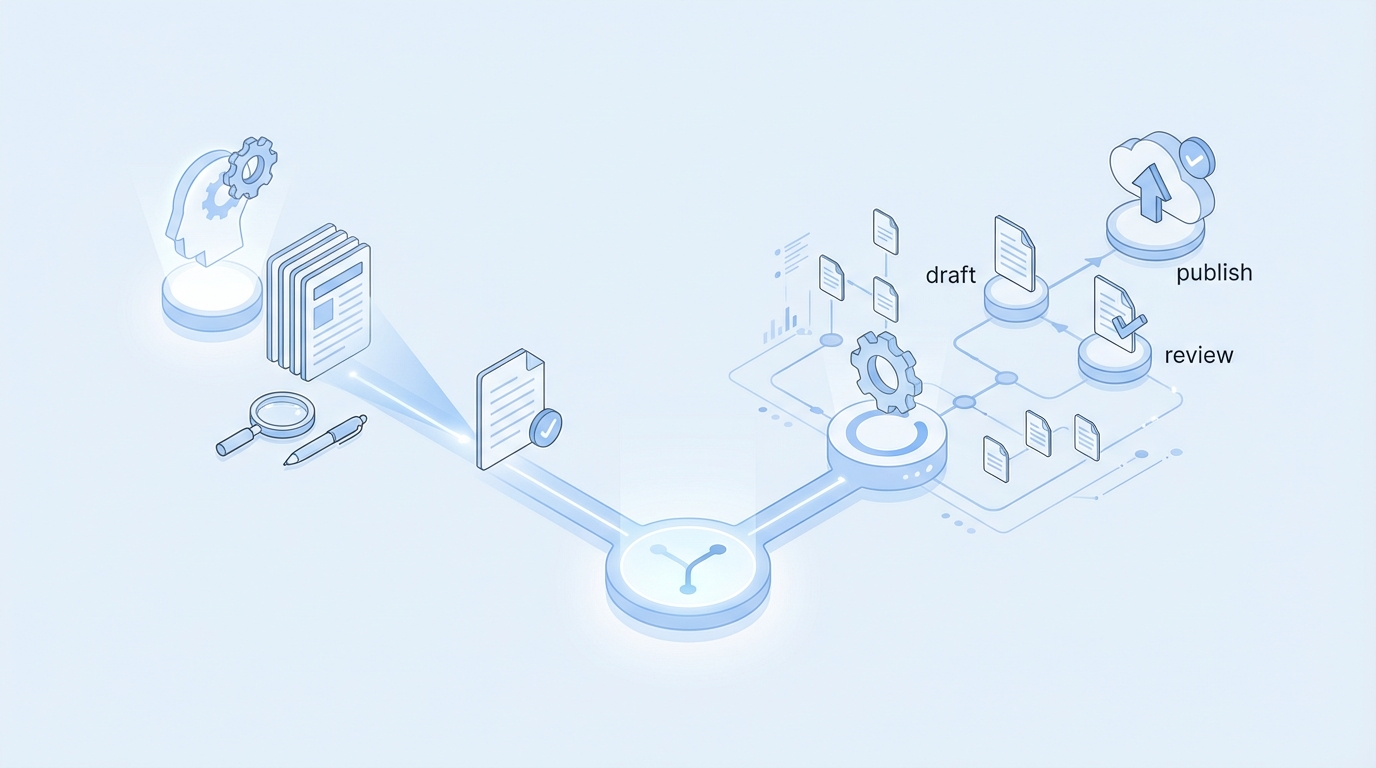
Frase.io and Oleno overlap in “AI is involved in content creation,” but they’re built for different outcomes. Frase is broadly positioned around research, briefs, and optimization workflows (Skywork review). Oleno is positioned around a governed, deterministic pipeline that runs Discover to Brief to Draft to QA to Publish (first-party).
| Feature Category | Frase.io | Oleno |
|---|---|---|
| SERP research and brief building | ✓ (Skywork review) | ✓ (first-party) |
| Content optimization guidance | ✓ (Rankability list) | ✓ (first-party) |
| AI writing assistance | ✓ (Software Finder) | ✓ (first-party) |
| Google Search Console integration | ✓ (Software Finder) | ✗ (not claimed here) |
| WordPress integration | ✓ (Software Finder) | ✓ (first-party) |
| Chrome extension | ✓ (Software Finder) | ✗ (not claimed here) |
| End-to-end pipeline automation | ✗ (not positioned as full pipeline) (G2 reviews) | ✓ (first-party) |
| Governance layer (brand rules and factual grounding) | Limited or unclear in public sources (G2 reviews) | ✓ via Brand, Marketing, Product Studios plus Knowledge Archive (first-party) |
| Automated QA gate before publishing | ✗ (not claimed here) | ✓ (first-party) |
| Programmatic SEO production focus | Some support via optimization, not the core story (Skywork review) | ✓ (first-party) |
| Idempotent CMS publishing (no duplicates) | ✗ (not claimed here) | ✓ (first-party) |
| Multi-channel social scheduling | Not a primary focus (Software Finder) | ✗ (not claimed here) |
| Review coverage and market visibility | Strong presence on review sites (G2 reviews, Capterra) | First-party positioning (no review links provided here) |
If you want, you can stop right here. This table is basically the decision.
If the thing you want is SERP research plus optimization guidance, Frase makes sense. If the thing you want is an engine that produces and publishes content at volume with governance and QA, you’re shopping in a different category.
If you’re evaluating this seriously for a team, it’s worth doing a walkthrough of your current workflow and identifying where content gets stuck. If Oleno’s pipeline is the missing piece for you, request a demo and we’ll map it to your exact CMS and content types.
Why Oleno is the practical alternative when you care about scale
Oleno is an alternative to Frase.io when your bottleneck is not research, it’s production. It’s for the moment where you’re sick of stitching together prompts, docs, and CMS steps, and you want a system that reliably runs the process end to end. A simple example is programmatic “alternatives” pages: the value isn’t one perfect draft, it’s publishing a lot of solid pages without losing your brand voice or shipping factual nonsense.
The founder story matters here, because it’s literally the problem being solved
I built Oleno because I lived the annoying workflow.
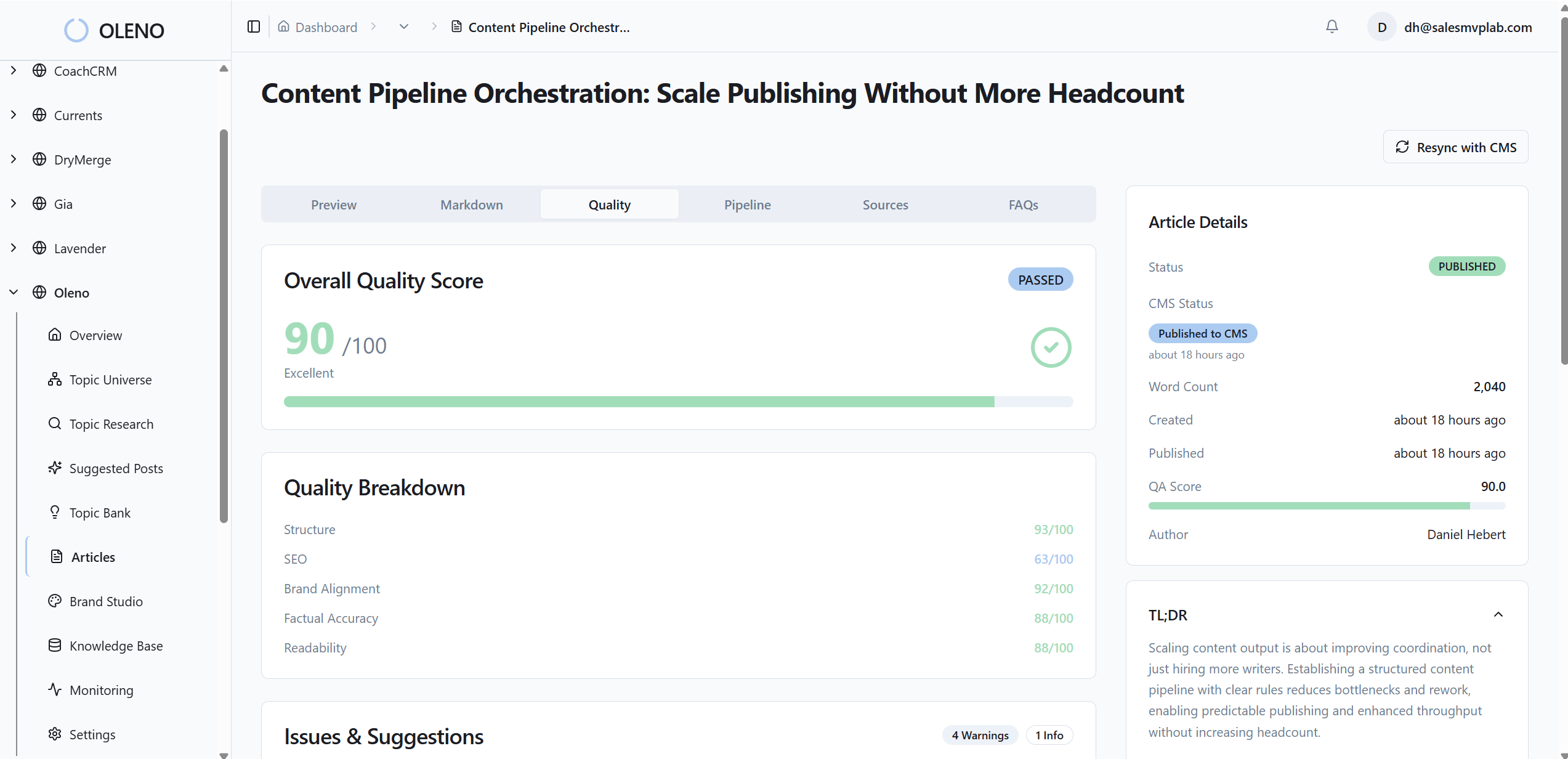
Last summer I was doing SEO and GEO for a B2C app, and I kept building little GPTs, prompting them, copy-pasting outputs, then manually adding everything into my CMS. It was taking 3 to 4 hours a day, and it felt like a complete waste of time. So I hard-coded an autonomous content engine into the CMS itself so it would queue topics, write them, QA them, and post them.
It started indexing quickly and pulling traffic. Then I showed it to coaching clients, mostly as a “look what I hacked together” thing. About 15 people basically asked the same question: can I use this? That’s when I turned it into a product.
What Oleno actually does (without the fluff)
Oleno is a deterministic content production engine with governance. That sounds fancy, but it’s pretty simple in practice.
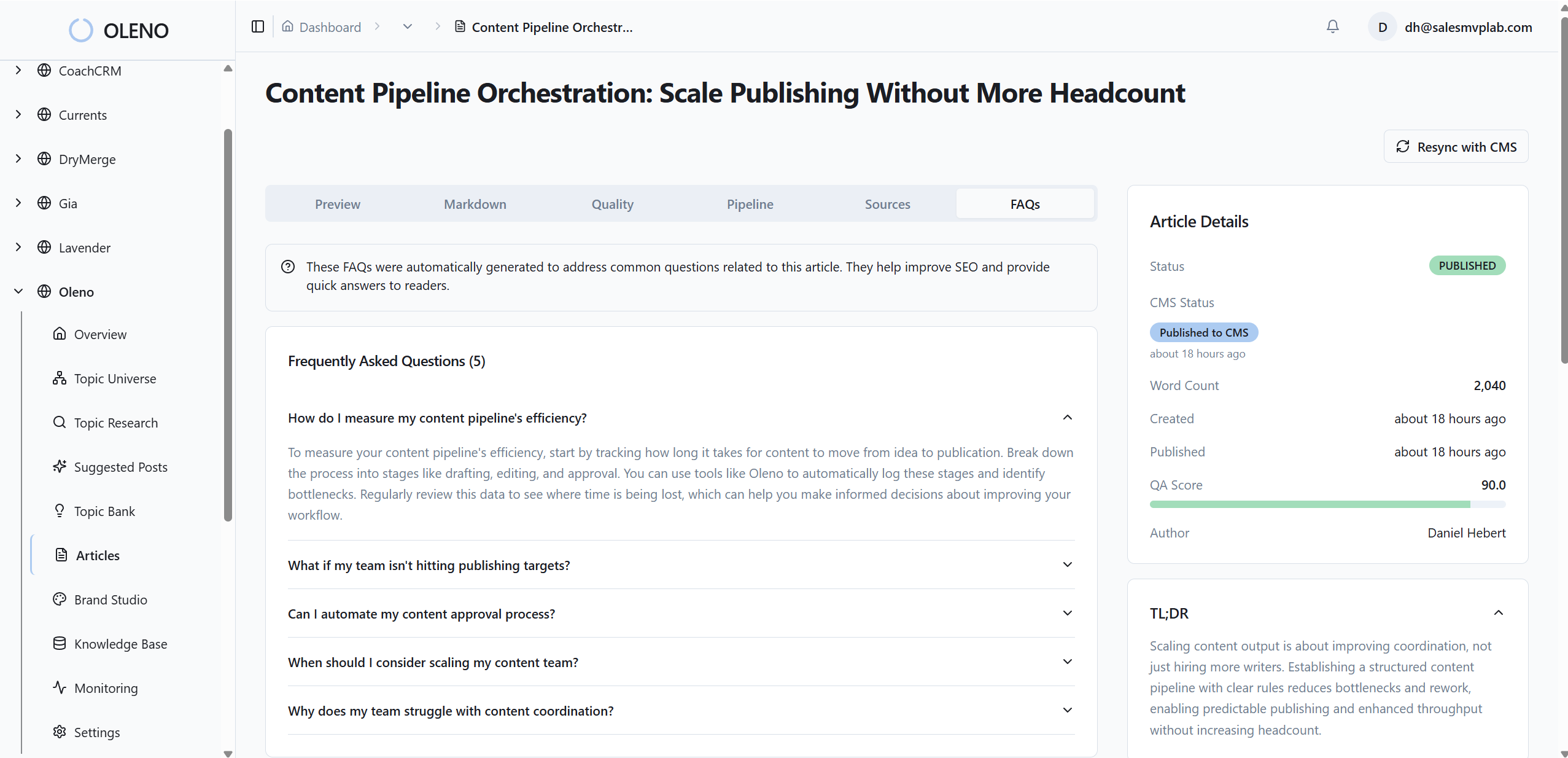
You define how your brand should sound and what claims are allowed. You ground the system in your actual knowledge and product truth via a Knowledge Archive. Then the engine runs a pipeline that looks like: discover topics, create a brief, draft the article, run QA checks, and publish to your CMS. It’s built for programmatic SEO and demand gen content where consistency matters more than creative writing.
The specific pieces that matter:
- Studios that act as a governance layer, including Brand, Marketing, Product, SEO, and Competitive (first-party)
- Knowledge Archive to ground generation in your real source material (first-party)
- QA Gate to catch issues before content goes live (first-party)
- Direct, idempotent publishing to WordPress, Webflow, Storyblok, and HubSpot so you don’t publish duplicates by accident (first-party)
And yeah, this is not for everyone. If your team publishes a couple posts a month and wants a nicer editor, you probably don’t need a production engine. But if you’re trying to scale an acquisition library and you keep hitting the same operational wall, this is exactly what it’s for.
Where Oleno replaces the “glue work” Frase users still end up doing
A lot of Frase.io users still end up with a workflow like this:
- Research and brief in Frase
- Draft and edit in Frase or Google Docs
- Track status in a spreadsheet or project tool
- Copy paste into CMS
- QA and fix formatting manually
- Publish, then realize you published two similar pages last month
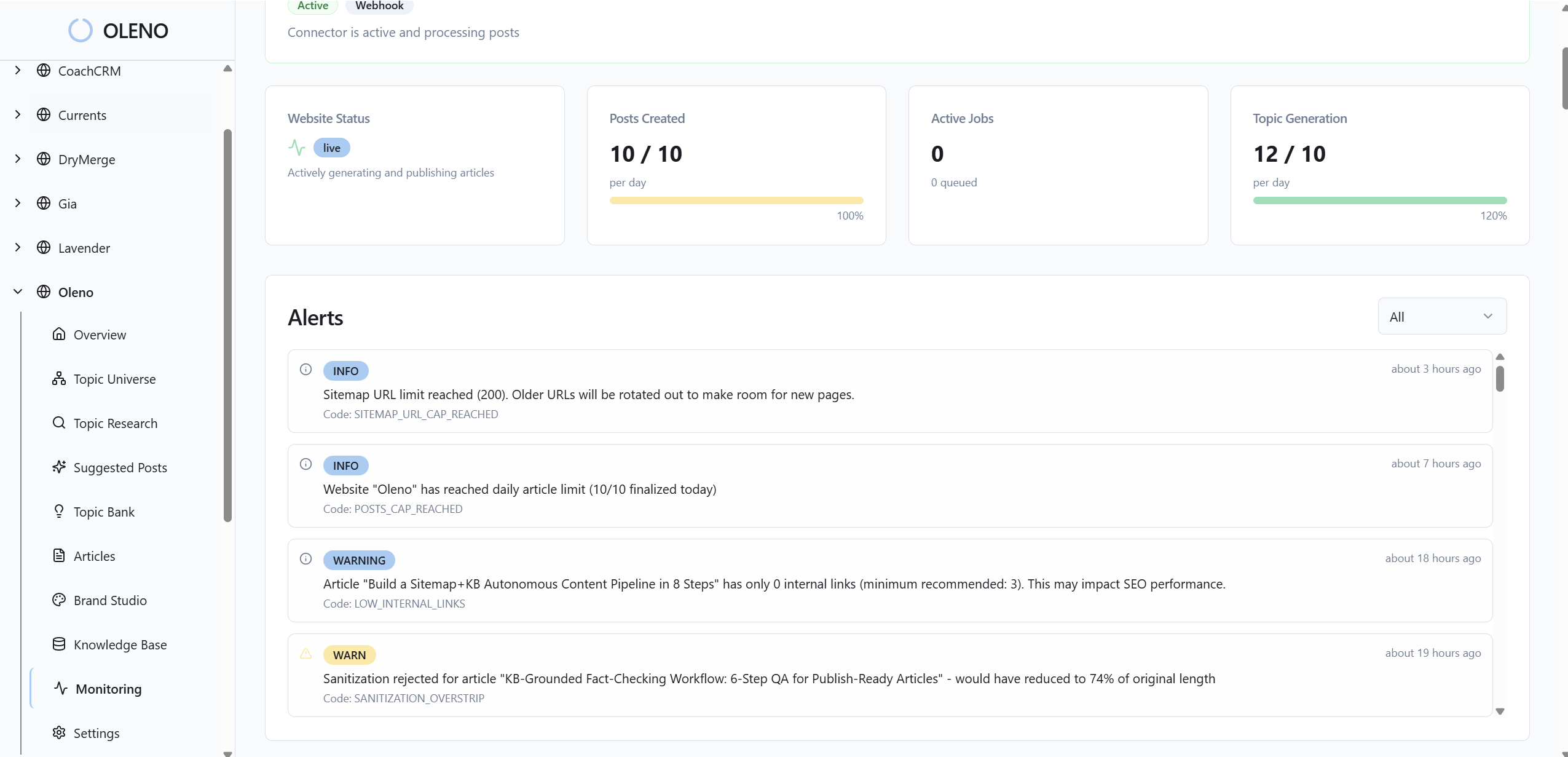
Frase can do a lot of the thinking work upfront. It doesn’t claim to be a full publish engine, and that’s fine. Oleno is built to take that whole chain and turn it into a system that runs the same way every time.
If that sounds like what you need, request a demo and we’ll walk through how the Studios, Knowledge Archive, QA Gate, and CMS publishing fit your current setup.
How to choose between Frase.io and Oleno without overthinking it
Frase.io is the pick when you want to improve research, briefing, and on-page coverage for a human writing workflow. Oleno is the pick when you want to operationalize content production and publishing at scale with governance and QA built in. A good rule of thumb is to look at your constraints: if editors and publishing steps are your bottleneck, you’ll get more leverage from a production engine than another optimization workspace.
A quick way to decide is to answer these questions honestly:
- Are we publishing enough volume that process problems are costing us real time?
- Do we have multiple writers or freelancers who struggle with voice and product accuracy?
- Do we keep finding the same mistakes late, like right before publish?
- Are we trying to build out hundreds or thousands of pages of acquisition content over time?
- Do we want the system to publish content, not just draft it?
If you’re mostly answering “yes,” you’re probably in Oleno territory.
Wrapping it up: what to do next
Frase.io is legitimately good at SERP-based research, briefing, and optimization, and you can see that reflected in product positioning and reviews (G2 reviews, Capterra). But if your real problem is throughput, governance, and publishing, you’ll eventually outgrow a tool that stops at the editor.
If you want to see how a governed, deterministic pipeline feels in practice, book a demo. We’ll look at your CMS, your content types (alternatives, comparisons, cluster pages), and where quality or speed is currently breaking.
The goal isn’t to “pick the better tool.” It’s to pick the tool that removes your bottleneck, without creating a new one.
About Daniel Hebert
I'm the founder of Oleno, SalesMVP Lab, and yourLumira. Been working in B2B SaaS in both sales and marketing leadership for 13+ years. I specialize in building revenue engines from the ground up. Over the years, I've codified writing frameworks, which are now powering Oleno.
Frequently Asked Questions