Topic Cluster Playbook: Map, Prioritize, and Serve User Intent in 6 Steps

Most teams build topic clusters around keywords. Looks tidy in a spreadsheet, including the rise of dual-discovery surfaces:, but you end up shipping pages that say the same thing three different ways. Traffic bumps a little, then plateaus. Your team keeps writing, editing, designing, publishing. Little momentum. Lots of rework.
It’s usually not the writing. It’s the system. When intent is fuzzy and structure is loose, you burn budget filling a cluster with low-gain pages. That creates cannibalization and thin journeys. You fix one page and break another. The cure is straightforward: align clusters to intent, enforce originality upfront, and make sections citable on their own.
Key Takeaways:
- Anchor every cluster to clear user intent and define the new information you will add before you write
- Label and rebalance coverage by stage to avoid awareness-heavy clusters that cannibalize themselves
- Use saturation and cooldowns to throttle publishing so authority compounds instead of fragments
- Standardize briefs and snippet-ready H2s to make sections reference-worthy for search and assistants
- Enforce deterministic internal linking and schema so structure stays intact during busy weeks
- Operationalize the workflow end to end so you publish consistently without babysitting every draft
Why Topic Clusters Waste Budget When Intent Is An Afterthought
Clusters waste budget when they’re built on keyword similarity instead of user jobs. The fix is intent-first planning that labels every target query by stage and declares what new information you will add. Then structure each section for quick, citable answers that stand on their own.

What Actually Builds Topical Authority?
Topical authority grows when clusters map to real jobs, not just shared stems. Start by tagging every query with a stage: learn, compare, act. Then write a single sentence that states the unique insight your page adds that your site does not already cover. It forces differentiation before you draft.
If you want content to compound, move from ad hoc posts to autonomous content operations that coordinate strategy, structure, visuals, and publishing as one system. That is how you stop repeating yourself and start earning citations. For a quick refresher on why fragmentation hurts, see this candid content operations breakdown. For background on cluster thinking, skim MarketMuse’s explainer on topic clusters.
Spot The Misalignment Fast
Compare SERP intent to your page intent. If the top ten are “how to” with the shift toward orchestration and you wrote “what is,” you will fight uphill until you realign headlines and section openings.
- Scan for near-duplicate intent pages inside a cluster. Consolidate or retarget to adjacent jobs like comparison or checklist.
- Rewrite H2s to match how searchers phrase the question. Short, direct, first.
- Interjection.
- Use one canonical query per page and point every spoke back to the hub.
Where Teams Over-Index (And Why It Hurts)
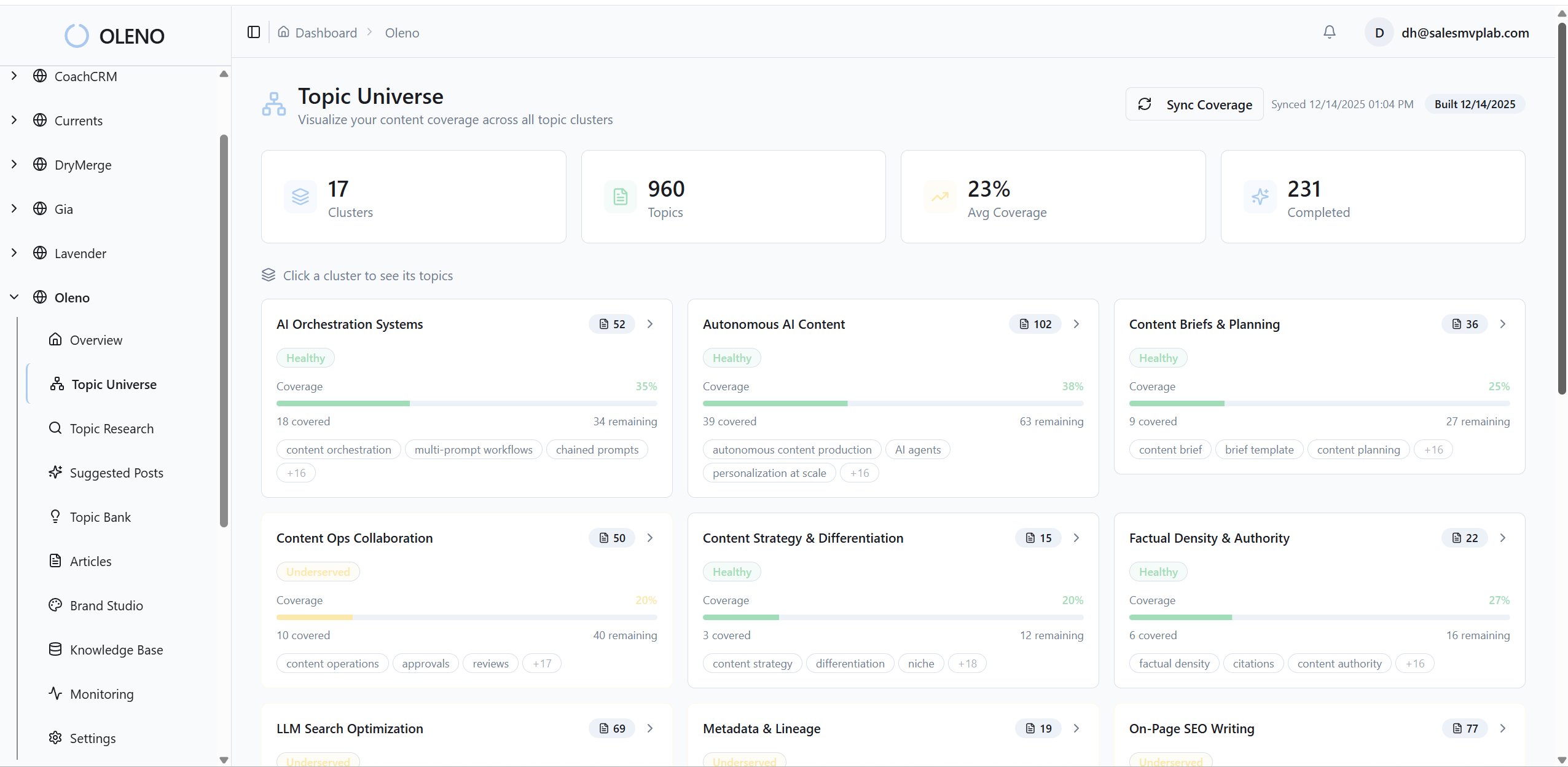
Awareness content is easy to ideate and quick to ship. That is why clusters often saturate at the top. The side effects are predictable: thin decision paths, split internal links, and editors stuck merging overlapping explainers. Label every cluster with saturation states, then publish accordingly: underserved, healthy, well-covered, saturated.
When a cluster hits saturated, you pause net-new unless you have information gain that materially improves the hub or a critical spoke. This is where systems thinking helps. If each page must declare its new contribution upfront, duplication drops and authority grows. For a useful second perspective, see Analytica House’s guide to topic clustering as core strategy.
Map The Journey: Intent-Stage Coverage Without Cannibalization
You avoid cannibalization by inventorying pages by stage, then grouping them by shared questions and entities. From there, assign roles, wire internal links, and enforce cooldowns. The outcome is a clear trail from learn to compare to act, without overlaps.

Audit Existing Content By Intent
Inventory your current pages and tag each by stage. Add the primary question answered and the canonical query. Then highlight pages inside the same cluster with overlapping questions or identical stages. That becomes your fix list. Snapshot coverage by stage. If awareness holds 70 percent of a cluster and decision holds 10 percent, including why ai writing didn't fix, you know exactly what to brief next.
Group And Label Pages Without Guesswork
Group by shared user questions and entity overlap, not just head terms. A simple matrix helps: topic entity, core question, stage, audience segment, outcome. Pages that share three or more attributes likely belong in the same cluster, with one page acting as hub. Assign spoke types deliberately, such as how-to, comparison, or checklist. Link spokes back to the hub and forward to a next-best page to keep momentum. If you want a step-by-step framing, this overview from Masterful Marketing on topic cluster content strategy is solid, and the patterns align with the content orchestration shift many teams are making.
Curious what this looks like in practice? Try generating 3 free test articles now.
The Cost Of Coverage Saturation And Duplicate Pages
Coverage saturation and duplicate intent pages erode authority by splitting signals and wasting production time. The real cost shows up in editing hours, design cycles, and slow journeys that never reach decision content. Fixes pay back quickly once you consolidate and rebalance.
Let’s Pretend You’re Publishing Weekly
Let’s pretend you publish four awareness posts a month in one cluster for three months. That is twelve similar explainers. Traffic rises a bit, then stalls because internal links and external mentions split across too many pages. You also paid for design and editing twelve times. A well-structured hub with three differentiated spokes would likely outperform while cutting upkeep in half.
Put numbers on it. If each post consumes four hours of writing, two hours of editing, and one hour of design, you spent eighty-four hours that quarter. Consolidating to one hub and three spokes might land near forty hours. That delta is a full week of work you could invest in decision content. Case in point, patterns in this Minuttia topic cluster case study mirror the same saturation and consolidation wins.
Find And Fix Cannibalization
Cannibalization hides where “what is” explainers and “how to” guides chase the same head term, or where multiple comparisons target the same competitor. Set simple rules: if two pages share 60 percent of their outline, consolidate them. If they share a head term but serve different stages, retitle and restructure to signal stage explicitly. Move duplicate subtopics into the page with stronger link equity and tighter structure. Speed-first drafting without upstream rules makes this worse, which is why teams should understand common ai writing limitations before scaling.
Stay Sane: Links, Schema, And Governance That Prevent Rework
Structure reduces rework when it is deterministic. Lock internal linking to verified URLs, including why content now requires autonomous, generate schema programmatically, and set cooldowns with clear recoverage triggers. You will publish faster and worry less about regressions on busy weeks.
Deterministic Internal Linking Rules
Internal links should be rule-based, not vibes-based. Use verified URLs only, place five to eight links per article, and write natural, two to five word anchors that fit the sentence. Link hubs and spokes both directions, and include a “next-best page” pointer inside each section to reduce dead ends.
- Prefer exact page title matches when it helps clarity.
- Keep placement at natural sentence boundaries.
- Never fabricate URLs, even as placeholders.
The payoff is deterministic internal linking that stays stable over time and supports dual discovery visibility across search and assistants.
Schema And Governance You Can Trust
Generate JSON-LD for Article, FAQ, and BreadcrumbList automatically, then validate before publish. Keep FAQ content identical on-page and in schema. Programmatic generation and validation prevent drift, especially when multiple pages ship in a sprint. Tie this to a QA threshold that checks structure, knowledge accuracy, and snippet readiness, then require a 90-day cooldown per question unless a material change justifies recoverage.
The Repeatable 6-Part Playbook You Can Run Weekly
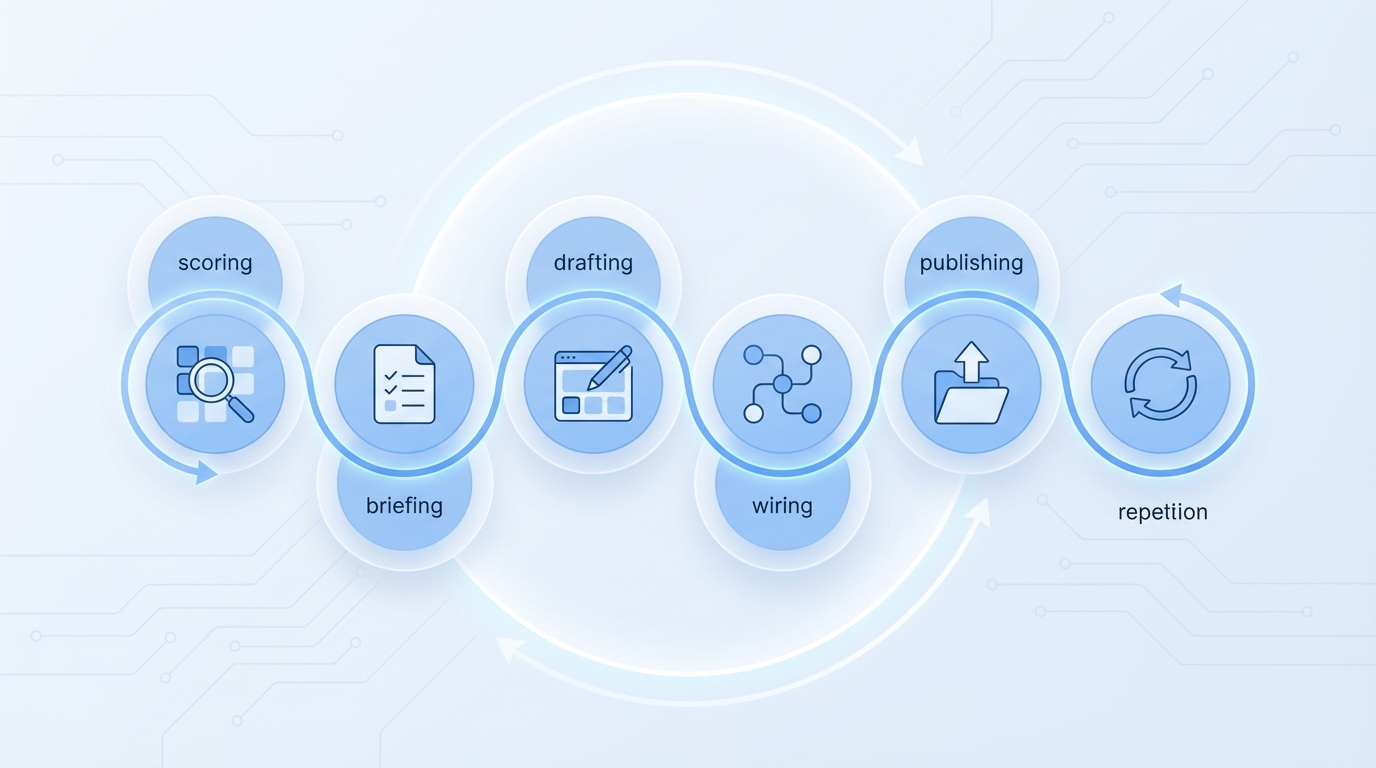
A weekly playbook removes guesswork. Score candidates by coverage gap, saturation, and uniqueness. Brief for stage. Draft with snippet-ready sections. Wire links and schema programmatically. Publish, then choose the next gap. It is boring in a good way.
Prioritize With Coverage, Saturation, And Information Gain
Score each candidate across three inputs. First, coverage gap by stage. Second, saturation level from underserved to saturated. Third, novelty, which you can capture as information gain relative to what exists. Prioritize high-gap, healthy clusters with strong information gain. Pause saturated clusters unless the update materially improves the hub or a spoke. If you need a primer on the concept, revisit information gain scoring.
Brief Templates For Intent Stages
Keep briefs tight and stage-aware. Use four fields: target query, primary answer, three supporting claims, citation list. Then tailor by stage:
- Awareness: definition, common pitfalls, one short example
- Consideration: decision criteria, tradeoffs, lightweight comparison
- Decision: proof points, implementation steps, checklist
When optimizing ai content writing, add a “what’s new here” note to enforce differentiation.
Snippet-Ready H2s And Paragraph Patterns
Open every H2 with a 40 to 60 word direct answer. Keep a three-sentence pattern, then expand with context and a quick example. Make sections stand alone cleanly. Review for snippet readiness explicitly, not as an afterthought. This pattern improves clarity and eligibility for citations. If you want a quick cross-check, see this overview of patterns alongside snippet-ready structure and a short primer from SeeknetUSA on clusters.
Learn the exact 3-step process teams use to stabilize clusters each week. Try using an autonomous content engine for always-on publishing.
How Oleno Operationalizes Topic Clusters End To End
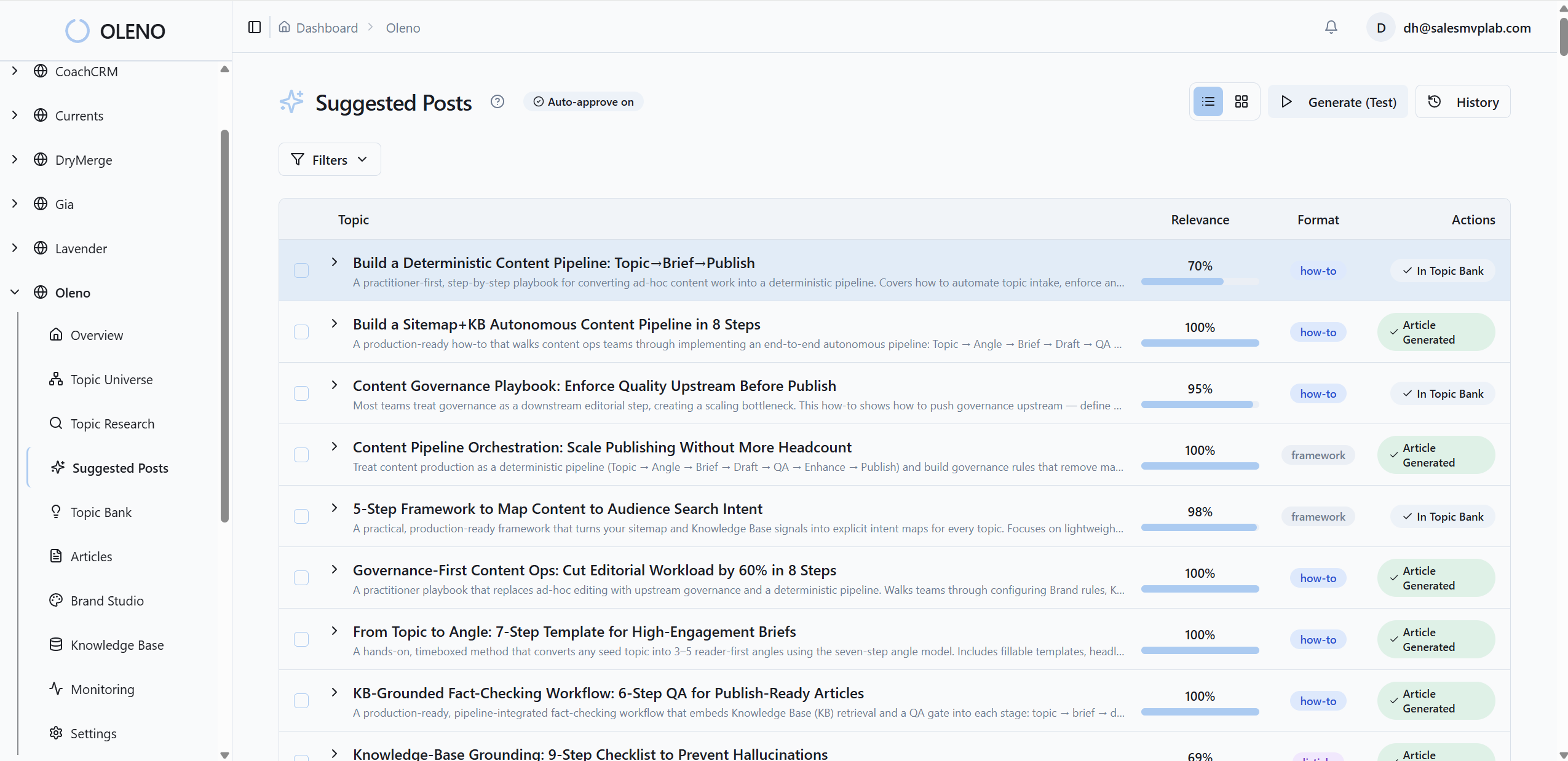
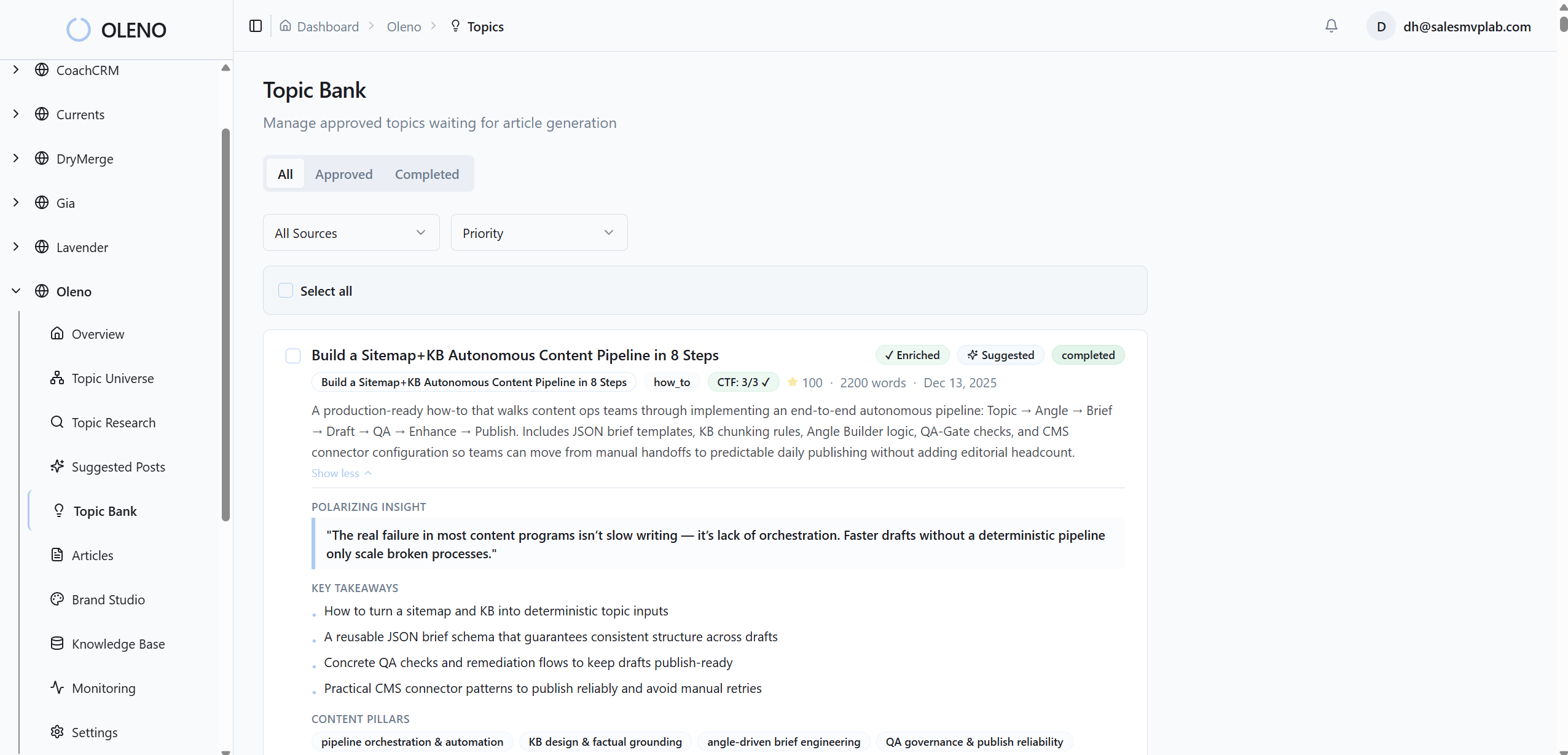
Oleno turns the workflow above into a governed pipeline. It maps clusters, tracks coverage and saturation, enforces cooldowns, and publishes complete, brand-consistent articles with links, schema, and visuals included. You set the direction. It runs daily.
What Oleno Automates So You Don’t Babysit
Remember that weekly triage between keywords, drafts, images, and publishing? Oleno replaces it with a fixed sequence: Topic Universe to Brief to Draft to QA to Links to Schema to Publish. It calculates coverage and saturation, scores uniqueness during brief generation, and applies a 90-day cooldown by question. You focus on strategy, not patching drafts or chasing broken links. If you are wondering why a system is necessary, start with the case for autonomous systems need.
How It Structures For Snippets And LLM Citations
Every section opens with a direct, 40 to 60 word answer and follows a three-sentence structure. Oleno validates snippet readiness during QA, then attaches JSON-LD for Article, FAQ, and BreadcrumbList automatically. Visual Studio places brand-consistent images and relevant product screenshots where they reinforce understanding, not just decoration. Sections are built to be referenced cleanly by search and assistants.
Where Determinism Removes Headaches
Oleno injects internal links from verified sitemaps only and matches anchor text to page titles with natural phrasing. Schema is generated programmatically and validated. Publishing maps fields to WordPress, Webflow, or HubSpot, and duplicate posts are blocked. QA checks structure, brand alignment, knowledge grounding, and snippet readiness. When a draft fails, Oleno iterates until quality thresholds are met, which means fewer “frustrating rework” cycles for your team. This is the opposite of fragmented tooling, and it is why so many teams found their why content broke moment before moving to a system.
Ready to eliminate weekly cluster wrangling? Try Oleno for free.
Conclusion
If your cluster plan is just a list of similar keywords, you will keep paying to rewrite the same page. Re-anchor clusters to intent, enforce new information before drafting, and make sections citable. Then lock the structure with rules for links, schema, and cooldowns so quality holds under load.
You can run this by hand for a while. It works, then real life intrudes and corners get cut. That is usually when duplication creeps back in and editors start merging near-identical pages again. A governed system removes the drama. You set direction, then let the pipeline do the work. Curious to see it end to end? Try generating 3 free test articles now.
About Daniel Hebert
I'm the founder of Oleno, SalesMVP Lab, and yourLumira. Been working in B2B SaaS in both sales and marketing leadership for 13+ years. I specialize in building revenue engines from the ground up. Over the years, I've codified writing frameworks, which are now powering Oleno.
Frequently Asked Questions