Topic Coverage Audit: 8-Step Playbook to Find High-Impact Gaps

You don’t build authority by chasing keywords. You build it by owning topics that matter to your buyers and covering them with intention. That’s the job of a topic coverage audit—turn a messy pile of pages into a clean map of what you’ve said, what’s missing, and what deserves to ship next.
I’ve seen both sides. As a solo marketer trying to write fast. As a sales leader searching for a link that should exist and doesn’t. When you stop guessing and start mapping, the whole operation calms down. Less rework. Fewer “didn’t we write this already?” moments. More content that actually moves pipeline.
Key Takeaways:
- Treat keywords as signals; prioritize coverage gaps that compound authority
- Build a canonical topic map across KB, sitemap, and posts to end duplicates
- Cluster by pillars, label saturation, and enforce cooldowns to prevent churn
- Score snippet readiness, recency, and intent so every article pushes buyers forward
- Align backlog to product surfaces and objection handling, not vanity metrics
- Run an 8-step audit weekly; your queue becomes obvious, not argued
- Operationalize with deterministic systems for briefs, QA, visuals, links, schema, and publishing
Why Keyword Chasing Misses Authority-Building Gaps
Keyword wins don’t equal authority. Authority compounds when you map topics, enforce differentiation, and deliberately expand clusters. Think coverage, not queries. The audit turns your site and KB into a single source of truth, so you stop duplicating effort and start building moats.

What Is A Topic Coverage Audit And Why Now?
A topic coverage audit answers one question: what should we write next to build authority, not just traffic. You inventory everything—knowledge base articles, sitemap pages, and posts—then normalize titles and merge variants into canonical topics. It’s less glamorous than a shiny keyword list, but it’s the only way to stop cannibalizing yourself.
Right now, most teams are shipping content faster than they can govern it. That speed is great for volume and terrible for coherence. The audit creates a canonical map so coverage decisions are obvious: where you’re thin, where you’re repeating, where decision-stage content is missing entirely. When you can see the gaps, prioritization gets simple.
If you need a framing lens, bring a risk-weighted mindset. In audits, you don’t sample randomly—you go where the impact is likely highest. The same idea applies here: align coverage to authority gaps and buyer decisions, not surface-level search volume. For structure inspiration, see the principles behind a risk-based internal audit.
The Difference Between “Ranking Content” And “Coverage That Compounds”
Ranking content is a snapshot. Coverage is a system. You can have three top-10 articles that still fragment your narrative if they live in different clusters and don’t ladder up to a pillar. Compounding coverage looks at clusters, saturation, and recency, then selects the one next topic that moves a buyer to the next step.
Here’s the subtlety teams miss: a high-traffic awareness piece can still dilute authority if it steals attention from neglected decision content tied to your product surfaces. That’s why audits tag each topic by funnel stage and anchor internal links toward pillar pages. The goal isn’t more pages—it’s stronger signals and cleaner paths.
Compounding also requires recency discipline. If your decision guides are 240 days stale, but you just shipped three “basics” posts, you’re signaling the wrong thing to humans and machines. Audit, label, schedule the right updates. Your future self will thank you.
Why Teams Publish The Same Idea Twice (And Don’t Notice)
No canonical topic map. No dedup rules. No cooldowns. That’s how “7 Tips For X” gets written three ways in six months. Separate authors. New quarter. Fresh editorial theme. And suddenly you’ve split internal link equity across three thin angles instead of one strong source of truth.
Fix it with clustering and normalized titles. Group “How To Price Enterprise Plans,” “Enterprise Pricing Guide,” and “Pricing For Enterprise Customers” under one canonical topic, then pick a keeper and 301 the rest if needed. Add a 90-day re-coverage window so even great ideas don’t get rewritten just to scratch an editorial itch.
You’ll reduce frustrating rework and free up cycles for net-new coverage. One more thing: set a semantic similarity threshold (even a rough one) so variants trigger a check before they enter production. It’s a small guardrail that prevents a lot of churn.
The Real Root Cause: No Canonical Topic Map, Just Pages
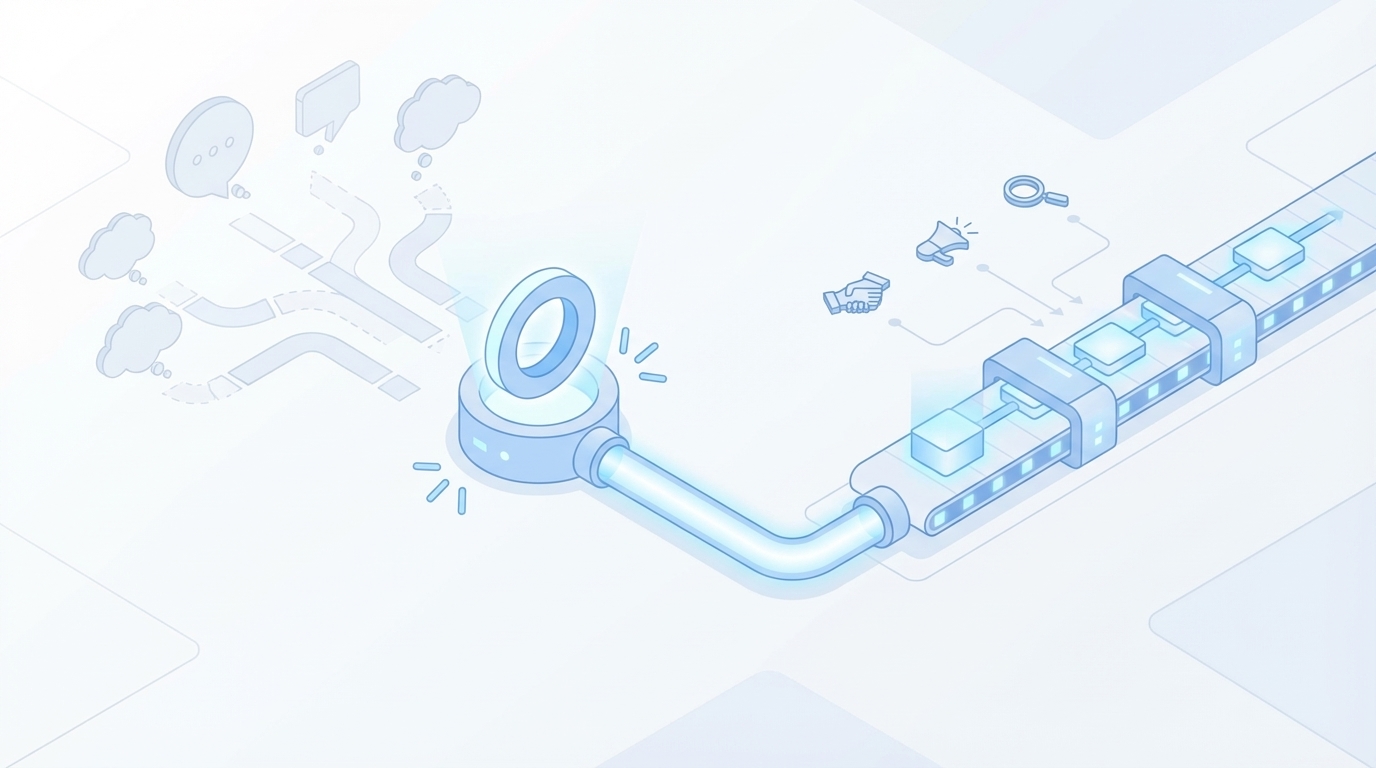
Most audits chase traffic deltas. They miss the structural issue: disconnected pages without a governing map. Unify inventory, cluster canonically, and enforce dedup rules. That’s when the thinness shows up—overlapping angles, orphan posts, and unclear pillars.
What Traditional Audits Miss
Traditional SEO audits love dashboards—keywords, ranks, traffic deltas. Useful, but they rarely normalize topics across your KB, sitemap, and blog. So they can’t see three near-duplicates hiding under slightly different titles, or the decision guide that never got a link from the pillar it supports.
The fix is mechanical. Aggregate your content universe, normalize naming, and cluster by concept. Then apply rules: deduplicate, select a canonical slug, and label each topic by intent stage. When you introduce objective rules, editorial arguments vanish. The map decides, not the loudest voice.
Borrow from enterprise audit structure: end-to-end, repeatable, and documented. If you’re building a system, it should behave like one. For a process lens, skim an audit management playbook and adapt the cadence to content.
How Clusters Anchor Authority Across The Buyer Journey
Clusters aren’t just SEO architecture. They’re how you operationalize narrative. A strong cluster defines the pillar, assigns topics to funnel stages, and creates a path from “what is it” to “why choose us.” That path is what buyers need and what machines can understand.
Label clusters as underserved, healthy, well-covered, or saturated. Then direct energy to the right spot: underserved clusters need foundational coverage, healthy ones need depth, saturated ones need restraint and maintenance. Add funnel intent tags so the next piece doesn’t just add volume—it advances the journey.
This is where your content starts compounding. You’re not guessing anymore. You’re sequencing work. One piece sets up the next, and internal links carry authority up the stack instead of leaking it sideways.
Where Your Own KB And Sitemap Hide The Truth
Your KB often contains the truth your blog ignores—differentiators, product nuance, implementation guidance, objection handling. Your sitemap reveals orphaned pages and outdated explanations. Combine them and normalize titles across both. You’ll find gaps quickly: a clean “why now” in the KB with no public-facing counterpart; a product update without a supporting guide.
Merge near-duplicates. Mark the canonical source. Then measure coverage, saturation, and recency at the topic level, not the URL level. That’s the only granularity that keeps you honest. And only then should you prioritize net-new work or updates. Process playbooks from operations translate well here; adopt the repeatable mindset you’d use for any audit-driven improvement. If helpful, skim a set of process transformation playbooks and borrow the cadence.
The Measurable Cost Of Flying Blind On Coverage
Duplication isn’t just messy. It’s expensive. Rewrites, updates, and off-intent drafts burn cycles you don’t have. A coverage audit quantifies the waste and redirects effort to decision-stage topics that move conversations forward.
The Rework Tax: Duplicates, Updates, And Missed Intent
Let’s pretend your team ships 20 posts a month and 20% are duplicates or off-intent. At six hours per post, that’s 24 hours gone. Add 10 hours of last-minute “we need to update that explainer” edits, and you’ve lost another day. That’s a week a quarter. On work you didn’t need to do.
The math is simple, but the opportunity is bigger. Those hours could produce the buyer’s guide your sales team keeps asking for, or the implementation FAQs that cut pre-sales back-and-forth. Rework isn’t just lost time—it’s momentum you never built.
We don’t need perfection. We need fewer unforced errors. A canonical map and a cooldown rule erase a surprising amount of waste.
The Opportunity Cost Of Saturated Clusters
Publishing a fourth “basics” post inside a saturated cluster feels productive. It’s not. Every cycle you spend there is a cycle you didn’t spend on decision content tied to product surfaces. And here’s the nuance: a modest lift in conversion from the right decision guide often beats incremental traffic from another intro article.
If your pillar already ranks well, your next move isn’t more content—it’s stronger connective tissue and better answers. Decision-stage assets, internal link structure, and clear schema. The audit protects you from confusing activity with authority.
When you do write, aim for information gain—say something new, not louder. That’s how you avoid cannibalizing your own cluster signals.
When Fragmentation Breaks Internal Linking And Discoverability
Duplicate angles confuse anchor text and split internal link equity. Search engines and AI assistants see weak, inconsistent signals because your summaries don’t line up and your structure isn’t clean. The fix isn’t mystical—it’s operational.
Stabilize the structure. Open H2s with 40–60 word direct answers. Use clean markup and schema that clarifies meaning. Inject internal links deterministically so they reinforce pillars, not random neighbors. The payoff is quiet but real: better snippet eligibility and fewer content dead-ends. If you want a broader quality lens, this operational audit perspective is useful—repeatability beats heroics.
The Moment It Clicks: From “What Should We Write?” To “Here’s The Queue”
The click happens when your backlog stops being a debate. Sales knows what’s coming. Product marketing stops begging for a competitive page. SEO isn’t policing duplicates. The queue is visible, prioritized, and tied to revenue moments.
When Sales Can’t Find The Right Link (Again)
I’ve been on the sales side when the “perfect” resource didn’t exist—or lived in a buried doc. It’s a headache. You end up sending a half-relevant blog post with a caveat and hoping the buyer reads between the lines. That’s not a strategy.
A coverage audit surfaces those missing decision pages—pricing rationale, implementation risks, competitive trade-offs—and puts them at the top of your backlog. Sales conversations get tighter. Follow-ups get shorter. And you stop reinventing answers in email threads.
Here’s the practical test: if a rep can’t find it in two clicks, it may as well not exist. The audit makes those gaps painfully obvious.
The 3am Update That Shouldn’t Have Happened
We’ve all been there. Launch eve. Something in the “canonical” explanation is off. Someone is editing at 3am because there was no canonical page—just two similar posts and a Notion note. That scramble is optional.
A prioritized backlog with cooldowns prevents these fire drills. Recency tags put important decision pages on a maintenance cadence. Dedup rules kill accidental overlap. And when you do update, you update the one source of truth instead of chasing echoes.
You’ll still have last-minute changes sometimes. But they won’t be caused by structural mess.
Who Benefits Most From A Coverage Audit?
Everyone who touches the narrative. Product marketing maps content to product surfaces and objections. Sales gets linkable, story-driven assets that match real conversations. SEO stabilizes clusters and fixes internal link structure so authority doesn’t leak.
- Product marketing: aligns content to differentiators and proof points
- Sales: gets clean anchors for the talk track
- SEO: gains reliable clusters and internal linking patterns
One interjection. Leadership gets predictability—work tied to revenue moments, not vanity metrics. Governance you can defend looks a lot like the internal compliance audit playbook: simple rules, enforced consistently.
The 8-Step Audit You Can Run This Week
Run this as a weekly rhythm. Inventory, normalize, score, and prioritize. You’re not looking for perfection—you’re building a durable system that guides what ships next.
Step 1: Aggregate Your Inventory From KB, Sitemap, And Posts
Start by pulling everything. Export your KB docs, crawl your sitemap, and list existing posts. Normalize titles—singular/plural, verb forms—so “setup” and “set up” don’t become two topics. Capture URLs, last-updated dates, and intent notes.
Store it in a sheet or simple database. The goal is a full-population view, not a sample. No filters yet. Just collect, because the patterns hide in the aggregate.
Two quick adds: mark obvious product surfaces and tag content that’s clearly decision-stage. Those anchors will help later when you prioritize.
Step 2: Normalize And Cluster Into Canonical Topics
Group near-duplicates and variants into a single canonical topic per concept. Assign each to a cluster (pillar). Create basic dedup rules: a title regex list, a semantic similarity threshold, and a “keep” canonical slug. You’re designing traffic lanes, not speed bumps.
This is where editorial debates shrink. When “Enterprise Pricing Models” and “How To Price Enterprise Plans” are in the same bucket, you stop arguing about which to write—you decide which to keep and which to redirect.
Document the rule once and reuse it. Discipline beats memory.
Step 3: Calculate Coverage, Saturation, Recency, And Snippet Readiness
At the topic level, count existing assets, note last-updated days, and assign a quick snippet-readiness score (do H2s open with a 40–60 word direct answer?). Roll up to cluster saturation: underserved, healthy, well-covered, saturated.
This turns a messy list into a map. You’ll see the thin spots immediately. It also surfaces outdated decision pages that deserve attention before you chase another awareness keyword.
One more pass: flag orphan pages with no internal links and patch them into their cluster. Easy win, material impact.
Step 4: Map Intent And Business Alignment
Tag topics by funnel stage—awareness, consideration, decision. Then tie each to product surfaces/screens, common sales objections, and an ARR proximity proxy (ICP fit or plan tiers). Your goal isn’t mathematical precision; it’s directional alignment to moments that matter.
Use documented sales questions to anchor intent. If reps are fielding “How does implementation work?” weekly, that’s not an awareness blog post—it’s a decision guide that should link from pricing, onboarding, and the product pillar.
Now your backlog starts pointing at revenue, not vanity metrics.
Step 5: Flag Redundancies And Enforce Cooldown Windows
Mark topics that appear multiple times across posts. Choose the canonical source of truth and set a 90-day cooldown before re-covering. If recency >180 days on decision content, schedule an update. These two rules alone eliminate a surprising amount of churn.
This is maintenance as strategy. You’re telling the system when to write and when not to. It’s the difference between steady authority and busywork.
If you like structured checklists, the format behind a SOX audit’s eight steps maps well here—simple stages, clear gates, repeatable outcomes.
How Oleno Operationalizes Your Topic Coverage Audit End-To-End
You can run the audit manually. Or you can make it the way the system runs every day. Oleno turns the playbook into a closed loop: strategy, differentiation, writing, visuals, QA, links, schema, and publishing handled consistently.
Step 6: Prioritize With Impact–Effort And Information Gain
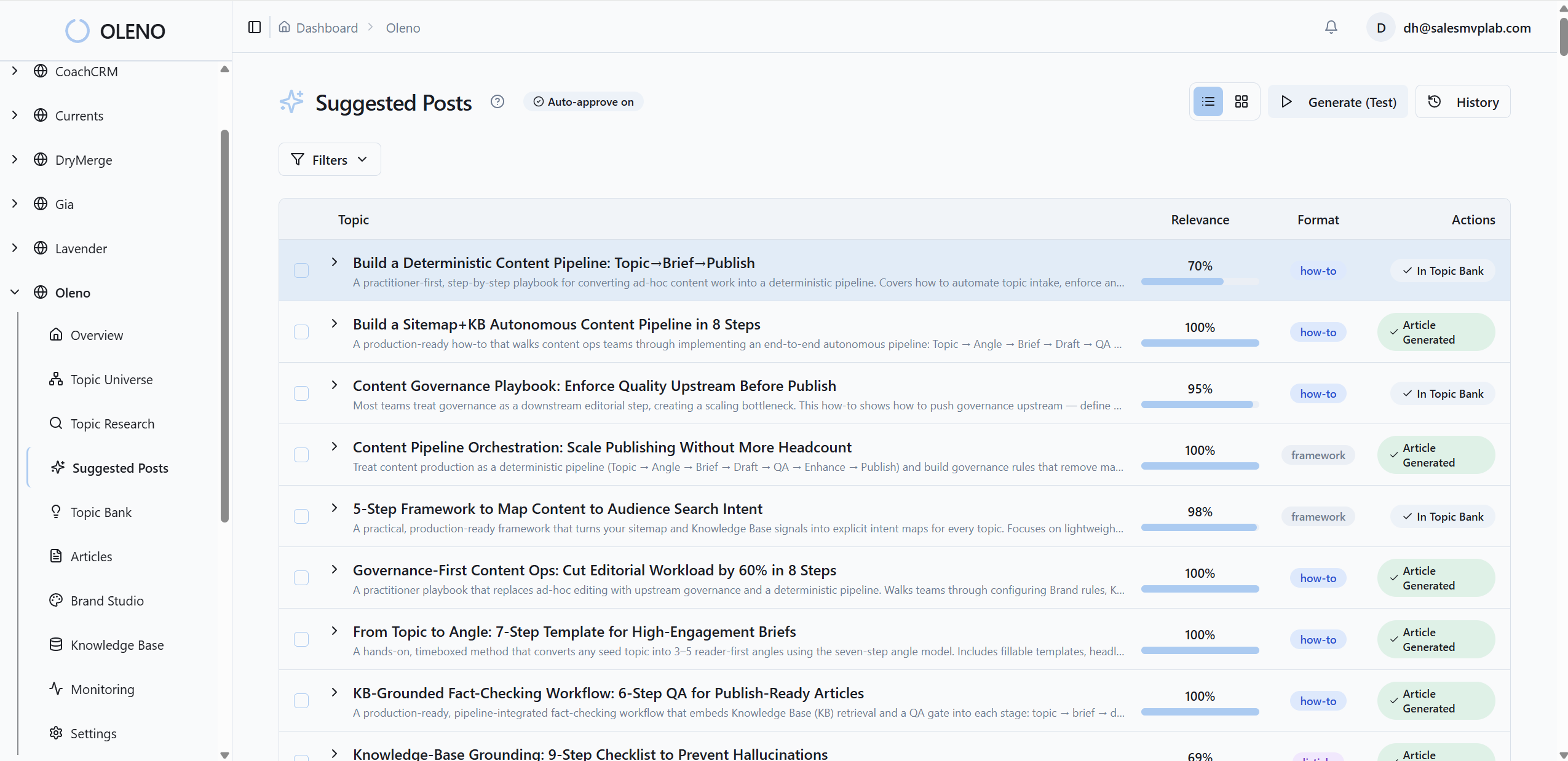
Prioritization works when the rules are explicit. In practice, you score impact from ARR proximity and funnel stage, score effort from SME time and asset complexity, and add an information gain proxy so you don’t rehash what already exists. Oleno bakes this into Brief Generation with Information Gain Scoring, which calculates a 0–100 uniqueness score and flags low-differentiation outlines before any drafting happens.
The result is fewer duplicates, less cannibalization, and clearer signals inside each cluster. It’s not about writing more—it’s about investing energy where authority grows. The transformation ties directly to the rework tax you were paying earlier. Waste drops when repetition is blocked at the source.
- Product capability: Brief Generation with Information Gain Scoring (0–100) flags shallow outlines before writing
- Benefit: you stop shipping repeats that dilute cluster signals and consume hours you don’t have
Step 7: Output A Backlog With Briefs And Acceptance Criteria
A good backlog includes the “what” and the “how you’ll know it’s good.” Oleno auto-generates structured briefs with angles, outlines, and authoritative external link candidates. Acceptance criteria are explicit: snippet-ready H2s, schema present, and internal links to pillar pages. QA-Gate enforces those rules before anything ships.
This removes the scramble. No last-minute edits to fix structure or tone. No hoping someone remembers to add schema. You get consistent, citable sections that stand alone cleanly—good for readers, clear for machines.
- Product capability: QA-Gate and Snippet-Ready Structure validate section-level clarity and schema pre-publish
- Benefit: fewer late edits, higher eligibility for featured snippets and AI citations
Step 8: Handoff, Publish, And Monitor Recency/Cooldowns
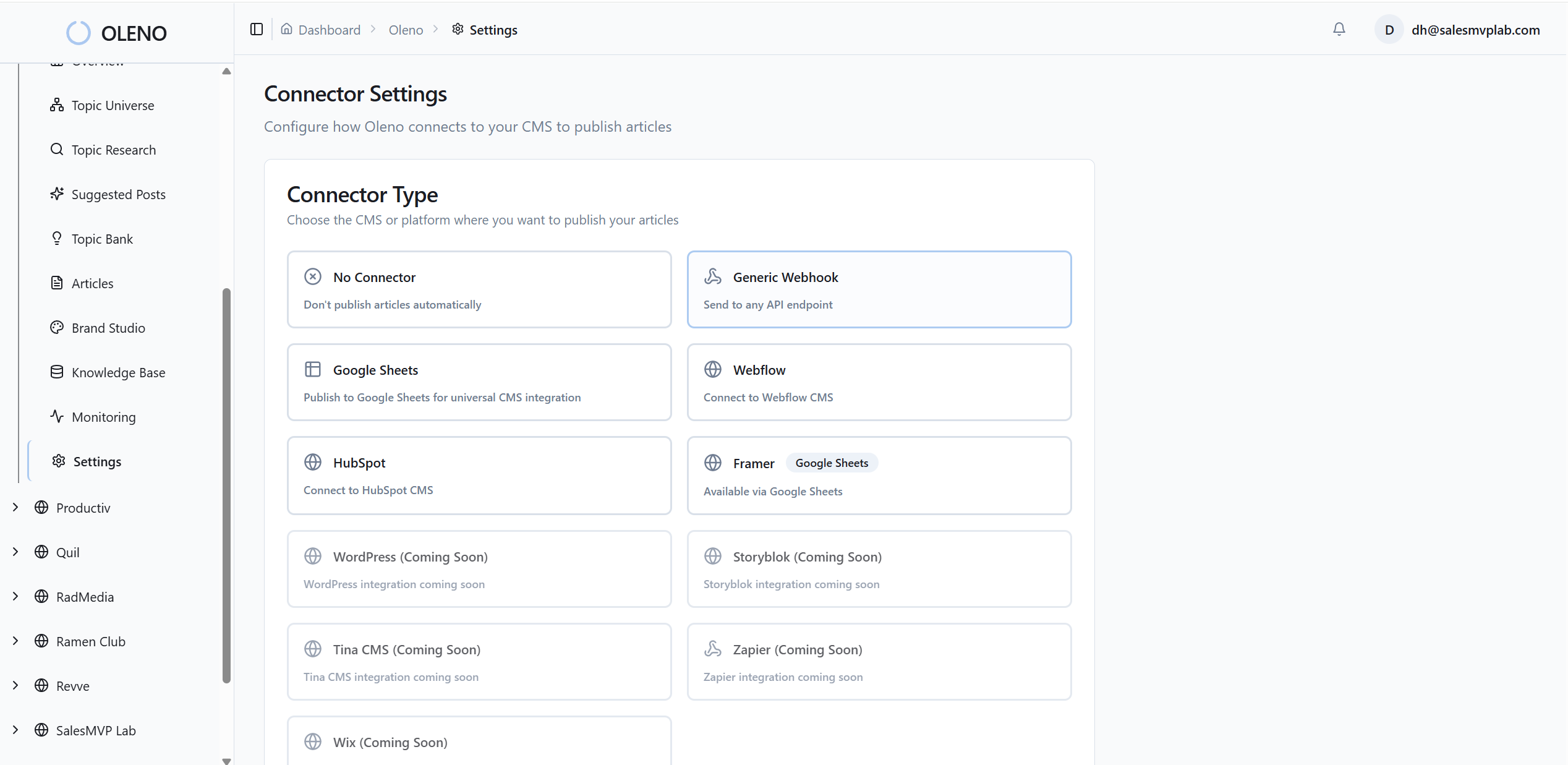
Publishing should be boring. Oleno delivers final articles directly through connectors for WordPress, Webflow, and HubSpot. Deterministic Internal Linking uses only verified sitemap URLs and exact-match anchor text. JSON-LD schema is generated programmatically. Duplicate publishing is prevented by design. Visual Studio prioritizes solution sections for product visuals, so what ships looks like your brand without a design fire drill.
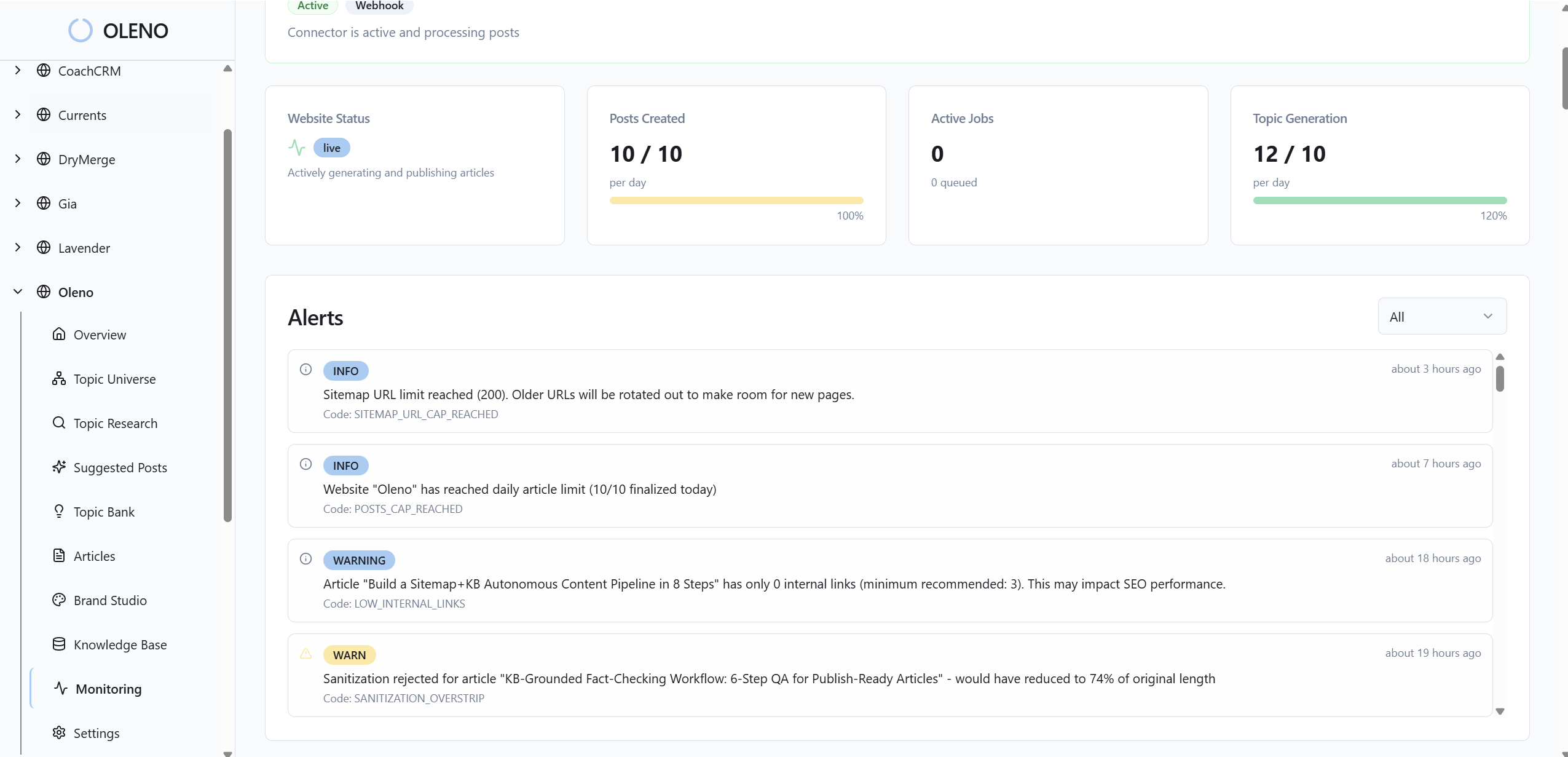
This is where the earlier costs disappear. No fabricated links that break credibility. No “oops” publishes. No 3am formatting cleanup. Just a steady flow of publish-ready work that respects your cooldown and recency rules.
- Product capability: Publishing & Connectors + Deterministic Internal Linking + JSON-LD schema
- Benefit: cleaner structure, fewer failures, and reliable handoffs from draft to live
Want to see the full pipeline run on something you care about? Try Generating 3 Free Test Articles Now. It’s a fast way to feel the difference between tools that write drafts and a system that ships complete, on-brand articles.
Conclusion
Keywords tell you what exists. Coverage tells you what’s missing. When you audit topics instead of hunting queries, you stop duplicating effort and start compounding authority. The work becomes predictable—clusters stabilized, decision content prioritized, updates disciplined.
Run the 8-step audit until it’s muscle memory. Then let a system enforce the rules so your team can focus on judgment and story. Less rework. Fewer scrambles. More content that moves buyers forward. That’s the job.
About Daniel Hebert
I'm the founder of Oleno, SalesMVP Lab, and yourLumira. Been working in B2B SaaS in both sales and marketing leadership for 13+ years. I specialize in building revenue engines from the ground up. Over the years, I've codified writing frameworks, which are now powering Oleno.
Frequently Asked Questions