Topic Coverage Audit: 8-Step Playbook to Find & Prioritize Gaps

Back when I ran a site with 80 regular contributors and 300 guests, we grew by covering topics from every angle. Volume helped, sure. But what really moved us was breadth plus depth without repeating ourselves every other week. That took a system. Not a stack of drafts.
Later, leading marketing inside small SaaS teams, the bottleneck was different. I could write fast and on-brand, but scaling that quality without duplicating ideas was painful. We tried transcripts. Hired freelancers. Shipped good content that didn’t map cleanly to the product. Rankings went up. Pipeline didn’t. That gap is where a coverage audit earns its keep.
Key Takeaways:
- Use a single inventory to see duplication clearly before you write another word
- Cluster by simple heuristics, then label saturation to prevent over-publishing
- Score information gain at the outline level to stop low-differentiation drafts early
- Merge, prune, or rewrite overlapping pages based on intent, not hunches
- Run a prioritization matrix with a strict 90-day cooldown so coverage compounds
- Treat content like a system, not a queue, and you will reduce rework and noise
Why Publishing More Creates Redundancy And Dilutes Authority
Publishing more, without a coverage map, creates redundant pages that answer the same intent and confuse both readers and search engines. Authority depends on signal strength across a cluster, not body count. Think of two “how to run enablement” posts fighting each other while your competitor owns a single definitive guide.

Step 1: Inventory your universe (KB, sitemap, published URLs)
Start by collapsing everything into one normalized CSV you can scan quickly. Pull your knowledge base, sitemap, and a crawl of published URLs. Capture title, slug, last updated, primary topic, and canonical. Add light structure that matters later: content type, funnel stage, pillar. Clean for variants, like trailing slashes and http/https.
A good inventory is fast to read and ruthless on duplicates. De-duplicate canonicals by URL and top-level slug. If you cannot export a field, infer it with consistent rules and document those rules inside the sheet. No prose dumps. Structure only. This is the moment you turn chaos into a single source of truth you can act on.
- Minimum fields to include:
- Title, slug, canonical URL
- Last updated date in ISO format
- Content type, funnel stage, pillar
- Topic key, short and human readable
One note: resolve “keeper” URLs now. It saves debate downstream.
What is a topic coverage audit and why does it matter?
A coverage audit asks three questions: where are we thin, where are we repeating ourselves, and what actually deserves a new page. It turns content from a queue into a system with shared rules. You get fewer drafts and more signal, with cooldowns and saturation labels that stop you from re-covering the same angle every three weeks.
If you want context on why speed alone falls short, read this short take on the shift toward orchestration. For process rigor, researchers emphasize repeatable steps and labeling discipline, which applies neatly to content audits in practice, as shown in methodology guidance on reproducible classification and in audit-oriented research methods.
Curious what this looks like in practice? Try generating 3 free test articles now.
Your Real Bottleneck Is Coverage Mapping, Not Keywords
The blocker rarely lives in keyword lists. It lives in not knowing how your topics group, including the rise of dual-discovery surfaces:, where you are saturated, and what angle would add net-new value. Coverage mapping gives you the map, shows the gaps, and points to the single next page that strengthens the cluster.

Step 2: Normalize and clean the dataset
Clean inputs reduce arguments later. Standardize titles to sentence case and slugs to kebab case. Normalize dates to ISO. Add a topic key that a human can read and a spreadsheet can sort. Map canonical-to-duplicate relationships and mark non-keepers for merge or redirect. If you track which KB doc influenced a page, log that too. It exposes over-reliance on a single source and reveals blind spots.
A quick data hygiene pass today can remove hours of back-and-forth next month. You are making editorial judgment easier by making structure obvious.
Step 3: Cluster pages and KB entries with simple semantic heuristics
Use a two-pass heuristic and keep it boring on purpose. First, group pages with exact phrase overlap in titles or H2s. Second, group on noun-phrase similarity in the topic key for softer matches. Assign each cluster to a pillar. Add a cluster coverage count that includes pages plus KB entries, not just published posts.
- Two-pass rule of thumb:
- Pass one: exact overlaps in titles or H2s
- Pass two: noun-phrase similarity on the topic key
- Threshold: two shared keyphrases means group, else review
For reproducibility, short written rules beat fancy models. That mirrors how reliable classification is handled in research, see the repeatability focus in reproducible classification approaches and reliability considerations in clustering.
How do you cluster without expensive tools?
Start with title n-grams and shared keyphrases in the first 100 words. Then apply human judgment to border cases. Keep thresholds simple and write your six-line rule set in the sheet. Re-runnable beats perfect. You want to be able to redo clustering after merges without reinventing the method each time.
The Cost Of Overlap: Wasted Budget, Confused Signals, Slower Gains
Overlap burns time and clouds signals. You spend hours editing two pages that compete for the same intent, then watch both underperform. While you fix cannibalization, you delay the single article that would have moved the cluster forward. That is real cost, not theory.

Step 4: Saturation mapping with clear labels and rules
Give each cluster a label based on coverage count and recency: underserved, healthy, well-covered, or saturated. As a simple model, 0–1 equals underserved, 2–4 equals healthy, 5–7 equals well-covered, and 8 or more equals saturated. If something was published in the last 90 days, bump it one level toward well-covered. Flag clusters that are saturated and poorly interlinked.
Short, consistent labels help you enforce discipline. Research on labeling consistency and inter-rater reliability underscores why simple categories work better than fuzzy ones, see reproducibility and labeling guidance. For audit follow-through, structured methods help avoid drift, as seen in audit literature on method rigor.
Where do teams over-publish without noticing?
Comfort zones. You repeat familiar language, low-effort angles, and what worked six months ago. Thought leadership blurs into soft takes that sound new but answer the same intent. Quick test: if two pages answer the same user intent in the first 200 words, you are duplicating signal.
- Common red flags:
- “Ultimate guide” variants inside one pillar
- Comparison pages that repeat the same pros and cons
- Feature explainers split into two near-duplicates
Here is the twist. System-level rules prevent this. If you want the why behind those rules, this perspective on autonomous systems for content frames cooldowns and saturation as operating constraints, not content ideas.
Let’s pretend you spend four hours per draft and two hours on edits. If 25 percent of your output overlaps, that is one full day per week lost to redundancy, plus the ranking drag of split signals.
Make It Tangible: Scoring Originality And Eliminating Redundancy
Originality can be measured enough to guide decisions. Score outlines for information gain against the cluster, then decide to merge, prune, or rewrite before you write. You will reduce “frustrating rework” and avoid publishing content that adds nothing new.
Step 5: Information gain scoring you can run in a spreadsheet
Build a scoring column that compares your proposed sections to existing pages in the cluster. Use a 0–100 scale. Zero to thirty means minimal net-new claims, including the shift toward orchestration, thirty-one to sixty means moderate uniqueness, sixty-one to one hundred means substantial new insight. Weight section-level novelty, like unique frameworks, proprietary data, or new examples. Synonyms do not count.
Anything below forty should trigger a rewrite or consolidation before drafting. This keeps drafts from drifting into repetition. It also addresses the reality that faster drafting alone does not solve originality, as outlined here on AI writing limits. For a research lens on originality and scoring criteria, see methods for originality evaluation and reproducible scoring frameworks.
Step 6: Redundancy detection to merge, prune, or rewrite
Run near-duplicate checks on titles, intros, and the “purpose” paragraph. If two pages target identical intents, select a canonical keeper and redirect the weaker one. If overlap sits around fifty to seventy percent, merge the unique sections and republish a single, stronger page. If a page is thin and off-pillar, prune it. Do not get sentimental.
- Fast decision rules:
- Merge if both pages carry backlinks or partial uniqueness
- Prune if quality is low and angle is not distinct
- Rewrite if the topic matters, but the framing is stale
For background on why duplication risks grow inside fragmented workflows, skim this content operations breakdown. Let’s pretend each merge saves three hours and each prune saves two hours of future upkeep. Across ten pages, that is a week you can spend on net-new coverage.
When should you merge vs. prune vs. rewrite?
Use intent and assets to decide. If both posts have backlinks, aim to merge and keep the stronger URL. If a page never earned links, traffic, or citations, prune and transfer any unique insight to a living page. If you keep seeing the same angle, rewrite with a different purpose and a higher information gain target. The goal is cluster strength, not page count.
A Better Operating Model For Coverage And Cadence
A reliable model ties prioritization to impact, effort, and cooldowns. You pick the highest-impact, highest-gain, lowest-effort work first, then enforce a 90-day wait per topic key. That keeps clusters healthy and prevents cannibalization. It also creates space for interlinking and schema to do their job.
Step 7: Prioritization matrix with impact, effort, and cooldown
Score each gap on business impact, information gain, and effort. A simple 3x3 grid works well. High impact, high gain, low effort rises to the top. Apply a 90-day cooldown at the topic key level to reduce cannibalization. Respect cluster balance, so you do not stack five posts in one pillar while others starve.
- Inputs to the grid:
- Impact: pipeline proximity and commercial fit
- Gain: originality score from the outline
- Effort: rewrite versus net-new draft
For a deeper systems view, this primer on autonomous content operations explains why predictable cadence and coverage rules compound authority over time.
Step 8: Execution plan with briefs, cadence, and enforcement
Turn the top-ranked gaps into briefs that capture the narrative, outline, unique angle, and the citations you expect. Set a weekly cadence your team can hit without heroics. Enforce cooldowns at approval. If a topic key is younger than 90 days, it waits. That discipline gives you time to strengthen interlinks and polish schema, which affects both SEO and LLM retrieval, as explored in this overview of SEO and LLM visibility alignment.
A quick side benefit: editing déjà vu fades. You are not rewording the same intro every Thursday.
Why should small teams adopt cooldown rules?
Small teams feel the pain of repetition most. Cooldowns force focus on net-new coverage. They reduce the “frustrating rework” loop and protect against unintentional cannibalization. They also put breathing room between related posts, which makes interlinking and schema maintenance realistic.
Ready to ship coverage with fewer drafts and less noise? Try using an autonomous content engine for always-on publishing.
How Oleno Automates The Topic Coverage Audit End-To-End
Oleno automates the entire coverage workflow, including why ai writing didn't fix, from ingesting your KB and sitemap to generating briefs, scoring information gain, and publishing complete articles. The system labels saturation, enforces cooldowns, injects internal links and schema, and ships on-brand visuals with text. You get a continuous pipeline, not a set of tasks.
Operationalizing inventory, clustering, and saturation
Oleno ingests your knowledge base and verified sitemap, then generates a Topic Universe that clusters related ideas and shows real-time saturation labels, from underserved to saturated. Inputs are normalized, duplicate topics are prevented, and a 90-day cooldown is enforced before re-coverage. Suggestions arrive daily and are prioritized by gaps and cluster health, so you always know what to write next. If you want to see how topics are sourced, start here: topic discovery.
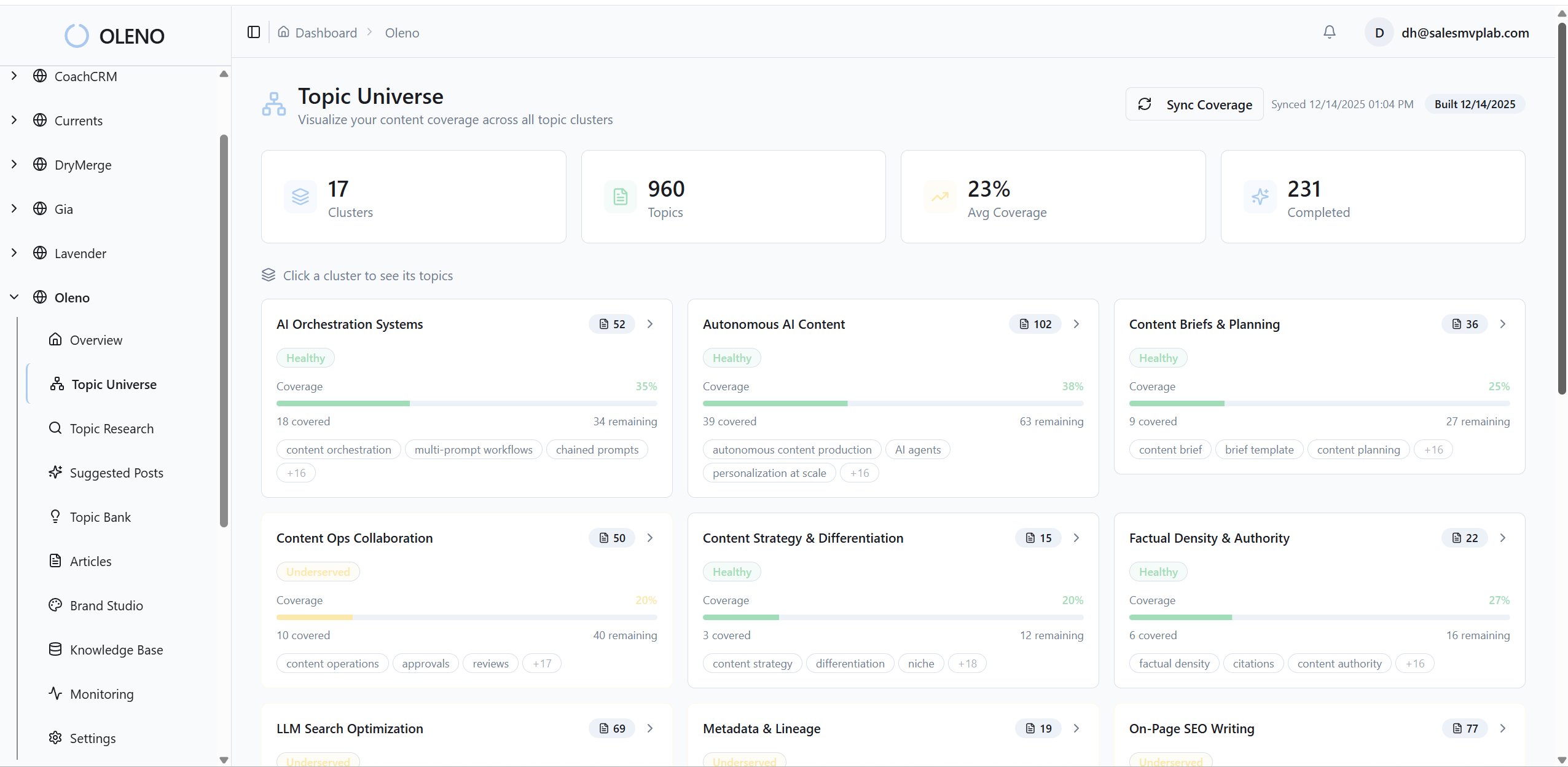
What you feel day to day is a calmer editorial meeting. The “what next” question is answered by coverage, not opinion.
Information gain, QA-gate, and duplication prevention
Competitive research runs during brief generation, with an Information Gain Score assigned before drafting. Low-gain outlines trigger early refinement and high-gain ones are rewarded during QA. Oleno’s quality gate checks structure, voice, and snippet readiness, then iterates until standards are met. Deterministic internal linking and schema get injected after draft and visuals, which reduces overlap and strengthens cluster signals. Here is a look at the mechanics behind those checks: QA systems.
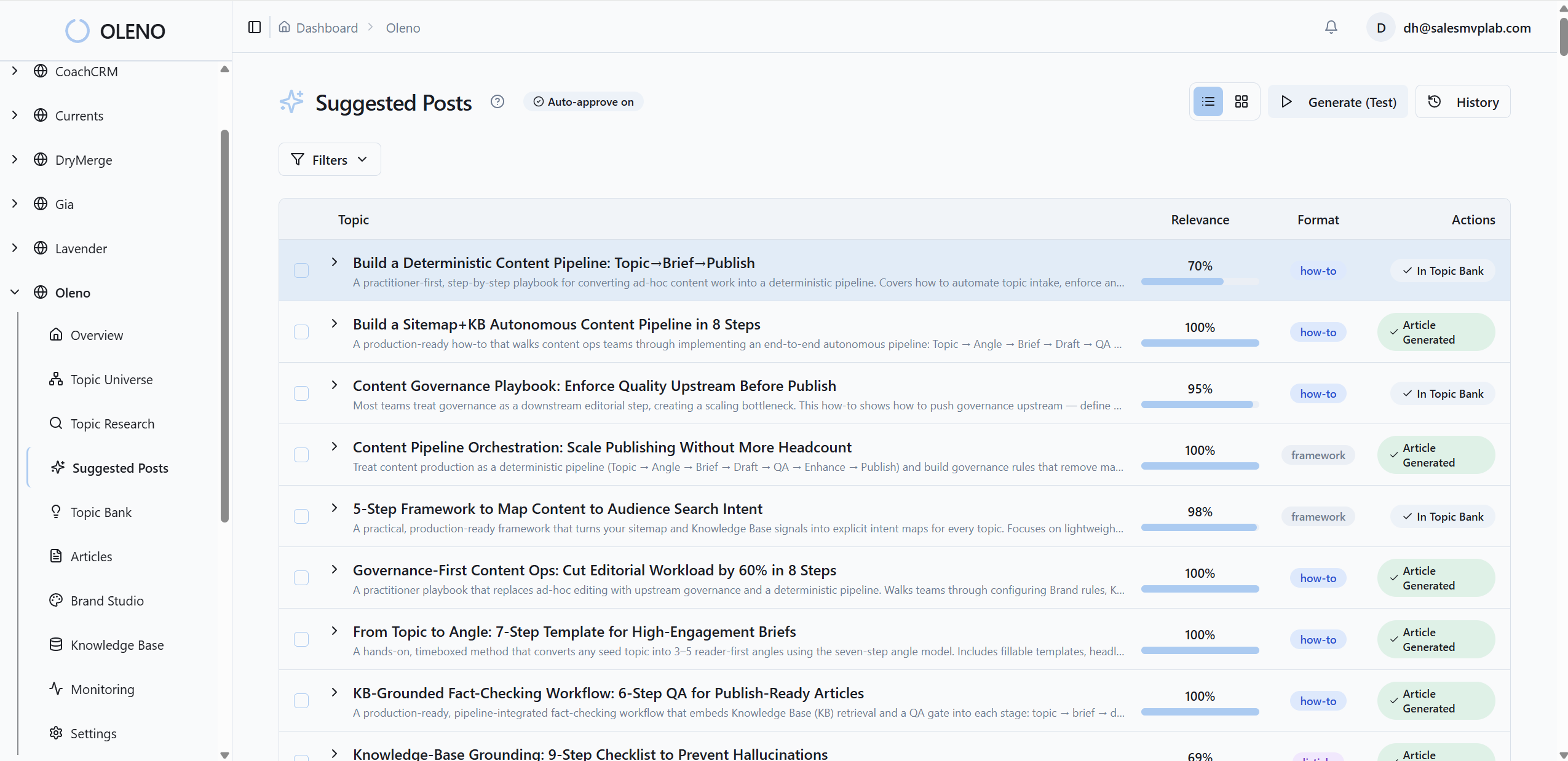
The deterministic internal linking guarantees 5–8 verified links with exact-match anchors, including why content now requires autonomous, and schema is generated programmatically. The result is less manual cleanup and fewer surprise duplicates.
When should you use the platform vs. a manual audit?
Use Oleno when you want a continuous, system-led pipeline without managing handoffs. The system maps coverage, prioritizes gaps, generates briefs, writes drafts, places visuals with Visual Studio, injects validated links and schema, and publishes to WordPress, Webflow, or HubSpot. Run a manual audit if you are validating the approach or reshaping your pillars, then hand the rules to Oleno. Either way, enforce the same fundamentals upstream: saturation labels, 90-day cooldowns, and information gain scoring.
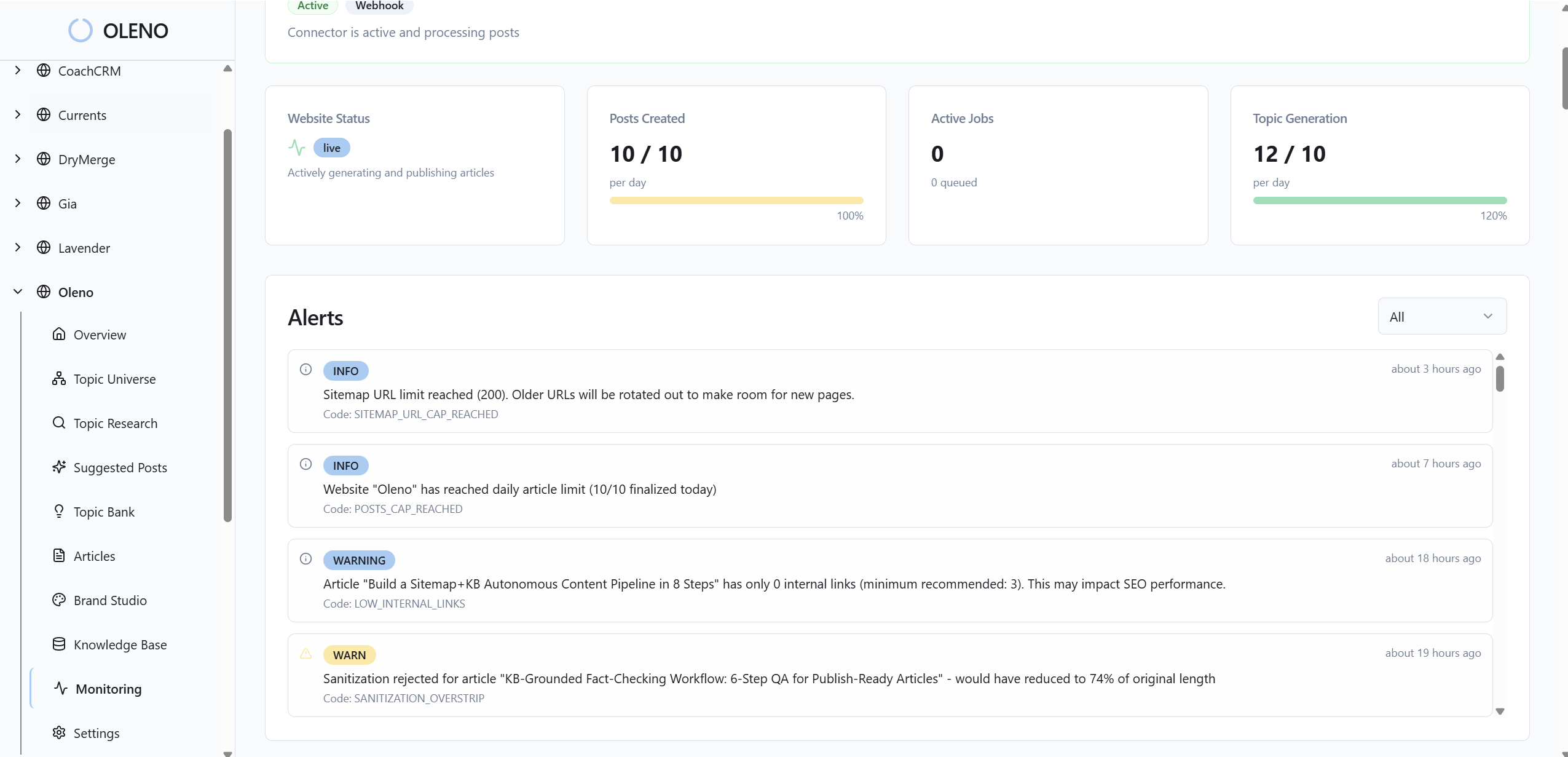
Remember the hours you were losing to overlap and rework? Oleno cuts that by preventing redundancy before drafting and by shipping consistently formatted, on-brand articles that strengthen clusters over time. Want to experience the pipe from topic to publish with no handoffs? Try Oleno for free.
Conclusion
If you treat content like a queue, you get repetition, mixed signals, and a calendar that never breathes. If you treat content like a system, you get clarity. Inventory first. Cluster with simple rules. Label saturation. Score information gain. Merge or prune overlap. Prioritize with cooldowns. Then publish on a cadence you can sustain.
I have lived both sides. The high-volume contributor network that grew because we covered breadth and depth without stepping on our own toes. The small SaaS team that shipped good content that did not map to demand. The difference was not effort. It was coverage discipline.
You can run this playbook manually today and see wins next month. Or you can let a system like Oleno do it every day, so you focus on the narrative and the offer while the pipeline protects your signal. Either way, the outcome is the same: fewer drafts, stronger clusters, and authority that compounds.
About Daniel Hebert
I'm the founder of Oleno, SalesMVP Lab, and yourLumira. Been working in B2B SaaS in both sales and marketing leadership for 13+ years. I specialize in building revenue engines from the ground up. Over the years, I've codified writing frameworks, which are now powering Oleno.
Frequently Asked Questions