Topic Discovery ROI Framework: Rank Ideas by Revenue Potential

Most teams chase traffic because it’s easy to measure and looks good on the dashboard. But here’s the rub: your highest-traffic posts can be the lowest contributors to pipeline. I’ve lived it. We outranked bigger brands for competitive terms and still watched demos stall because the topics never pulled buyers toward the product.
The shift isn’t mysterious. You move from volume-first to revenue-first by ranking topics based on their likelihood to influence opportunities. Not later. Now. That means you define revenue signals up front, score ideas against them, and let the score—not opinions—decide what gets published. The win isn’t a bigger content backlog. It’s a backlog that reliably feeds sales.
Key Takeaways:
- Rank topics by revenue signals (demos, trials, pricing views), not traffic
- Layer funnel proximity and deal influence on top of search data
- Penalize saturated SERPs you can’t differentiate against
- Build a simple scorecard from CRM and analytics pathing
- Operationalize rules so only high-ROI topics ship
- Use light, ongoing measurement to recalibrate—monthly works for most teams
If you want a faster start while you build the scorecard, there’s a simpler path. Try Using An Autonomous Content Engine For Always-On Publishing].
Why Traffic-First Topic Discovery Fails Revenue Teams
Traffic-first discovery fails revenue teams because volume doesn’t equal intent. You need to prioritize content that shows up near demos, trials, and pricing. When your posts appear within two to three touches of qualified opportunities, pipeline moves. If they don’t, you’re feeding curiosity, not revenue.

The Metrics That Actually Predict Pipeline
The metrics that predict pipeline are the user actions that precede sales conversations. Not vanity swings. When you anchor discovery in revenue signals—pricing views, demo starts, high-intent chat—your list shifts quickly. It surfaces topics that show up in journeys for closed-won accounts instead of those that entertain the masses and disappear.
Most dashboards blur this distinction. They elevate time on page, bounce rate, or top entrances. Those are fine for content health; they’re weak for revenue forecasting. Start with last-touch and assisted conversions from your CRM, then verify with sales notes. If an article never appears within two to three touches of a qualified opportunity, it’s not a priority. It can exist, sure, but it shouldn’t lead the line.
You’ll feel the difference in quality of inbound. SDRs stop complaining about unqualified leads. AE follow-up becomes specific. And your internal linking suddenly matters—because readers are actually moving from education to evaluation inside the same session.
What Happens When Content Is Detached From Your Product
When I led sales at a proposal software company, we ranked for monster keywords. We were proud of it. But too many posts sat miles away from the product. The audience learned something, then left. Sales couldn’t use the content in conversations. Attribution never moved in our direction. Frustrating rework followed.
The fix wasn’t more writing. It was discovery rules that biased topics connected to the core problem we solved—sending beautiful proposals and getting signatures reliably. Once we forced that alignment, the content didn’t just rank. It showed up in CRM journeys we cared about. It also stopped confusing our narrative. Every new post had a line of sight to a sales use case.
If you recognize this pattern, you’re not alone. Many teams drift because “what is” and “how to” content feels safe. It’s useful, but without proximity to the product story, it won’t move pipeline at the pace you need.
What Is A Revenue Signal And Why Should You Care
A revenue signal is a measurable action that correlates with movement toward a deal. Think trial starts, demo requests, pricing visits, repeat views of integration pages, or meaningful engagement with comparison content. You care because these signals separate casual readers from commercial intent.
Map these signals into tiers. Tier 1 is buying behavior (demos, trials, pricing). Tier 2 is evaluation (integration depth, comparison reads, ROI tools). Tier 3 is discovery (top-of-funnel research that still predicts next steps). Assign weights. Keep the list short so it’s measurable across every topic. If this feels close to a prioritization playbook, you’re right—ground it like you would any portfolio of bets, then enforce it. For context on how enterprise discovery gets framed, see the ServiceNow topic discovery documentation.
The Root Cause Blocking Revenue-Aligned Topics
The real blocker to revenue-aligned topics isn’t a lack of ideas; it’s how you rank them. Most teams over-index on search volume and forget to layer buying signals. Without CRM-assisted conversion data, you can’t see which queries actually precede deals. That’s why visibility helps your brand while leaving pipeline hungry.

Why Conventional Prioritization Misses Buying Intent
Conventional prioritization starts with volume, difficulty, and a competitive glance. Those inputs aren’t wrong. They’re just incomplete. They optimize for discoverability, not deal creation. If you don’t overlay funnel proximity—how frequently similar topics appear two to three touches before SQOs—you’ll elevate browsers over buyers.
The translation layer is where it breaks. Queries with the same head term can mask different intents. The same keyword can map to multiple jobs-to-be-done. You won’t catch that by staring at SERPs alone. Bring in CRM pathing, add a simple proximity score, and your backlog reshapes. You’ll retire pet topics faster and avoid the headache of “great post, no leads.”
Where Teams Lose The Plot Between Search Intent And Sales Intent
Here’s where smart teams stumble. They stop at “what is” and “how to” content that educates. That content is helpful, but it often fails to bridge into product use cases your sellers discuss daily. The result is polite applause from readers with no downstream action.
The move is to flag topics that naturally connect to a sales conversation. If a topic can’t be tied to a demo flow, trial setup, or integration path, park it or reshape it. Add a minimum bar: a topic needs at least two adjacent journeys—comparison, pricing, or integration pages—for a meaningful share of readers. That’s your path to intent, not just traffic. For measurement vocabulary that helps tighten the loop, review the ROI Institute basics.
The Hidden Costs Draining Your Content Budget
Hidden costs pile up when your backlog isn’t filtered for buying intent. Production hours, editing cycles, and design work compound on pieces that never touch pipeline. Over time, misaligned traffic pollutes analytics and nudges you toward more of the same. That’s not a publishing motion. That’s a treadmill.
Production Hours That Never Pay Back
Let’s pretend you ship 12 articles a month, six hours each across research, drafting, editing, and visuals. That’s 72 hours. If 70 percent of those posts never show near pipeline, you just burned 50 hours on content that doesn’t move deals. Even at conservative internal rates, that’s thousands per month you’ll never see again.
Now layer the hidden stuff. Manager approvals. Slack threads. Meetings to reframe the angle. The second pass on images because the first set didn’t match the narrative. By the time you’re done, a two-day piece turned into a week. Multiply that across a quarter and you’ll see why your team feels busy while pipeline stays flat.
If you’re nodding, you’re not broken. You’re just paying for coordination instead of outcomes.
The Compounding Cost Of Misaligned Traffic
Traffic that doesn’t convert does more than fail to convert. It muddies attribution, tempts you to chase shallow volume, and dilutes your site’s internal linking value. Support ends up fielding irrelevant questions. Sales gets inbound that looks active but isn’t qualified. Your content becomes a library without a front desk.
Over time, site architecture bends toward what attracts big numbers, not what your best buyers need to make decisions. That erodes narrative cohesion—the connective tissue sales relies on to close. It’s fixable. But the longer you let it run, the more your analytics lie to you about “what works.”
What Is The Opportunity Cost Of One Wrong Topic
One wrong topic displaces a right one. Let’s say a high-intent piece could have driven two demos a week for a quarter. That’s roughly 24 demo opportunities lost. At a modest 15 percent close rate and five-figure ACV, that’s visible revenue leakage.
If you want a way to quantify it, use a basic chain: expected demos per week x close rate x average deal size. It’s not perfect, but it’s honest. For a stepwise approach to ROI math, the CalHR training ROI overview offers a simple framing you can adapt to content decisions.
Still spending this kind of time on low-intent content? You don’t need to. If you want to see a system do the heavy lifting, you can Generate 3 Free Test Articles and compare the effort.
Operationalize The Framework In Your Editorial Workflow
Operationalizing the framework means turning your scoring into rules that run every day. Route high-scoring ideas forward, pause weak ones automatically, and keep a measurement loop that ties content back to pipeline. Monthly recalibration is enough for most teams.
Set Routing Rules To Auto-Promote Or Pause Ideas
Routing rules are how you stop debating every idea. Translate your scoring into thresholds—publish only topics with a composite score above X, require a clear differentiation note for saturated spaces, auto-promote ideas with Tier 1 signals even if search volume is modest. The goal isn’t to be harsh. It’s to be consistent.
Make the rules visible at intake. If you accept submissions from product, success, or sales, show them what earns a greenlight. You’ll get better pitches. More importantly, you’ll reduce the back-and-forth that slows teams down. Interjection. You’ll also discover where messaging gaps exist because submissions will cluster around what your field teams hear most.
Keep a “parking lot” for promising ideas that don’t yet meet the bar. Revisit them after your next recalibration. With a clean scoring model, some will rise as your product motion or seasonality shifts.
Establish A Measurement Loop That Maps Content To Pipeline
After publish, measure the same revenue signals you used to prioritize. Use CRM journeys to see where each article appears pre-opportunity, then update its score. If a post consistently shows assisted influence near SQO, boost its weight for related topics. If it fails to show up near conversion paths, downgrade and refresh the angle or internal link patterns.
Keep the loop light. Monthly is usually enough to catch direction and avoid thrash. Reweight intent tiers quarterly. When your pricing model or ICP changes, recalibrate the funnel proximity logic. For practical ideas on lightweight attribution without building a data team, I like the spirit of Atlassian’s prioritization framework—clear rules and simple scorecards beat elaborate models that no one can maintain.
The Revenue-First Topic Ranking Framework
A revenue-first ranking framework scores ideas by intent, funnel proximity, and deal influence, then divides by cost and saturation. It’s simple enough to maintain, strong enough to guide real trade-offs. The point is not perfection. It’s a repeatable way to publish more of what moves pipeline.
Define Revenue Signals To Track
Start with the actions most predictive of opportunities. Tier 1: demo requests, trial starts, pricing views. Tier 2: deep engagement with comparison or integration pages, ROI calculator completions. Tier 3: repeat visits within seven days, second-page paths into product education. These become your scoring backbone.
Keep the list short. If you track everything, you’ll prioritize nothing. For each signal, decide what counts as meaningful (e.g., time thresholds, scroll depth, adjacent page groups). Then map typical journeys. If a signal consistently appears two to three touches before an opportunity, it’s Tier 1 or Tier 2 by definition. That’s your gravity.
Resist the urge to argue edge cases. You can fold exceptions into the next monthly recalibration.
Build A Topic Scorecard From CRM And Analytics
Give each topic a row. Add columns for historical conversion rate (if any), assisted presence in past journeys, average deal size by landing segment, and internal search or sales-request signals. Pull CRM stages to snapshot attribution. Use analytics pathing to confirm whether similar topics lead to high-intent pages.
If you lack history, bootstrap with proxies. Product usage adjacency. Support ticket frequency. Sales win notes. Start small, then replace proxies with observed data over time. The scorecard’s job isn’t to be clever. It’s to make trade-offs visible so the team publishes with conviction. For measurement vocabulary to formalize this, see ROI Institute’s basics.
Fold in the composite score logic here: Topic ROI = (Intent Weight x Funnel Proximity x Deal Influence) / (Production Cost x Competitive Saturation). It doesn’t need decimals. It needs consistency.
Use A Prioritization Matrix To Surface Quick Wins And Bets
Plot topics on a 2x2 by Expected Revenue Impact and Effort. Quick wins live in high-impact, low-effort. Strategic bets sit in high-impact, high-effort. Fillers are low-impact, low-effort—use sparingly to maintain cadence. Avoid high-effort, low-impact work unless there’s a narrative reason to ship.
Set gates. Anything below a minimum composite score waits for a rewrite, better angle, or a stronger differentiation plan before entering production. Your future self (and your sales team) will thank you. For a clear template on how to run these trade-offs without debates, the Atlassian prioritization approach is a solid starting point.
How Oleno Embeds Your ROI Rules Into Daily Publishing
Oleno lets you encode your ROI framework into the content system itself. You define the revenue signals and thresholds; Oleno uses them to prefer aligned topics, enforce differentiation, and publish on cadence. The outcome is fewer wasted hours and more articles that show up in real buying journeys.
Configure Discovery To Prefer Revenue-Aligned Topics
Oleno analyzes your sitemap and knowledge base to decide what content should exist, then applies your rules during topic discovery. You can bias discovery toward product use cases and knowledge base strengths, and block weak or duplicative ideas before writing. This is where wasted production time disappears—bad fits never enter the pipeline.
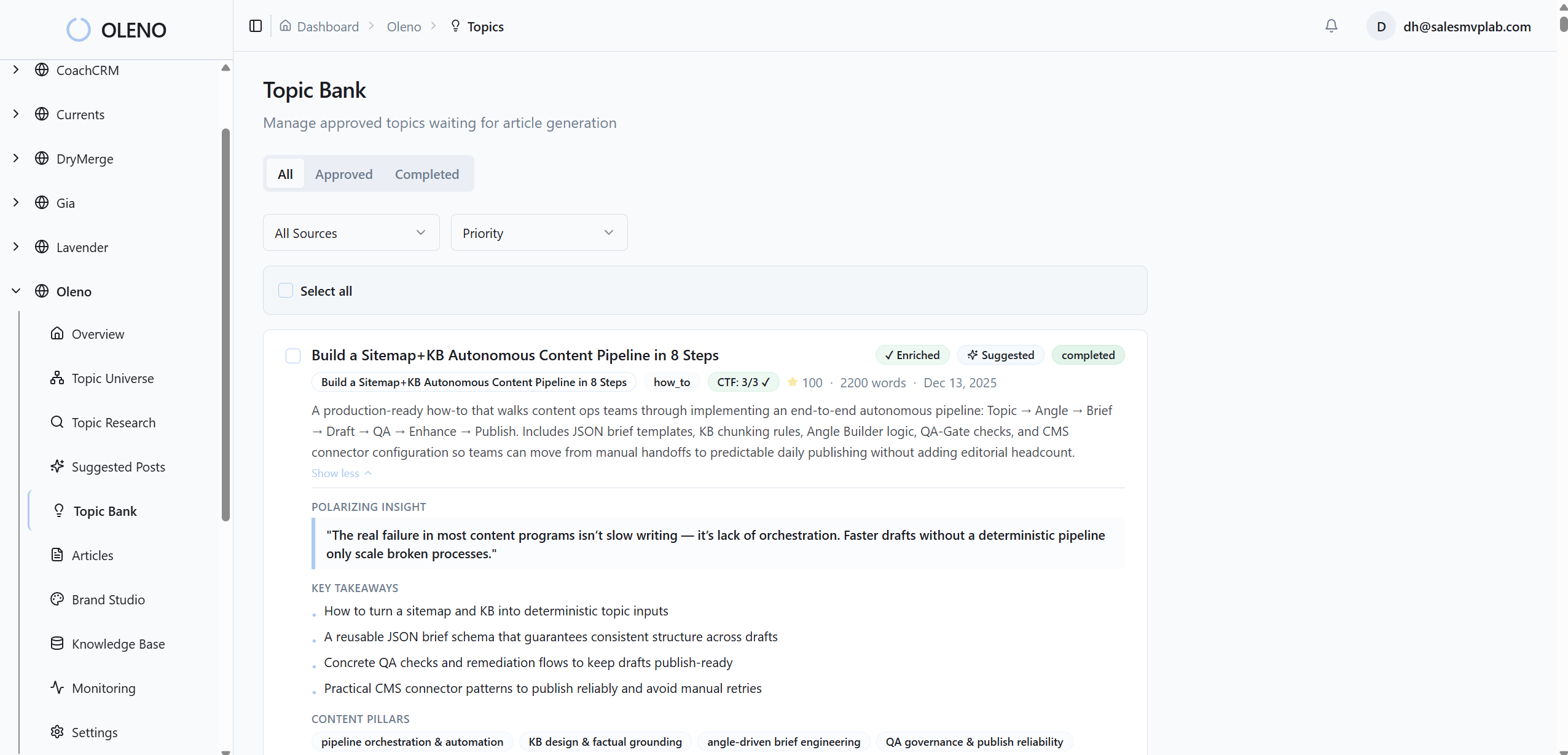
Because discovery runs daily, your backlog stays fresh without hand-tuning keyword lists or calendars. Oleno selects topics that can be written safely using your knowledge base. You still own strategy. The system executes it.
Enforce Differentiation So Low-Value Content Never Ships
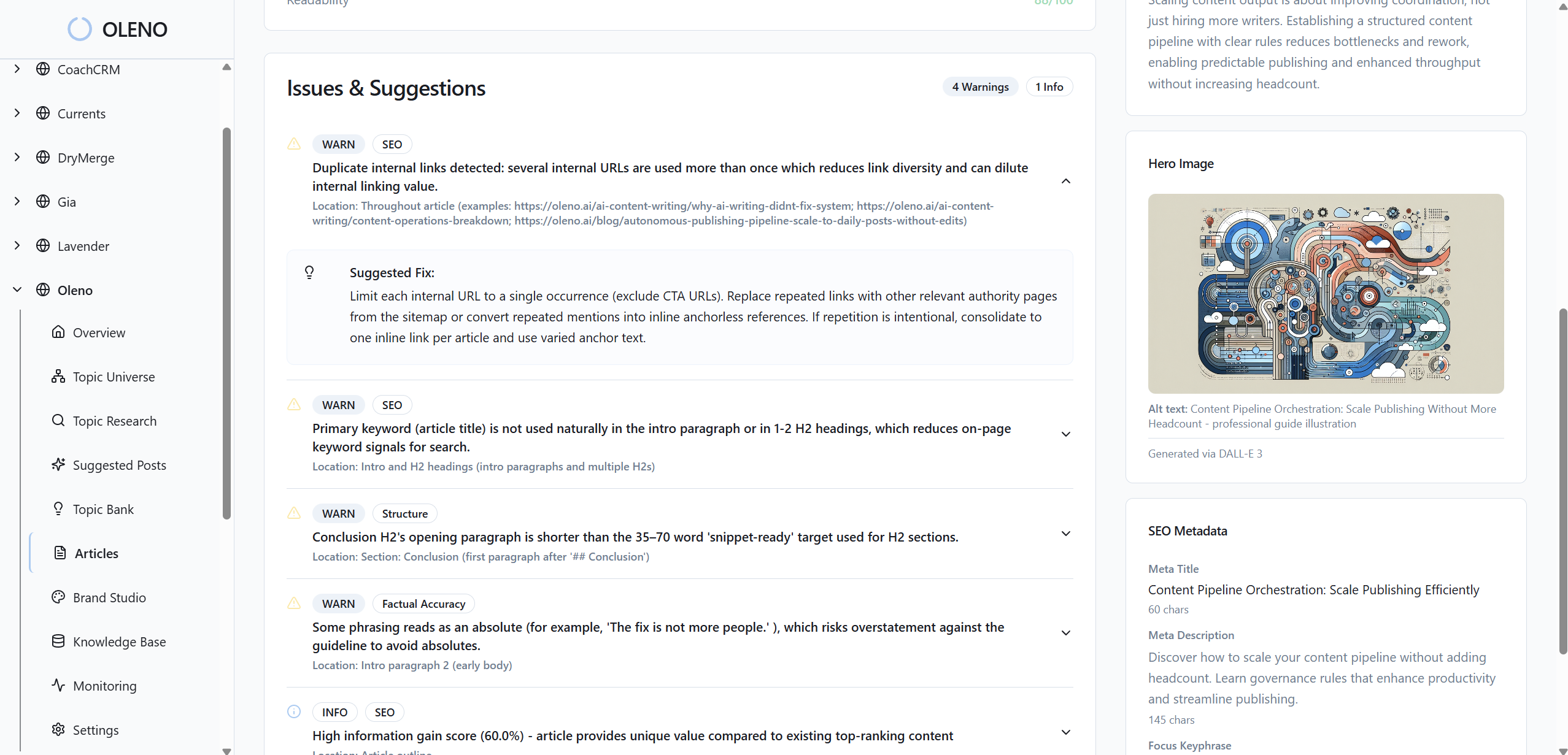
Angles are defined up front, and information gain is checked before drafting. If a topic can’t be differentiated, Oleno stops it early. That protects your narrative and reduces frustrating rework. From there, Oleno writes the draft in your voice, runs automated quality gates for structure, clarity, and knowledge base grounding, generates on-brand visuals, and publishes to your CMS on a reliable cadence.
This isn’t about hype. It’s about removing coordination costs so your team spends time on message and measurement. Oleno’s Topic Discovery, Angle and Brief Generation, QA Gate, Visual Generation, and CMS Publishing work as a deterministic pipeline. The payoff ties directly back to the costs we tallied: fewer misaligned hours, less analytics noise, and a backlog that reliably influences pipeline.
If you’d rather see the system than hear about it, let Oleno carry your rules. Try Oleno For Free] and judge it against your current process.
Conclusion
You don’t need more ideas. You need a simple, enforceable way to rank ideas by their likelihood to drive revenue—then a system that publishes those ideas without constant coordination. Define the signals, build a lightweight scorecard, and set rules that promote or pause. That’s the framework.
Whether you operationalize it manually or through Oleno, the outcome is the same directionally: fewer dead-end posts, clearer buyer paths, and content your sales team actually uses. Not perfect. Just repeatable—and finally pointed at pipeline.
About Daniel Hebert
I'm the founder of Oleno, SalesMVP Lab, and yourLumira. Been working in B2B SaaS in both sales and marketing leadership for 13+ years. I specialize in building revenue engines from the ground up. Over the years, I've codified writing frameworks, which are now powering Oleno.
Frequently Asked Questions