Topic Universe Playbook: How to Plan Coverage to Scale Content Marketing Without Redundancy

Most content calendars look busy. They don’t build authority. I learned that the hard way. Years ago, including the rise of dual-discovery surfaces:, we scaled a contributor network to tens of thousands of pages. Traffic spiked, sure. But when coverage wasn’t mapped to territory, we stepped on our own toes. Different writers, same intent, new headline. Classic cannibalization.
Fast-forward to small SaaS teams I’ve led. The calendar was full, everyone was working, and we still had gaps. Meanwhile, we rewrote existing ideas because no one could see the inventory clearly. When your system can’t tell you what to write next, you’ll keep guessing. And guesses create redundancy, not trust.
Key Takeaways:
- Treat content like a mapped system, not a list of ideas
- Use clusters, roles, and cooldowns to prevent duplicate intent
- Enforce net-new information in every brief to avoid shallow rewrites
- Score saturation by coverage and recency, not rank tools
- Govern publishing with simple rules: who owns what, and when updates win over net-new
- Build snippet-ready sections so answers are retrievable by search and AI
- Automate the guardrails where possible to remove decision fatigue
Why Most Calendars Cannibalize Authority
Most marketing calendars cannibalize authority because they plan tasks, not territory. Without a topic map and clear ownership, different writers hit the same intent with new angles, creating internal competition. The fix is structural: map clusters, label saturation, and decide what should publish next based on coverage, not vibes.
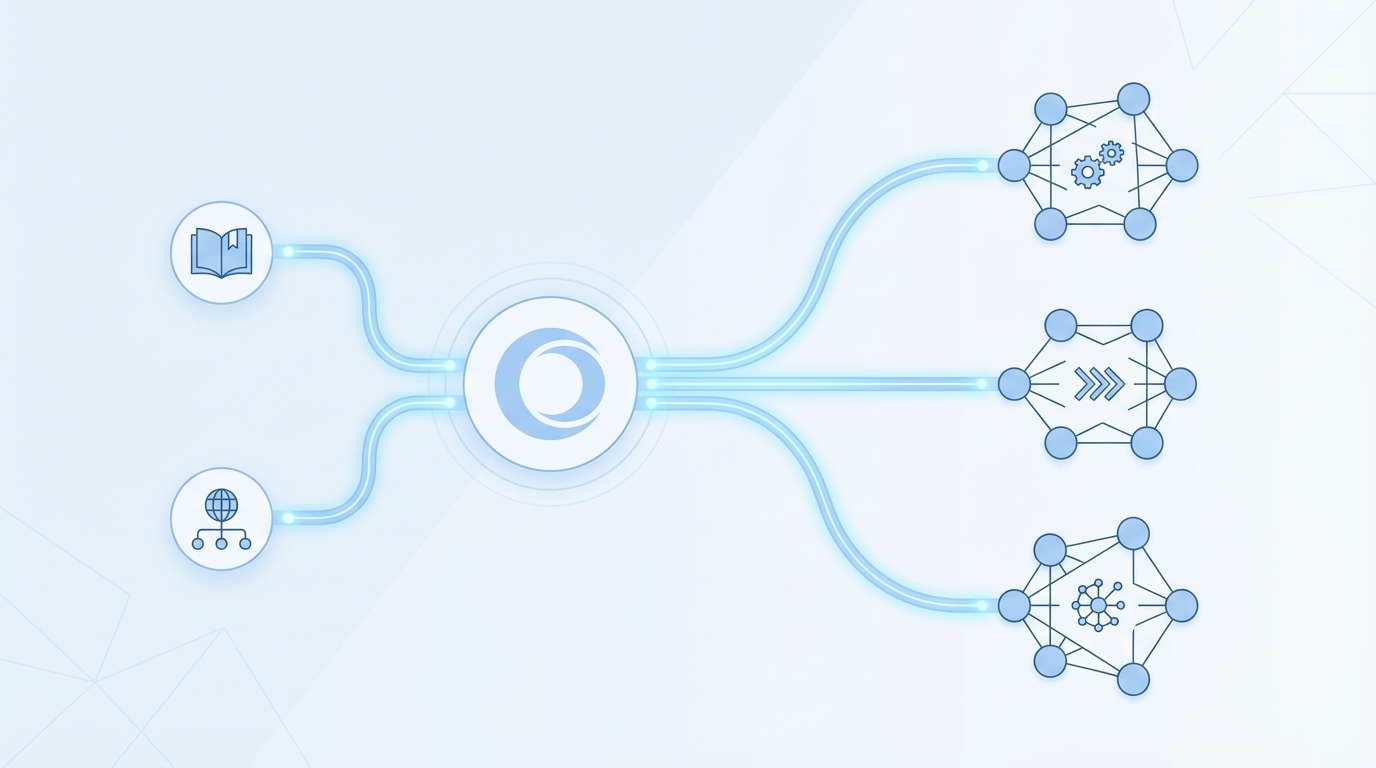
The Trap Of Topics Without Territory
When calendars are built from ideas, not inventory, including the shift toward orchestration, good people make reasonable choices that collectively erode authority. It’s not obvious in week one. It’s painfully obvious by quarter two—two “different” posts fighting the same query, one new, one last year’s “update” that wasn’t. The algorithm reads indecision. So do customers.
Define territory before tasks. Spell out clusters, allowed intents per cluster, and who owns the canonical. If a writer can’t answer “Which page owns this intent?” within a minute, you don’t have a system—you have a wishlist. Even mature teams slip here. A clean map prevents it. A calendar doesn’t. For a deeper framing on building reliable playbooks, I like how Content Marketing Institute’s guide to building a playbook lays out process over guesswork.
Duplicate Intent Looks Different But Acts The Same
Two phrases, one intent, same collision. “Best onboarding frameworks” and “onboarding playbook” can both be awareness. If you don’t enforce a cluster taxonomy that clarifies which page owns the query, you’ll split signals and drain momentum. Search engines won’t decide for you. They’ll shrug and rank neither well.
Here’s the simple test: could a reader satisfy the same job-to-be-done with either post? If yes, you’re duplicating intent. The antidote is ruthless role clarity per cluster—Comparison pages compare, Explainers explain, FAQs answer, and only one canonical page owns each query family. We learned this the hard way; now it’s a non-negotiable rule. Short rule. Big payoff.
The Real Root Cause Of Redundant Content
Redundancy isn’t a writing problem. It’s a governance problem. Audits tell you what happened. Governance decides what’s allowed next—ownership, naming, canonical behavior, and update rules. When those rules are vague or invisible, duplication becomes inevitable, especially across teams and quarters.

Inventory Is Not Strategy, Governance Is
A content audit is history, not navigation. You still need rules that assign ownership, including why ai writing didn't fix, decide how updates beat net-new, and prevent copycat angles inside a cluster. Without that, your “coverage plan” turns into a shuffle of similar posts that all feel slightly new and collectively slow growth. It’s death by polite duplication.
Governance lives in boring decisions—slug patterns, canonical owners, internal link spines, and cooldown windows. Each choice removes a whole category of mistakes later. If you want a reference that treats process as a competitive edge, CXL’s marketing playbooks overview is a solid complement to what I’m describing here.
Why Keyword Tools Miss How LLMs Retrieve Answers
Keyword tools score phrases. LLMs retrieve chunks. If your H2s don’t map to distinct, answerable questions, you blur in both worlds. You’ll end up with sections that look fine to humans but aren’t clean enough to cite or retrieve. Structure matters more than most teams admit.
Open each section with a direct answer, add context, then ground it with a brief example. Keep JSON-LD clean. Make sections stand alone. That’s how you increase eligibility for featured snippets and AI citations without obsessing over rank charts. If you want a parallel from media consumption, Think with Google’s Primetime Personal playbook shows how clear structure helps audiences (and machines) find the right moment, fast.
The Hidden Cost Of Redundancy Across Teams
Redundancy taxes time, trust, and trajectory. It burns hours on rework, splits signals across duplicate pages, and nudges teams toward topics detached from product outcomes. The bill doesn’t arrive as a line item. It shows up as slowed shipping, muddled clusters, and stale pipelines.
Time Lost To Rework And Internal Debates
Let’s pretend you have three writers. Each ships one overlapping article a month that later gets merged. Eight hours per piece at one hundred dollars per hour is 2,400 dollars monthly spent on content you didn’t need. Add two hours of debate and consolidation per piece, and you’re closer to 3,000. Monthly. For nothing new.
It’s not just money. It’s energy. Writers feel their work got sidelined. Editors become referees. Velocity dips, then morale dips. I’ve sat in those meetings. No one wins. The fix isn’t “try harder.” The fix is rules that preempt the overlap. If you’re wondering what a governed system feels like, you can get a taste without committing your roadmap: spin up a few drafts, look at the structure, then decide. If you’re curious, Try Generating 3 Free Test Articles Now.
The Compounding SEO Tax Of Cannibalization
Publish two pages for one intent and you split everything—links, clicks, internal references, attention. Each page looks like a weak candidate. Over time, the whole cluster underperforms. You can consolidate, but you’ll lose history, reset learnings, and spend cycles patching redirects and refactoring internal links. It’s cleanup, not compounding.
You don’t need a dozen tools to see this. You’ll feel it in performance lag and constant “which page is canonical?” debates. The answer is to prevent the collision with cluster roles, cooldowns, and additive briefs. If you need a pragmatic framing for building the muscle, the structure in HubSpot’s Ultimate Content Marketing Playbook aligns with the governance mindset I’m recommending.
The Friction You Feel When Coverage Has No Guardrails
Lack of guardrails shows up as decision fatigue. Endless Slacks about “Do we have this already?” and rushed drafts that re-say old things with new words. When leadership asks for a contrarian take, you ship a reworded explainer. Not because you’re lazy—because the system didn’t protect differentiation.
The 3 Pm Slack Ping That Derails Your Week
You know the one. “Do we already cover X, or should we spin a new post?” Without a map, the safe move is always “write again.” That’s how noise happens—overlaps, half-finished updates, and a queue that looks active but isn’t additive. I’ve lost weeks to that ping. You probably have too.
Guardrails remove decisions. If the last publish date inside a cluster is under ninety days, it routes to an update, not net-new. If the brief can’t pass a “net-new information” check, it doesn’t move forward. Simple rules scale surprisingly well. The result isn’t just fewer pings. It’s a calmer, cleaner pipeline. And yes, less rework.
When Leadership Asks For A New POV And You Ship The Same One
You’re asked for a contrarian take. You deliver a reworded explainer. Why? Because no one owns the cluster’s differentiation. The brief didn’t force net-new. The taxonomy didn’t force a unique job-to-be-done. So you shipped something that sounded smart and added… nothing.
Make this your rule: every new piece must add net-new information against the cluster. If it can’t, it updates a canonical page or doesn’t ship. One constraint. Massive impact. In my experience, that single policy cuts shallow spin-offs more than any “be more original” pep talk ever will.
Operate A Topic Universe That Scales Without Repeats
A Topic Universe is a map of everything you should cover, including why content now requires autonomous, organized into clusters with roles, owners, and cooldowns. It shows where you’re thin, where you’re strong, and what should be written next. You plan by coverage and recency, not gut feel. Authority starts to compound.
Build The Topic Universe From KB, Sitemap, And Focus Areas
Start with three inputs: your knowledge base, your live sitemap, and three to five content focus areas tied to revenue. Extract topics, then group them into clusters that match your pillars. Label the cluster by intent and stage—Awareness Explainer, Comparison, Implementation, FAQ—then assign owners. Keep it boring. Boring wins.
Your first win is visibility. You’ll immediately see where you’re underserved, healthy, or saturated. From there, backlog work becomes obvious: fill gaps in thin clusters, enforce cooldowns in heavy ones, and route anything within ninety days to updates, not net-new. This is where calendars stop guessing and start following the map.
Template: Cluster Modeling And Taxonomy, Pillar To Spoke Rules
Model one pillar per core topic. Define allowed child types and intents up front. Give each child a unique job so no two pages fight the same query. Decide your internal link spine—pillar to spokes, spokes to pillar, and siblings linked only when jobs are complementary. Structure teaches humans and machines what to trust.
Then codify your fields so briefs inherit the rules:
- Cluster name and owner
- Allowed intents and roles per child type
- Canonical page and slug patterns
- Target CTA and conversion path
- Internal link spine (pillar ↔ spokes)
Interjection. Don’t overthink the taxonomy. Clarity beats cleverness.
Template: 90 Day Cooldown Enforcement Workflow
Create one rule that solves a dozen problems: no new content on the same topic intent within ninety days unless it’s an update to the canonical page. Workflow is simple. Check the universe. If last publish date is less than ninety days, route to update. Log exceptions. Done.
Cooldown prevents noise, reduces cannibalization, and forces additive information in the next cycle. It also saves your editors from playing referee. If you’d rather test this approach than debate it, you can pressure test a governed pipeline quickly: Try Using An Autonomous Content Engine For Always-On Publishing. Two or three outputs will tell you if the rules make sense for your stack.
How Oleno Runs Topic Universe Governance End To End
Oleno is built to run this governance automatically. It discovers topics from your KB and sitemap, including ai content writing, organizes clusters, labels saturation, enforces cooldowns, and scores briefs for differentiation before a single paragraph is drafted. Publishing ships with visuals, internal links, and schema already in place.
Coverage And Cooldown Detection Built In
Oleno’s Topic Universe determines what to write next by mapping your topic landscape and labeling each cluster: underserved, healthy, well-covered, or saturated. It tracks recency and enforces a ninety-day cooldown so the pipeline emphasizes updates when it should and net-new only when it adds depth. Fewer accidental duplicates. Cleaner queues.
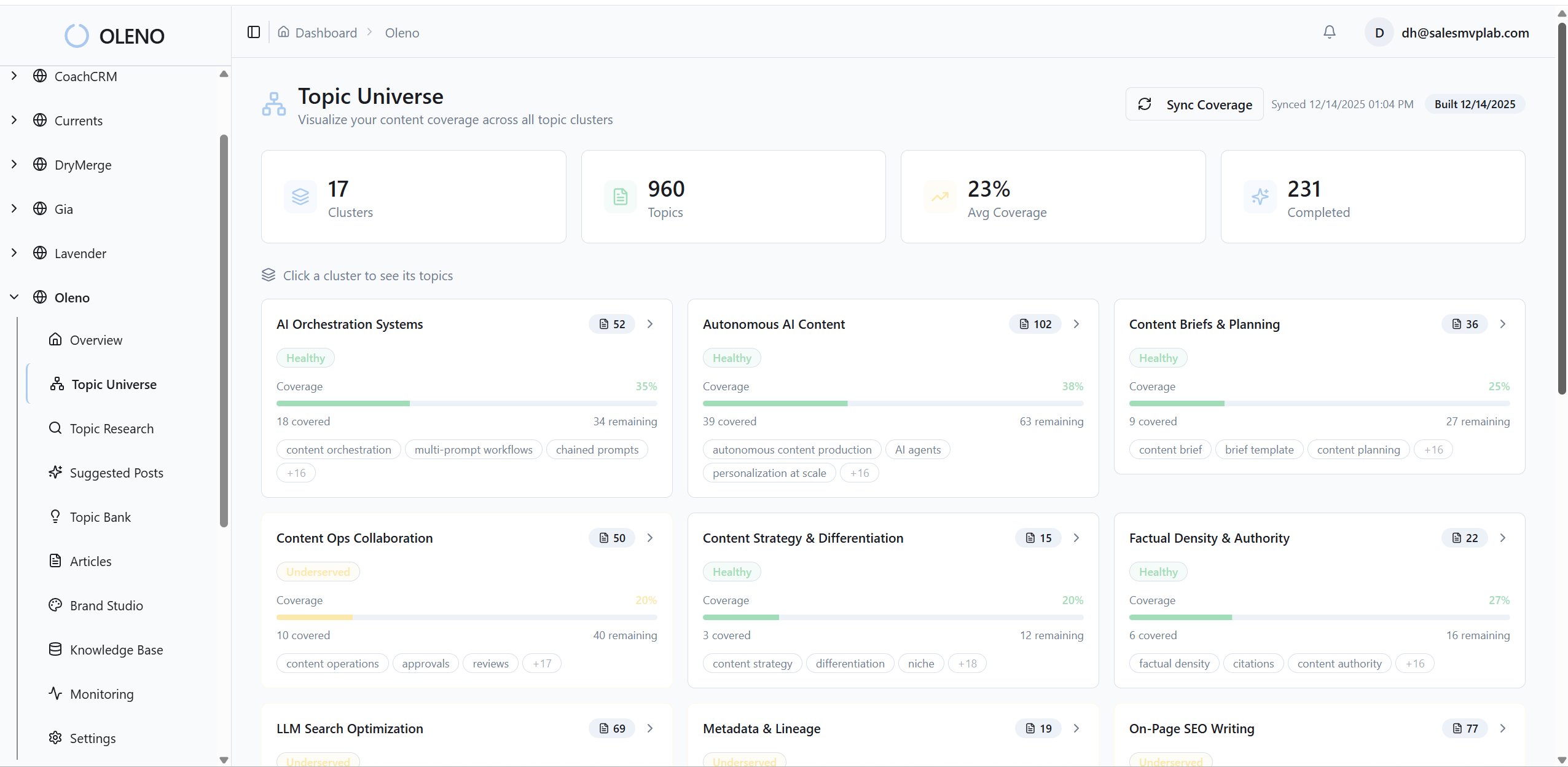
In practice, this means overlap gets flagged early. Writers don’t wonder if a topic is “safe”—the system shows the state and suggests the next best move. That’s how you avoid those 3 pm Slack pings and recover hours otherwise lost to debates. Outputs start to feel intentional again.
Information Gain Scoring Keeps Every Brief Additive
Before writing begins, Oleno analyzes top-ranking content, surfaces common coverage, and identifies missing perspectives. Each brief receives an Information Gain Score. Low scores trigger a rework before drafting—protecting your clusters from shallow rewrites that sound new but add nothing. High-gain content gets rewarded in QA, not just approved.
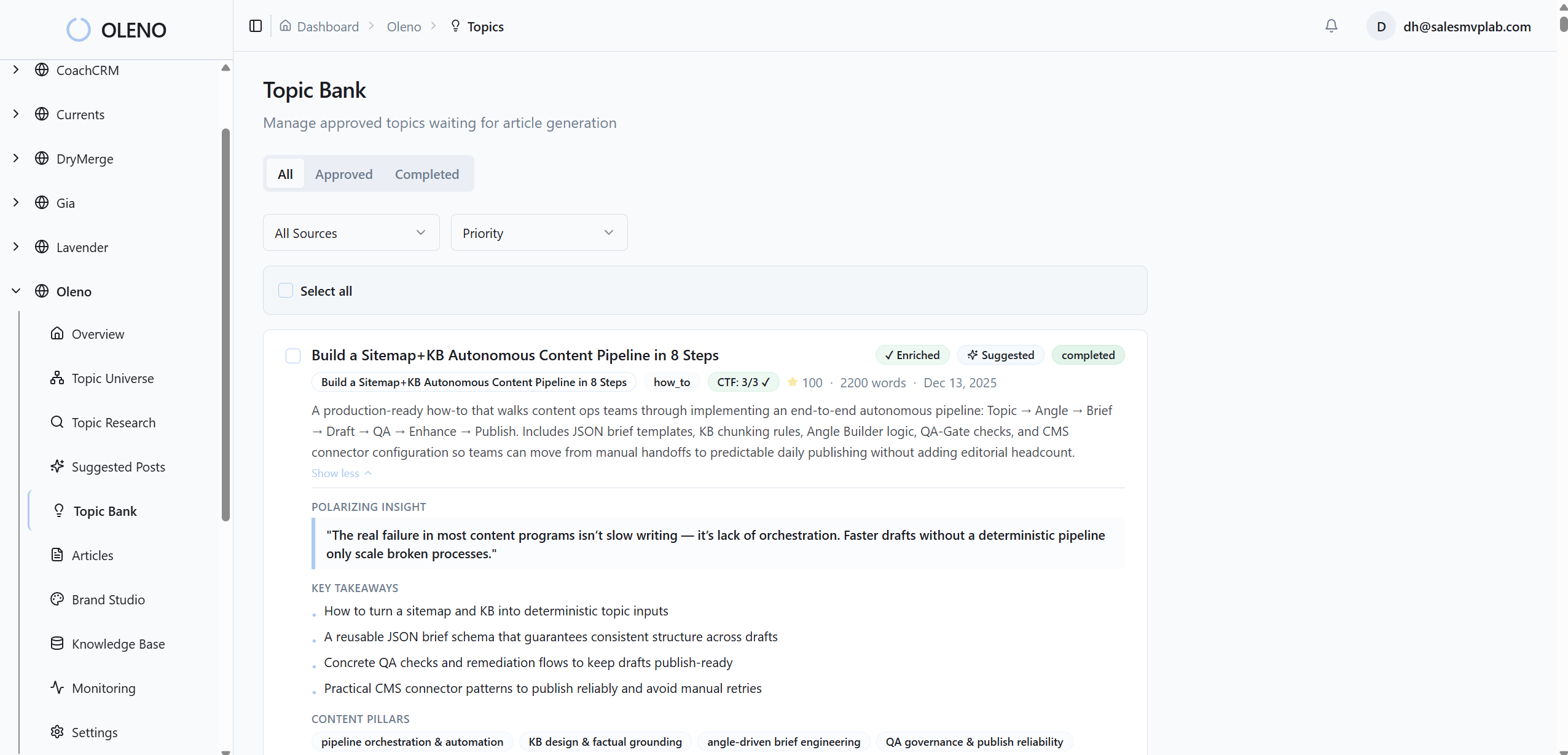
This is where duplication quietly disappears. The brief itself enforces net-new logic, so writers don’t have to guess. Over time, clusters gain depth, not just volume. If you’ve ever shipped an article and immediately felt “we already said this,” this is the safeguard you’ve been missing.
Publish-Ready Delivery With Visuals And Connectors
When a draft passes QA, Oleno finishes the job. Visual Studio generates brand-consistent hero and inline images using your color palette, marks, and style references. Product screenshots are matched to relevant sections and prioritized in solution areas. Alt text and SEO-friendly filenames are generated automatically. No scramble for stock images. No off-brand visuals.
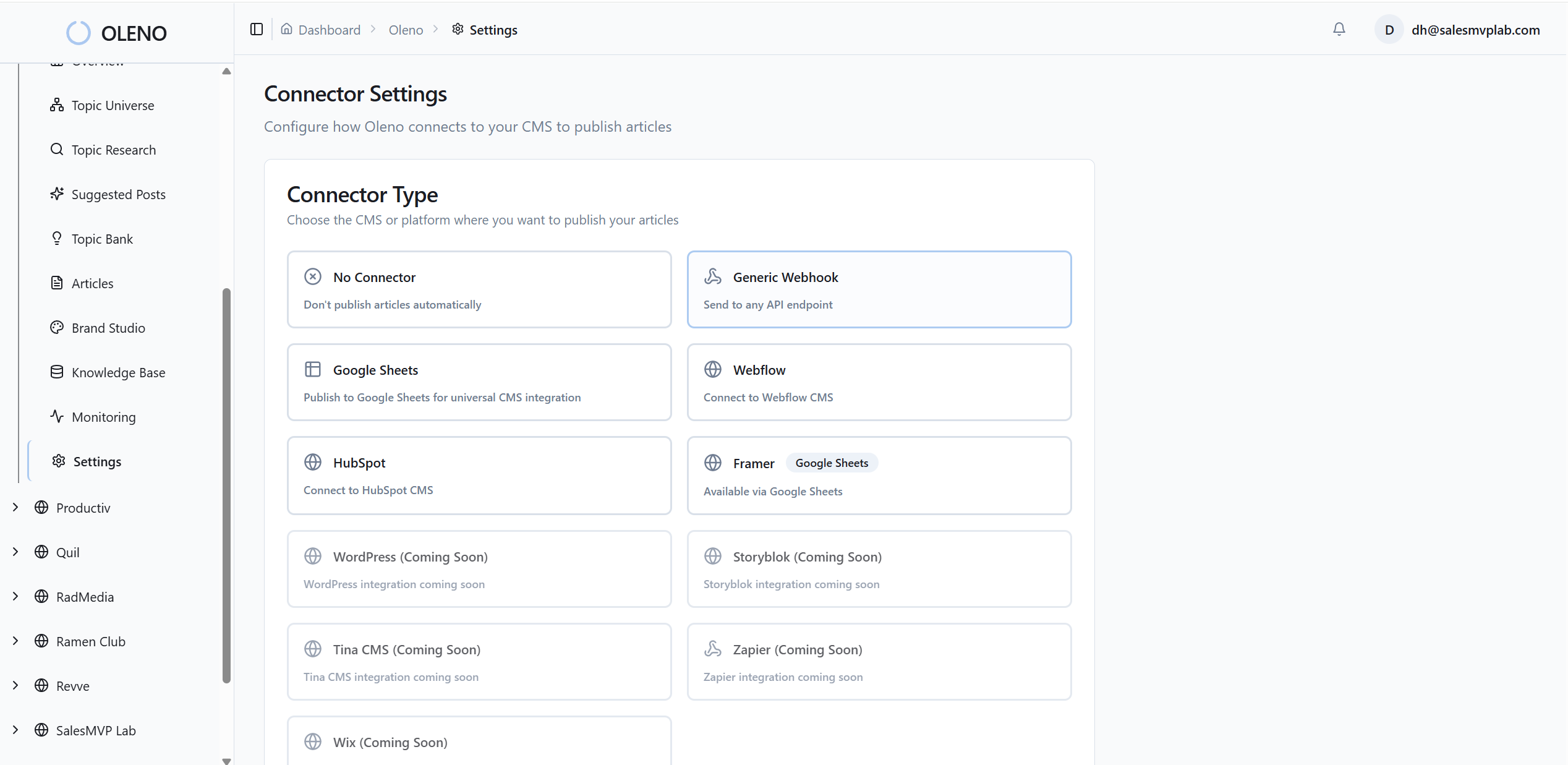
Publishing is deterministic: internal links are injected from verified sitemaps with exact-match anchor text, and JSON-LD (Article, FAQ, BreadcrumbList) is attached programmatically. Finally, connectors deliver the article to WordPress, Webflow, or HubSpot with mapped fields and duplicate prevention. The result isn’t a draft to clean up. It’s a publish-ready asset that reflects your brand. Want to see how this feels in your stack? Try Oleno For Free.
Conclusion
You don’t fix redundancy with more willpower. You fix it with a Topic Universe that turns territory into rules—clusters, roles, cooldowns, and additive briefs. When structure drives decisions, you stop duplicating intent, ship fewer but stronger pages, and build authority that compounds. That’s the shift: from a busy calendar to a disciplined system that earns trust, article after article.
About Daniel Hebert
I'm the founder of Oleno, SalesMVP Lab, and yourLumira. Been working in B2B SaaS in both sales and marketing leadership for 13+ years. I specialize in building revenue engines from the ground up. Over the years, I've codified writing frameworks, which are now powering Oleno.
Frequently Asked Questions