Topic Universe Playbook: Prioritize SEO Coverage Without Rank-Tracking

I’ve watched great teams burn cycles on "content strategy" that’s really just a keyword spreadsheet dressed up as a plan. A lot of motion. Not a lot of momentum. When you measure positions, you end up editing what’s already half-decent and miss entire clusters with zero coverage. That’s how you get near-miss rankings across five URLs and no durable authority.
Here’s the shift that actually compounds: treat coverage as the constraint. Map your topic universe, score saturation, enforce cooldowns, and don’t put anything in the queue that won’t expand the map or strengthen a canonical target. You’ll publish less duplication, have fewer messy rewrites, and build trust faster. Not because you wrote more. Because each piece added something new.
Key Takeaways:
- Treat coverage as the operating constraint, not keywords as ideas
- Map a topic universe with clusters, saturation labels, and cooldown rules
- Score information gain before writing to prevent duplication
- Route all work to canonical topic IDs to avoid cannibalization
- Shift prioritization from rank charts to coverage gaps and business value
- Use a rankless pipeline to direct scarce effort where authority grows fastest
Ready to skip the theory and see it run end to end? Try Oleno For Free.
Keywords Are Not Ideas, Coverage Is The Constraint
Most teams treat keywords like ideas; they’re not. Coverage is the constraint that keeps your roadmap honest and additive. When you prioritize topic saturation and cooldowns over positions, you stop recreating the SERP and start compounding authority by cluster. Think inventory management, not inspiration.
The Hidden Cost Of Uncoordinated Coverage
When teams chase individual keywords, they tend to write the same angle over and over with small variations. You get five mid-depth pages that split authority rather than one strong pillar and a few sharp satellites. No one page earns a snippet, and editors spend time stitching together internal links after the fact.
I’ve made this mistake. Back when we scaled a contributor network to thousands of posts, breadth came easy. Depth didn’t. The fix wasn’t “write harder.” It was treating ideas like SKUs. If a proposed piece didn’t expand coverage, it didn’t ship. It feels strict at first. Then your backlog gets clearer and your wins consolidate.
What Is A Topic Universe And Why Does It Matter?
A topic universe is a single, living map of what you intend to own: clusters, canonical topic IDs, current coverage state, and recency. It answers one question reliably. What should we write next to build authority without duplicating ourselves. In practice, it looks like a table with fields you trust.
Think of it as stock levels for ideas. Underserved clusters get inventory. Saturated ones go on a cooldown. Healthy areas get intentional re-coverage, not random refreshes. Want a practical primer on structuring pages for clarity while you’re at it? Skim Google’s SEO Starter Guide. It pairs nicely with a coverage-first model.
Authority Grows When You Control Coverage, Not Positions
Authority grows when you direct effort to coverage gaps and consolidate on canonical targets. Rank charts are a lagging mirror; coverage rules are steering. Label clusters, enforce cooldowns, and gate briefs by information gain, and you’ll reduce duplication while nudging every new piece toward compounding outcomes.

What Traditional Approaches Miss
Traditional approaches worship outputs, rank and traffic, without governing inputs. The result is predictable: too many pages chasing the same intent, plus a backlog of “quick wins” edits that keep you near page one without ever owning the topic. It’s not lazy work. It’s misdirected.
A coverage-first model flips the lens. Audit what you’ve actually published, map it to clusters, and set guardrails: saturation thresholds, recency gates, re-coverage triggers tied to business value. You’re not anti-optimization. You’re anti-duplication. If it doesn’t increase information gain or strengthen a canonical page, it waits.
How Cluster Maps Prevent Cannibalization
Cluster maps reduce cannibalization by enforcing a canonical topic ID per pillar and routing new ideas accordingly. The pillar becomes the home for broad intent; satellites cover distinct, non-overlapping sub-intents. Internal links point up to the pillar and across to siblings where helpful, not everywhere “just because.”
In practice, that looks like rejecting low-gain angles that restate 70% of your pillar. Or merging them before they get written. You preserve depth where it belongs and clarity for machines and humans. If you want another perspective on structuring content for assistants and snippets, this Answer Engine Optimization primer is a useful complement.
The Waste You Can Eliminate In Eight Weeks
Eight weeks is enough to cut duplication materially. Start with a coverage score per topic, set a cooldown window, and add an information gain gate to briefs. You’ll reduce rework, shrink QA time spent untangling conflicts, and consolidate link equity on canonical targets where it can actually win.
Let’s Pretend Your Team Ships 20 Posts Per Month
Let’s pretend you ship 20 posts monthly. Seven expand coverage. Thirteen repeat what you already said with new headlines. That’s 65% duplication. At a conservative 6 hours per post, that’s 78 hours of frustrating rework, hours you could have spent on three genuinely new pillars and two product-led walkthroughs.
The real tax isn’t just time. It’s narrative drift. Duplicates produce conflicting advice, create contradictory internal links, and force last-minute rewrites to stitch stories back together. A simple coverage score and a “reject if saturation > 1.0” rule clears a surprising amount of this noise quickly.
The Downstream Impact On Velocity And QA
Duplicates slow velocity in invisible ways. Reviewers get stuck negotiating which paragraph lives where. Link fixes pile up. Schema gets patched to match a different canonical target. You feel fast writing the draft. You pay for it during edits, publishing, and one week later when a teammate ships a similar piece.
Introduce two upstream gates: information gain at the brief stage and saturation at the topic stage. QA time shifts from triaging structural mistakes to clarity and accuracy. It’s the difference between policing the factory and improving the product. And yes, it helps with snippet readability too.
How Much Authority Leakage Comes From Over-Publishing?
When five URLs compete for the same intent, internal links get noisy and external links scatter. No single page earns enough signals to win the snippet. You get near-misses everywhere. I’ve seen this at companies with strong writers and great design. The problem wasn’t talent; it was a lack of coverage control.
Authority compounds when you direct attention and links to the canonical target and let satellites do discrete jobs. Coverage rules create that pressure. If you want a refresher on fundamentals that support this model, bookmark Google’s SEO Starter Guide. It’s a solid sanity check for structure and meaning.
Still dealing with this manually across spreadsheets and Slack threads? Start a controlled test. Try Generating 3 Free Test Articles Now.
When Publishing More Starts Delivering Less
Publishing more starts delivering less when your best pieces cannibalize each other. The fix isn’t to slow down; it’s to change the unit of work. Show coverage scores, enforce cooldowns, and route ideas to canonical IDs. You’ll keep speed while preventing self-competition.
The Moment Your Best Article Cannibalizes Itself
You finally ship a strong pillar. Two weeks later, a well-meaning “how-to” repeats 70% of its points. Traffic flattens. The team’s confused. Leadership asks for a fix. The issue isn’t writing quality. It’s lack of coverage control. A 90-day cooldown would’ve blocked the duplicate from entering the queue.
I’ve been on both sides of that conversation. As a seller receiving content leads, I watched great traffic that didn’t push toward our solution because it overlapped or drifted off-pillar. As a marketer, I watched reviews get longer and tougher. The lesson: set gates before the draft exists, not after.
What Should You Do When The CEO Pushes For Faster Results?
Don’t argue for “less.” Reframe the unit of work. Put a prioritized topic universe on one page: coverage scores, business value, estimated effort. Then pitch three high-gain topics that expand clusters you already have some authority in. It reads like speed with discipline, which is much easier to approve.
If you need a practical framework to anchor that conversation, this concise SEO Playbook pairs well with a coverage-first approach. Use it to align on structure, not to justify another round of edits on overlapping content. Small interjection. If a topic fails cooldown or gain, it waits.
Build A Rankless Topic Universe In Sheets Or A Lightweight DB
You don’t need fancy software to start. A sheet or lightweight DB is enough to map topics, score saturation, and apply cooldowns. Build five views: seeds, topics, pages, coverage, and priority. Once this runs for a couple of weeks, decisions stop being subjective debates and start looking like operations.
Audit Signals And Extract Topic Seeds
Start by pulling your sitemap, knowledge base titles, and product pages into a single table. Normalize to rows: one candidate per line, with fields for source, URL, inferred intent, and preliminary pillar. Simple queries catch 80% of duplicates via title n-grams or semantic similarity. Humans review the remainder.
The goal isn’t to be perfect on day one. It’s to get a workable seed list that represents how your site talks about your product, customers, and categories. Within a week, you’ll see the obvious patterns: where you’ve over-published and where you’ve never planted a flag. That’s your first backlog.
- Deliverable: CSV with columns [seed, source, url, pillar_guess, intent, notes].
Cluster Mapping And Canonical Topic IDs
Group seeds into clusters with crisp hub definitions. Assign a stable canonical topic ID for each pillar and subtopic, like pillar_slug.subtopic_slug. Store it in a topics table, and define the canonical URL for the pillar. Everything routes from this ID, briefs, internal links, and schema hints.
Satellites inherit the pillar’s ID and add a variant when needed. If a new idea doesn’t add information gain to the cluster, it’s either rejected or merged. This is how you prevent duplicate pages later. It’s also how you make internal linking boring and correct by default.
- Deliverable: topics.csv with [topic_id, pillar, subtopic, canonical_url, state].
Coverage And Saturation Scoring Formulas
Calculate three metrics per topic ID. Coverage: number of distinct pages mapped to the ID. Saturation: coverage divided by your max allowed per cluster. Information gap: a 0–1 score based on overlap with existing pages; lower overlap equals higher gap. Keep the formulas simple so they’re explainable.
Set thresholds that create sensible gates. Healthy under 0.6 saturation. Saturated at 1.0. Recency gate of 90 days. If gap is low and saturation is high, it’s a fast reject. If gap is high and saturation is low, it’s a fast yes. This prevents endless back-and-forth in planning meetings.
- Example formulas: coverage = COUNT(pages), saturation = coverage / max_allowed, gap = 1 - Jaccard(n-grams).
How Oleno Automates Topic Universe, Cooldowns, And Prioritization
Oleno automates the rankless pipeline you just sketched: it discovers topics, enforces cooldowns, scores information gain in briefs, and publishes with deterministic structure. It doesn’t track rankings or do analytics; it’s focused on ensuring what ships is differentiated, on-brand, and mapped correctly.
Topic Universe Strategy Layer
Oleno’s Topic Universe discovers topics from your knowledge base and sitemap, organizes them into clusters, and labels states like underserved, healthy, well-covered, and saturated. It enforces a 90-day cooldown before re-covering the same topic, so duplicates don’t sneak back into the queue while you’re busy.
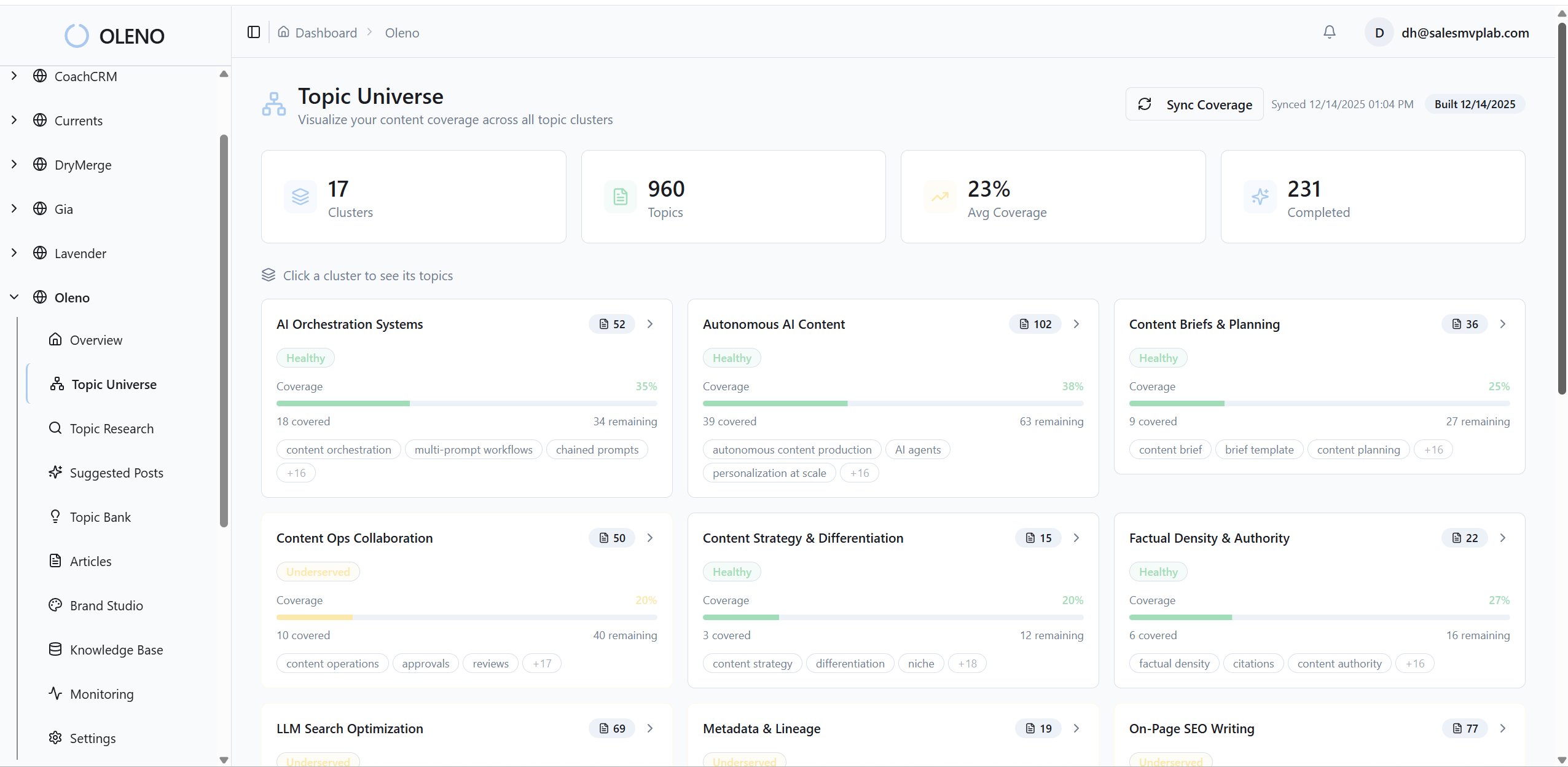
Briefs inherit this strategy. During brief generation, Oleno analyzes top-ranking content to identify common coverage, missing perspectives, and shallow explanations, then calculates an Information Gain Score. Low-differentiation outlines get flagged before anyone writes a word. You ship fewer repeats and more net-new angles.
Cooldown Enforcement And Re-Coverage Triggers
Cooldowns are enforced by default, which lowers accidental cannibalization. But Oleno doesn’t freeze your roadmap. Re-coverage triggers fire when clusters decay or when strategic priorities change, so you can re-enter a topic with intention. That keeps motion purposeful rather than reactive to rank blips.
The outcome is less time spent rewriting or merging posts after the fact. You’ll see the difference in planning sessions too. Debates become “what expands coverage now?” not “which overlapping draft do we push first?” That reduces the 3am rewrites and the post-publish link surgery no one enjoys.
Deterministic QA, Internal Links, And Publishing
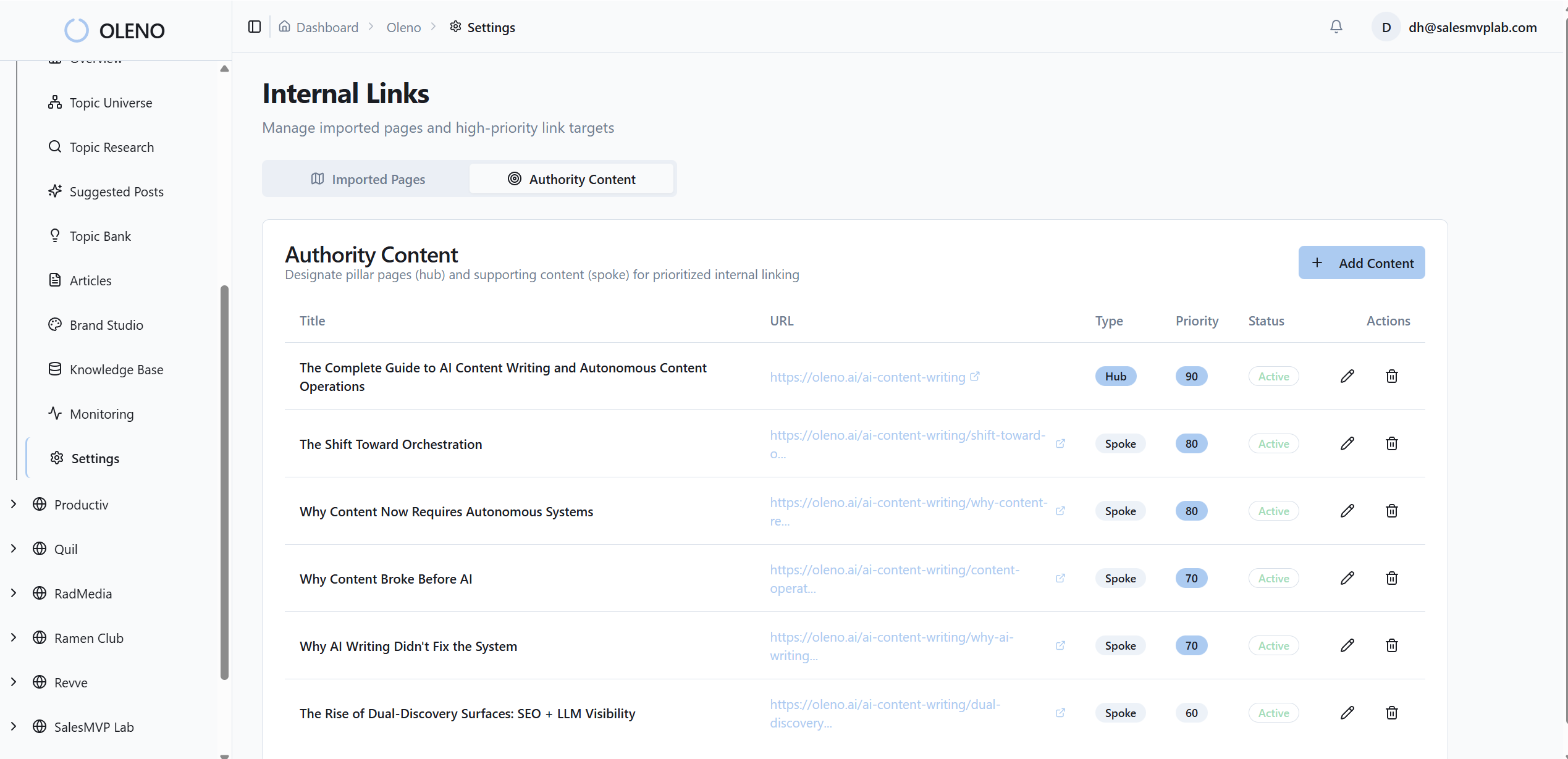
Oleno’s QA gate evaluates drafts against 80+ criteria: structure, brand alignment, snippet readiness, and information gain. Internal links are injected from verified sitemaps only, with anchor text matching page titles. JSON-LD schema is generated automatically, and finished articles publish directly to WordPress, Webflow, or HubSpot.
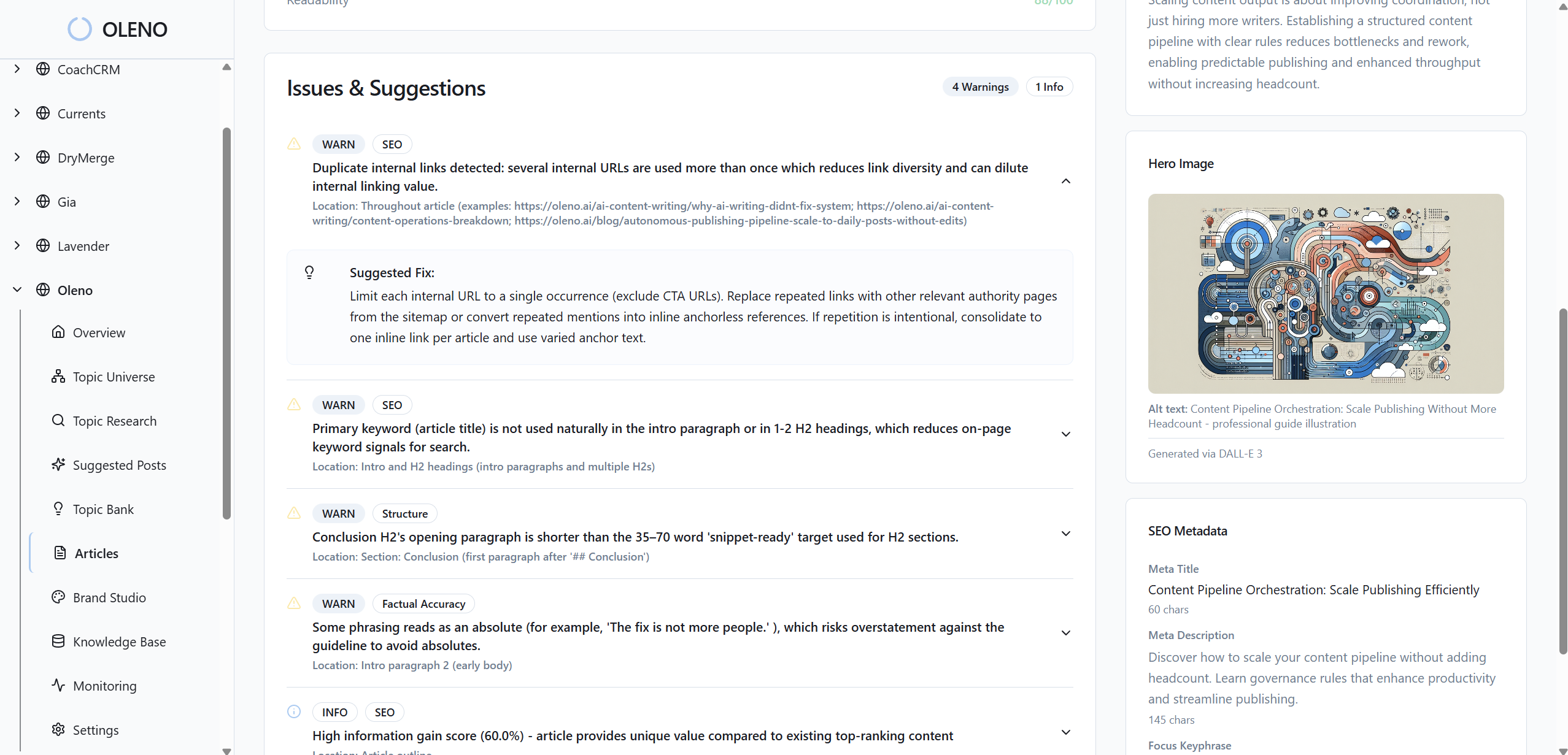
This isn’t analytics or monitoring. It’s the boring, necessary rigor that prevents duplicates, broken structure, and off-brand visuals. Visual Studio generates on-brand hero and inline images, prioritizing solution sections and aligning screenshots to relevant sections. The result is consistent, citable pages that reinforce your clusters.
If this is the operating model you want without adding headcount, it’s straightforward to test. Try Using An Autonomous Content Engine For Always-On Publishing.
Conclusion
Coverage control is the quiet lever. Treat content like a system, not a set of pages. Map the topic universe, set cooldowns, and gate briefs by information gain. You’ll write fewer redundant words, publish with more confidence, and see authority concentrate where it should, on canonical pages that actually win. If you want the system to run daily without spreadsheets, Oleno’s built for that.
About Daniel Hebert
I'm the founder of Oleno, SalesMVP Lab, and yourLumira. Been working in B2B SaaS in both sales and marketing leadership for 13+ years. I specialize in building revenue engines from the ground up. Over the years, I've codified writing frameworks, which are now powering Oleno.
Frequently Asked Questions