Translate Market POV into Deterministic AI Demand‑Gen Jobs
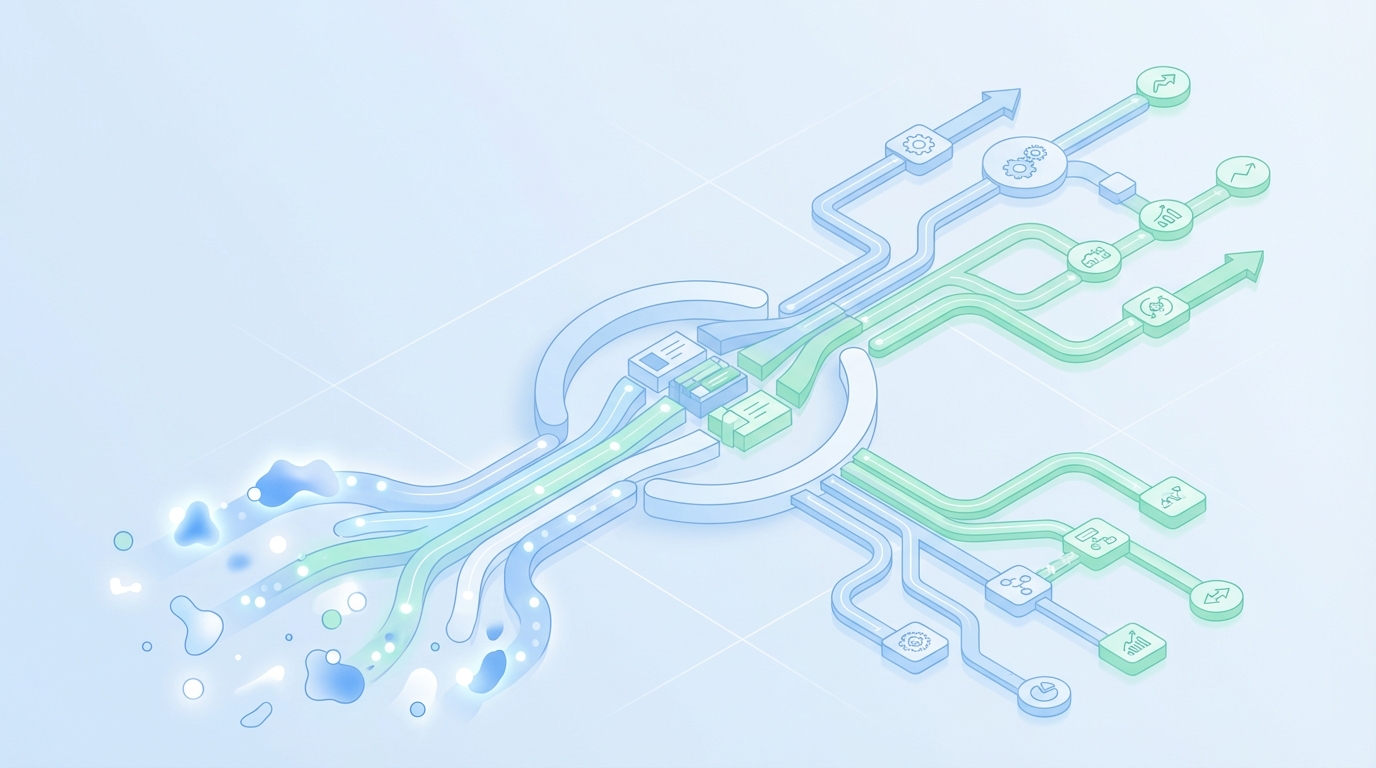
Most teams don’t struggle to define a point of view. You’ve got a deck. A few strong lines. Maybe a manifesto. The problem hits when you try to run that POV through AI and expect it to hold up under volume. It drifts. People disagree. Publishing slows. You’re back in meetings, not in market.
I’ve been on both sides. As a solo marketer cranking out content fast, then as a leader trying to keep quality and voice intact across a team. Speed helped, briefly. But the minute we scaled output, judgment moved to the wrong place, downsteam, in edits and approvals. The fix wasn’t “better prompts.” It was translating strategy into jobs a system can execute the same way, every day.
Key Takeaways:
- Encode your market POV into machine-readable inputs, constraints, and evidence, so jobs enforce it, not editors
- Run demand gen as a small set of deterministic jobs (Acquire, Educate, Convert) with a shared pipeline
- Quantify coordination tax and claim risk; the bottleneck is inconsistency, not ideation
- Ground every asset in approved knowledge and claim bounds to reduce rework
- Use canary-style rollouts, sampling, and rollback rules to scale safely
- Let humans set direction; let the system run the work
If you want to see this approach applied to your voice and topics, you can test it quickly. Curious how your POV holds up in a governed flow? Generate 3 Free Test Articles.
Why Your Market POV Is Not Running Your Demand Engine
Your market POV doesn’t run your demand engine because decks aren’t machine-readable. AI can’t enforce beliefs, claims, or tone it can’t parse. You need structured inputs, constraints, and evidence that the job consumes every time. Otherwise, you’re betting on memory and manual judgment at the end.
What Does “Machine-Readable Strategy” Actually Mean?
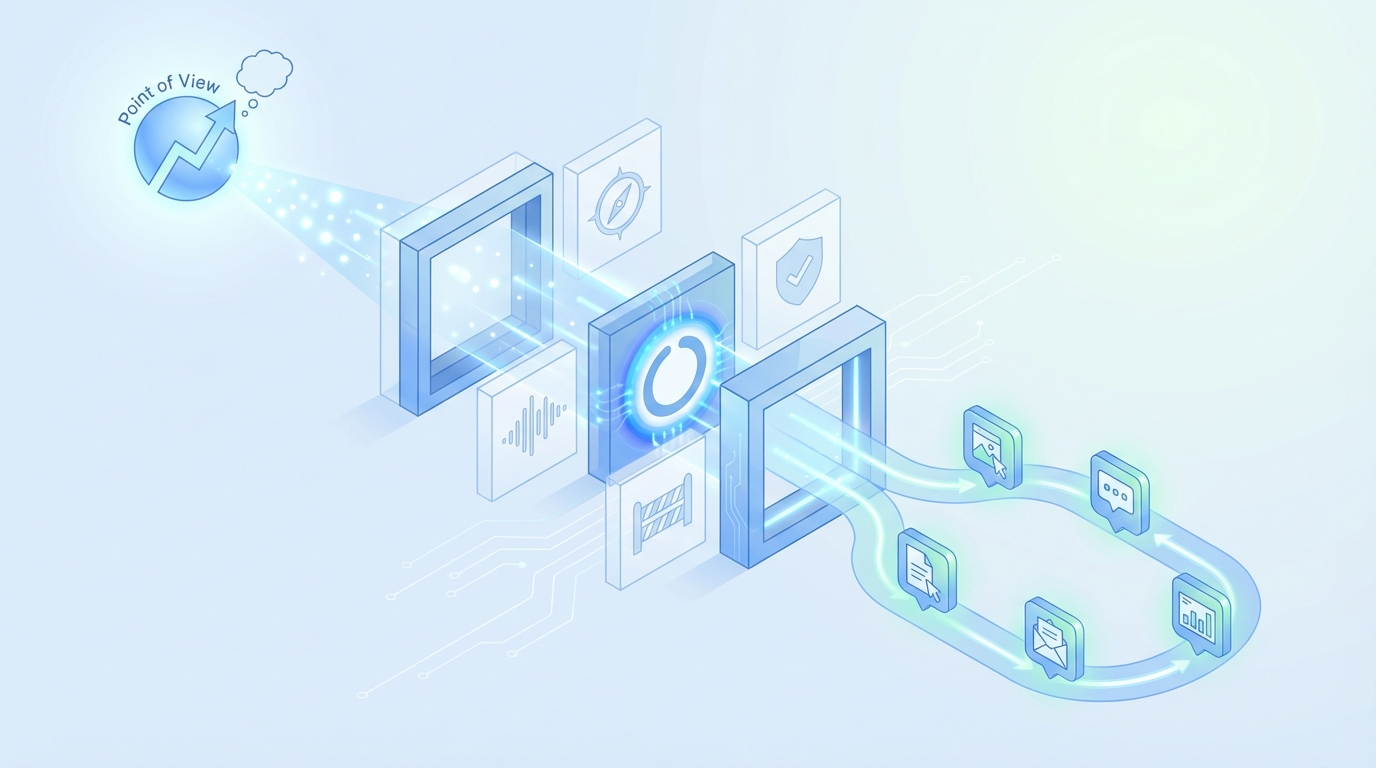
Machine-readable strategy means your positioning isn’t prose, it’s a set of fields your jobs consume and enforce. At minimum, it codifies ICP traits, message pillars, allowed claims, and proof sources. That turns “our stance” into data the pipeline uses to decide what to create and what to reject.
Most teams stop at messaging docs. Useful for people. Not for jobs. A system can’t “remember” your POV; it can only follow rules and fetch evidence. So, translate beliefs into inputs and boundaries: which pains matter, which outcomes you support, which claims are in-bounds, and where proof lives. We’ve seen this shift cut review loops because the job never attempts work it can’t prove. It fails closed instead of hallucinating.
And here’s the real payoff. When strategy is encoded, your voice and claims don’t depend on who wrote Tuesday’s draft. They’re enforced by the job, at the same standard, every time. Humans focus on narrative and angle, not policing commas or disclaimers. That’s the point.
The Drift Problem When AI Speed Meets Human Coordination
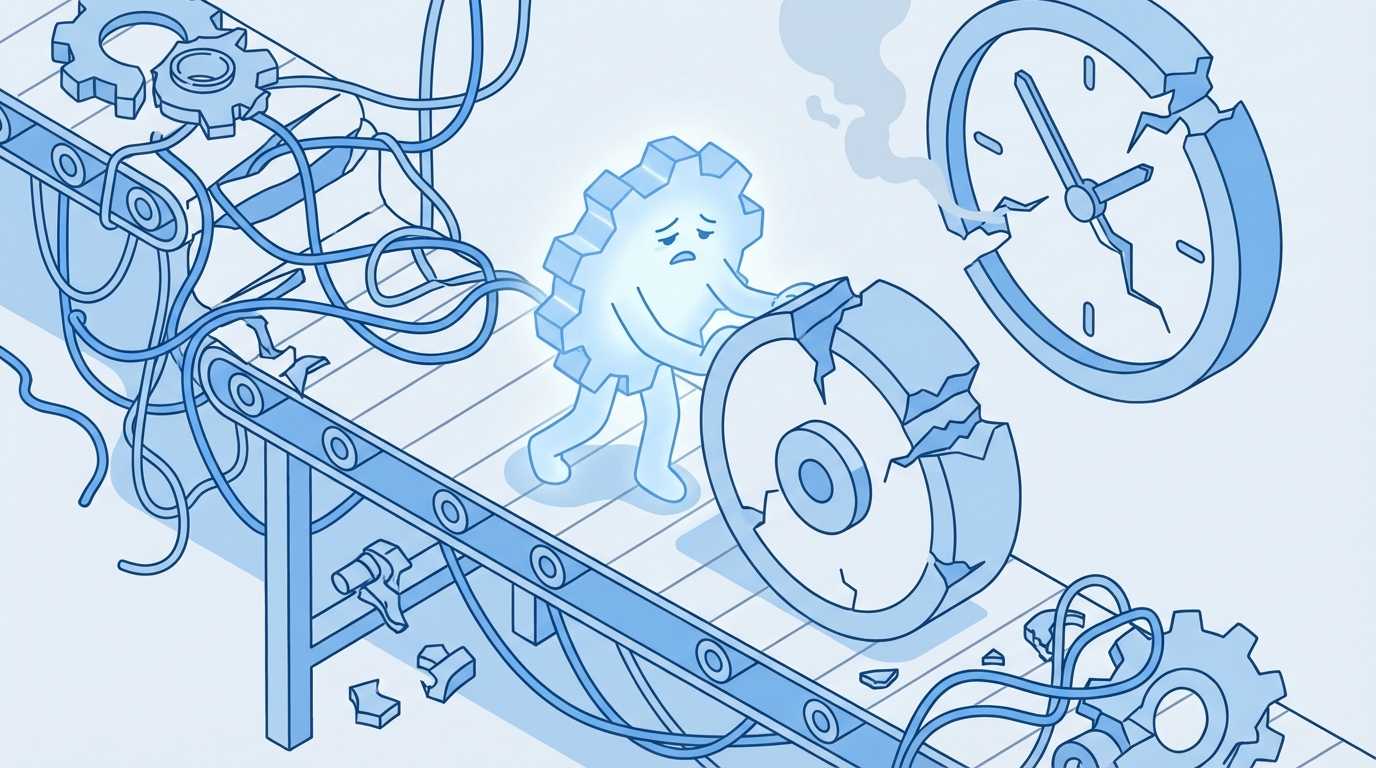
Drift shows up fast when speed meets coordination. Tone slides. Lines repeat. Claims edge past what legal would approve. It’s not bad intent. It’s that judgment is happening downstream, in edit pass four, instead of upstream in rules the job can apply.
Prompt-first workflows amplify this. More drafts means more reviews, which means more inconsistent calls under deadline pressure. One manager says “ship it,” another says “rewrite.” Multiply by 20 pieces a month and your calendar becomes a triage board. The signal is predictable: rising review hours, shrinking publish count, growing frustration. We’ve lived it. It’s a tax you pay every sprint unless rules move upstream.
The fix is simple to say, harder to do: encode decisions at the system level. The job should enforce voice, structure, and claim boundaries long before an editor sees a draft. Let the machines handle structure checks. Your team should focus on story, not commas.
Why “More Prompts” Will Not Fix Execution
Prompts produce text. Jobs run systems. That distinction matters. A job owns inputs, evidence sources, guardrails, success metrics, and a deterministic path from Discover to Publish. Prompts own instructions and vibes. They change; jobs don’t.
Think about what you want to repeat reliably a thousand times. It’s not clever phrasing; it’s a pipeline that never forgets voice rules, always checks claim bounds, and fails when evidence is missing. A job should decide what to make (based on governance), how to structure it (locked H2/H3), and when it’s ready (QA gates). That’s orchestration, not prompting.
Plenty of marketers agree. Even mainstream overviews, like Harvard DCE on AI’s impact in marketing, point to structure and guardrails as the difference between novelty and operational value. Speed helps. Reliability is what compounds.
The Real Bottleneck Is Translation Into Jobs, Not Ideas
The bottleneck isn’t lack of ideas, it’s encoding your POV into jobs a system can actually run. That means your positioning turns into intent signals and rules, not brainstorms. With a clear job taxonomy and a shared pipeline, governance binds at every step and drift has nowhere to hide.
Translate Your POV Into Intent Signals Buyers Already Show
Start by turning positioning and product truths into a prioritized set of intent signals. You’re mapping “what to say” and “why it matters” to funnel stages and inclusion rules. If ICP traits are present and KB coverage exists, green light. If a claim would cross a boundary, exclude. No debate. No “maybe later.”
This isn’t keyword lists; it’s decision logic. For Acquire, signals might be “ops leader searching for scalable content workflows” plus “existing KB coverage on governance and QA.” For Convert, signals could be “evaluation intent for comparisons” plus “claim rules and fairness constraints active.” The point is to make discovery a filter, not a brainstorm. The system should be able to justify selection with a rationale and a source, not a hunch.
If you want a baseline on what “full-funnel” inputs look like, overviews like UnboundB2B’s demand generation guide show how awareness, education, and evaluation connect. You’re just encoding that into rules the job can enforce.
Define The Job Taxonomy And The Pipeline That Actually Runs
You don’t need 14 job types. You need three to start: Acquire, Educate, Convert. Each comes with assets produced, cadence, inputs, constraints, and stage-fit KPIs. Acquire ships discoverable, scalable content. Educate ships frameworks and POV explainers. Convert ships comparisons and product explainers under fairness and claim safety rules.
All three share the same deterministic flow: Discover → Angle → Brief → Draft → QA → Publish. Studios change inputs, not the process. That matters because governance should bind at every step, voice profile at Brief, claim bounds at Draft, KB grounding at QA. When someone asks “what broke,” you point to the stage and the rule, not the person. That’s how teams debug systems instead of debating opinions.
The Hidden Cost Of Manual Briefs And Prompt Chains
Manual briefs and prompt chains look cheap. They aren’t. The real cost is coordination, editing, approvals, claim reviews, and analytics you can’t trust. It compounds monthly, and it shows up as time, money, and morale.
The Compounding Tax On Editing And Approvals
Let’s pretend you ship 20 pieces a month. Each needs two editor hours and one SME hour because of drift and claims clean-up. That’s 60 hours. If fully-loaded hourly cost averages $120, you’re spending $7,200 a month before distribution. Multiply by 12 and you’re nudging $86,000 in coordination tax.
You feel it as slowdowns and inconsistent judgments. One piece flies through. Another gets stuck for two weeks. You push “ship” anyway, then field Slack threads when someone spots a risky line about “seamless integrations” you don’t fully support. None of this is about creativity. It’s about missing rules that a job should enforce upstream.
And the kicker? Those hours don’t improve narrative as much as they mop up structure, voice, and accuracy. That’s human time spent fixing what the system should have prevented.
Still carrying that tax every month? There’s a calmer way to operate. When you’re ready to offload the busywork, Try Using An Autonomous Content Engine For Always-On Publishing.
Claims And Analytics: Risk Surface And Visibility Debt
Without encoded claim boundaries, one sentence about security or integrations can trigger legal loops and trust issues. You don’t need scare tactics to see the math. At scale, even a 5% error rate means weekly retractions. Jobs with claim constraints reduce that risk before draft one even exists.
Then comes attribution. If assets aren’t tagged to a job, stage, and KPI, analytics devolve into opinions. You can’t compare like for like, pause the right job, or increase cadence where it works. Schema-less volume turns dashboards into noise. With job templates, UTM and metadata stay consistent, and content structure is comparable. Now you can see which jobs drive pipeline and which need a reset.
Industry write-ups, such as Demand Gen Report’s coverage of AI agents in B2B, keep pointing to the same thing: structure and governance are what make automation safe enough to scale.
When Drift Becomes Rework, Teams Burn Out
Teams burn out when the system relies on heroics. Drift creates rework, rework steals time, and the calendar never eases up. You don’t fix that with another prompt library. You fix it by deciding once, then enforcing everywhere so small teams can keep cadence.
A Story You Might Recognize From The Field
We were a team of three. The CEO, the VP Product, and me, doing marketing, sales, and a dozen other things. I didn’t have time to write. We recorded the CEO, transcribed the videos, and shipped. It got words on the page fast, and the voice had authority. But structure and search intent suffered, and tying posts back to demand-gen outcomes was hit or miss.
At another stop, we had strong content, a great voice, beautiful design, and we ranked for topics far from our product’s core. The content team was winning SEO. Sales couldn’t use half of it. That mismatch created more internal requests, more rewrites, more context handoffs. None of it malicious. Just a system that pushed judgment downstream and relied on manual alignment every time.
When we finally encoded the rules, what to say, how to say it, what claims we could own, and what proof we needed, the rework dropped. Output got steadier. People could breathe.
What If Small Teams Could Run Like Large Ones?
Here’s the shift. Treat output like infrastructure, not campaigns. Set rules once. Run jobs daily. Strategy stays human. Execution becomes a system. You still decide the narrative, the POV, and the tradeoffs. The system just applies that call the same way every time.
This isn’t about replacing judgment. It’s about moving it upstream so your experts make decisions once, not 50 times a month. When the jobs enforce voice, structure, and claims, you stop paying the drift tax. Small teams start operating like large ones, steady cadence, consistent narrative, fewer fires.
Encode Your POV As Deterministic Jobs The Team Can Run
To encode your POV, translate positioning into intent and evidence, define job templates, and build a schema that the orchestration layer validates at every step. Keep it deterministic, success looks the same every time, and fail closed whenever proof is missing.
Translate Positioning Into Intent, Evidence, And Success Criteria
Turn key messages and product truths into machine-readable intent: ICP traits, pains, triggers, and proof points. Attach evidence sources: product docs, help docs, customer stories. Add include/exclude rules. Discovery should fail closed if required proof isn’t present. That’s how you prevent hallucinations, not fix them.
Write this like a config, not a paragraph. Keep it terse and testable. Then define success criteria aligned to stage-fit, coverage expansion for Acquire, message adoption for Educate, evaluation assistance for Convert. If it can’t be measured in that context, don’t include it. You’ll avoid “vanity metrics” arguments later.
To make this concrete, include fields like these after you write the narrative and constraints:
- intent_name
- icp_signals[]
- must_cite_kb[]
- disallowed_themes[]
- rationale
Include the note that discovery selection should fail closed when must_cite_kb is empty.
Design The Job Taxonomy And The Machine-Readable Schema
Start simple: Acquire, Educate, Convert. For each, define assets, required inputs, constraints, cadence, and KPIs. Acquire might produce long-form and programmatic clusters with duplication checks. Educate ships frameworks and category POV explainers. Convert ships comparisons and product explainers with fairness rules.
Then define a schema the orchestration layer can validate. Keep required fields explicit and short-circuit failures before publish. You want predictable execution, not surprise drafts. In practice, the schema often includes:
- job_type
- inputs {topic, icp, funnel_stage}
- constraints {voice_profile, banned_terms[], claim_bounds[]}
- evidence {kbs[], citations_required: true}
- qa {checks[], min_score}
- cadence {frequency, cooldown_days}
- metadata {utm, tags[]}
- routing {studio, pipeline}
If you’re mapping research inputs to jobs, templates like Relevance AI’s agent patterns can spark how you structure reusable inputs, then you encode your governance on top.
Bind Governance To The Pipeline, Then Test Safely
Map constraints to governance bindings: voice profile, allowed claims, fairness rules for comparisons, KB grounding strictness. Hook the job to a shared flow, Discover → Angle → Brief → Draft → QA → Publish, so the same gates fire in the same order, for every output. This is where consistency actually happens.
Roll out in stages. Use canary runs, small batch, lower risk, sample outputs statistically, and publish behind controlled gates. If a canary fails QA or violates claims, stop, adjust constraints, and retry. Document rollback rules the system can apply automatically. You’ll move faster knowing you can reverse decisions without drama.
How Oleno Turns Your POV Into Governed Jobs You Can Run Daily
Oleno runs demand generation as a system. You configure governance once, voice, positioning, product truth, and claim boundaries, and Oleno enforces those rules across jobs and studios. The result is steady publishing with far less drift, fewer risky claims, and lower coordination tax.
Governance Layer Encoded Once, Enforced Everywhere
In Oleno, governance is the starting line: brand voice rules, positioning and POV, approved product truths, and claim boundaries. You set those once. Oleno applies them everywhere, at Brief, at Draft, and especially at QA, so jobs don’t drift or cross lines.
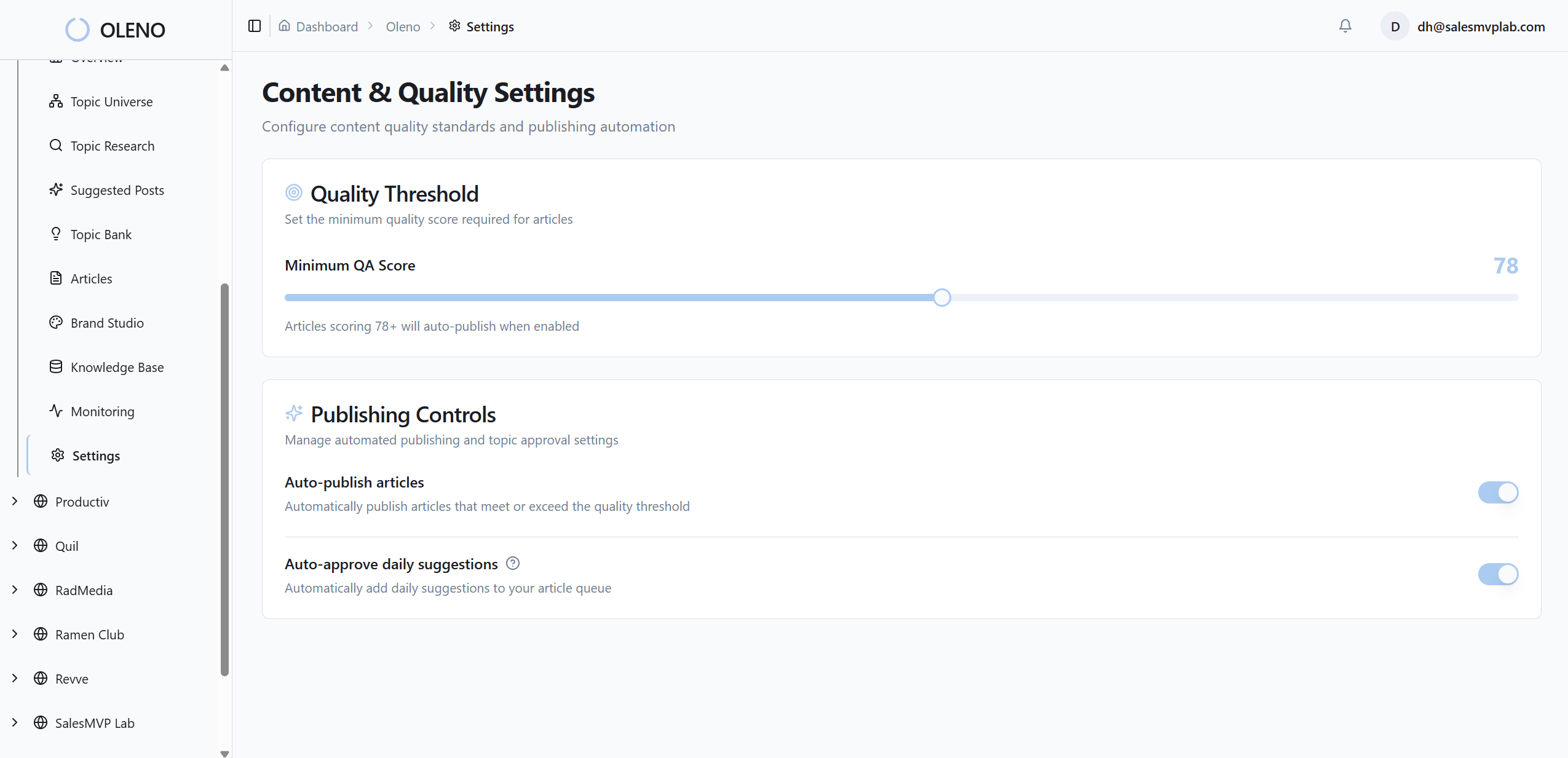
Because the rules are encoded, editors stop playing defense. The system enforces language do/don’t lists, structure, and claim bounds before anyone hits “publish.” This directly lowers the $7,200/month coordination tax you felt earlier, because it prevents the errors that create rework. Strategy stays human. Enforcement stays automatic.
Studios As Job Runners Across Acquire, Educate, Convert
Oleno organizes work into studios that run specific jobs. Enable Acquire for discoverable, scalable content. Enable Educate for frameworks and category explainers. Enable Convert for comparisons and product explainers under fairness rules. Each studio uses the same pipeline: Discover → Angle → Brief → Draft → QA → Publish.
Studios change inputs; the process doesn’t. That keeps cadence predictable. It also makes ops visible, what’s queued, what’s blocked, and why, so you scale coverage without losing control. Small teams get leverage without adding headcount or coordination overhead.
QA Gates, KB Grounding, And Controlled Rollouts
Nothing publishes in Oleno without clearing QA checks: voice and tone alignment, narrative structure compliance, clarity and logical flow, grounding and accuracy, and SEO/LLM-readability structure. If a draft fails, Oleno revises automatically until it passes. That’s how risky claims and tone drift get blocked upstream, not in a last-minute edit.
Oleno also supports controlled publishing and sampling so you can raise cadence safely. Run smaller batches first, sample outputs to catch edge cases, and lean on trend signals to keep the system healthy as volume grows. If something dips, roll back quickly and adjust constraints. You move fast without rolling the dice.
Want to see how this works with your voice and topics, not a demo dataset? Try Oleno For Free and watch your POV run as a system, daily.
Conclusion
You don’t need more prompts. You need your market POV translated into jobs that run the same way, every time. Encode the rules once. Bind them to a shared pipeline. Fail closed when evidence isn’t there. Then let the system handle structure, claims, and cadence so your team can focus on story and strategy. That’s how small teams publish like large ones, without the rework hangover.
About Daniel Hebert
I'm the founder of Oleno, SalesMVP Lab, and yourLumira. Been working in B2B SaaS in both sales and marketing leadership for 13+ years. I specialize in building revenue engines from the ground up. Over the years, I've codified writing frameworks, which are now powering Oleno.
Frequently Asked Questions