Turn Brand Voice into Reusable Writing Rules: 7 Templates

Most teams try to “fix voice” in edits. That’s backwards. If your rules aren’t explicit and enforceable, you’ll keep sanding drafts until they’re smooth and bland. I’ve lived that cycle. It burns hours, irritates writers, and still doesn’t protect the brand when volume spikes.
Here’s the shift: convert taste into rules. Make voice observable. Then let people and machines check it the same way, every time. When you do, cadence stops slipping, reviews get lighter, and your content actually sounds like you—across posts, pages, and platforms.
Key Takeaways:
- Convert vague pillars into machine-checkable rules that humans can interpret and systems can enforce
- Separate taste (guidance) from policy (must-haves) to cut down rework and debate
- Quantify the rework tax so leadership prioritizes voice-as-rules, not line edits
- Use a seven-template toolkit to codify tone, terminology, hooks, and CTAs
- Operationalize rules in briefs and QA so drafts pass on voice before you touch them
- Let editors focus on accuracy and logic while automated checks police voice drift
Ready to stop editing the same lines? Use an Autonomous Content Engine For Always‑On Publishing.
Why Style Guides Drift And Teams Keep Editing The Same Lines
Most style guides fail because they’re aspirational, not operational. They list values, not behaviors. When rules aren’t explicit, editors debate taste and drift creeps in under pressure. A practical fix is turning pillars into testable rules that reduce negotiation and increase repeatability.

The real problem is not intention, it is execution
Everyone wants a consistent voice. But intent without enforcement is just hope. If you can’t point to a rule and say “this sentence passes, that one fails,” the room defaults to opinion. That works at five posts a quarter. It collapses at five posts a day.
Here’s the tell: your edits repeat. Same hedges, same passive constructions, same soft verbs. These are not one-off fixes. They’re missing policies. A better approach borrows from usability research, where tone is dimensional and observable. See Nielsen Norman Group’s tone of voice dimensions for a clean way to define sliders instead of slogans.
When teams codify what “confident, practical, direct” means at the sentence level, they reduce ambiguity. Machines can flag violations. People can fix intent, not punctuation. Quality rises, and oddly, the work feels lighter.
What does voice drift look like in practice?
You’ve seen it. Social sounds friendly. Long‑form reads like a whitepaper. Sales emails swing from pushy to vague depending on who drafted them. None of it’s “wrong,” yet together it feels scattered. That inconsistency makes readers work harder than they should. When trust thins, conversions follow.
Drift accelerates with more hands. Two competent writers can land in different places using the same guide because “confident” means 12 different things in their heads. Meanwhile, reviewers normalize everything back to safe middle. The result? Personality gets edited out, then leadership wonders why performance stalls.
Fixing drift requires a unified rulebook. Not a manifesto. A sheet that shows acceptable sentence lengths, banned hedges, preferred verbs, tone sliders by channel, and examples in context. That clarity pays for itself in fewer rounds and fewer surprises.
Why do smart teams still miss this?
Because voice gets treated like taste. Taste is subjective. It invites debate and defers decisions to the loudest or most senior person in the room. Policy ends debates. When you convert pillars into rules, you move voice from “I feel” to “we agreed.”
This matters at scale. Lock the must‑haves into rules. Leave nice‑to‑haves as guidance. Once voice is policy, you can automate checks. Humans focus on logic and story, which is where their time is valuable. You’ll still disagree sometimes. But you’ll disagree about ideas, not commas.
Translate Vision Into Rules People And Systems Can Follow
Machine‑checkable rules are clear, observable, and enforceable. They include examples, counter‑examples, and patterns a linter or QA gate can detect. If a rule can’t be tested, it’s just preference. Good rules make voice scalable across writers and channels without watering it down.

What does a machine‑checkable rule look like?
It’s unambiguous. “Use active verbs like ‘ship, verify, publish.’ Avoid ‘leverage, utilize.’” That’s enforceable. “Be punchy” isn’t. Strong rules pair positive/negative examples with triggers systems can catch: regex patterns for weasel words, thresholds for hedging, and sentence length bands by format.
You don’t need to boil the ocean. Start with the top five recurring edits across your last ten drafts. Codify those. Then add a few channel‑specific exceptions. This is exactly how brand platforms recommend moving from traits to standards—see Frontify’s guide to brand voice for a practical translation model.
One more thing: rules evolve. Version them. Note the rationale. When you change a rule, explain why. Future you will thank past you.
Map pillars to observable behaviors
Pillars are the “why.” Behaviors are the “how.” If your pillar is “confident,” define its behaviors: minimal hedging, strong verbs, short openers, limited subordinate clauses. If your pillar is “practical,” require a concrete example within the first 150 words and ban vague claims without KB support.
Make it specific:
- Sentence length: 8–18 words for lead sentences, 12–26 words elsewhere
- Hedging threshold: max one per 200 words (e.g., “might,” “could,” “probably”)
- Verb families: prefer “ship, verify, publish, measure, prove” over “leverage, utilize, maximize”
- Rhythm: at least one sub‑10‑word sentence per section
And then test drafts against those behaviors. Interjection: document exceptions for legal or compliance content.
Separate taste from policy
Policy is enforceable. Taste is guidance. Lock policy into your brief and QA checklist. House taste in a living “inspiration” doc with examples, not rules. Editors should be trading notes on argument strength and evidence, not whether a sentence “feels formal.”
That split protects velocity. It also protects voice. Ironically, stricter rules make room for bolder ideas because writers know the guardrails. They can push within bounds instead of guessing what will get red‑lined later.
The Hidden Costs Of Subjective Edits You Cannot See On Dashboards
Subjective edits tax small teams quietly. The cost shows up as lost hours, slipped cadence, and avoidable risk. Quantify it to make the fix a priority. Then convert recurring edits into rules so quality improves without adding headcount or meetings.
The rework tax on small teams
Let’s pretend you publish 20 articles a month. You spend 1.5 hours per draft on voice fixes—verbs, hedges, rhythm, tone. That’s 30 hours gone. Add three channels repurposed from that article, and you’re easily at 50+ hours of rework that creates zero net‑new value.
Multiply across quarters and it’s a part‑time role spent on preventable edits. A rules‑first system doesn’t eliminate all polishing. It shrinks it. Teams that adopt simple do/don’t lists and tone thresholds see faster reviews because everyone knows what “done” means. For plain‑English examples, skim CoSchedule’s brand voice guidelines.
No need for heroics. Start by eliminating the top five offenders. Measure again in a month. You’ll feel the difference in calendar space, not just a spreadsheet.
Opportunity cost in lost cadence
Cadence is a growth lever. Miss it consistently and your pipeline stutters. Two rounds of tone fixes can push Tuesday’s post to Friday. That slip ripples into next week’s schedule, then your monthly plan. Meanwhile, search and social both reward reliability.
Lock voice into your briefs and QA. If a draft violates the brief, it fails QA. That prevents last‑minute debate that tanks cadence. Reliability becomes a decision, not luck. Your team will thank you for fewer “Are we publishing today?” Slack messages.
Error paths that invite brand risk
Inconsistent voice creates inconsistent claims. One post hedges modestly. Another overstates outcomes. Reviewers get tired. Risk slips through. Policy as code helps. Ban words that trigger legal review. Require that any claim beyond common knowledge be backed by your knowledge base.
Machines should catch the obvious before humans read a word. That’s not about replacing judgment. It’s about focusing it where it matters: on accuracy and argument, not phrasing.
When Drafts Sound Like A Stranger, You Lose Trust Fast
Voice drift erodes trust because it makes people wonder who’s talking. Leaders disengage when edits balloon. Teams get defensive. A shared, enforceable rulebook reduces friction and keeps drafts aligned without killing tone. It’s not about control; it’s about clarity.
The exec who stops writing because edits drain time
I’ve been that exec and worked with them. Early on, when structure and voice were clear, I could ship three to four strong posts a week. As teams grew, writers lacked context, edits ballooned, quality dipped, and velocity fell. That’s not their fault. It’s a system problem.
When we turned tacit voice into explicit rules—verbs to use, hedges to avoid, sentence rhythm to hit—leaders reengaged. Drafts stopped getting sanded down to neutral. And the team moved faster because we weren’t relitigating style in the comments.
The three inbox threads nobody enjoys
Legal flags a superlative. Sales wants harder CTAs. Editorial wants more empathy. Three threads, one draft, no owner. It’s frustrating rework. A shared rulebook prevents that tug‑of‑war. Decisions live in the rules: which superlatives are banned, where CTAs go, and how empathy shows up.
You still debate edge cases. But you’re not debating fundamentals. That leaves more time for story, proof, and differentiation—which is what readers care about anyway.
What if you could approve rules once, not every line?
That’s the unlock. Approve policy, not prose. Then use templates and checks to enforce it. Writers focus on ideas. Editors focus on evidence. Systems catch drift early. Consistency goes up without slowing down.
If you want to test this on your own content, generate a couple of policy‑driven drafts and compare edit time. When you’re ready, you can also Generate 3 Free Test Articles to see how a rules‑first system feels.
Reusable Templates That Convert Voice Into Rules
Seven templates turn voice from taste into rules. They cover pillars-to-behaviors, lexicon enforcement, terminology, hooks, CTAs, tone scoring, and brief/QA fields. Use them together and you’ll cut debate, reduce rework, and make automation safe.
Template 1: Pillars To Behaviors Rule Sheet
Turn each pillar into six to eight observable behaviors. “Confident” becomes minimal hedging, strong verbs, and lead sentences under 14 words. “Practical” becomes an example in the first 150 words and a ban on vague claims without KB support. Show two in‑context examples and two anti‑examples for each pillar.
This one‑pager goes in every brief and onboarding packet. It becomes the shared language reviewers use in comments. It also gives machines something to check. If a rule can’t be validated by a human or a script, tighten it until it can.
Template 2: Lexicon Policy With Banned Terms And Regex
Make a two‑column table: banned term → approved alternative. Add simple regex to catch passive helpers (“was|were|been|being” + “by”), filler adverbs (“really|very|extremely”), and weasel words (“leverage|utilize|innovative”). Include a test block of “violations” so linters or QA gates can validate enforcement quickly.
Add terminology notes for product names and capitalization. Consistency here prevents brand erosion and unnecessary rework later. And yes, there will be exceptions. Document them with a short rationale.
Template 3: Terminology Map And Capitalization Rules
List approved product, feature, and process names. Clarify noun vs. verb usage, abbreviations, and capitalization patterns. Add decision notes for gray areas to stop the same argument from popping up six months later.
Show examples in context—full sentences, not just words in isolation. Writers need to see how terms behave alongside tone and rhythm. That’s what gets reused correctly.
Template 4: Sentence Hooks And Transitions Library
Provide 10 hook patterns and 10 transition starters aligned to your voice. Keep them short and specific. For example: “Most teams think X. They’re wrong.” Or, “Here’s the trade‑off: Y vs. Z.” Require at least one hook pattern and two transition starters per piece to keep rhythm consistent.
This won’t make writing robotic. It gives writers a reliable starting cadence. Over time, your content starts to “sound” like you without everyone memorizing the same lines.
Template 5: CTA Frames And Close Patterns
Define five CTA frames that match your offer and tone. “Value CTA” (“Get X in Y days”), “Proof CTA” (“See how teams do Z”), “Problem‑Solution CTA,” etc. For each, specify verbs, objection handling, and length. Pair each with acceptable variants.
Then codify location rules. Example: one CTA in the first third, one mid‑article, one in the solution or conclusion. A checklist makes this enforceable. A linter makes it automatic.
How Oleno Operationalizes Brand Voice Templates Across The Pipeline
Oleno turns these templates into daily practice. Voice rules guide drafting. Brief fields mirror the rulebook. QA gates enforce policy before publish. The goal isn’t perfection. It’s predictable, repeatable execution that cuts rework and protects cadence.
Template 6: Tone Scale Matrix With Scored Examples
In practice, a tone matrix beats a paragraph of advice. Create 1–5 scores for formality, empathy, and authority. For each score, write two model paragraphs and two anti‑examples. Map channels to bands (e.g., social empathy 3–4, long‑form authority 4–5).
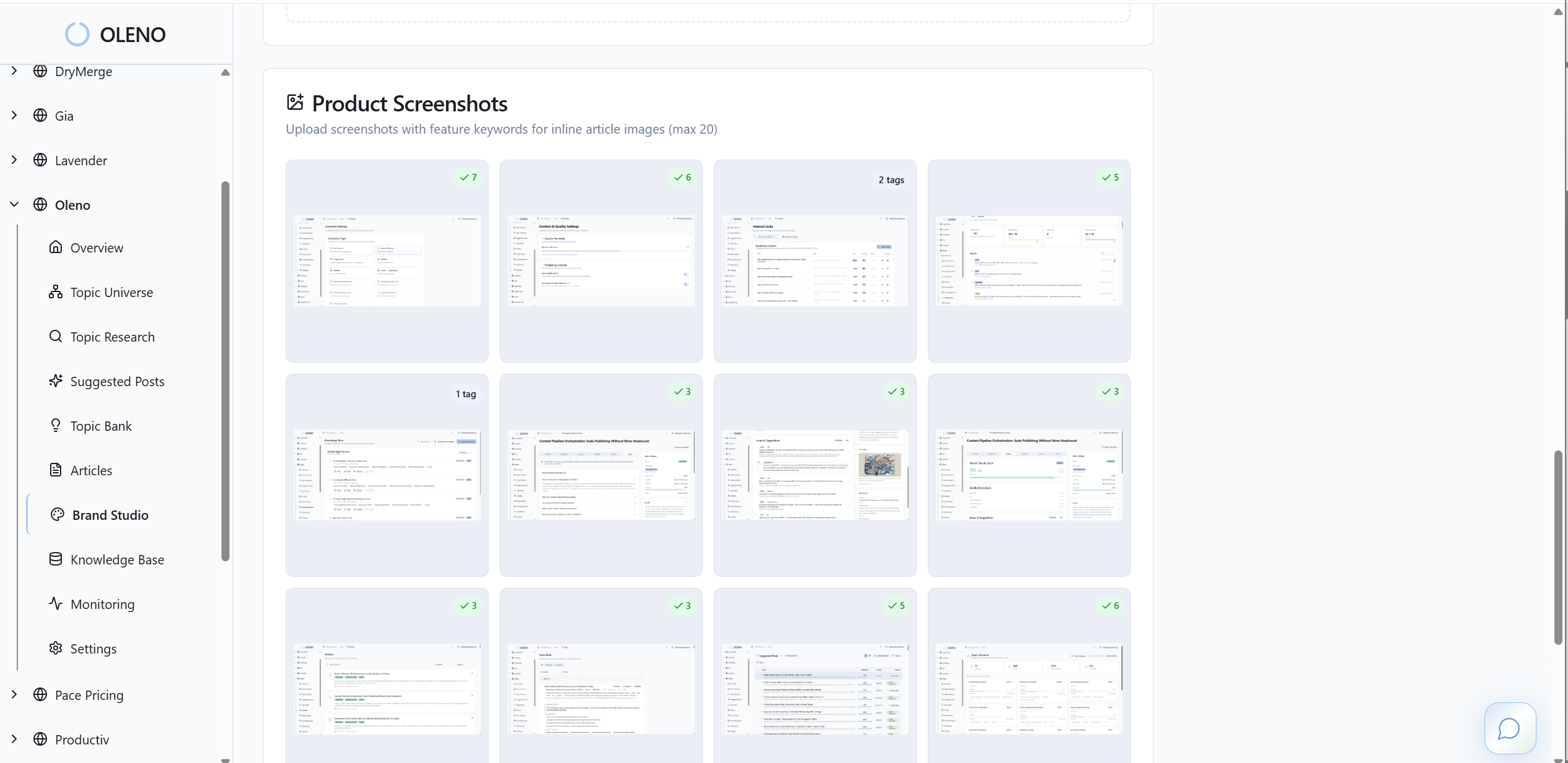
In Oleno, this matrix becomes part of the brief and drafting context. It keeps first drafts close to the intended register so editors aren’t dragging tone uphill later. For more on dimensional tone models, see Acrolinx guidance on tone of voice.
Template 7: Brief Fields And QA Gate Checklist
Add explicit fields to your brief: target tone scores, banned‑terms link, required hook patterns, and chosen CTA frame. Mirror those fields in your QA gate so the same items get verified pre‑publish. If a draft violates the brief, it fails QA. No negotiation, just a clear pass/fail.
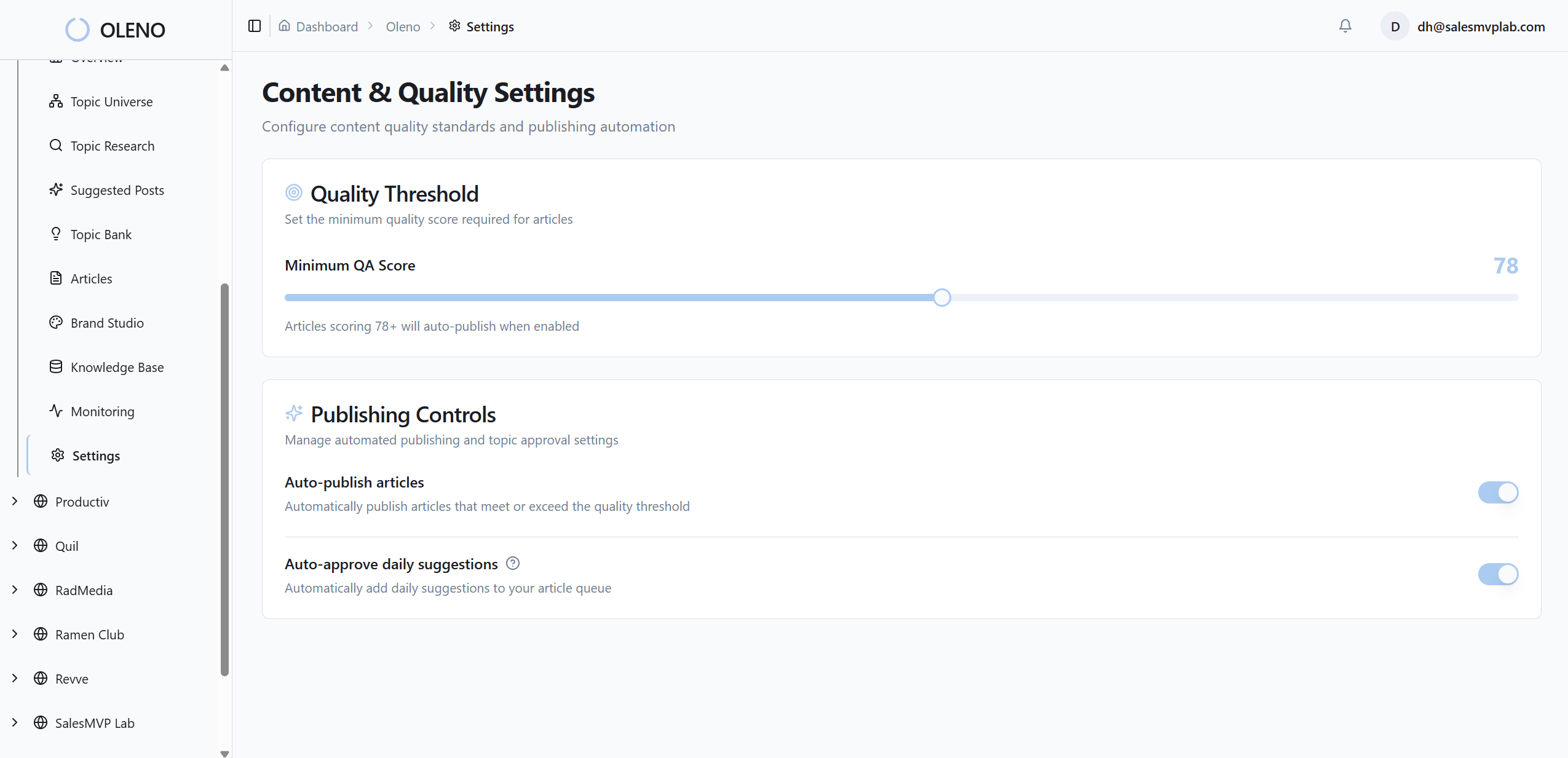
Oleno treats this as a closed loop. The brief sets expectations. Drafting follows them. QA enforces them. Publishing waits until the system says “this matches policy,” which is how you protect cadence without endless threads.
How Brand Studio Applies Rules At Draft Time
Oleno uses Brand Studio to apply your voice rules inside the drafting step. Your banned terms, preferred verbs, tone sliders, and hook patterns inform every sentence choice. That reduces voice edits later and keeps the rhythm you want from the first paragraph.
This isn’t a “writer’s assistant.” It’s policy applied at creation. Writers get consistent outcomes. Editors move straight to substance—accuracy, logic, narrative—because the voice already aligns with the rulebook.
How The QA Gate Enforces Voice Before Publish
Oleno’s QA gate checks voice consistency, narrative structure, SEO/LLM clarity, and knowledge‑base grounding before anything ships. If a piece drifts from the brief or hits banned terms, publishing is blocked until fixes land. That replaces late‑stage comment chains with a predictable pass/fail.
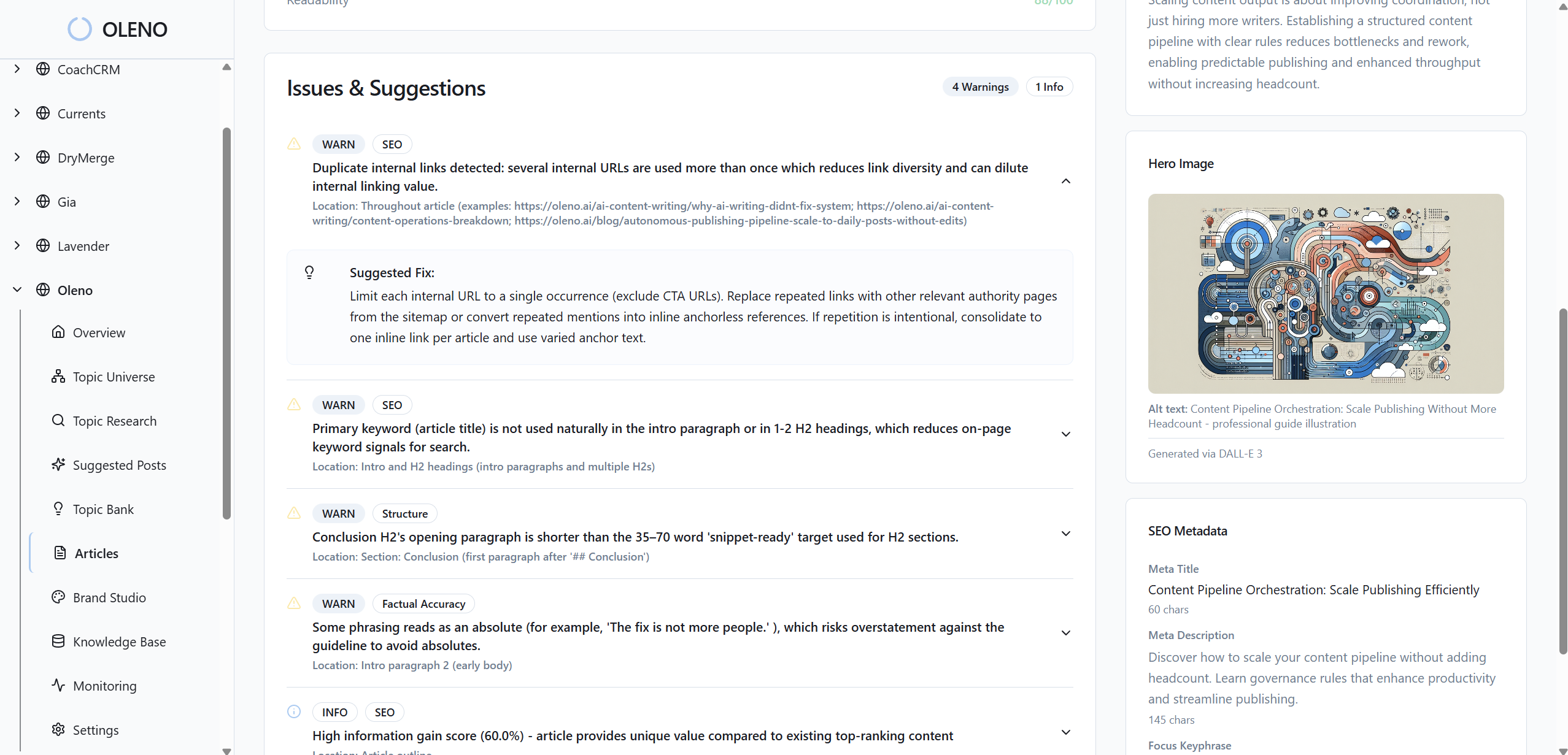
Combined with direct CMS publishing, you cut the rework tax and stop slipping cadence due to tone debates. If you’re ready to see it on your site, Try Oleno For Free and watch policy, drafting, QA, and publishing click together.
Conclusion
You don’t fix voice with more edits. You fix it with rules that humans can follow and systems can enforce. Turn pillars into behaviors. Codify lexicon and tone. Bake rules into briefs and QA. Then let automation defend the guardrails while your team focuses on ideas. That’s how you scale volume without losing yourself. And that’s how you stop editing the same sentence for the fifth time this week.
About Daniel Hebert
I'm the founder of Oleno, SalesMVP Lab, and yourLumira. Been working in B2B SaaS in both sales and marketing leadership for 13+ years. I specialize in building revenue engines from the ground up. Over the years, I've codified writing frameworks, which are now powering Oleno.
Frequently Asked Questions