Turn Content Into Infrastructure: 8-Step Orchestration Playbook

Most teams blame “writing speed” for slow content. It is rarely the actual blocker. The real drag is everything wrapped around the writing: picking topics, including the rise of dual-discovery surfaces:, enforcing voice, aligning visuals, linking correctly, pushing to the CMS without breakage. The writing is fine. The workflow is not.
This is a common situation. You probably have a dozen informal rules scattered across docs and heads, plus a few “we always fix that later” habits that burn time. Once you see the hidden handoffs clearly, you stop chasing word count and start fixing the system.
Key Takeaways:
- Shift the focus from draft speed to eliminating coordination waste across briefs, visuals, links, schema, QA, and publishing
- Standardize a fixed execution order so quality becomes predictable and rework drops
- Encode rules as policies, then let software enforce them before human review
- Open every H2 with a 40–60 word direct answer to improve snippet eligibility
- Generate visuals from a brand asset library, not one-off edits or stock scrambles
- Inject internal links and JSON-LD programmatically after content locks to prevent errors
- Use a pass gate to block low-gain, off-voice, or structurally weak articles before publish
The Hidden Costs Draining Your Content Budget
The costs that hurt you are not the obvious ones. Writing feels expensive, yet the silent losses show up in rework, handoffs, and “quick fixes” near publish. The pattern is repeatable. Briefs drift, visuals fall out of step, and links break in the CMS. That is where the budget leaks.

What Is The Real Bottleneck Today?
Your bottleneck is the missing system that coordinates topics, briefs, structure, visuals, links, schema, QA, and publishing. You likely have ideas, you likely have capable writers. The gap is orchestration that eliminates friction across steps. Workflows, not writing, drain your budget.
You can see it in the handoffs: content ops shares a loose brief, a writer improvises, design hunts for images, editors patch voice and structure, someone fixes links, and finally, the CMS swallows an hour. Each hop changes format and context. That is where time slips.
If you want a clean diagnostic, map one recent article end to end. Time-box each activity, include rework, and note where people wait on others. Then compare that to what a system would do in a fixed order. You will find the latency in the gaps, not the typing speed. For context on running content as a system, start with ai content operations and the rationale for autonomous systems.
Short example: let’s pretend your draft took 4 hours, yet the brief, edits, visual hunt, link fixes, and CMS work totaled 6 hours. The writing was not the constraint. Coordination was.
You will see a similar theme in other domains. Orchestration in infrastructure reduces failure points by coordinating discrete tasks into one governed flow, a point echoed in Infrastructure Orchestration.
The Downstream Tax Of Manual Handoffs
A vague brief becomes a generic draft. Design scrambles for images that fit the message. Editors retrofit voice and structure, which knocks headings out of snippet shape. CMS publishing breaks metadata, so now links and schema get hacked in by hand. One small ambiguity travels downstream and multiplies.
Turn common edits into rules. If you always ban a phrase, make it a banned term. If you always rewrite intros for snippets, write the pattern and enforce it. If you always fix internal links, inject them deterministically from your sitemap after text and visuals lock. Policies shift energy upstream.
Set a minimum bar to ship. A pass gate, say 85 as a clear threshold, blocks low-gain, off-voice, or structurally weak pieces before they hit your CMS. You can iterate post-publish, but you should not pay for preventable cleanup twice. That quality gate is not an analytics dashboard, it is a decision point.
Let’s quantify the stall cost. Let’s pretend your team spends 6 hours per post on non-writing work. At 20 posts a month, including the shift toward orchestration, that is 120 hours of coordination. At a modest blended rate, you are buying a monthly headache and risking credibility when small details slip. That is budget you could reallocate to new angles or deeper research.
For a deeper breakdown on why fragmentation causes rework, see this content operations breakdown and why pure speed created its own problems in ai writing limits.
Operate Content Like Infrastructure
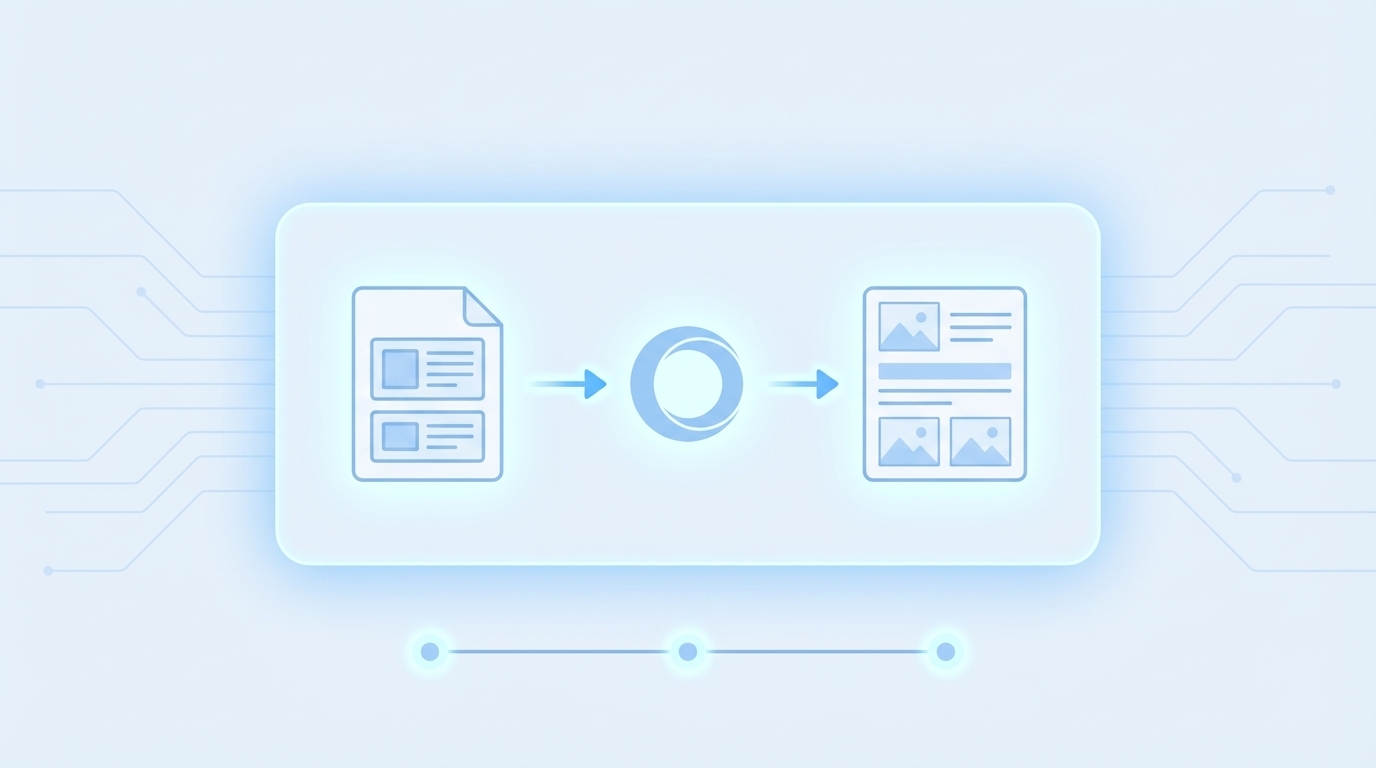
Treat content like a continuous, closed loop. Topics feed briefs, drafts follow a fixed structure, visuals, links, and schema attach deterministically, QA enforces the bar, and publishing runs through connectors. Then coverage data feeds back into what you write next. It turns content from projects into an operating system.
Why Treat Content As A Continuous System?
A closed loop reduces surprises. Each stage produces structured outputs that the next stage expects. Topics become briefs, briefs become drafts, drafts get snippet-checked, visuals attach where they clarify meaning, links and schema come after text and images lock, and QA decides if it ships.
You can standardize the execution order so quality becomes measurable. A simple sequence works well:
- Topic universe and coverage rules
- Brief with differentiation
- Draft with snippet openings
- Visuals placed with brand rules
- Internal links injected
- Schema attached
- QA gate
- Publish via connectors
Separate creativity from correctness. Creative differentiation lives in the brief and draft. Correctness lives in code and rules: internal links from verified sitemaps, programmatic schema, filenames and alt text created automatically, field mapping to your CMS. Do not mix them, you will reduce noise and ship more confidently. For the mindset shift, see the orchestration shift and how to structure for both search and assistants in dual discovery.
A similar principle shows up in enterprise automation. Governance and flow matter more than tool speed, as described in Automation And Orchestration Strategies For The Cloud First Enterprise.
Curious what this feels like in your stack? You can Request a demo now.
The Core Principles Of A Governed Pipeline
Determinism beats hope. Lock the order of operations, define pass or fail, and enforce constraints. If a step fails, such as missing schema or weak information gain, the system retries or stops. No guesswork near publish.
Use policy as code. Encode brand voice, banned terms, image placement rules, link boundaries, and schema defaults. If it is repeatable, codify it. If it is subjective, constrain the options and validate outputs against the constraint.
Prefer logs over vibes. Keep inputs, outputs, retrieval events, QA scores, publish attempts, retries, and version history in system logs. Not dashboards, not analytics, just enough trace to explain outcomes and retry work without manual sleuthing.
Plan With Precision: Topics, Saturation, Briefs
Precision starts with a real inventory and a shared taxonomy. Build one source of truth for topics, define what “covered” means per cluster, and enforce cooldowns so you do not over-publish. Then wire differentiation into briefs so drafts add something new, not just more words.

Map The Topic Universe And Taxonomy
Inventory canonical sources. Pull from your knowledge base, sitemap, product areas, and core narratives. Cluster by intent and product pillar. Tag each topic with lineage, which makes drift traceable. This becomes your single topic bank, the place you look before you write.
Define clustering and naming rules. Decide how granular a cluster should be, which terms roll up to which parent, and how to handle synonyms. Consistent taxonomy avoids duplicate coverage and clarifies measurement. It also keeps writers and editors aligned on scope.
Keep the bank fresh. Generate or import daily suggestions based on gaps and relevance. Approve into the queue. Archive or cool down topics as coverage improves so attention shifts to new ground, not last month’s ideas. See how to build that durable store in topic bank and keep it stocked with a daily topic engine.
The same thinking shows up in infrastructure playbooks. Taxonomy and dependency structure drive repeatability and cost control, a point reinforced in the Cloud Infrastructure Playbook.
How Do You Define Coverage And Saturation?
Set thresholds per cluster. Label clusters “underserved,” “healthy,” “well-covered,” and “saturated.” Tie thresholds to the number of high-quality pieces that address different intents, not total post count. Add an intent diversity note so everything does not drift toward the same funnel stage.
Enforce cooldowns. Prevent re-covering the same topic for 60 to 90 days unless there is a clear update or counterpoint. Cooldowns reduce repetitive content and free capacity for genuine gaps. When you circle back, define the delta you will add.
Govern re-coverage deliberately. Require a stated angle change, new research, or product update. If there is no meaningful information gain, hold the line and spend cycles elsewhere. For help on what to publish next, see topic priorities and how to keep cadence balanced with a deterministic topic pipeline.
Build Strategy-Driven Briefs With Information Gain
Force differentiation upfront. Analyze top-ranking coverage and your own inventory to spot gaps and stale takes. Assign an Information Gain Score to the outline and flag low-gain briefs before writing. It is cheaper to redirect here than to fix a generic draft later.
Wire in sources and visuals. Include authoritative references you plan to earn, internal pages to connect, and a visual plan for the hero and inline images. Assign product screenshots to the sections where they actually teach, instead of decorating randomly.
Hand off a fully constrained brief. Include the narrative arc, H2 and H3 structure, snippet-ready openings, banned terms, voice cues, and target word counts per section. The draft should follow the brief precisely. No improvisation on structure. For field-level guidance, check these brief templates and how to get the angle right in angle creation.
Want the daily topic queue without spreadsheets? You can try using an autonomous content engine for always-on publishing.
Produce With Structure: Drafting And Visuals
Production gets easier when sections write themselves into snippet shape and visuals follow rules instead of taste. Open each H2 with a 40 to 60 word direct answer, then place visuals where they clarify meaning. Simple rules reduce rework and raise your hit rate.
Draft For Snippet-Ready Sections And Brand Voice
Open every H2 with a three-sentence paragraph. First sentence gives the direct answer, second adds context, third grounds it with a quick example. This format improves scannability for humans and machines, and it gives editors a clear line of sight on clarity.
Enforce voice with a linter. Codify tone, including why content now requires autonomous, phrasing, banned terms, and CTA patterns. Remove AI-sounding language, normalize microcopy, and maintain a consistent rhythm across sections. If you always edit a phrase, make it a rule the writer never needs to fix again.
Keep sections modular. Each H2 and H3 should stand alone cleanly. Chunk length and clarity help readers and increase the odds that assistants and search engines cite the right paragraph. For patterns that consistently win snippets, see snippet structure and how to keep pieces reusable with a modular structure.
This mirrors reliability thinking in other domains, where structural choices reduce failure, as described in Why Infrastructure Orchestration Can Save You.
Where Do Visuals Go And How Are They Governed?
Define placement rules. One hero image with a clear concept. Two to three inline visuals that explain tricky ideas or show a point-in-time UI. Product screenshots matched to solution sections by meaning, not convenience. Visuals should teach something the text cannot.
Automate brand consistency. Centralize your asset library with colors, marks, and style references. Generate alt text and filenames programmatically. Do not run one-off image editing loops that break consistency. You can move faster without sacrificing visual credibility.
Tag visuals to sections in the brief. Decide early which concepts deserve visuals and what those visuals should convey. This avoids the last-minute scramble for stock art that hurts trust. For practical patterns, see how to create on-brand images and complement them with voice governance. A short overview of visual rules is covered in this guidance on visual governance.
Make Publishing Deterministic: Links, Schema, QA, Release
Publishing should be a yes or no decision. Links inject from verified sitemaps, schema validates before delivery, QA checks 80 plus criteria, and connectors push to your CMS reliably. If a check fails, it retries or stops. No last-minute guesswork.
Deterministic Internal Linking And JSON‑LD Schema
Inject internal links programmatically after text and visuals lock. Scan only verified URLs from your sitemap, select five to eight relevant pages, and place links at natural sentence boundaries. Keep anchor phrases concise and descriptive. Fabricated URLs should be impossible.
Generate and validate schema. Produce JSON‑LD for Article, FAQ, and BreadcrumbList. Validate before publish and attach as metadata via your CMS connector. No manual schema edits in the CMS. Schema clarifies meaning for machines, the content does the human work.
Align links to your architecture. Use hub and spoke patterns to reinforce pillar pages and cluster cohesion. Prioritize links that help readers progress from problem, to approach, to product. For practical audits and patterns, see an internal linking audit and programmatic FAQ schema steps.
QA Gate, Enhancement Loops, And Publishing Connectors
Enforce a pass threshold. Evaluate structure, information gain, brand alignment, snippet readiness, visual placement, and metadata. If a score misses the bar, trigger refinement loops automatically before publish. Minimum pass example: 85. You raise quality without overloading editors.
Publish via connectors, not copy and paste. Map fields once, deliver as draft or live, and prevent duplicates by design. Log publish attempts and retries so failures are fixable without guesswork. Notify sparingly for draft ready, publish success, generation failures, or low topic inventory. No noise, just reliable signals.
If you want to go deeper on resilience and retries, the tradeoffs look a lot like infrastructure orchestration patterns that keep systems dependable, as discussed in Why Infrastructure Orchestration Can Save You.
How Oleno Automates The 8‑Step Pipeline
Here is where the system becomes practical. Orchestration replaces one-off prompting. Each step is deterministic, auditable, and designed to produce complete, on-brand articles. No manual handoffs required, and no new analytics to manage.
What Running The System Looks Like In Practice
One governed flow. Strategy initialization loads your knowledge base, including ai content writing, sitemap, brand voice, and focus areas. Topic Universe maps clusters, tracks coverage, enforces cooldowns, and queues daily suggestions. Approved topics become briefs that include competitive research, gap analysis, and an Information Gain score.
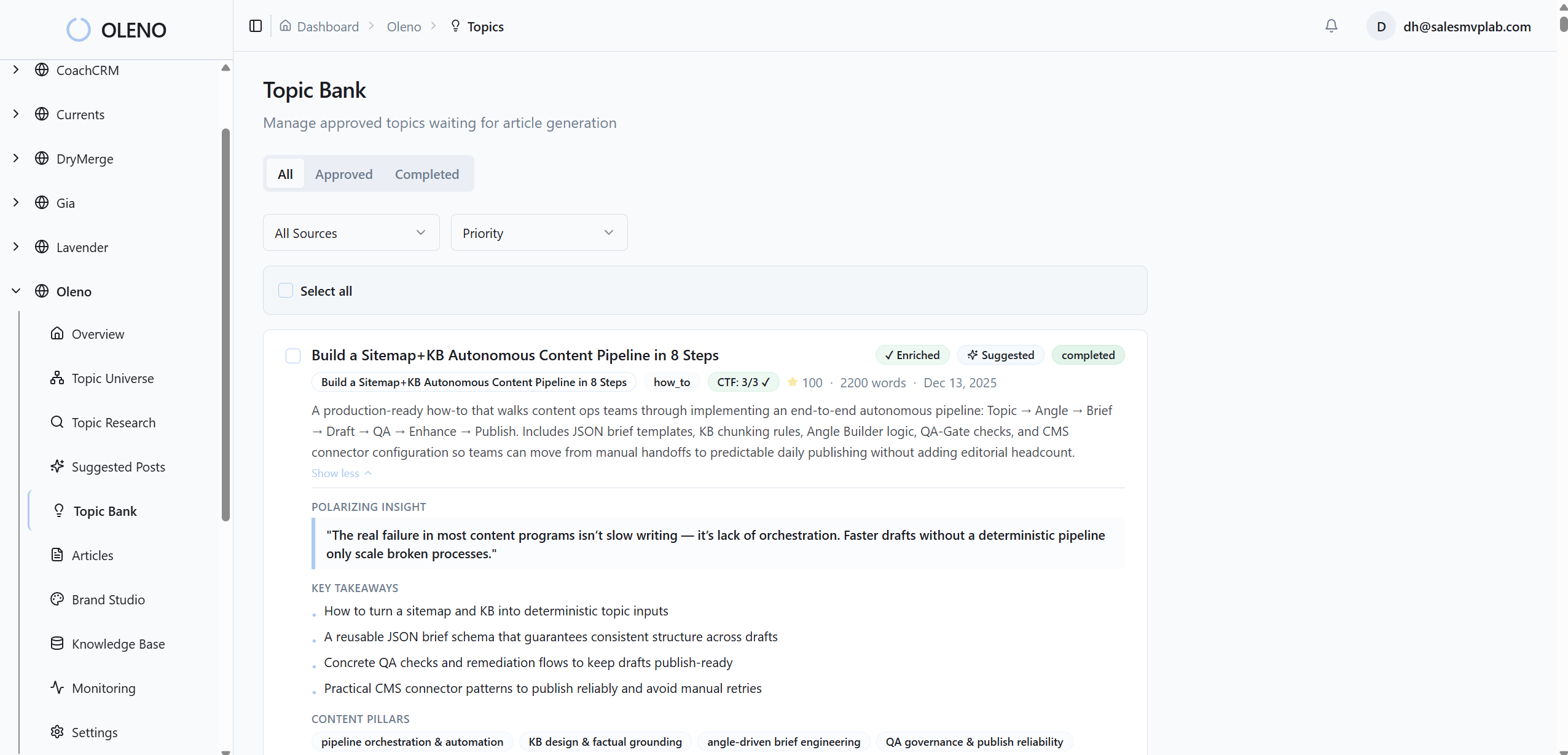
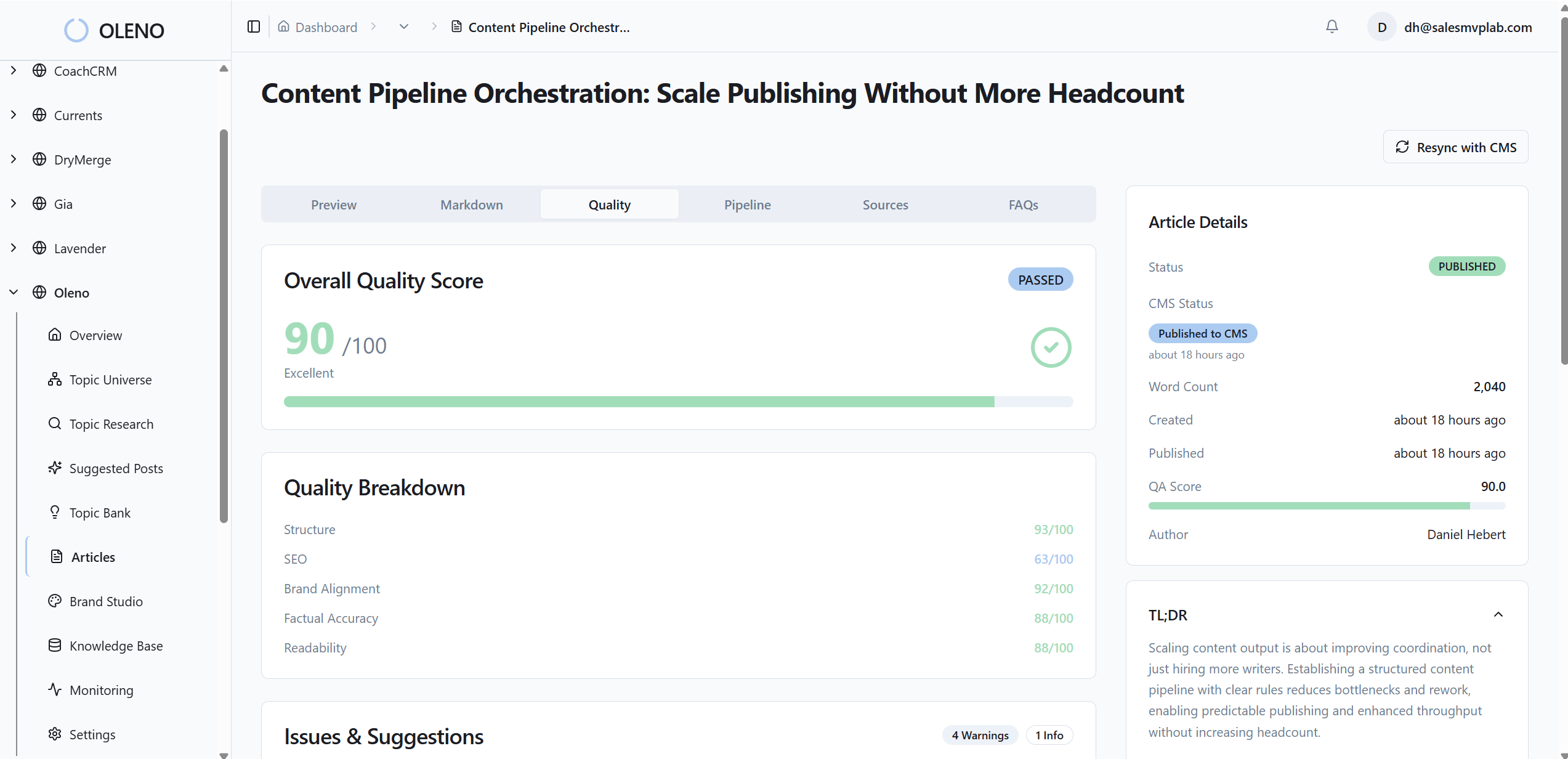
Draft to publish without manual handoffs. Drafts follow the brief exactly, with 40 to 60 word snippet openings for each H2. Visual Studio generates a hero and two to three inline images using brand assets, matches product screenshots to relevant sections, and writes alt text and filenames automatically.
Deterministic finish. Internal links inject from verified sitemaps only. JSON‑LD schema is generated and validated. The QA gate evaluates 80 plus criteria and triggers refinement loops when needed. Publishing maps fields to WordPress, Webflow, HubSpot, or Google Sheets with retries and debounced notifications. For a walkthrough, see an orchestrated pipeline and harden delivery with CMS reliability patterns.
If you prefer to trial this flow before committing, you can try using an autonomous content engine for always-on publishing.
Implementation Rollout: From Pilot To Daily Cadence
Start with a pilot cluster. Pick one pillar, set cluster thresholds and cooldowns, and convert five to ten topics into fully constrained briefs. Run the pipeline end to end, tuning voice, snippet length, visual rules, and link boundaries in the process.

Gradually expand scope. Add clusters once the pilot hits its QA pass rate. Introduce publishing to a staging environment first. Tighten rules where drift persists and document changes as policies, not tips. Your work becomes a system, not a set of reminders.
Move to always on. Approvals shift to brief-level governance. Daily suggestions keep the queue full. The system handles QA, visuals, links, schema, and publishing. Your team spends time on strategy and the exceptions that warrant human judgment. For rollout context, revisit the ai content operations hub and this path to deterministic publishing.
Remember the coordination tax we quantified earlier? Here is how it changes with automation. Oleno replaces fragmented steps with a single, governed pipeline that runs every day. Topic Universe prevents over-publishing and keeps coverage balanced. The brief generator enforces differentiation with an Information Gain score and recommended external sources. The drafting stage produces snippet-ready sections that align to your brand voice. Visual Studio generates brand-consistent hero and inline images, plus alt text and filenames, without manual edits. Internal links inject from verified sitemaps, and schema attaches as validated JSON‑LD. The QA gate evaluates structure, voice, and clarity against 80 plus criteria. Connectors publish to your CMS reliably.
In practice, deterministic execution cuts the non-writing burden that creates frustrating rework and late-night fixes. Teams using Oleno often redirect those hours into better angles and product storytelling, not coordination.
To make this concrete, here are the specific capabilities that matter most:
- Topic Universe maps clusters, tracks saturation, and enforces cooldowns so coverage compounds instead of repeating.
- Brief generation performs competitive research, calculates an Information Gain score, and flags low-differentiation outlines before writing.
- Visual Studio generates brand-consistent images, matches product screenshots to relevant sections, and produces SEO-friendly alt text and filenames automatically.
- Internal links are injected algorithmically from verified sitemaps only, and JSON‑LD schema is generated and validated before publish.
- The QA gate blocks weak structure, off-voice phrasing, and low information gain, then enhancement loops fix issues before anything ships.
If you want to watch this run end to end, Request a demo.
Conclusion
You do not need more drafts. You need fewer handoffs that fail quietly and create work you did not plan to do. When you operate content like infrastructure, the system becomes the product. Topics flow into briefs, briefs into drafts, drafts into complete, on-brand articles that publish cleanly.
Start small. Pick one cluster, set coverage rules, and encode the editorial instincts you apply every week. Then let the pipeline enforce them. The payoff is not just fewer headaches. It is a steady cadence of credible, reference-worthy content that compounds without heavy management.
About Daniel Hebert
I'm the founder of Oleno, SalesMVP Lab, and yourLumira. Been working in B2B SaaS in both sales and marketing leadership for 13+ years. I specialize in building revenue engines from the ground up. Over the years, I've codified writing frameworks, which are now powering Oleno.
Frequently Asked Questions