How Category Frames Break and Enemy Frameworks Reset Them

Using enemy frameworks in category content usually matters most when your team is already producing content, but buyers still compare you on the wrong stuff. You felt this recently if you shipped an article, read it back, and realized it sounded fine, but could've been written by almost anyone in your category.
That’s the headache. The content isn’t bad. It’s just not resetting how the market thinks. And for a Head of Marketing on a 1 to 3 person team, that creates frustrating rework fast. You brief the writer, rewrite the angle, edit the draft, then still worry the piece won’t move pipeline because it inherited the market’s defaults instead of challenging them.
This is where category framing has to become a system, not a clever moment in one good article. By the time Oleno shows up in this piece, the important part should already be clear: if your point of view only exists in your head or scattered docs, it won’t survive scale.
Key Takeaways:
- Enemy frameworks work best when they define what your category is pushing against, not just what your product offers.
- If your team needs more than two major POV rewrites per article, the problem is usually framing drift, not writing quality.
- In the GEO era, consistent market framing across 20 to 40 assets matters more than one smart standalone post.
- Category Studio turns an approved enemy frame into reusable logic that can guide downstream content jobs.
- Enemy frameworks sharpen positioning, but they won’t fix weak product truth, vague audience definitions, or missing strategy alignment.
Why Generic Positioning Keeps Buyers On The Wrong Criteria
Generic Positioning Leaves Buyers Comparing You On The Wrong Criteria
Generic positioning creates a very specific problem: buyers start evaluating you with someone else’s scorecard. If your article says “save time with AI” or “create content faster,” you’ve already accepted the frame set by a crowded market. Now you’re being compared on speed, volume, and surface features, even if your actual advantage is governed execution and consistent point of view.
I’ve seen this play out a lot with lean SaaS teams. The Head of Marketing knows the company has a stronger argument. But because that argument isn’t fully encoded, the content falls back to safe language. Safe language is expensive. It sounds polished enough to publish, but weak enough to trigger extra review rounds. If three stakeholders each spend 20 minutes trying to “tighten the message” on every draft, and you publish eight pieces a month, that’s eight hours gone right there. One workday. Just on fixing framing drift.
Back at PostBeyond, I could write 3 to 4 strong blog posts a week because the context lived in my head and I was close to the customer pain. Once the team grew, output got slower, not faster. The writer had less context than I did, and I had less time than before. So quality dipped, reviews got longer, and the whole thing became a tax on the team. Same pattern here. When framing doesn’t transfer, your content operation starts leaking time.
If you want a simple diagnostic, check your last five category or thought leadership articles and ask three questions. Did they all push against the same bad assumption in the market. Did they all define the old way in similar language. Could a new writer explain your category enemy after reading them. If the answer is no to two of those three, your positioning is still living as opinion, not operating logic.
A weak frame doesn’t just blur your message. It hands the market your narrative.
When Category Language Is Weak, Content Inherits The Market’s Defaults
Content always borrows a frame from somewhere. If you don’t define one, the category will do it for you.
That’s why keyword-led content and feature-led content often feel productive at first, then disappointing later. You rank a bit. You publish regularly. Maybe traffic even rises. But the buyer learns the market’s language, not yours. And the market’s language usually benefits incumbents, broad platforms, or whichever vendor got there first with a simple story. A smaller team can’t afford that. You don’t have enough shots to waste them.
There’s a fair counterpoint here. Sometimes feature-led content is the right move, especially when buyers are deep in evaluation and need clarity fast. I’m not arguing every article has to be category theory. The issue is when your top-of-funnel and mid-funnel content never establishes a frame worth carrying downstream. Then the rest of the funnel has nothing solid to build on.
In GEO, this gets worse. LLM-driven discovery doesn’t just reward isolated helpful pages. It leans toward brands that repeat a clear point of view across many assets. That’s what KB Source 1 and KB Source 5 are really getting at. Differentiation isn’t a nice add-on anymore. It’s part of whether your brand looks cite-worthy at scale. If article one says “AI makes writing faster,” article two says “content teams need efficiency,” and article three says “brand voice matters,” you may have accurate content, but you don’t yet have a usable market position.
If you’re trying to reduce that editing tax early, you can request a demo and see how governed category framing gets set up before it reaches the draft stage.
Why Strong Category Framing Starts By Naming What You Reject
Strong Category Content Starts By Naming The Enemy, Not Listing Benefits
Strong category content usually starts with opposition. Not negativity for the sake of it. Precision.
When you name the enemy, you give buyers a frame of reference. That matters because confused buyers rarely evaluate well. They need to understand what old belief, old process, or old category assumption no longer holds up. Once they see that clearly, your point of view has somewhere to land.
This is one of those places where people get a little uncomfortable. They think naming the enemy sounds too aggressive or too theatrical. Fair concern. If you overdo it, you end up writing cartoon copy. But the answer isn’t to avoid contrast. It’s to make the contrast useful. The enemy should be a broken way of thinking, not a strawman competitor. For Oleno’s positioning, that enemy often looks like fragmented execution, prompt-by-prompt content work, or the Editing Tax that shows up when AI drafts faster than your team can verify them.
The easiest test is this: can your enemy framework be stated in one sentence that a buyer would recognize from lived experience. Something like, “The bottleneck isn’t writing speed, it’s fragmented execution that creates rework.” That’s usable. “Legacy systems are outdated” isn’t. Too broad. Too soft. No teeth.
And there’s a second test. If your team can’t explain what you’re pushing against in under 15 seconds, the frame is still too fuzzy to scale. Buyers won’t hold a vague argument in their head. Neither will your writers.
A Usable Framework Turns Opinion Into Repeatable Execution
Opinion becomes useful when it survives handoffs. That’s the real bar.
A lot of teams do have opinions. The founder has them. The PMM has them. Sales definitely has them. But they show up unevenly. One webinar sounds sharp. One LinkedIn post lands. One article gets it right. Then two weeks later the whole message drifts because nobody translated that opinion into a repeatable structure.
That’s why I’d argue framing is much closer to governance than copywriting. Copy is the expression layer. The real problem sits upstream. What does the team believe is broken in the market. What are you replacing it with. What implication should every piece of content carry. If those questions aren’t settled, every draft becomes a fresh negotiation.
Let’s pretend your team publishes 12 articles in a quarter. If half of them need one extra review cycle because the point of view is unclear, and each cycle burns 45 minutes across marketing, leadership, and maybe PMM, you’re looking at 4.5 hours of senior time on a problem that should’ve been solved once. That’s before talking about lost momentum, delayed publishing, or the quiet cost of articles that technically go live but never shape how the buyer sees the problem.
This is also why prompting alone doesn’t get you there. Prompting can generate text. It can’t reliably hold a market argument together across months of production. KB Source 8 makes that point well. Speed without structure creates noise. In my experience, that’s exactly where most teams get stuck.
How Category Studio Turns Strategy Into Reusable Framing Logic
Category Studio Turns A Strategic Stance Into Reusable Operating Logic
This is where Oleno comes in, and specifically where category studio matters.
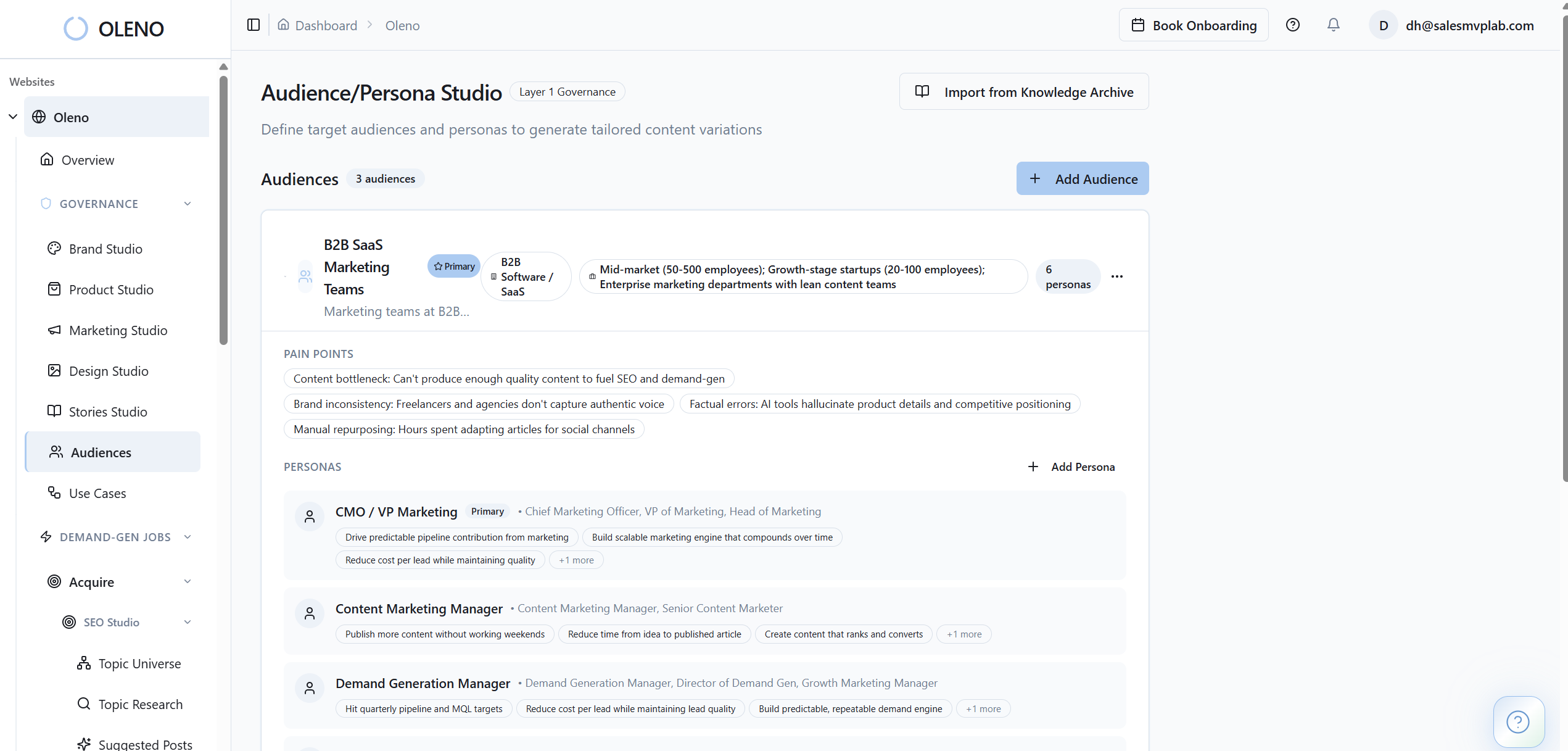
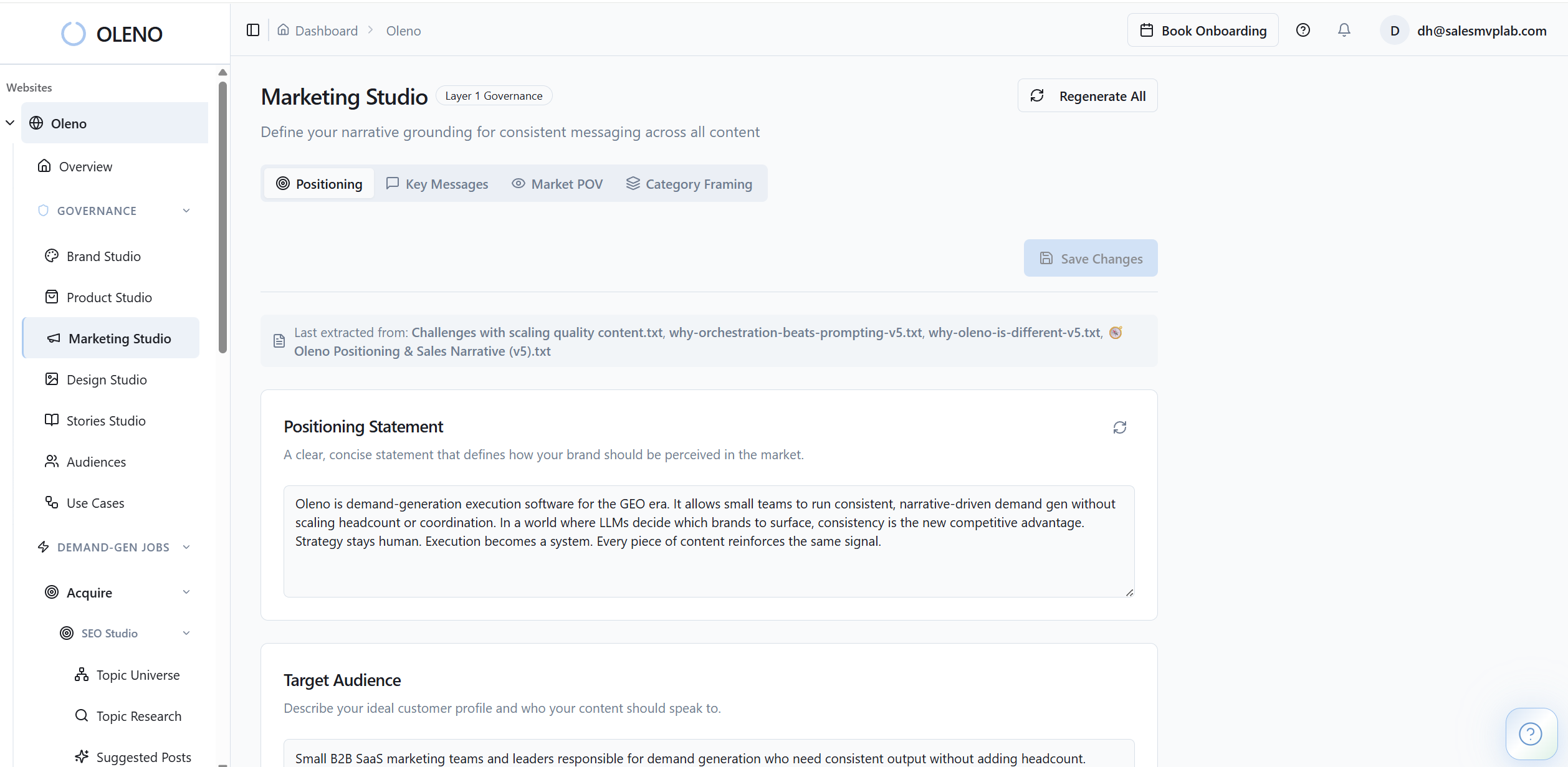
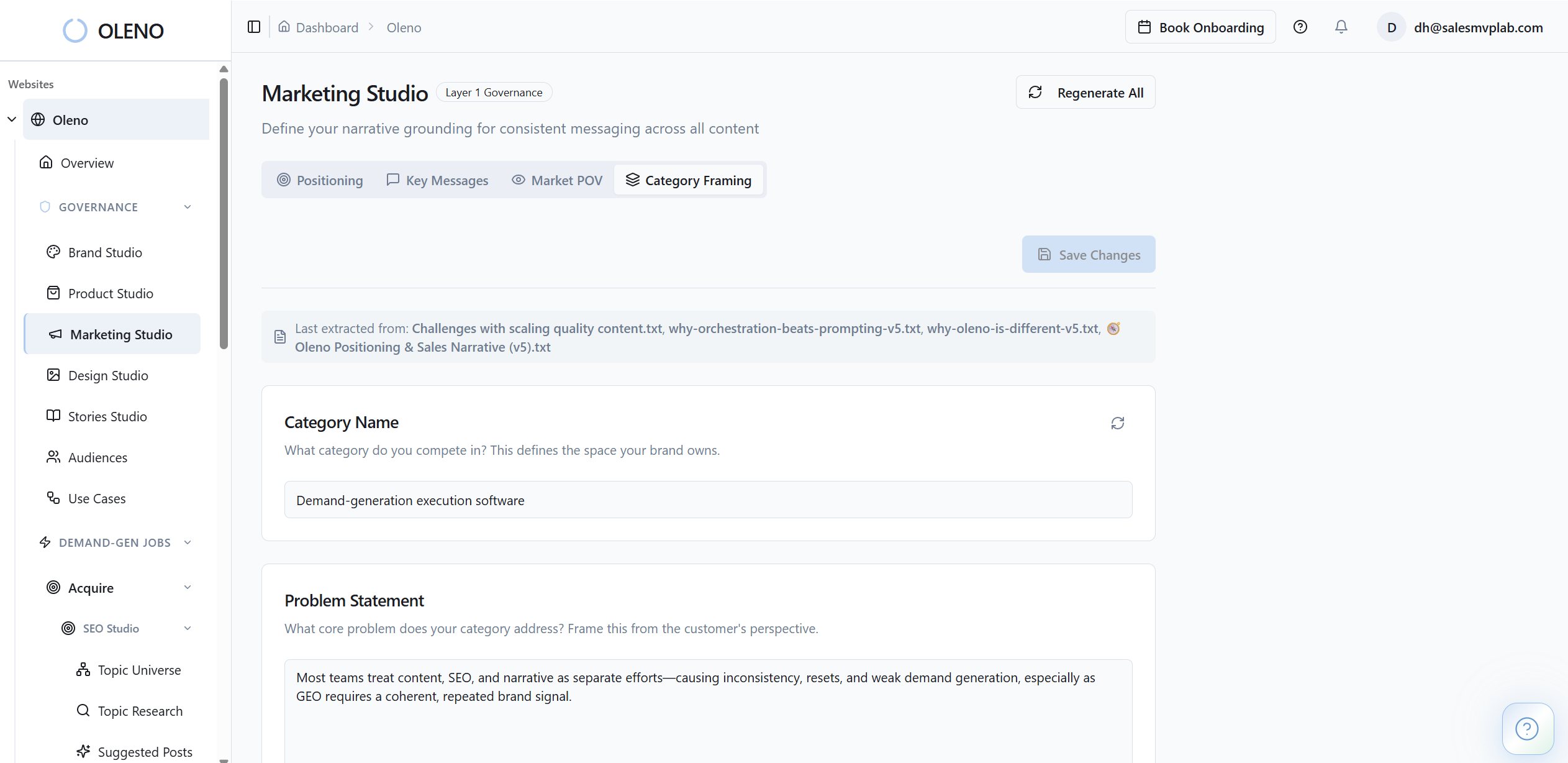
Category studio is built to capture category framing in a way the rest of the system can use repeatedly. Instead of leaving your strategic stance buried in a planning doc or trapped in one leader’s head, you define the market frame you’re pushing against, the alternative you want to establish, and the implication that should carry through your category content. Then that logic becomes available to downstream content generation rather than needing to be restated from scratch every time.
That matters more than it sounds. Because most content teams don’t actually fail at coming up with a decent angle once. They fail at carrying the same sharp angle across enough assets that the market starts to remember it. Oleno’s broader setup is designed around that. Marketing studio holds your point of view and category framing. Product studio holds product truth and boundaries. Audience and persona targeting makes sure the message lands differently for a Head of Marketing than it would for an enterprise CMO. Category studio sits inside that system and applies the framing where category content is supposed to do the heavier narrative work.
You can think of it like setting the rails before the train moves. If the rail is “AI writing is the solution,” the article goes one direction. If the rail is “AI writing sped up drafts but made fragmented execution more obvious,” you go somewhere much more differentiated. Small difference on paper. Big difference in market interpretation.
If you want to see how that structure turns into actual output, request a demo and look at how category framing gets encoded once, then reused across the system.
One Approved Frame Can Guide Every Downstream Content Job
One approved frame can do more work than most teams expect. That’s the upside.
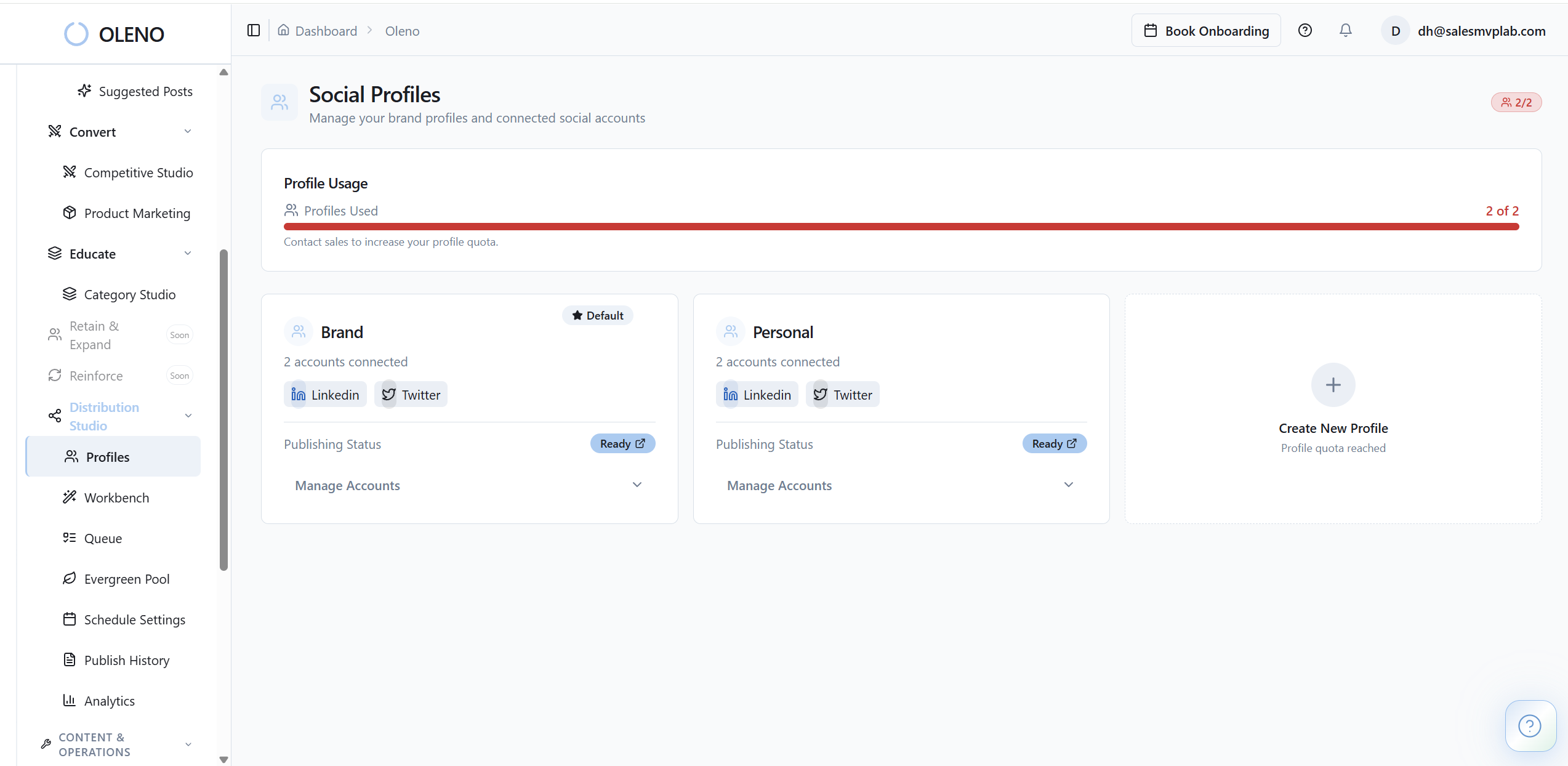
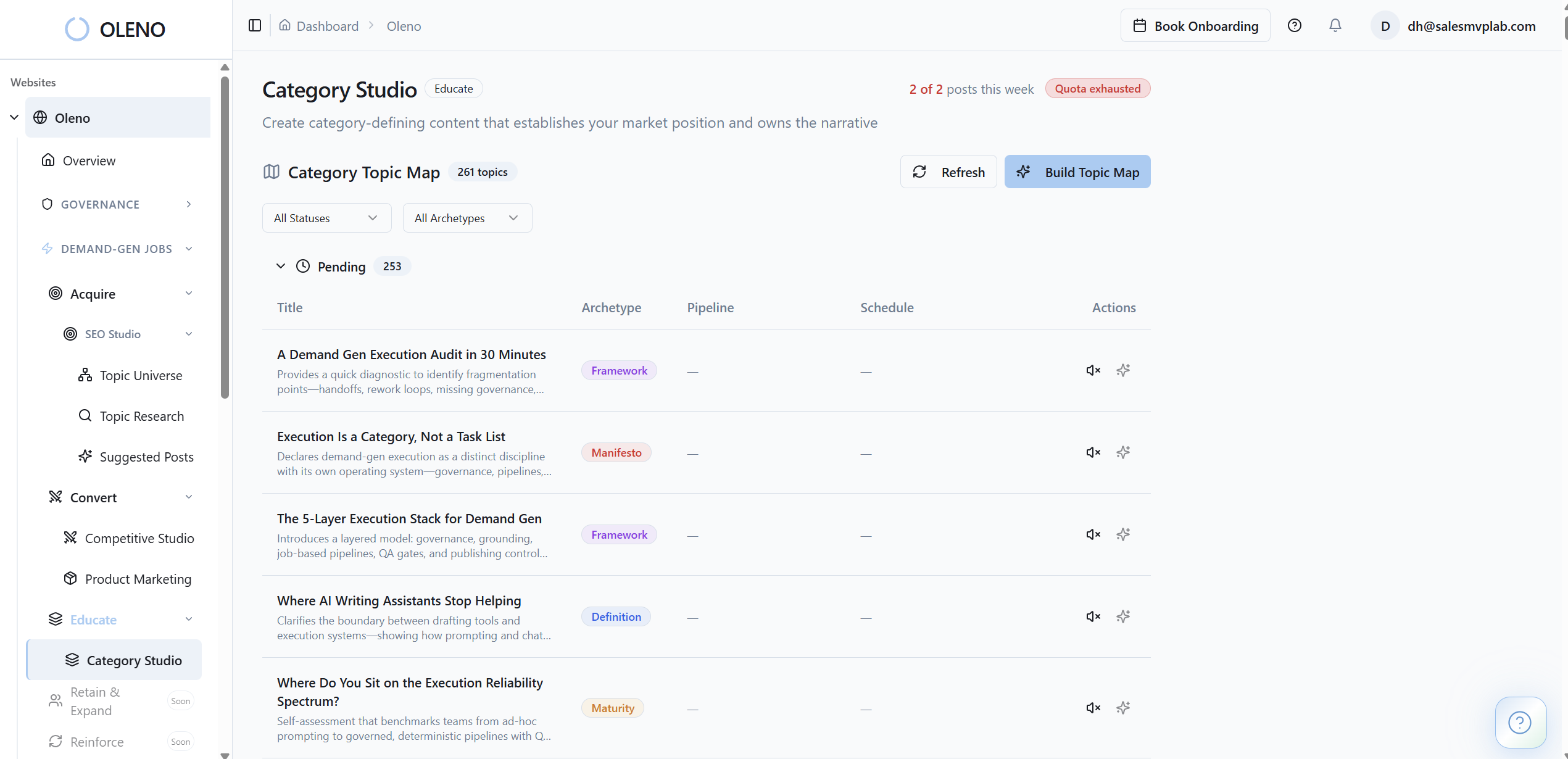
Once the core framing is set, it can guide more than a single category article. It can influence acquisition content, evaluation content, product-led content, and even social distribution after the article is approved. That doesn’t mean every asset becomes identical. It means they stop contradicting each other.
The practical mechanism is pretty straightforward. First, the team defines the enemy frame clearly enough that it can be reused. Second, that frame lives alongside the rest of the approved messaging, product truth, and audience context. Third, downstream jobs pull from those approved inputs instead of inventing the angle ad hoc. So the writer or system isn’t deciding from scratch what the category argument should be. The argument is already governed. Execution happens inside those boundaries.
There’s a real concession worth making here. This won’t make every draft publish-ready on the first pass. You’re still going to have edge cases, rough sections, or moments where a piece needs tightening. But if the frame is encoded well, the kind of editing changes. You stop fixing the thesis and start refining the expression. That’s a much better use of senior marketing time.
This is also where the governance-first model matters. Oleno doesn’t rely on one prompt template hoping the next draft remembers last month’s strategic stance. It separates approved truth from execution. That lowers the odds of narrative drift across a bigger content run. Not zero. Lower. And for a lean team, lower is already a huge win.
How One Enemy Frame Changes The Final Article
One Enemy Frame Can Transform A Vague Category Article Into A Clear Point Of View
Let’s make this real with a growth-stage SaaS example.
Picture a Head of Marketing at a 60-person B2B SaaS company. Team of two, maybe three if they’re lucky. They’ve tried freelancers. They’ve tried AI tools. They’ve maybe even ranked for a few terms. Still, content feels disconnected from pipeline. Every draft sounds useful, but generic. Review cycles drag because leadership keeps saying some version of “this doesn’t quite sound like us.”
Before an enemy framework gets encoded, the category article usually says the obvious stuff. AI speeds up writing. SEO needs consistency. Teams need more output. None of that is wrong. It’s just not very ownable. A competitor can publish almost the same article by lunch.
After the frame is reset, the article changes shape. Now it argues that the real problem isn’t lack of output. It’s fragmented execution. Or prompting debt. Or the Editing Tax created when fast drafts still need humans to rebuild strategy, product truth, and point of view into every piece. Same broad topic. Different argument. Different buyer takeaway.
This is exactly why one Oleno-generated article reportedly got a prospect at Revve to say “Well damn” and sign up without a demo or sales call. The point wasn’t that one article magically closes every deal. It was that the output itself carried enough sharpness and credibility to prove the system behind it had substance. That’s a high bar. And frankly, most content misses it.
Resetting The Frame Reduces Editing Loops Before Publishing
The second effect is operational, not just strategic. Editing gets shorter when the article starts from the right frame.
You’ve probably seen the opposite. Draft comes in. The structure is fine. The grammar is fine. The examples are fine. But the whole thing is leaning on the wrong assumption, so now someone senior has to rewrite the opening, the comparison logic, the takeaway section, and half the CTA language. That’s not editing. That’s rebuilding.
If you want a simple red-flag checklist, look for these three signals in your current process:
- The biggest edits happen in the first 30 percent of the article, where the frame should’ve been set.
- Leadership comments keep using phrases like “more differentiated,” “push the POV harder,” or “this sounds like everyone else.”
- The same strategic correction appears across three or more drafts in a month.
That pattern usually means the issue sits upstream, not with the writer.
I learned a version of this years ago. At Proposify, we had a strong content team and ranked really well for a lot of topics. But some of the content sat too far from the solution and didn’t carry a strong enough demand-gen narrative back toward product relevance. Great traffic. Weaker commercial pull. That’s the trap. A weak frame can still generate output. It just can’t steer interpretation very well.
When the frame is set earlier, editing becomes narrower. You might still tweak examples, tighten language, or adjust the audience emphasis. But you’re not fighting the article’s worldview anymore. That saves time. More importantly, it makes the final piece sound like your company actually believes something.
Where Enemy Frameworks Stop Helping On Their Own
Enemy Frameworks Sharpen Positioning, But They Do Not Replace Product Truth
Enemy frameworks are useful. They’re not magic.
They won’t invent differentiation if the product story itself is muddy. They also won’t rescue content that makes unclear or unsupported claims. If your framing says the market is broken because of fragmented execution, but your product explanation is vague or inconsistent, buyers will feel that gap immediately. Sharp framing with weak truth underneath can actually make the problem more obvious.
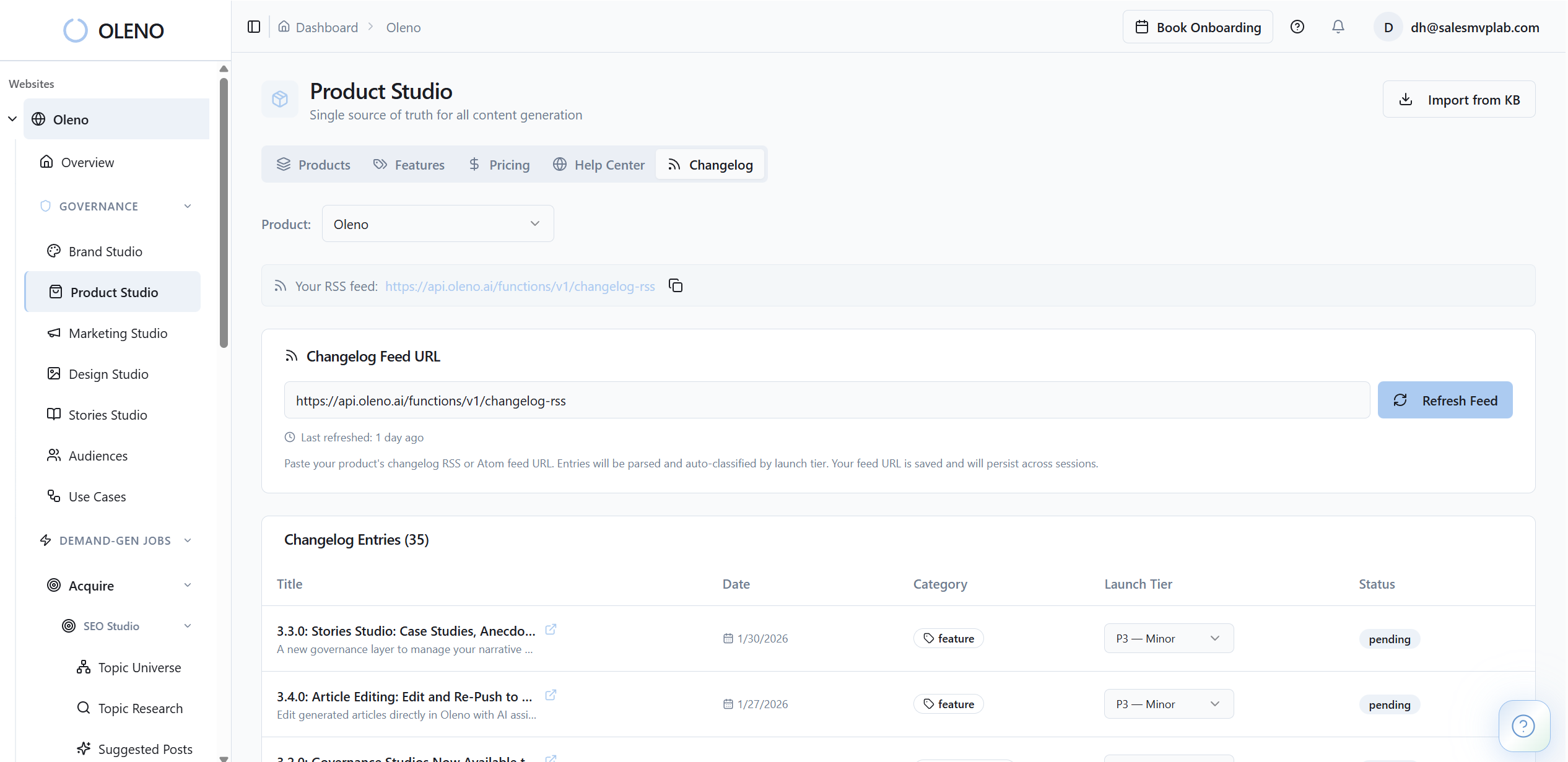
That’s why this has to stay connected to product studio and the rest of the governed inputs. Category studio can carry the market argument. Product studio keeps the product claims accurate and bounded. Marketing studio carries the broader point of view. Audience and persona targeting keeps the language relevant to who you’re trying to persuade. Pull one of those out and the frame gets shakier.
A lot of teams resist this because they want the framing layer to do all the work. I get it. If you’re buried in execution, it’s tempting to hope one strong narrative device will fix the whole system. It usually won’t. It sharpens. It doesn’t replace.
So if your team still disagrees on your core market argument, solve that first. If product claims are outdated, fix that. If your audience definitions are too broad, tighten them. The frame needs something true to sit on.
A Strong Frame Still Fails If The Team Has Not Agreed On The Strategy
This is the other limitation, and it’s a big one. The best enemy framework still falls apart if the team hasn’t actually aligned on strategy.
You can’t encode clarity you don’t have. If the founder wants one story, PMM wants another, and demand gen wants something softer for conversion reasons, category framing becomes political instead of useful. Then every article becomes a proxy fight. You feel that as slow approvals, weird compromises, and content that tries to say three things at once.
There is a case for some flexibility here. Early-stage companies do need room to test angles. You shouldn’t lock yourself into a rigid message too early. But once you’ve got customer patterns, clear objections, and a few repeated buying triggers, indecision becomes expensive. At that point, the cost of staying fuzzy is usually higher than the risk of choosing a sharper frame.
A practical threshold I’d use: if the team can’t finish the sentence “buyers should stop evaluating this category based on ___ and start evaluating it based on ___,” you’re not ready to operationalize an enemy framework yet. Workshop that sentence first. Get agreement. Then encode it.
Otherwise you’re just scaling ambiguity.
The Next Step Is To Encode One Frame And Run It
Teams That Govern Category Framing Spend Less Time Re-Explaining Their Point Of View
Teams that govern category framing tend to spend less time re-briefing, re-explaining, and re-editing the same core argument. That’s the real gain. Not louder opinions. Less strategic repetition inside the workflow.
For a lean SaaS marketing team, I wouldn’t start with five frameworks. Start with one. Pick the market belief that hurts you most. Define what you reject, what replaces it, and what implication should show up in category content. Then run that across a small content set. Three articles is enough to learn a lot. You’ll see quickly whether review cycles shorten, whether the message stays more consistent, and whether the team starts sounding more like one company instead of three different contributors.
That’s also a safer way to adopt this. Narrow scope. Clear test. Fewer moving parts.
The Fastest Next Step Is To Encode One Frame And Test It Across A Content Run
If your team is tired of paying the Editing Tax every time category content gets drafted, the fastest next step is pretty simple: encode one enemy framework in category studio, then test it across one focused content run tied to a real campaign or narrative theme.
That lets you measure something concrete. Are the first drafts closer to the real argument. Are approvals faster. Does the content sound more differentiated without needing a senior marketer to rewrite the thesis every time. If the answer starts leaning yes, you’ve got something worth rolling out further.
And if you want to pressure-test that setup with your own positioning, book a demo and walk through one frame before you try to scale it across the rest of your content program.
About Daniel Hebert
I'm the founder of Oleno, SalesMVP Lab, and yourLumira. Been working in B2B SaaS in both sales and marketing leadership for 13+ years. I specialize in building revenue engines from the ground up. Over the years, I've codified writing frameworks, which are now powering Oleno.
Frequently Asked Questions