Why Demand Generation Execution Software Matters in the GEO Era

77% of teams are already using or exploring AI in marketing, but that stat hides the real problem: most of them still run demand gen through a pile of disconnected tools, prompts, people, and review loops. If you’re a CMO or VP Marketing, you’ve probably felt this this week already. Strategy is clear in your head. Somewhere between the brief, the draft, the PMM notes, the SEO edits, and the CMS, it comes out blurry.
Demand-generation content execution software is a marketing execution system that turns strategy into consistent, multi-format demand generation by operationalizing governance, product truth, audience context, and publishing workflows inside one coordinated environment. Unlike AI writing assistants or SEO platforms, demand-generation content execution software is built to hold the whole system together over time, not just produce one useful output at a time.
The category showed up because GEO changed the bar. In the SEO era, you could get away with strong tactics and weak consistency for a while. In the GEO era, LLMs are synthesizing what they see across your body of work. That means the brands that get surfaced tend to be the ones repeating a clear story, a clear position, and clear product definitions again and again.
Key Takeaways:
- The bottleneck usually isn’t writing speed. It’s fragmented execution.
- Fragmented Demand Generation is the enemy: too many tools, too many handoffs, no shared source of truth.
- GEO rewards consistency across dozens or hundreds of assets, not random bursts of content.
- This category is not about drafting faster. It’s about making execution repeatable.
- If strategy lives in decks and truth lives in Slack, drift is almost guaranteed.
- The teams that win tend to define voice, positioning, audience, and approved claims before they scale output.
Why Fragmented Demand Generation Breaks in the GEO Era
Demand generation execution software matters now because most teams don’t actually have a demand-gen system. They have activity. That worked well enough when channels were more forgiving. It works a lot worse when humans, search engines, and LLMs are all judging your brand at the same time.
Most Teams Are Running Motion, Not a System
A lot of marketing teams look organized from the outside. There’s a content calendar. There’s an SEO tool. There’s a PMM. There’s probably an agency or freelancer somewhere in the mix. But once you zoom in, the whole thing is stitched together. Strategy lives in a deck. Product nuance lives in someone's head. SEO priorities live in another platform. Final approval lives in a Slack thread no one can find later.
That’s Fragmented Demand Generation. Not laziness. Not lack of talent. Just a patchwork system that got built one fix at a time until nobody can really say where the source of truth is anymore. And that matters more than people think, because when the system is fragmented, every asset becomes a mini reset.
A good gut check is the 3-Layer Gap test. If your executive POV, product truth, and writer context live in three different places, you’ll pay for it in rewrites. Every time. If two or more of those layers are disconnected, the problem isn’t content quality. The problem is execution design.
GEO Raises the Cost of Inconsistency
Google could be messy and still useful to you. You could rank a strong page even if the rest of your body of work was a little all over the place. LLM-driven discovery is less forgiving. These systems don’t just inspect one page. They infer who you are from repeated patterns.
That changes the game. A random burst of 20 articles might create traffic. It may not create trust. And if your positioning drifts from one page to the next, or your product framing changes depending on who wrote the piece, you send weak signals right when consistency matters most.
According to McKinsey’s research on generative AI adoption, marketing and sales are among the biggest areas of AI experimentation, which is part of why this gets messy so fast: more content gets produced, but the system around that content often doesn’t improve at the same rate (McKinsey). More output without stronger structure usually creates more review overhead, not less.
Every Tool Solves a Piece, Which Is Why the Whole Thing Still Fails
Content tools help you draft. SEO platforms help you find opportunities. Agencies help you ship. AI writers help you get words on the page faster. None of that is useless. Fair point. Most teams need some of those tools.
But the stack breaks because each tool assumes the rest of the system is already working. It isn’t. That’s the hidden flaw. The handoff between systems becomes the job. And once the handoff becomes the job, the team spends more time coordinating than compounding.
I’ve seen this pattern enough times that I think of it as the Relay Race Trap. Everyone on the team is moving. Nobody is moving together. The baton keeps getting dropped in the handoff, then leadership wonders why speed isn’t translating into pipeline. If you want to see what a connected alternative looks like, you can request a demo.
Why Faster Writing Tools Don’t Fix a Broken Execution Layer
Demand generation execution software is not another writing category. It exists because the old mental model is wrong. Teams keep buying tools that optimize parts of the workflow while leaving the full execution layer unresolved.
Faster Drafting Was Never the Core Problem
AI made drafting faster. That part is real. But speed on draft one doesn’t mean speed to publish, and it definitely doesn’t mean consistency across a quarter of output. That’s where a lot of teams get fooled.
Last summer, a founder was doing the manual GPT grind for a B2C app. Prompting, copy-pasting, moving content into the CMS, repeating the same task every day for 3 to 4 hours. It produced output. It did not produce a reliable operating system. That distinction matters. A lot.
If draft creation gets 70% faster but review and correction double, you didn’t actually win. You just moved the work downstream. That’s the Draft-Speed Illusion. If your post-draft process takes longer than your first draft, your bottleneck was never writing.
Prompt Workloads Push the Real System Back Onto Humans
Prompt-based workflows feel flexible because they are. That’s also why they break. Every prompt depends on the person writing it, the context they remember, the examples they include, and the judgment they apply afterward. So the humans still carry the hard part of the system.
That burden shows up in six places:
- someone has to decide what should exist
- someone has to add missing product context
- someone has to catch positioning drift
- someone has to verify claims
- someone has to rewrite for the audience
- someone has to publish and distribute correctly
And yes, that someone is usually your team. Which means as output grows, coordination grows too. Not linearly either. More like a tangled ball of extension cords behind a desk. Add one more tool and now the whole thing is harder to trust.
This Category Is About Governed Execution, Not Content Creation
Demand-generation content execution software is a different category because it governs the repeatable layer underneath content production. It doesn’t just help create assets. It determines how those assets stay aligned to a shared story, a shared audience model, and a shared product truth over time.
That’s why the “not X, but Y” distinction matters. This is not AI writing with a little process wrapped around it. It’s an execution category built for marketing teams that already know what they want the market to understand, but can’t reliably get that understanding into every asset at scale.
There’s a case to be made for keeping things lightweight if you publish very little. If you’re doing 2 to 4 pieces a month, and the same person owns strategy, writing, and review, you may not feel the pain yet. Cross 12 to 20 meaningful assets a month, or bring in 3 or more contributors, and the cracks usually show up fast.
The Cost of Fragmentation Gets Ugly Fast
Fragmented Demand Generation sounds abstract until you put numbers around it. Then it gets uncomfortable. Not because one thing is broken, but because five smaller failures start stacking on top of each other.
More Contributors Often Create More Drift
At PostBeyond, one marketer could push out 3 to 4 strong blog posts per week because the context was all in one head and the writing framework was clear. As the team grew, output didn’t rise in a straight line. It got slower. The writer didn’t have the same product context, authority, or positioning instincts, and the person who did have them had less time to write because leadership work took over.
That story matters because it’s common. Most teams assume adding contributors increases capacity. Sometimes it does. If the context transfer is weak, it increases drift first. My rule of thumb is simple: if a new contributor needs more than 3 revision rounds to hit the mark, the system is missing shared context, not talent.
Rankings Alone Don’t Mean Demand Gen Is Working
One company had a strong content team, strong writers, strong design, and strong rankings. They were showing up for a lot of topics. But the content sat too far away from the solution, so there was no clean line from traffic to demand. Great visibility. Weak narrative pull.
That’s a brutal place to be, honestly. You can point to the dashboard and say things are working. Meanwhile, pipeline stays fuzzy. This is where a lot of SEO programs quietly fail. They optimize for reach while ignoring narrative gravity.
Let’s pretend you publish 30 articles a quarter, each costing $800 all in between labor, tools, edits, and distribution. That’s $24,000. If even half of those articles are detached from your market position or product entry point, the waste isn’t just content spend. It’s lost repetitions of the story buyers needed to hear.
Coordination Cost Can Pass Creation Cost
This is the cost most leaders miss because it’s spread across calendars, comments, and meetings. One PMM reviews for accuracy. One SEO lead rewrites the intro. A content lead changes the angle. A founder tweaks the POV. Someone fixes formatting in the CMS. None of those tasks look huge on their own.
Added together, they become the tax. If 5 people spend just 20 minutes each touching a piece after draft stage, that’s 100 minutes of review labor per article before publish. Hit 25 articles in a month and you’re at 41.6 hours. More than a full work week. Gone.
There’s a threshold where content operations stop being a creation problem and become a coordination problem. For scaling SaaS teams, that threshold often shows up once 4 or more stakeholders regularly touch content before publication. That’s when execution debt starts compounding faster than output.
What This Feels Like for the Team Carrying It
Fragmented execution creates a specific kind of frustration inside a marketing team. The strategy sounds tight in leadership meetings, then every article comes back with the same issues. Wrong audience angle. Weak product framing. Neutral positioning. Frustrating rework. Same conversation, different draft.
Strategic Leaders End Up Doing Repair Work
The review cycle becomes a tax on the people who should be shaping direction. Instead of deciding what the market needs to hear next, they’re fixing claims, tightening positioning, and rewriting intros because the context didn’t survive the handoff.
You’ve probably lived this one. You approve the narrative once, then re-approve it 17 more times in fragments. That’s not scale. That’s leakage.
Quarterly Planning Turns Into Quarterly Resetting
Busy teams can still feel like they’re starting over every quarter because the system never really holds onto what was learned. Messaging changes. Priorities shift. Writers change. Agency context disappears. Old briefs are useless. Nothing compounds because nothing stays connected.
And this part is easy to miss: the emotional drain isn’t just overload. It’s the sense that the team is working hard and still not building market memory. That’s the part that stings.
What Category Leaders Do Instead
Category leaders replace Fragmented Demand Generation with a system. Not a pile of prompts. Not a handful of scattered docs. A system. That’s the shift this category is really about.
Here’s the three-part model:
- Unified Governance: Strategy scales only when positioning, voice, audience, and product truth are defined once and enforced everywhere.
- Systemic Execution: Demand generation works best when planning, creation, review, and publishing operate as one repeatable workflow instead of disconnected tasks.
- Compounding Consistency: GEO visibility improves when a brand repeats a clear, differentiated narrative across enough high-quality outputs for humans, search engines, and LLMs to trust it.
Governance Has to Exist Before Scale Works
Governance is a loaded word, but the idea is simple. Decide the important stuff once. Your point of view. Your audience segments. Your approved product definitions. Your use cases. Your voice. Your constraints. Then stop re-deciding them every time a new asset gets made.
Back in 2012 to 2016, a contributor-driven site grew to 120k monthly visitors because it had both breadth and depth, and enough recurring input to create long-tail compounding effects. Traffic spikes showed up at 500 pages, 1,000, 2,500, 5,000, then 10,000. Most individual pages got fewer than 100 views a month. Still, the catalog worked because volume and quality reinforced each other. That pattern matters now even more. GEO tends to reward repeated clarity across lots of assets, not isolated hero pieces.
The 500-Page Rule is useful here. Before you have broad coverage, inconsistency hides. After you build enough surface area, inconsistency becomes visible to everyone, including machines. That’s why governance has to come before scale, not after.
The Best Teams Repeat on Purpose
A lot of marketers are scared of repetition because they think it sounds lazy. I’d argue the opposite. Repetition is how markets learn what bucket to put you in. The problem isn’t repetition. The problem is random repetition with no message discipline.
The best teams don’t keep reinventing the frame. They repeat strategically across formats, channels, and funnel stages. Same core truth. Different angle. Same category point of view. Different audience context. Same product reality. Different use case.
That’s also why GEO changes the stakes. LLMs aren’t looking for your most creative sentence. They’re looking for a stable pattern they can trust. If your positioning changes every six weeks, you’re teaching the market to stay uncertain. If you want to pressure test what that system could look like in your own team, request a demo.
Planning, Knowledge, and Production Have to Stay Connected
Demand gen compounds when three things stay linked: what should exist, what is true, and what gets published. Break that chain and the team starts guessing. Guessing leads to drift. Drift leads to rework. Rework leads to slower output and weaker signal.
This is where the category becomes practical, not theoretical. The planning layer should determine what topics matter. The knowledge layer should hold the market POV, audience context, and product truth. The production layer should execute from those inputs repeatedly. If one layer lives outside the others, the machine loses reliability.
| Dimension | Old Way | Category Way |
|---|---|---|
| Strategic Source Of Truth | Strategy lives across decks, Slack threads, prompts, and people | Governance is centralized and reusable across execution |
| Content Creation Model | Each asset is treated like a new one-off project | Each asset is generated from a shared execution system |
| Narrative Consistency | Voice, claims, and positioning drift over time | Messaging stays aligned across formats and contributors |
| GEO Readiness | Inconsistent signals weaken LLM confidence and visibility | Repeated, structured signals strengthen discoverability |
| Team Scaling | More contributors create more rework and coordination cost | More output comes from system leverage, not chaos |
| Pipeline Impact | Rankings and activity may rise while conversion logic stays weak | Content aligns more tightly to demand-gen outcomes and funnel needs |
Think of it like a manufacturing line with bad drawings. You can hire faster operators. You can buy shinier tools. If the blueprint is unclear, you just make bad parts faster. Same issue here.
How Oleno Puts This Category Into Practice
Oleno is what demand generation execution software looks like when the category gets operationalized for a marketing team. Not as another writing tool. As a system that ties strategy, product truth, audience context, and execution together so output can scale without drifting.
Oleno Starts With the Rules, Not the Draft
Oleno uses marketing studio, brand studio, product studio, audience & persona targeting, and use case studio to define the inputs that usually stay scattered across docs, Slack, and people. That matters because when your positioning, approved claims, audience context, and use-case framing are set upfront, the draft is no longer starting from scratch every time.
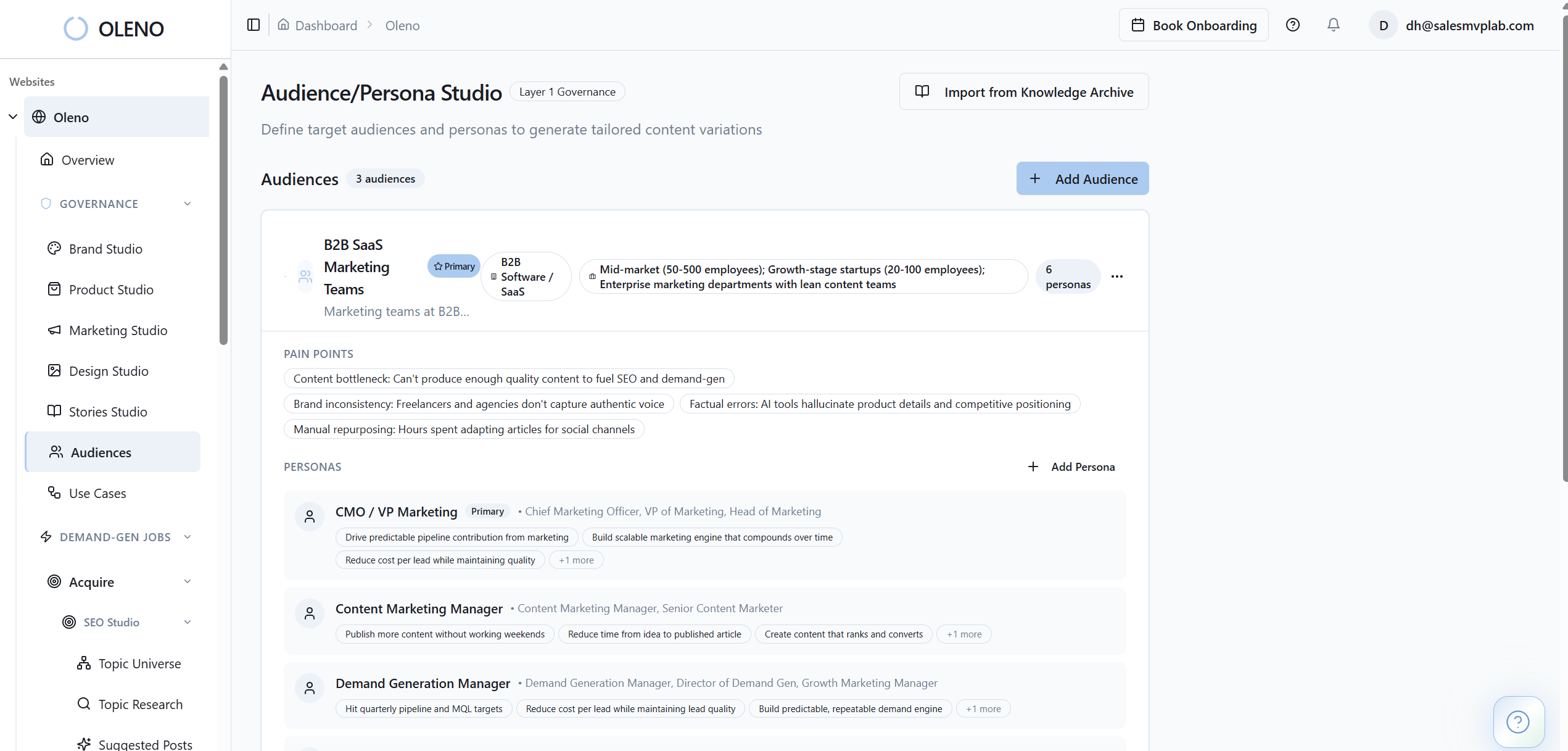
That structure reduces the review burden in a very practical way. Marketing studio keeps the market POV and enemy framing consistent. Product studio anchors product accuracy and approved boundaries. Audience & persona targeting and use case studio make the same topic land differently for different buyers and situations, instead of flattening everything into one generic article.
Planning and Production Share the Same System
This is where a lot of tools fall apart. Planning happens in one place. Writing happens in another. Publishing happens in a third. Oleno connects those layers through storyboard, programmatic seo studio, category studio, competitive studio, product marketing studio, buyer enablement studio, and orchestrator so the work moves from approved topics to draft to QA to publish inside one system.
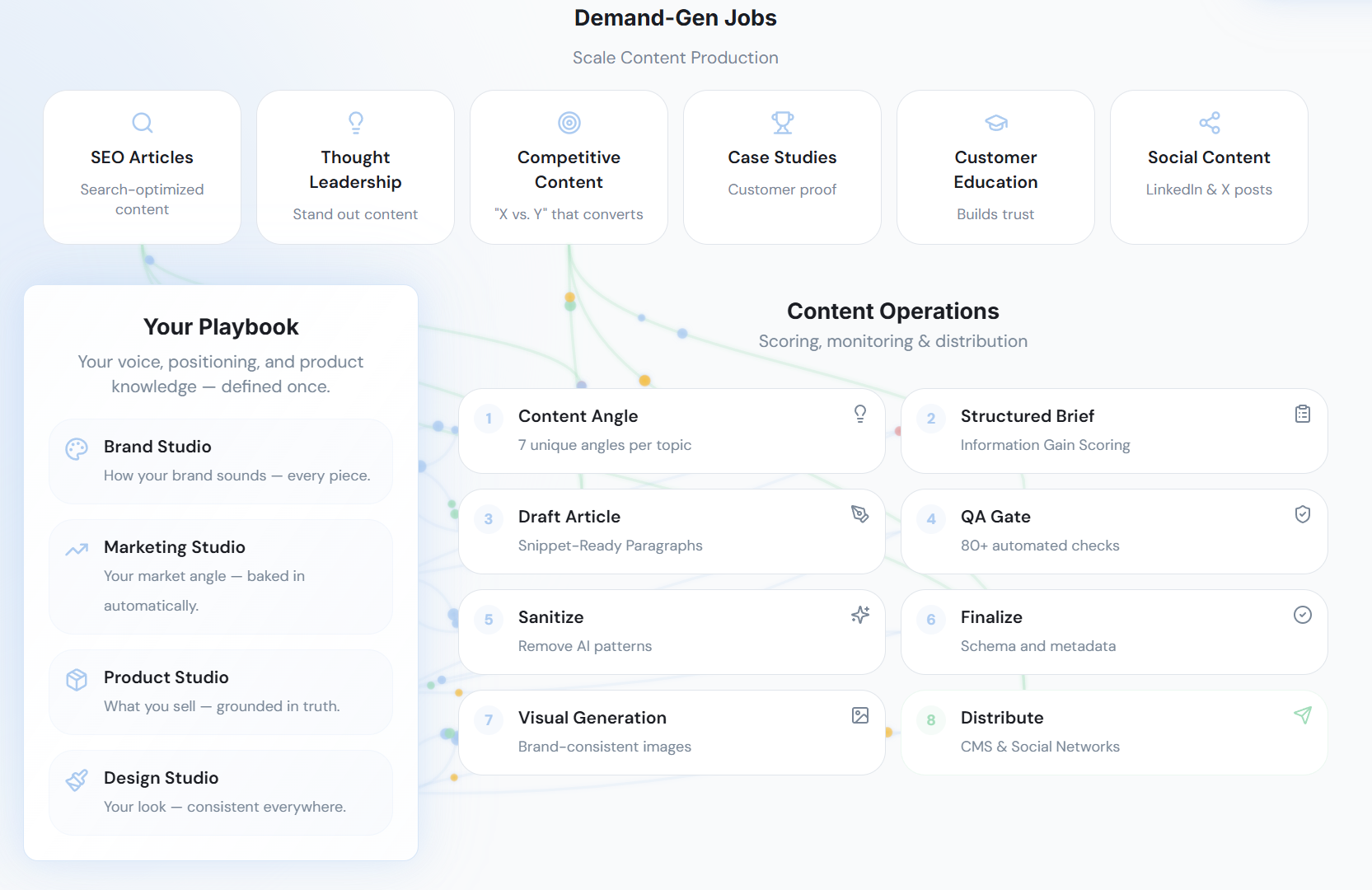
That means the team isn’t manually rebuilding the same process every week. Programmatic seo studio handles acquisition content at a steady cadence. Category studio supports long-form market-defining pieces. Product marketing studio covers feature and use-case content. Competitive studio handles evaluation-stage pages. The orchestrator schedules existing approved topics, runs the blueprint pipeline, and enforces quotas and pacing instead of waiting for someone to push every button.
And that’s the real point. Different job types. Shared system.
Compounding Starts When the Hand-Off Tax Drops
Oleno also closes the loop with quality gate and cms publishing, so the work doesn’t stall right before the finish line. Quality gate checks content against standards before it moves on. CMS publishing pushes finished work directly into your CMS without the usual copy-paste mess.

For teams trying to scale across SEO, category content, competitive pages, and product marketing without adding a lot more headcount, that’s where the compounding starts. Fewer resets. Fewer review loops. More consistent repetition of the same market signal. If you want to see how that works in practice, book a demo.
The Category Exists Because Execution Finally Matters as Much as Strategy
Demand generation execution software exists because the old stack leaves too much unsolved between strategy and publish. In the GEO era, that gap gets expensive fast. Humans notice it. Search engines notice it. LLMs notice it too.
The category is really for teams that already know what they want to say, but are tired of losing that clarity in execution. If that sounds familiar, the question isn’t whether you need more content. It’s whether your system can repeat the truth well enough for the market to believe it.
About Daniel Hebert
I'm the founder of Oleno, SalesMVP Lab, and yourLumira. Been working in B2B SaaS in both sales and marketing leadership for 13+ years. I specialize in building revenue engines from the ground up. Over the years, I've codified writing frameworks, which are now powering Oleno.
Frequently Asked Questions