What Demand Generation Execution Software Actually Changes

You spent time on content this week and still felt like nothing really moved. That’s the tell. The problem usually isn’t volume. It’s fragmented execution.
Demand-generation content execution software is a marketing execution system that turns strategy, positioning, audience context, and product truth into consistent, governed content production across channels, so teams create a compounding brand signal instead of isolated assets. Unlike an AI writer, SEO platform, or content calendar, demand generation execution software is built to keep strategy and production connected over time.
This category showed up because GEO changed the bar. Humans still matter. Search still matters. But now LLMs matter too, and they reward consistency in a way most teams aren't built for.
Key Takeaways:
- The biggest bottleneck in demand gen usually isn't writing speed. It's fragmented execution.
- Prompting can create output fast, but output alone doesn't create pipeline.
- When content, SEO, positioning, and product truth live in different places, drift is almost guaranteed.
- Growth-stage SaaS teams need a system that preserves context, not more random tools.
- Demand generation execution software exists to make content cumulative instead of disposable.
Why Fragmented Execution Breaks Demand Generation
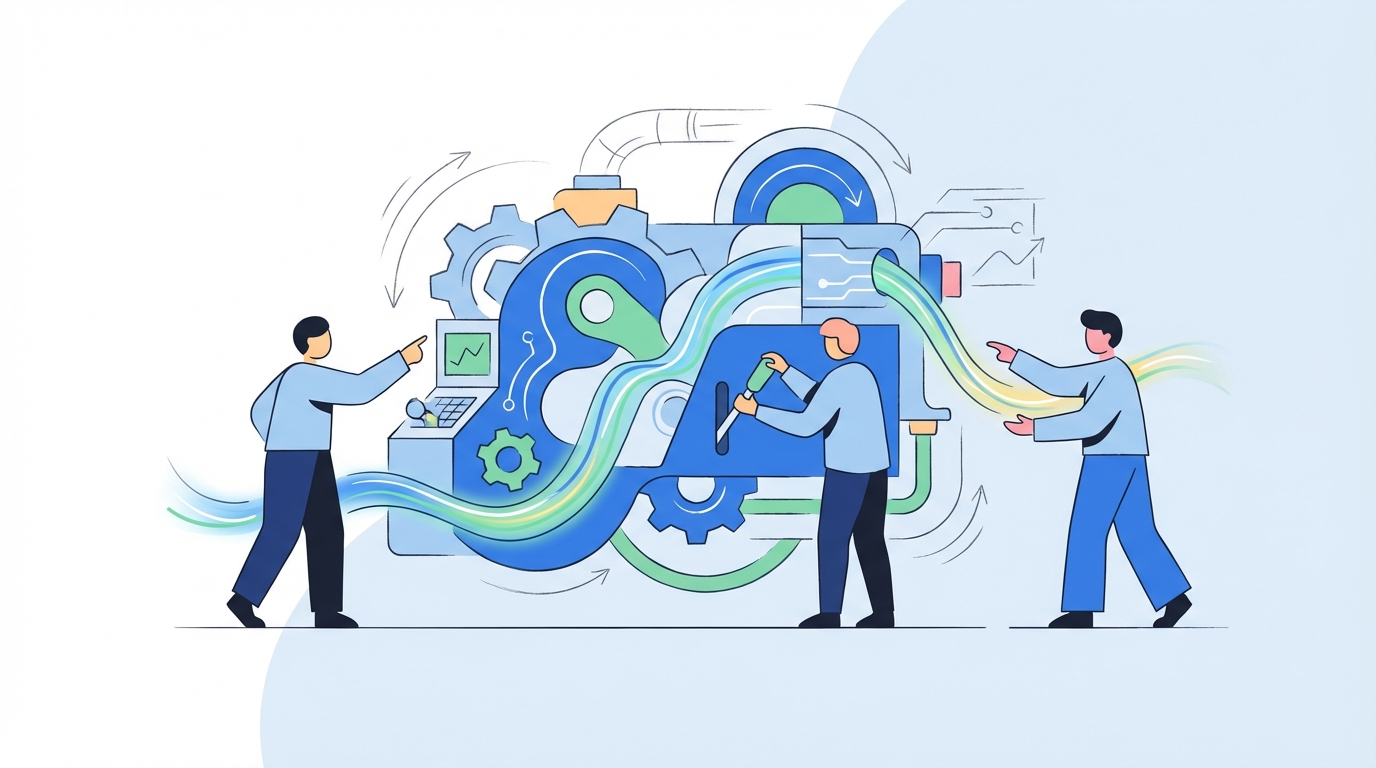
Demand generation execution software matters because most teams are still running demand gen like a set of disconnected tasks. One person handles strategy. Another handles SEO. Someone else writes. Then a founder jumps in late, product marketing corrects claims, and the CMS upload happens whenever someone has time. That isn't a system. That's Fragmented Demand Generation.
More Output Won't Fix a Broken System
Most teams don't have a content problem. They have a handoff problem.
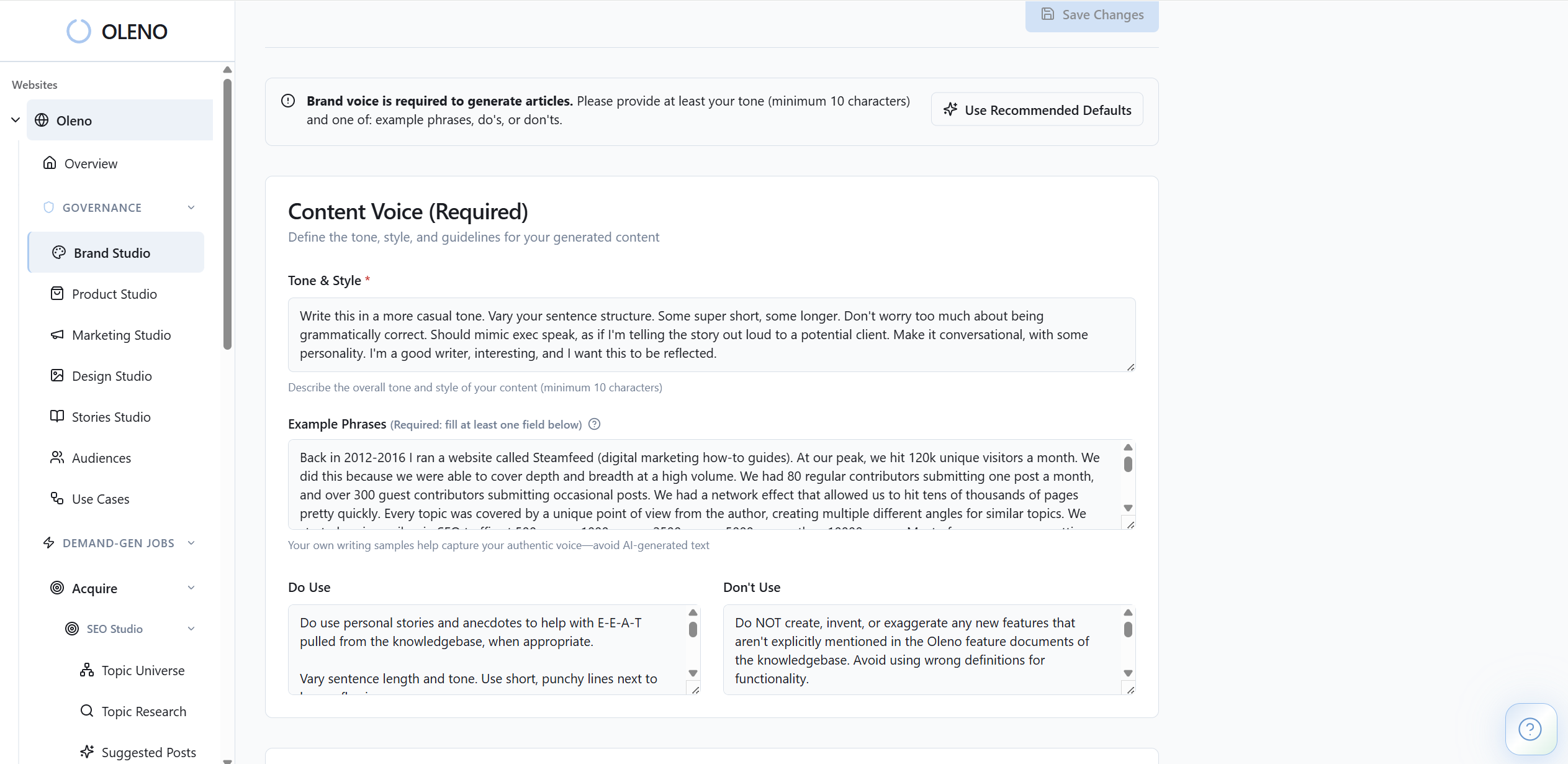
You can publish more and still lose. I've seen this up close. Back in 2012 to 2016, we scaled a contributor-driven site to 120k monthly visitors because we had both breadth and depth. We had 80 regular contributors, 300-plus guest contributors, and we started seeing search spikes at 500 pages, 1,000 pages, 2,500 pages, 5,000 pages, then 10,000 pages. Volume helped, sure. But volume only worked because there was enough structure and enough quality to make all that output add up.
That's the first rule here. I call it the Signal Stack Rule: output compounds only when positioning, quality, and consistency move together. If one of those breaks, volume turns into noise. Growth-stage teams feel this fast because they don't have room for wasted motion.
A Head of Marketing at a 40-person SaaS company lives this every week. Monday is keyword planning in one tool. Tuesday is product updates from Slack. Wednesday is drafting in another app. Thursday is review comments in Google Docs. Friday is a half-finished article that still doesn't sound like the company. Sound familiar?
Prompt Speed Created a False Sense of Progress
Prompting feels useful because it makes the blank page disappear. Fair point. For one-off tasks, that can be enough.
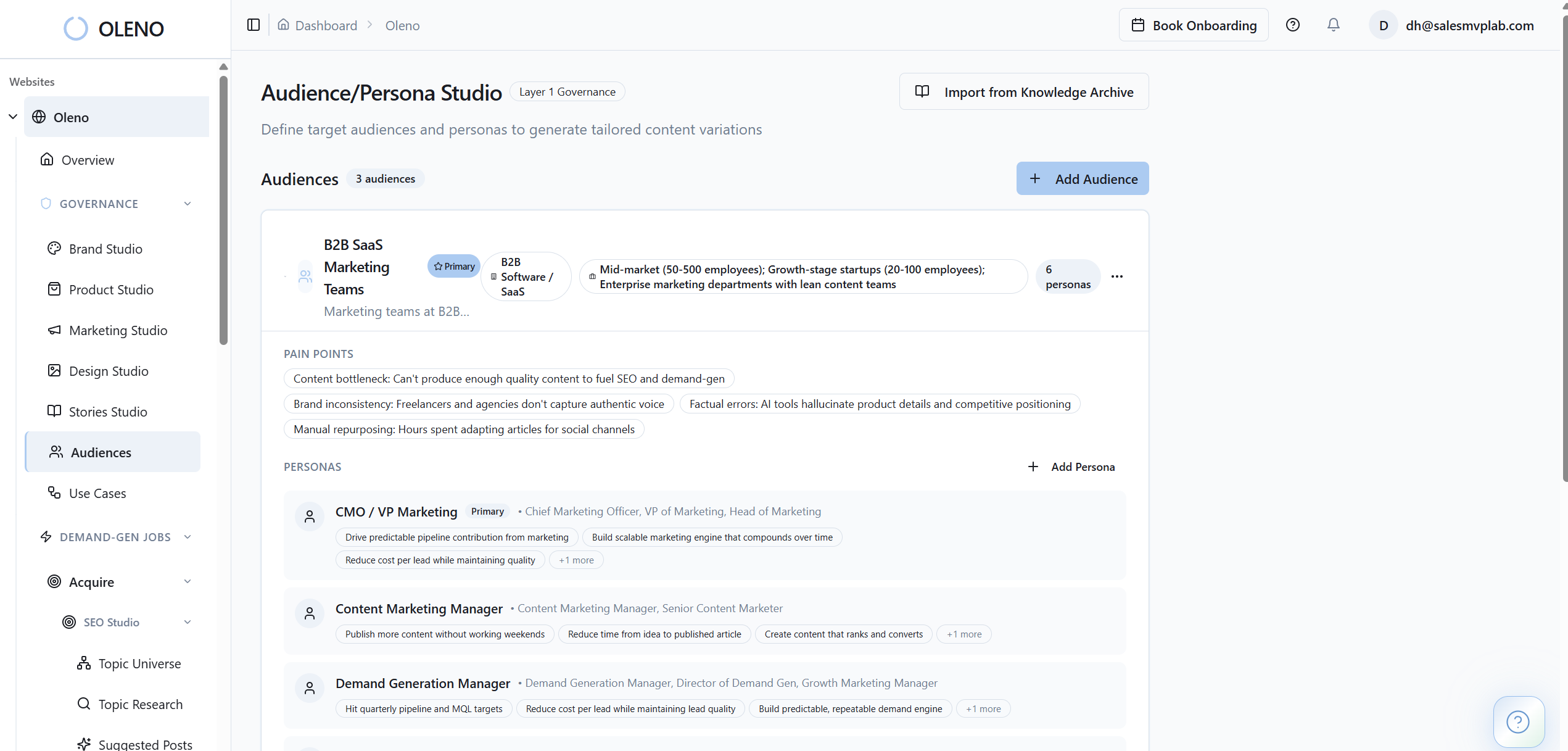
But demand generation isn't a one-off task. It's repeated market education with the same truth, same stance, same audience logic, and the same product boundaries showing up over and over again. Prompting doesn't own that. Humans do. Which means the human review burden keeps climbing as output climbs.
Last summer, while building a B2C app, I ended up creating a bunch of GPTs and manually copy-pasting outputs into a CMS. It was taking 3 to 4 hours a day. The content got created. But I was still carrying the system in my head, in the prompts, in the review loop, in the publishing. That's not leverage. That's just a different kind of labor.
If you're still fixing the same issues every week, you haven't automated the work. You've automated the first draft.
GEO Rewards Repetition With Precision
GEO changed what good looks like. Search used to reward a mix of tactics and persistence. LLM-driven discovery puts more weight on clarity, product definitions, point of view, and consistency across many assets. That's why random wins don't carry as far anymore.
According to Google's guidance on helpful, people-first content, content should show clear expertise and serve a real purpose, not just exist to rank (Google Search Central). LLMs take that pressure further. They pull from patterns across many sources. If your market story keeps shifting, your signal gets diluted.
The old instinct is to publish more disconnected pieces and hope something lands. The new reality is harsher. Consistency across 30 assets usually beats 300 assets that don't agree with each other. That's the question the rest of this article needs to answer: if output isn't the real bottleneck, what is?
Why the Old Marketing Stack Can't Build a Compounding Signal
The real issue isn't that teams need better prompts. It's that the default stack was never designed to carry one coherent market narrative from planning through publishing.
Your Tools Optimize Tasks, Not Coherence
Content tools optimize drafting. SEO platforms optimize keywords and audits. Agencies optimize delivery capacity. AI writers optimize speed. None of those are useless. Some of them are genuinely helpful.
Still, they optimize pieces. Not coherence.
That distinction matters more than most people realize. I use the Piece-vs-System Test for this. If a tool helps you create a better single asset but doesn't improve how your next 50 assets stay aligned, it's a piece tool. Demand gen needs a system tool. Growth-stage teams get punished when they confuse the two because they don't have extra people to stitch everything together.
| Dimension | Old Way | Category Way |
|---|---|---|
| Operating Model | Separate tools, prompts, people, and vendors | Unified system for governed execution |
| Source Of Truth | Scattered across docs, heads, and message threads | Centralized strategy, product, and audience context |
| Content Consistency | Drifts as output scales | Reinforces the same narrative repeatedly |
| Review Burden | Heavy manual QA and repeated resets | Fewer corrections because rules exist upfront |
| GEO Visibility | Weak, inconsistent signal for LLMs | Stronger compounding signal across content |
| Team Efficiency | Coordination cost rises with volume | Output grows without matching overhead growth |
A lot of teams think they need one more app to close the gap. I'd argue the opposite. They need fewer disconnected layers and one operating model that holds the line.
Splitting Narrative, SEO, and Content Guarantees Drift
When positioning lives in one doc, product truth lives in another, audience notes sit in someone's head, and the writer gets a rushed brief at the end, drift isn't a risk. It's the default.
At LevelJump, we used founder-led videos and transcripts to get content out faster. That part worked. But the structure needed for SEO wasn't really there, and topic discovery was weak. So we had thought leadership. We had decent raw material. We did not have a system that turned it into demand.
This is where the old mental model breaks. Teams think content, SEO, and narrative are separate specializations that can be connected later in review. Review is too late. Review catches drift after you've already paid for it.
If product marketing, SEO, and brand only meet at the approval stage, the content has already inherited the context gap. That gap is where rework starts.
This Category Is Not Another Writing Tool
Demand generation execution software is not another AI writer with a nicer prompt box. It isn't an SEO platform with content attached either. And it isn't a glorified content calendar.
It's the operating model that starts with strategy and keeps that strategy attached to execution all the way through. Who is it for? Mostly SaaS marketing teams that need consistent GTM content across multiple funnel stages, multiple contributors, and multiple discovery surfaces without rebuilding context every single week.
The exception is worth stating. If you're a solo founder publishing one thoughtful post a month from your own brain, you may not need this category yet. Manual can still work at very low volume. But once you need weekly cadence, multiple content types, product accuracy, and audience-specific angles, the old stack starts leaking badly. And the leak gets expensive fast.
That leads to the harder question. What does fragmented demand generation actually cost?
The Hidden Cost Shows Up In Time, Pipeline, And Positioning
Fragmented Demand Generation doesn't usually fail in one dramatic moment. It bleeds you slowly. Hours first. Then consistency. Then trust in the system.
Coordination Cost Becomes Higher Than Creation Cost
A lot of growth-stage teams still think creation is the expensive part. Usually it isn't. Coordination is.
Let's pretend a Head of Marketing is producing 8 serious assets a month. If each one needs 45 minutes of re-briefing, 30 minutes of product correction, 20 minutes of tone cleanup, and 25 minutes of publishing cleanup, that's 120 minutes of overhead per asset. Eight assets turns into 16 hours a month of pure correction tax. That's two full working days, and that's before strategy, distribution, or measurement.
I've seen this pattern before. At PostBeyond, I could write 3 to 4 quality posts a week because I had the full context in my head and I was using a structured writing framework. As the team grew, the writer didn't have that same context, and I had less time to write because I was stuck in meetings and managing. Output slowed. Quality dipped. Not because the writer was bad. Because the system for transferring context was bad.
That's the Context Debt Rule: every missing piece of context turns into labor later. Sometimes your labor. Usually your most expensive labor.
If you want to see how content teams are being pushed toward more structured systems, not just more output, the Content Marketing Institute's research keeps showing process maturity has a strong link to success (Content Marketing Institute).
Rankings Alone Don't Build Demand
You can rank well and still miss the business outcome. I've lived that too.
At one company, we had strong writers, strong design, and very strong rankings on Google for a bunch of topics. But the content sat too far from the product and too far from the actual buying journey. We were getting traffic without building a demand narrative that pulled people toward a trial or a serious evaluation. Good SEO. Weak demand generation.
This is one of the more overlooked mistakes in B2B SaaS. Teams celebrate traffic as if traffic and pipeline are basically the same thing. They aren't. They overlap sometimes. Not always.
If content doesn't reinforce the same market POV, same product frame, and same use-case logic, every asset has to win on its own. Very few do. That's why a high-ranking library can still produce inconsistent pipeline impact.
You don't need more top-funnel noise. You need assets that agree on what the problem is, why the old way fails, and why your approach matters.
Resets And Reviews Tax Every Future Asset
The frustrating part is that manual review doesn't just slow the current asset. It also fails to prevent the next mistake. You pay again next week.
McKinsey's work on generative AI makes a fair point: AI can improve productivity, but only when it's embedded inside redesigned workflows and decision processes, not layered onto broken ones (McKinsey). That's exactly the trap here. Most teams layer AI on top of fragmented execution and then wonder why the review queue gets worse.
One mid-article thought. This is usually where people get a bit discouraged.
Because once you see it, you can't unsee it. The team isn't lazy. The strategy probably isn't even that bad. The system is just forcing smart people to keep carrying work that should have been captured once and reused. So what does a better model actually look like?
What Fragmentation Feels Like Inside A Small Marketing Team
Fragmented Demand Generation feels like constant reset mode. You are working. The team is working. But nothing feels cumulative, because each asset starts with fresh uncertainty and ends with another round of patchwork corrections.
Hard Work Without Compounding Progress
A Head of Marketing at a 60-person SaaS company doesn't usually wake up worried about article structure. They're worried about pipeline. But half the week gets pulled into doc cleanup, missed context, late product corrections, and trying to explain the same positioning for the fifth time to different contributors.
That wears on you.
Your instinct might be to blame yourself for not running a tighter ship. I don't think that's fair. The old stack is built around human memory and human rescue. When the system depends on someone remembering the category frame, the approved feature wording, the right audience angle, and the CTA logic at the right moment, burnout isn't surprising. It's built in.
Context Gaps At The Start Of Every Asset
Every new asset begins with a small act of reconstruction. What's the audience? Which use case matters here? What can we say about the product? What's the angle? What are we not saying anymore? Which old draft had the better explanation?
If you have to answer those questions manually every time, you are in what I call Reset Mode. And if you're in Reset Mode, output won't compound.
Some teams prefer that manual flexibility, and that's valid when the content program is small or highly bespoke. But once you're publishing across SEO, comparison, product-led, and thought leadership motions, that flexibility turns into drag. The more channels you add, the more the context gap widens.
Review Becomes The De Facto System
When there isn't a real system, review becomes the system. That's when every draft needs a brand pass, a product pass, a PMM pass, and a founder pass before anyone feels safe publishing.
You already know how that movie ends. Delays. Frustrating rework. A backlog that quietly grows. Then the quarter resets and everyone says the content plan didn't really work.
The sharper question is this: what do the teams that get out of Reset Mode do differently?
What Category Leaders Do Instead
Demand generation execution software exists because strong teams eventually realize they can't review their way to consistency. They need to encode the rules upstream.
The category works around three pillars:
- Strategic Governance: The system starts with positioning, audience context, product truth, and brand rules so execution has durable boundaries.
- Orchestrated Production: Content creation runs as an end-to-end workflow across planning, drafting, review, and publishing rather than isolated tasks.
- Compounding Signal: Every asset reinforces the same market narrative across channels and discovery surfaces, improving consistency for buyers, search engines, and LLMs.
Governance Has To Come Before Generation
The old way starts with output. The better way starts with truth.
That means positioning first. Audience logic first. Product definitions first. Brand rules first. Not because process is fun. It usually isn't. But because every weak input creates downstream argument and correction. That's why tactics without strategy fall apart so quickly in content systems. April Dunford said it bluntly years ago on a panel I was listening to, and she was right. If positioning is fuzzy, the tactics don't save you.
A useful diagnostic is the Four-Source Check. Ask these four questions before you scale content: Is your market POV documented? Is your audience segmentation explicit? Are product claims bounded? Is your brand voice teachable? If two or more answers are no, don't scale output yet. You'll scale rework.
This category is built for teams that need to publish weekly across acquisition, evaluation, and product-led content, but don't want each contributor inventing the plan from scratch.
Execution Should Reinforce The Same Strategy Across Every Asset
Once strategy is captured, execution should stop acting like a series of random writing events. It should behave more like a production line with judgment where judgment belongs.
That doesn't mean robotic content. And yes, that's a fair concern. The status quo has one real advantage: humans can improvise in the moment. But improvisation is useful only after the boundaries are clear. Jazz works because the players know the key.
So the rule becomes: if the strategy changes, update the system; if the strategy doesn't change, stop re-explaining it asset by asset. This is where the work starts to feel cumulative. One article informs the next. One use case connects to the next cluster. One product truth carries into the next comparison page.
Teams that do this well also stop treating the funnel like a set of unrelated content buckets. Acquire, educate, convert, retain. Different job to be done. Same underlying narrative.
Compounding Visibility Requires Repetition Without Drift
This is the part most teams underestimate. Repetition is not the enemy. Drift is.
Back when we scaled to 120k visitors, a lot of individual pages got fewer than 100 views a month. That would have looked weak if you judged each page alone. But the network mattered. Breadth plus depth plus consistency created traffic spikes as the library grew. That same compounding logic matters even more now, because GEO favors brands that show a stable point of view across many assets.
You don't need to say the exact same thing every time. You do need the same market logic showing up repeatedly. Same enemy. Same audience understanding. Same product truth. Different angle. Same spine.
That's when the category starts making sense. If you want to see what that looks like inside a real system, request a demo.
How Oleno Turns The Category Into Daily Practice
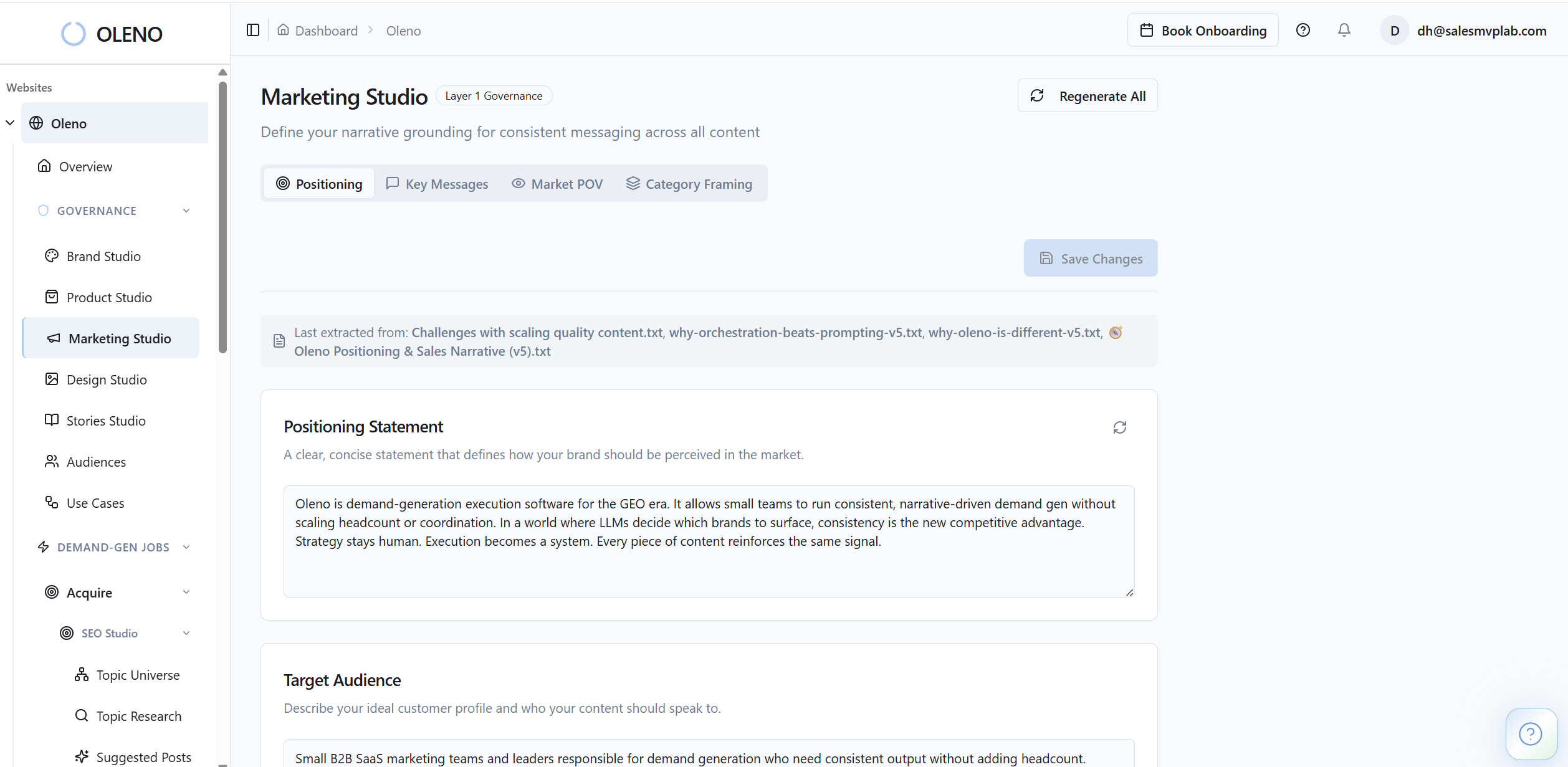
Oleno is one example of this category in practice. Not the category itself. The category is the operating model. Oleno is software built around that model.
Oleno Connects Strategy To Execution
Oleno starts by capturing the inputs most teams keep scattered. brand studio sets the voice and writing rules. marketing studio captures category framing, key messages, and narrative logic. product studio keeps product truth, feature boundaries, and approved descriptions in one place. audience & persona targeting plus use case studio make sure the same topic can be framed differently for the right buyer and the right job to be done.
That matters because the manual alternative is what growth-stage teams already hate: re-briefing writers, correcting claims, and cleaning up generic drafts after the fact. Instead of treating each article as a fresh prompting exercise, the system starts from the governed inputs first. That's a meaningful shift.
Oleno Reduces Coordination Debt Across The Pipeline
The second piece is production. storyboard helps turn strategic direction into a balanced plan across audiences, products, and use cases. orchestrator runs the workflow across briefs, drafts, QA, and publishing cadence. quality gate checks whether outputs meet the required standard before they move forward. cms publishing pushes finished content directly to the CMS, which cuts out a bunch of copy-paste overhead that small teams quietly lose hours to every month.
I'd make one concession here. A system like this does ask for upfront setup. You have to define your voice, your audience, your product truth, your market stance. That takes work. But that work is the work. If a team skips it, they usually pay for it later through reviews, resets, and mixed messaging.
This Is Where The Category Stops Being Theory
This category becomes real when strategy stops living in decks and starts showing up consistently in the actual assets you publish. Oleno leans into that through category studio for long-form point-of-view pieces, product marketing studio for product-fit content, buyer enablement studio for decision-stage assets, and programmatic seo studio for acquisition content that needs to scale without losing structure.
For executive visibility, executive dashboard gives marketing leaders a view into cadence, quality trends, and coverage gaps, so they don't need to micromanage the operation to know whether the engine is healthy. If you want to see how that system looks in practice, book a demo.
From Activity To Compounding Execution
Demand generation execution software is really about one shift: stop treating demand gen like disconnected output, and start treating it like a system that preserves context. That's the move.
Fragmented Demand Generation feels normal because most teams grew into it. But normal isn't working very well anymore. In GEO, the brands that show up consistently have usually done the boring but important thing first. They captured the truth once, then built execution around it.
About Daniel Hebert
I'm the founder of Oleno, SalesMVP Lab, and yourLumira. Been working in B2B SaaS in both sales and marketing leadership for 13+ years. I specialize in building revenue engines from the ground up. Over the years, I've codified writing frameworks, which are now powering Oleno.
Frequently Asked Questions