Where AI Writing Assistants Stop Helping at Scale

Where AI writing assistants stop helping is where ai writing assistants hit the wall of system work, not writing work. Demand-generation execution software is a governed marketing system that turns strategy into consistent, compounding content and campaign execution by unifying narrative, product truth, audience context, and publishing workflows inside one operating layer. Unlike AI writing tools, demand-generation execution software is built to run repeatable market execution, not just generate standalone text. It emerged because GEO made fragmented content operations a real liability, and where ai writing assistants break down is exactly where consistency starts to matter more than draft speed.
Most teams don't actually have a content problem. They have a Fragmented Demand Generation problem. Content lives in one place, product truth in another, voice in someone's head, SEO in a tool, and final judgment in a tired reviewer staring at draft number 17 for the week. That's fine when you're publishing once in a while. It starts to break when you're trying to build real market presence across SEO, LLM visibility, product education, and pipeline.
Key Takeaways:
- AI writing assistants are useful for drafts, but they don't solve coordination, consistency, or market execution.
- Fragmented Demand Generation gets worse as teams add writers, tools, and review steps.
- GEO raises the bar because LLMs surface brands with consistent signals, not just fast output.
- Demand-generation execution software exists to connect strategy, truth, and publishing into one repeatable system.
- The winning shift is simple to say and hard to do: stop managing pieces, start running a system.
Where AI Writing Assistants Stop Helping First
Faster drafts still leave you with a broken operating model
AI writing assistants are good at making blank pages disappear. That's useful. I've used them. Most marketers have. But that benefit gets overstated fast, because writing speed is only one tiny part of demand generation.
The real work starts after the draft exists. Somebody has to decide what should be written. Somebody has to make sure the piece reflects your point of view, your product truth, your audience, your use case, and your market frame. Somebody has to check whether this article supports a bigger narrative or just adds another disconnected page to the pile. That's where ai writing assistants stop helping.
Prompting looks productive because text appears quickly. But output is not demand generation. Demand generation is a system of repeated, market-facing execution that has to hold together over time, across writers, channels, and funnel stages. If you don't have that, you're not building signal. You're creating activity.
Human rescue becomes the real bottleneck
Most teams notice the limit when every piece needs cleanup. The draft is fine, sort of. The structure is close, sort of. The tone sounds like your brand, maybe. The product details are mostly right. And now a PMM, content lead, or founder has to rescue it.
That's the hidden cost. Not the first draft. The rescue work after it.
When I started at PostBeyond, I could write 3 to 4 strong blog posts a week because I had the context in my head and a structured way of writing. As the team grew, our content writer didn't have the same depth of context I had. That wasn't a talent problem. It was a context problem. They took longer. The output got weaker. And I had less time to write because I was in meetings, managing people, doing everything else. Sound familiar?
That pattern shows up all over B2B SaaS. More contributors should mean more throughput. Often it means more rewrites, more review cycles, and more waiting. Fragmented Demand Generation hides inside that gap.
GEO punishes inconsistency harder than search used to
SEO let a lot of bad habits slide. You could win on tactics for a long time. Publish enough. target enough keywords. Build enough links. You could get traffic even if the broader story was a mess.
GEO changes the math. LLMs don't just inspect one page. They infer who you are from repeated signals across a body of work. That means weak positioning, mixed narratives, vague product definitions, and inconsistent voice have a higher cost now.
So where ai writing assistants stop helping is also where GEO starts exposing the cracks. A tool can generate ten drafts. It can't, by itself, make ten drafts reinforce the same market truth.
Why The Market Bought Writing Speed Instead Of Execution Control
Most teams solved the visible problem, not the real one
The visible problem was obvious. Writing takes time. Drafting is expensive. Teams are overloaded. AI writing assistants showed up and made that first pain easier to manage.
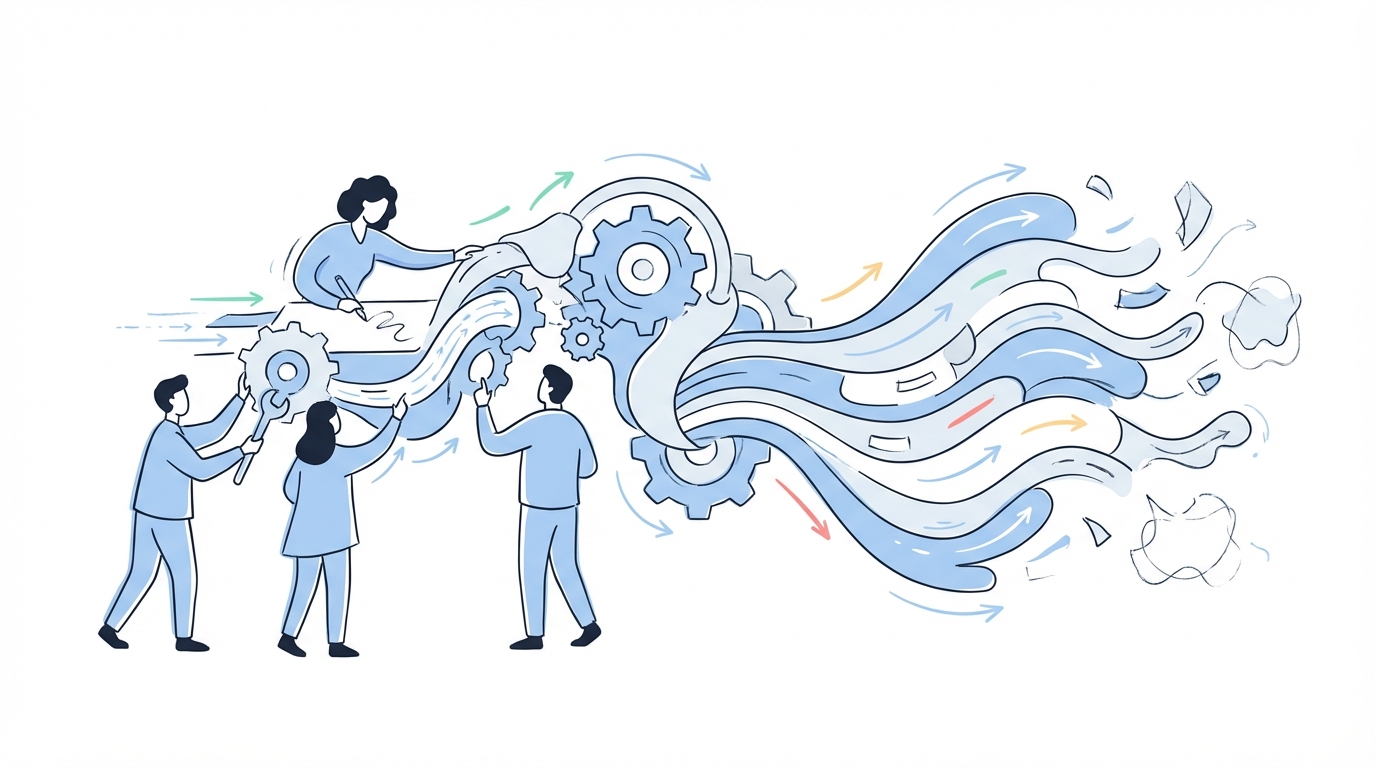
But the real issue wasn't slow typing. It was fragmented execution without a system.
That's why a lot of teams feel weirdly disappointed after the initial AI honeymoon. They got faster. They didn't get cleaner. They generated more. They didn't compound more. The bottleneck moved from creation to coordination, which is a much nastier problem because it touches everything.
For scaling SaaS teams, this gets especially painful. You've got writers, PMMs, SEO leads, demand gen managers, maybe agencies too. Nobody is lazy. Nobody is clueless. But if each function is operating from slightly different assumptions, the market sees inconsistency, not sophistication.
Separate tools make each task better and the full system worse
This is the trap. Your writing tool gets better drafts. Your SEO tool gives you keywords and audits. Your PMM team owns messaging docs. Your founder has the real market opinions in their head. Your product team has the accurate feature boundaries. Your CMS handles publishing.
Individually, each thing can look fine.
Collectively, it's a mess.
You end up with local efficiency and global inconsistency. One article sounds sharp but has weak product relevance. Another is accurate but boring. Another ranks but doesn't lead anywhere. Another has strong insight but misses search intent. Another gets repurposed for social but loses the original point along the way.
Not because the team is bad. Because the system is split apart.
This category exists because demand gen became cross-functional
Demand generation used to be easier to fake. You could run campaigns in bursts and call it a strategy. That's getting harder. Buyers encounter you through articles, comparison pages, thought leadership, social posts, product education, and now AI-generated answers. All of those surfaces shape belief.
Demand-generation execution software is designed for marketing teams that need those surfaces to stay aligned while output scales.
That matters most for teams in the 100 to 500 employee range. You've got enough people to create real volume. You've also got enough people to create drift. A founder-led team can brute force alignment for a while. A scaling team can't. You need system memory.
| Dimension | Old Way | Category Way |
|---|---|---|
| Source Of Truth | Lives across prompts, docs, people, and review threads | Lives in one operating layer that carries strategy into execution |
| Content Creation | Standalone drafts optimized piece by piece | Assets created from shared narrative, product truth, and audience context |
| Quality Control | Manual rescue through edits, meetings, and resets | Constraints reduce drift before it spreads |
| Market Visibility | Weak, mixed signals across SEO and LLM surfaces | Repeated, coherent signal that compounds over time |
| Team Efficiency | Coordination cost rises with every contributor | Work scales through repeatable workflows |
Why Fragmentation Gets More Expensive Every Month
More contributors can create more drag, not more leverage
Back in 2012 to 2016, I ran a site called Steamfeed. At the peak we hit 120k unique visitors a month. We had 80 regular contributors and more than 300 guest contributors over time. We also saw step changes in traffic at 500 pages, 1000 pages, 2500 pages, 5000 pages, then 10000 pages.
That experience taught me something important. Volume matters. Breadth matters. But only when the content quality is real and the overall library compounds.
Now compare that with a scaling SaaS team. You add contributors, but you don't have the same shared framework, context, and editorial logic. So every new person adds coordination cost. Review cost. Training cost. Correction cost. You aren't getting a network effect. You're getting a tax.
Honestly, that's the part a lot of teams underestimate. They budget for writing. They don't budget for all the human glue required to keep fragmented work from drifting apart.
Narrative drift kills visibility before teams notice it
Invisibility in AI-generated results usually doesn't happen in one dramatic moment. It happens slowly. One article frames the problem one way. Another uses softer language. Another changes the product story. Another targets a totally different audience without saying so. Over time, the market gets a blurred picture of who you are.
LLMs are especially tough on this. They reward clear repetition. Not repetitive copy. Clear repetition of core truth.
If your stance changes from asset to asset, you miss the compounding effect. If your enemy framing disappears half the time, you dilute your position. If your product gets described three different ways, you risk confusion right when the buyer is trying to understand where you fit.
That's not just a content issue. That's a demand issue.
Rankings can go up while pipeline stays flat
I saw this at Proposify. We had a strong content team. Great writers. Strong design. We ranked really well for a lot of topics. But a lot of that content sat too far away from the actual solution, so the traffic didn't really compound into demand the way it should have.
That was a frustrating lesson. You can win search and still lose the bigger game.
Let's pretend your team publishes 24 articles a month. If each one takes two extra review rounds, and each round pulls in a content lead plus a PMM for 20 minutes, that's 16 extra hours a month right there. Add rewrites, Slack threads, and publishing cleanup, and now you've burned a meaningful chunk of one person's week just keeping the machine from wobbling. And you still may not have a coherent narrative showing up in market.
That's the cost structure of Fragmented Demand Generation. More output. More drift. More rescue. Not enough accumulation.
Why Busy Teams Still Feel Like They Are Starting Over for Where ai writing assistants
Your team probably isn't the problem
You're not behind because your team doesn't care. You're not behind because your writers are weak. You're not behind because AI failed. Most of the time, your team is working hard inside a system that forgets itself every few days.
Each new draft needs context reloaded. Each freelancer needs rebriefing. Each product update needs a manual pass through messaging, content, SEO, and distribution. Each campaign starts with, "Wait, what are we saying again?"
That gets expensive. Fast.
Endless review usually means the system forgot what matters
Constant review feels responsible. It can even look like quality control from the outside. But if every asset needs the same kinds of fixes, you don't have a review function. You have missing system memory.
And that's exhausting at the leadership level. You start worrying about what got published without you seeing it. You start second guessing whether the team is actually reinforcing the story you want in market. You start wondering why content output is up but confidence isn't.
I've seen this more than once. The activity is there. The accumulation isn't.
Activity without accumulation is what really wears people down
This is the emotional cost most dashboards miss. You can be publishing. You can be shipping campaigns. You can be paying agencies and writers and PMMs. And still feel like nothing is stacking.
For a CMO or VP Marketing, that's the worst part. Not just the wasted hours. The loss of trust that this thing is building anything durable.
What Replaces Fragmented Demand Generation
Governance has to happen before generation
The fix isn't better prompting. It's deciding the important stuff once, up front, before content gets created.
- Governed Strategy: The category starts by encoding positioning, voice, product truth, and audience context before any content is generated.
- Connected Execution: It links planning, creation, review, publishing, and reinforcement so demand generation runs as one system instead of separate tasks, especially when evaluating where ai writing assistants.
- Compounding Consistency: It creates repeated, reliable market signals across assets and channels so visibility and pipeline improve through accumulation, not one-off wins.
Most teams try to solve inconsistency at the editing stage. That's late. By then, drift has already entered the system. A better model is to define your point of view, product boundaries, audience framing, and structure rules before the draft exists.
That doesn't remove human judgment. It puts human judgment where it belongs.
Repeated truth matters more than repeated prompting
Prompting repeats instructions. Strong execution repeats truth.
That's a big difference. One is task-level. The other is system-level. When category leaders publish, they aren't reinventing their stance every week. They're reinforcing it through different angles, different formats, and different stages of the funnel.
We learned a version of this the hard way at LevelJump. We were recording videos with the CEO and turning them into written content. That made publishing faster. But it lacked the structure and topic targeting needed to perform well in search. We had insight. We didn't have a system that connected insight to discoverability.
That's why the better standard is not "can we make content faster?" The better question is "can we keep saying true, differentiated things in a way that compounds across channels and over time?"
Want to see what governed execution looks like when a team stops living prompt to prompt? See how Oleno works for scaling teams.
Demand gen works when the whole chain is connected
A working demand gen system connects what should exist, how it should sound, what it can claim, who it's for, how it gets reviewed, where it gets published, and how it gets reused. Miss one of those links and the rest starts to sag.
That said, not every team needs a huge operating layer on day one. Some teams can get a lot of mileage out of tighter process and better discipline. Fair point. But once output rises and contributors multiply, process docs alone usually aren't enough. The gaps start showing.
What I've seen work is simple in theory. Keep strategy human. Encode the rules that shouldn't drift. Run execution across the full chain, not just the draft. Then measure whether the work is actually compounding.
How Oleno Makes This Operational
Oleno starts with shared context, not better prompts
Oleno is built around the idea that demand generation breaks when narrative, product truth, voice, and audience context live in different places. So instead of asking marketers to restate those things every time, it puts them into a shared operating layer first.
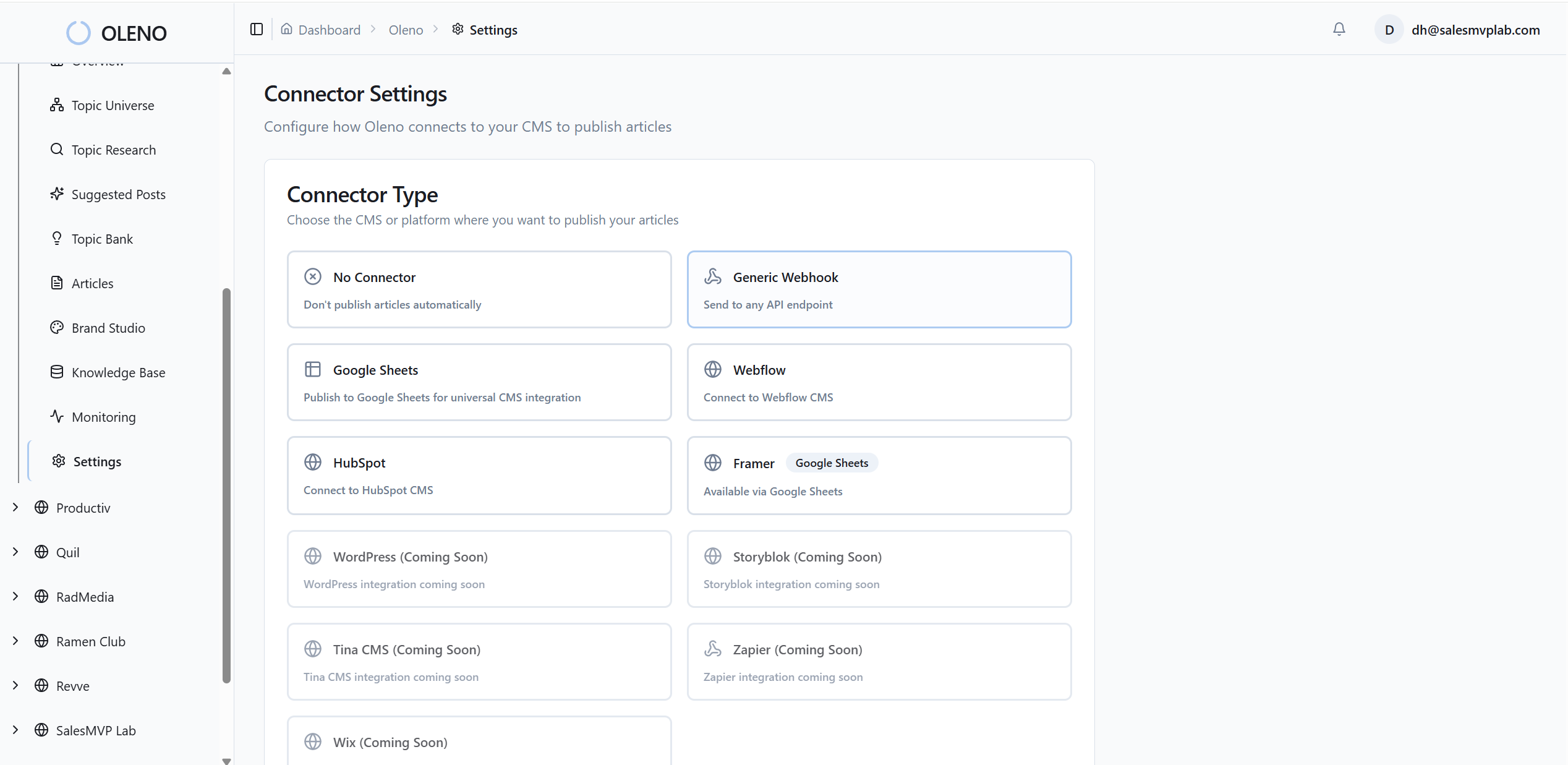
Marketing studio carries category framing, key messages, and your point of view into briefs and drafts. Product studio keeps approved product descriptions, feature boundaries, supported use cases, pricing context, and screenshots grounded in one place. Audience & persona targeting makes the same topic land differently for different buyers instead of sounding generic to everyone.
That matters because the rescue work starts dropping when the system stops forgetting what matters.
Output grows without the same coordination tax
Programmatic seo studio handles acquisition content through a locked-outline pipeline that discovers topics, builds briefs, drafts articles, scores them, and moves them toward publishing on a steady cadence. The orchestrator schedules and runs those jobs against cadence and quota settings. The quality gate blocks weak or non-compliant output before it turns into more review debt.
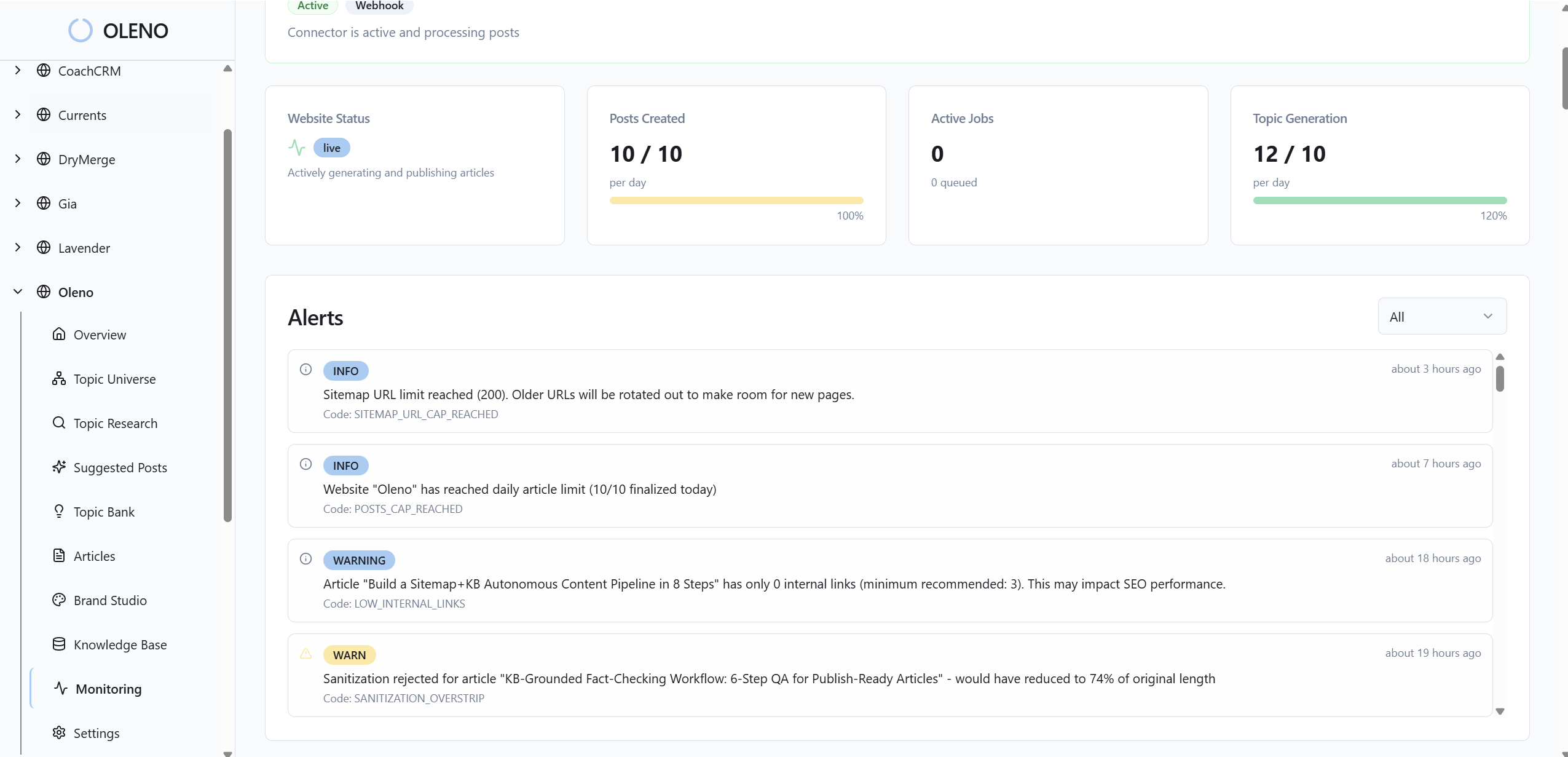
For teams trying to go from 4 to 8 articles a month up to 20 to 40 plus, that's the difference between scaling output and scaling headaches. CMS publishing closes the loop by pushing finished content directly into your CMS, which cuts out a surprising amount of manual cleanup.
Start with one governed pipeline and see how much review debt you can remove. If you want to map that out for your team, request a demo.
This is how content starts compounding again
Oleno also gives teams ways to keep the broader system aligned, not just the article draft. Stories studio brings founder stories, customer anecdotes, sales insights, and industry examples into thought leadership so the writing feels lived in. Category studio handles long-form market framing built around enemy-based arguments and delayed product mention. Product marketing studio keeps mid-funnel education grounded in product truth instead of vague feature copy.
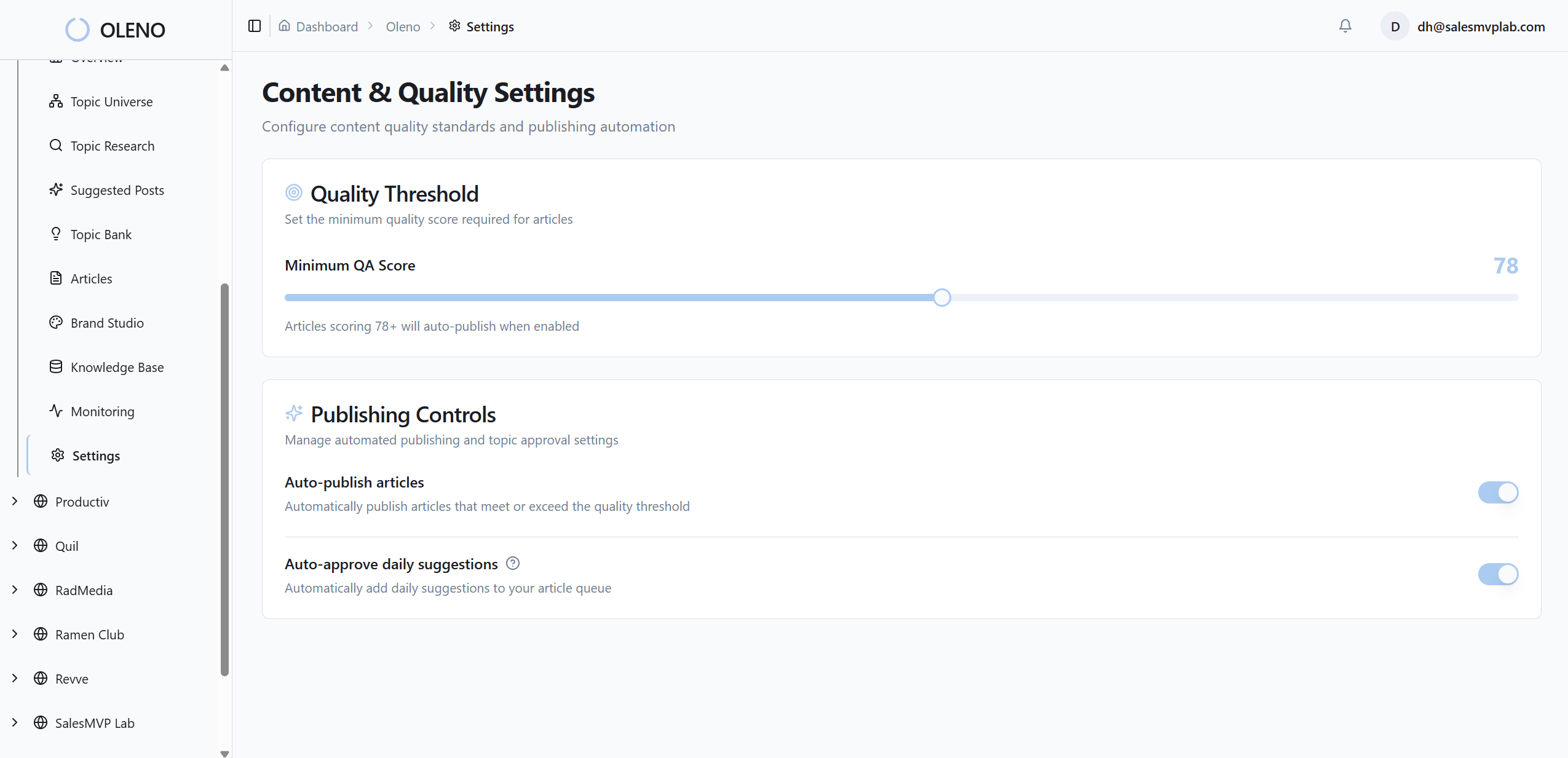
You can see the pattern. Shared truth first. Repeated execution second. More output, yes. But more importantly, less drift.
For a VP Marketing or CMO, that's usually the real win. Not just publishing more. Building a body of work that says the same true thing often enough, clearly enough, that search engines, LLMs, prospects, and your own team all get a sharper picture of who you are.
If your team is tired of more drafts creating more coordination work, book a demo.
A Better Way To Answer Where AI Writing Assistants Stop Helping
AI writing assistants stop helping when the draft stops being the bottleneck. That's the real line. After that point, the problem is execution drift, missing context, review debt, and weak compounding signal across the market.
That's why this category exists. Not to replace strategy. Not to replace marketers. To give strategy a system it can survive inside.
And that's really the shift. You stop asking, "How do we generate more?" You start asking, "How do we make every piece reinforce the same market truth?" Once you make that move, where ai writing assistants stop helping becomes a useful question. Because it points you toward the system you actually needed all along.
About Daniel Hebert
I'm the founder of Oleno, SalesMVP Lab, and yourLumira. Been working in B2B SaaS in both sales and marketing leadership for 13+ years. I specialize in building revenue engines from the ground up. Over the years, I've codified writing frameworks, which are now powering Oleno.
Frequently Asked Questions