Where You Sit on the Demand-Gen Execution Reliability Spectrum

Most teams can ship content. The question is where you sit on the execution reliability spectrum, meaning how often your demand gen shows up on time, on message, and consistent enough that buyers (and LLMs) can trust it.
Demand-generation execution software is a marketing operations system that ensures reliable, brand-consistent content and narrative across channels by encoding positioning, product truth, audiences, and voice into governance, then running research, briefs, drafting, review, publishing, and distribution so teams ship a coherent signal that GEO and humans can trust. Unlike AI writing tools or SEO platforms, demand-generation execution software isn’t trying to “write better,” it’s trying to make your execution predictable across hundreds of pieces.
And the enemy is pretty clear at this point: Fragmented Demand Generation. A patchwork of tools, prompts, and people where your narrative, product truth, and voice live in different places, so everything drifts and nothing compounds.
Key Takeaways:
- Execution reliability is the new baseline for GEO, because LLMs reward brands that repeat the same clear story across lots of content.
- Fragmented Demand Generation creates “busy marketing” that looks productive but causes drift, rework, and weak compounding.
- You can map your team to a maturity spectrum and improve it without buying anything, if you treat governance like a system input instead of a doc nobody reads.
- Once you hit governed execution, content stops resetting every quarter and starts stacking.
Execution Reliability Beats Volume in GEO
Execution reliability beats raw volume in GEO because LLMs don’t rank one page, they reconcile patterns across your entire library. In old-school SEO, you could brute-force traffic with tactics. GEO’s stricter. The signal you repeat across 100–500 pieces is what earns citations, recall, and clicks.
You can feel this shift if you’ve ever looked at your own library and noticed the story changing every month. One quarter you’re “the platform.” Next quarter you’re “the system.” Then you’re “the AI thing.” That inconsistency isn’t just a branding nitpick. It’s a trust problem.
And it’s usually not because your team is lazy. It’s because demand gen got stitched together.
Consistency beats speed in the GEO era
Consistency is what LLMs can confidently repeat. That’s the whole game.
LLMs don’t read your latest blog post and decide you’re the expert. They build an internal model from patterns. Repeated definitions. Repeated framing. Repeated point of view. Clear boundaries about what you do and don’t do. When your content contradicts itself, even in small ways, you’re basically training the model to be unsure about you.
Speed still matters, to a point. But speed without repeatability creates noise. A lot of teams are shipping more drafts than ever, and getting less demand than before. That’s not always because the writing is bad. It’s because the output doesn’t add up to a single story.
Back in 2012 to 2016, I ran a site called Steamfeed. We hit 120k unique visitors a month, and it wasn’t because every post was a masterpiece. It was because we were consistent at scale. We had 80 regular contributors, 300+ guest contributors, and we saw spikes at 500 pages, 1000 pages, 2500 pages, 5000 pages, then 10000 pages. Most posts got under 100 views per month. But volume plus quality plus consistency compounded.
GEO has that same compounding feel, except the “reader” is also a model.
Fragmented demand generation looks like progress but kills compounding
Fragmented Demand Generation is sneaky because it looks like you’re doing the work.
You have an SEO tool. You have an AI writer. You have a PMM doc. You have a content calendar. You have a Slack channel for approvals. You have a freelancer who “gets it” most of the time. You have a designer who makes it pretty. You have a demand gen manager who repurposes it for social when they have time.
It feels like a system. It’s not.
It’s a bunch of local optimizations. Each piece might look fine in isolation, but the collection doesn’t reinforce itself. And GEO punishes that. Not in an emotional way. In a math way. The model doesn’t see a stable pattern, so it doesn’t build confidence.
The worst part is the hidden cost. You end up doing resets. Rebriefing. Rewriting intros. Fixing positioning drift. Correcting product claims. Re-explaining the same audience context over and over.
That’s the headache tax.
The new bar is reliability across hundreds of pieces
Execution reliability means you can answer basic questions without squinting.
Can you ship 20 articles next month without your VP of Marketing personally rewriting half of them? Can you publish without a last minute Slack fire drill because someone noticed the messaging changed again? Can you generate content for multiple personas without it turning into generic mush?
Most teams are somewhere between “we’re trying” and “we’re drowning.”
The bar now looks like this:
- Your positioning shows up the same way across the funnel.
- Your product truth doesn’t get invented or drift.
- Your voice doesn’t depend on one editor who holds it all in their head.
- Your process doesn’t collapse when one person goes on vacation.
That’s not a writing problem. It’s an execution reliability problem.
Stop Treating Content, SEO, and Narrative as Separate Jobs
Most teams don’t need better prompts, they need a system that makes the fundamentals show up every time. That’s the whole reframe. Content, SEO, and narrative aren’t separate jobs. They’re the same job, just expressed in different assets and channels. This is exactly what demand-generation execution software exists to coordinate.
This is the “not X, but Y” moment.
Not AI writing tools. Not SEO platforms. Not another template library.
A governed execution system that encodes what you believe, what’s true, who you sell to, and how you sound, then applies it everywhere without relying on heroics.
The tool stack optimizes pieces, the system optimizes outcomes
Tools are built to make one step better.
Write faster. Audit keywords. Improve readability. Suggest headings. Check a score. Schedule posts.
Useful. I’m not anti-tool.
But demand gen outcomes come from the chain staying intact. Topic selection connects to positioning. Brief connects to audience. Draft connects to product truth. Publishing connects to distribution. Distribution connects to measurement. Measurement feeds back into what you do next.
When those are separate jobs owned by separate tools, you get fragmentation. And fragmentation creates drift.
You might ship a lot, but you don’t build a coherent market impression. Buyers don’t build a clear frame for you. LLMs don’t either.
Prompting delegates governance to humans and creates review debt
Prompting feels like leverage until you do it at scale.
I’ve done the manual GPT grind. Last summer, I was building a B2C app and trying to market it through SEO and GEO. I made a bunch of GPTs, kept prompting and copy-pasting, then manually adding the output into my CMS. It was taking 3 to 4 hours a day. Just pure waste.
And even when the drafts were decent, the bigger problem was that all the judgment sat on me. I had to catch inaccuracies. Fix the tone. Reinforce the same story. Decide what to write next. Make sure the thing didn’t contradict something else we published last week.
Prompting pushes governance onto humans. That’s why review debt grows as output grows.
You end up with a system where the AI writes, and the humans carry the actual demand gen. That doesn’t scale. It just shifts the work into editing and coordination.
Orchestration turns fundamentals into repeatable execution
Orchestration is just a fancy word for “the system runs the work, not your head.”
The fundamentals don’t live in a doc. They live in the workflow. Positioning isn’t a slide deck. It’s a constraint that shows up in every brief, every intro, every comparison, every callout. Product truth isn’t something PMM catches at the end. It’s present from the start.
When you orchestrate, you’re not relying on perfect prompts. You’re relying on a repeatable chain.
And once you have that, adding volume doesn’t multiply chaos. It just increases output.
The Measurable Cost of Fragmented Demand Generation
Fragmented Demand Generation taxes you in three places, time, trust, and visibility, and you can see it on your calendar and backlog. The obvious complaint is “we aren’t publishing enough.” The real cost is you’re publishing without compounding, so the work looks busy but doesn’t convert into durable demand or a coherent market signal.
A lot of CMOs and VPs I talk to think the cost is “we aren’t publishing enough.” That’s the surface symptom. The deeper cost is you’re publishing without compounding.
Rework and resets outpace creation as headcount increases
Headcount doesn’t fix reliability. Sometimes it makes it worse.
At PostBeyond, I was the sole marketer and I could crank out 3 to 4 high quality blog posts per week because I had full context and I was using a structured framework. As the team grew, output didn’t magically accelerate. Our writer didn’t have the context I had, so it took them longer to create lower quality output than me. Then I had less time to write because I was in exec meetings, managing the team, doing everything else.
That’s the pattern. You add people and you add handoffs. You add handoffs and you add rework.
Let’s pretend you have a scaling SaaS team with 10 people touching content in some way:
- 1 SEO lead
- 2 writers
- 1 PMM reviewer
- 1 demand gen manager
- 1 designer
- 1 marketing ops person
- 1 VP who has to “approve messaging”
- and a couple freelancers floating around
If every article takes:
- 2 hours to write
- 1 hour of edits
- 30 minutes of stakeholder review coordination
- 30 minutes of publishing and formatting
- 30 minutes of distribution prep
That’s 4.5 hours per article. Now multiply by 20 articles a month. That’s 90 hours.
And here’s the killer. In a fragmented setup, the coordination and rework grow faster than the writing time. The writing might stay 2 hours. The rest balloons. That’s where you start feeling like your team is “busy” but you’re not moving.
Visibility erodes when your story changes from piece to piece
GEO visibility isn’t just about being indexed. It’s about being cited and surfaced as an answer.
When your definitions and POV drift, the model’s confidence drops. If one article frames the problem as “content operations,” another frames it as “AI workflows,” and a third frames it as “demand gen strategy,” you’ve diluted your own positioning.
You might still get traffic. You might even rank.
But you’ll struggle to build the kind of coherent signal that shows up in AI generated answers, especially when buyers ask category questions like “what should we use to scale demand gen content” or “how do we stay consistent across channels.”
Fragmentation makes you look like five different companies.
That’s a costly mistake.
What Fragmentation Feels Like on a Tuesday Afternoon
It feels like shipping all day and still being behind. Every asset turns into a negotiation about tone, messaging, and what the product actually does. Positioning lives in one doc, claims in another, a Slack thread changes the story, and a late draft drags through five rounds of subjective edits.
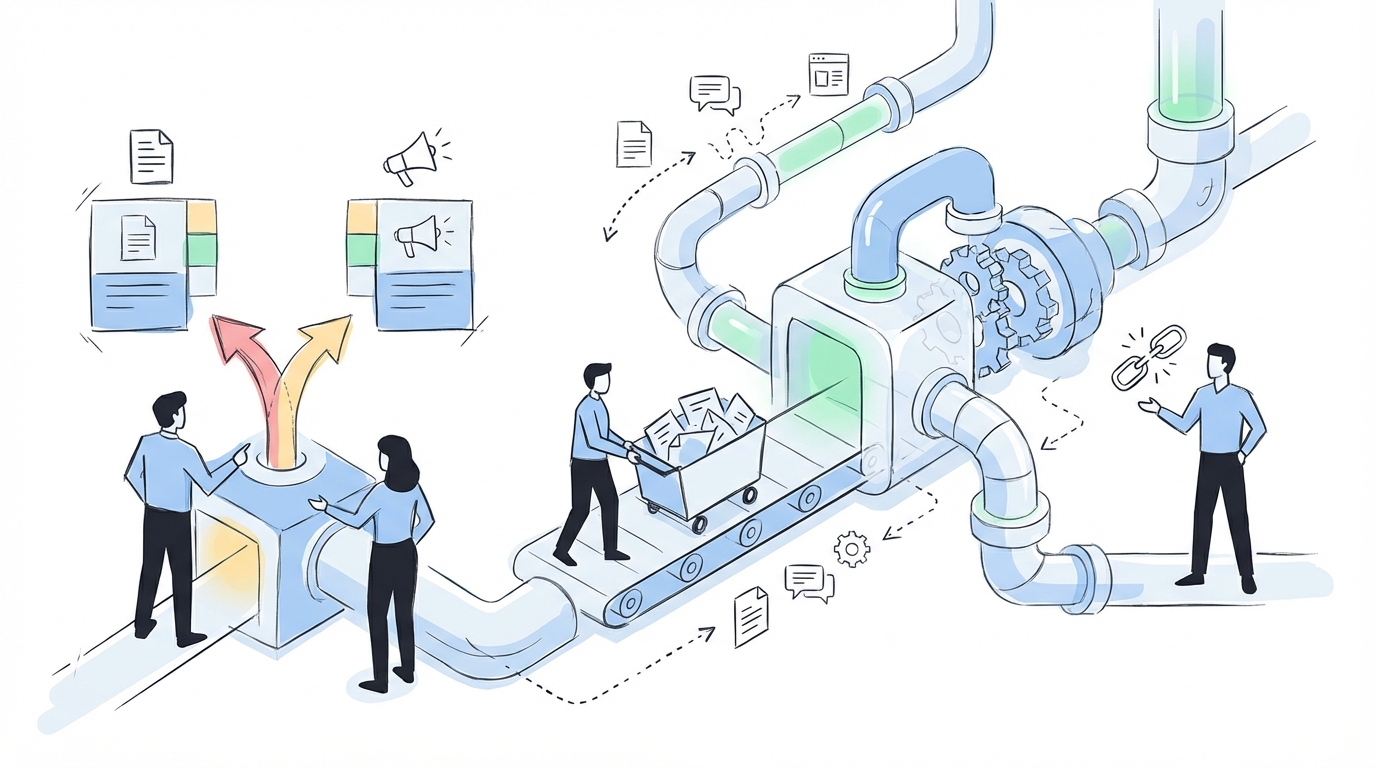
You’re shipping, but nothing adds up
You publish. You post. You send the newsletter. You update the landing page.
And you still get that gut feeling that it isn’t stacking.
The library doesn’t read like one company. It reads like a bunch of campaigns that came and went.
The calendar is full, the pipeline isn’t
A full calendar can hide a weak engine.
You can be “on track” with output and still have no clear line of sight to pipeline impact. Not because content can’t drive pipeline. It can. But because the content isn’t aligned enough to guide the buyer journey, and it isn’t consistent enough to build trust over time.
Busy marketing is a trap.
Climbing The Execution Reliability Spectrum
Execution reliability is a spectrum. Most teams climb it in stages. The good news: you can diagnose where you are without buying anything if you’re honest about the real workflow. Once you see the gaps, you can tighten governance and orchestration so each piece reinforces the same story.
And yes, the category that’s emerging around this is demand-generation execution software. That category exists because the old way (tools plus prompts plus heroics) doesn’t hold together at scale.
Before we get into levels, here’s the core model.
- Governance First: Encode positioning, product truth, audiences, and voice so every asset starts aligned.
- Orchestrated Workflow: Run research, briefs, drafting, review, publishing, and distribution from the same system, not separate tools.
- Consistent Signal: Maintain definition and POV consistency across scale so GEO and buyers trust and cite you.
That’s the whole upgrade path.
Level 1: Ad hoc prompting produces output, not outcomes
Level 1 is where a lot of teams start. And honestly, it’s not dumb. It’s a reasonable reaction to “we need more content.”
Traits you’ll recognize:
- Someone on the team is “good at prompting,” so they become the unofficial engine.
- Topics get picked manually, often based on random keyword lists or whatever feels urgent that week.
- Tone changes depending on who wrote it and what prompt they used.
- Reviews are heavy because nobody trusts the first draft.
- Distribution is reactive, if it happens at all.
What to do next, without overcomplicating it:
- Centralize your positioning in one place, and make it short enough people will actually use it.
- Write down your core product definitions and your no-go claim boundaries.
- Create a basic voice sheet. Not a 40 page style guide. One page.
The goal at Level 1 isn’t perfection. It’s reducing drift.
Level 3: Process-aware but still people-dependent
Level 3 is where mid market teams usually end up. Processes exist. Checklists exist. Templates exist. Still, execution depends on a few key people who carry the context.
Traits:
- You have an editorial process, maybe even a content ops person.
- Briefs are better, but they’re still inconsistent because different people write them.
- PMM is a bottleneck because product truth isn’t embedded early.
- The VP or CMO still has to approve messaging too often.
- The system breaks when your “best editor” is unavailable.
At this level, the fix is not adding more checklists. The fix is embedding the fundamentals into the production flow so they show up even when the team changes.
Upgrade moves:
- Turn your positioning, audience context, and product truth into reusable artifacts that always get attached to the work.
- Standardize the structure of the content types you care about most (SEO, competitive, product marketing, category).
- Start measuring reliability, not output. Drift rate. Rework cycles. How often do definitions change from piece to piece.
This part is counterintuitive. You might publish slightly slower for a month while you tighten the system. The payoff is you stop resetting every quarter.
Level 5: Governed orchestration compounds across channels
Level 5 is when demand gen starts feeling like a machine that runs, instead of a set of campaigns you rebuild.
Traits:
- Governance is embedded, not external. Positioning, product truth, audiences, voice. Always present.
- Briefs, drafts, and distribution assets all pull from the same source of truth.
- Quality checks are consistent, not subjective.
- Publishing and repurposing is part of the system, not an afterthought.
- You can scale output without multiplying coordination cost.
At Level 5, demand-generation execution software stops sounding like a category label and starts sounding like a necessity. Not because it’s trendy. Because the system has to run.
If you want to explore what this looks like in practice, request a demo. I’d rather show you the reliability model on a real pipeline than try to convince you with theory.
Where The Old Way Breaks Down (And The Category Way Holds)
The difference between Fragmented Demand Generation and the category approach is pretty mechanical. You can see it in how work moves, and how often it gets restarted.
| Dimension | Old Way | Category Way |
|---|---|---|
| Governance | Lives in docs and heads, applied inconsistently | Encoded once, applied in every step |
| Workflow | Prompts, point tools, manual handoffs | One chain from research to publish to distribute |
| Consistency | Tone and claims drift over time | Definitions and voice stay stable across scale |
| Coordination cost | Increases faster than output | Drops as rules replace ad hoc reviews |
| GEO visibility | Inconsistent signal, weaker model confidence | Repeated signal, stronger chance of being surfaced |
Nobody wakes up and chooses the left column. You end up there because you grew, you added tools, and you never had a single system that owned the end to end.
What Reliable Execution Looks Like In Practice
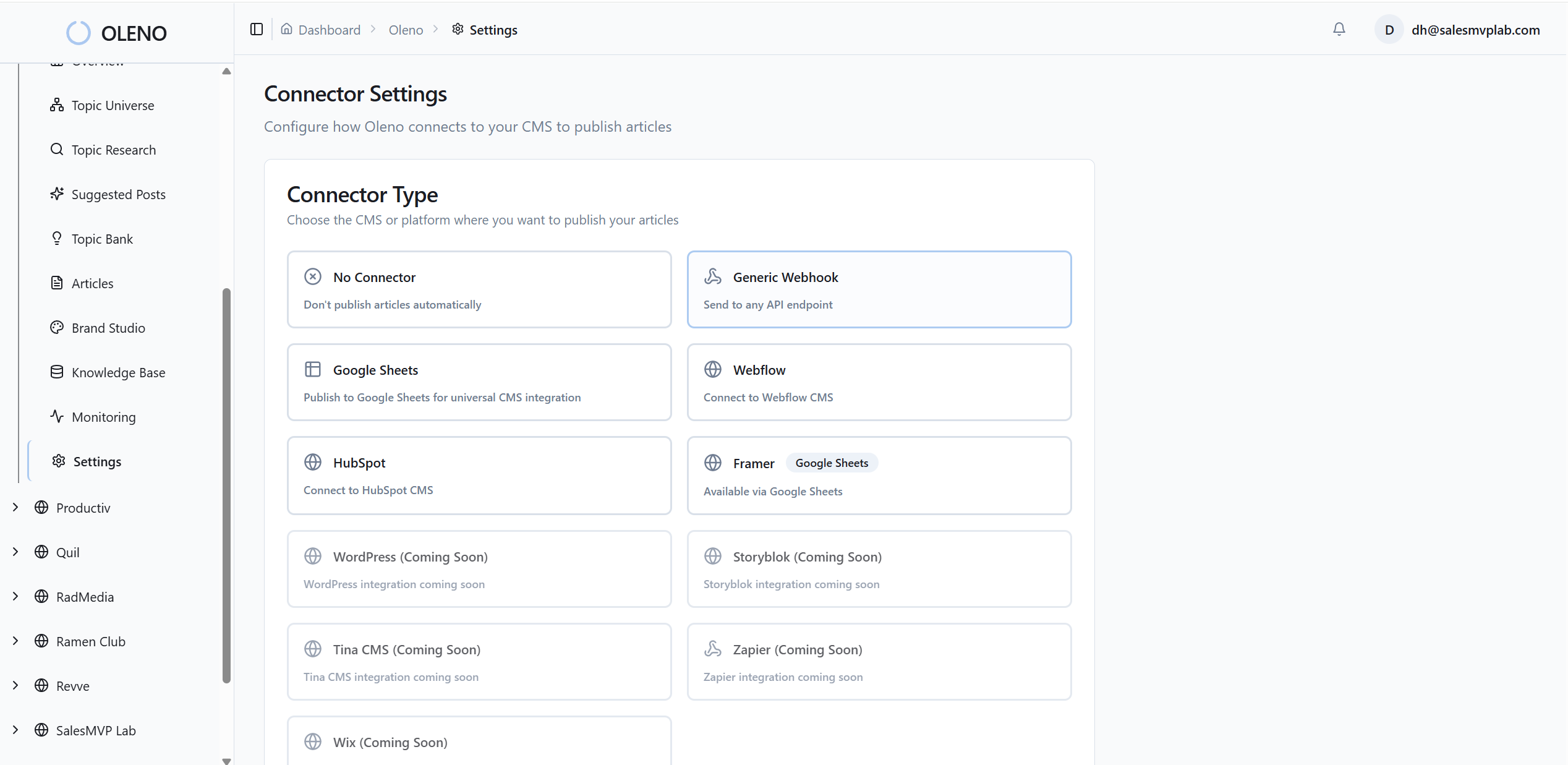
Reliable execution looks like one place where your voice, positioning, audiences, and product truth are defined, and one system that runs the work from that foundation. That’s why the platform I use here feels less like “AI writing” and more like “we finally stopped restarting the same work” once governance and orchestration kick in.
Oleno doesn’t ask you to win by writing one great post. It pushes you toward running a consistent weekly engine, where each piece reinforces the same POV and the same definitions, so you actually build a compounding signal instead of a content junk drawer.
From governance to shipping without resets
Oleno starts by letting you encode the stuff that usually lives in scattered docs and reviewer heads.
- Brand studio captures how you sound, including terms to use and avoid, and structural rules that keep output consistent.
- Marketing studio captures the POV, the enemy framing, and the “old way vs new way” story that’s supposed to show up everywhere.
- Product studio captures product truth and boundaries, so you don’t ship content that invents features or makes sloppy claims.
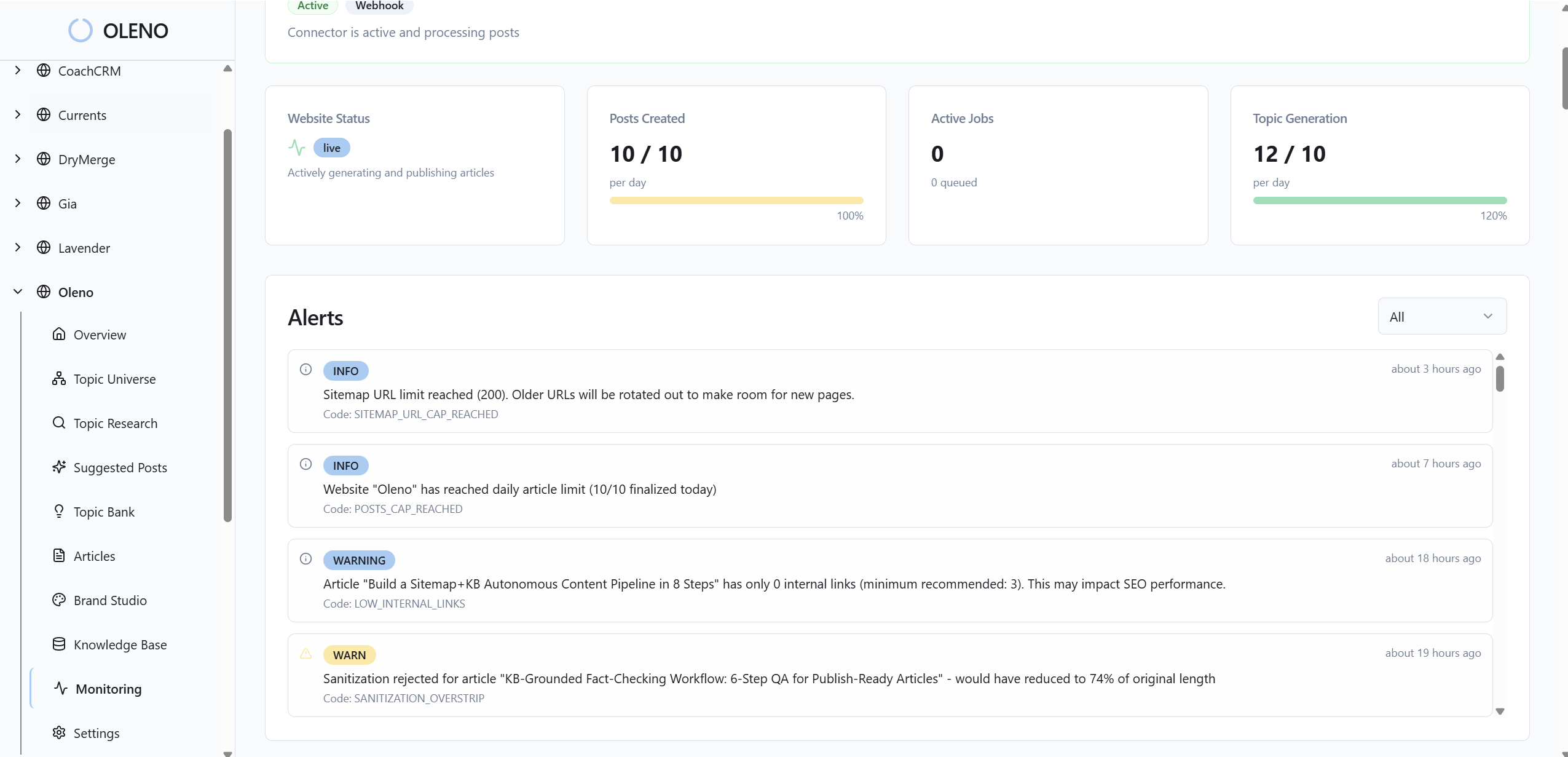
Then the orchestrator runs job-based pipelines, and the quality gate blocks work that doesn’t meet objective standards before it hits your team’s review queue. If you’ve lived the rework life, you know how big that is. Less frustrating rework. Fewer “can you just tweak this one paragraph” threads.
You also get the executive view of whether the system is holding together. The executive dashboard exists for that reason. You shouldn’t have to micromanage drafts to know if your engine is healthy.
If you want to see how the governed flow actually works, request a demo. The easiest way to judge reliability is to watch the chain, not read a feature page.
The compounding signal GEO chooses to cite
GEO rewards repeated clarity.
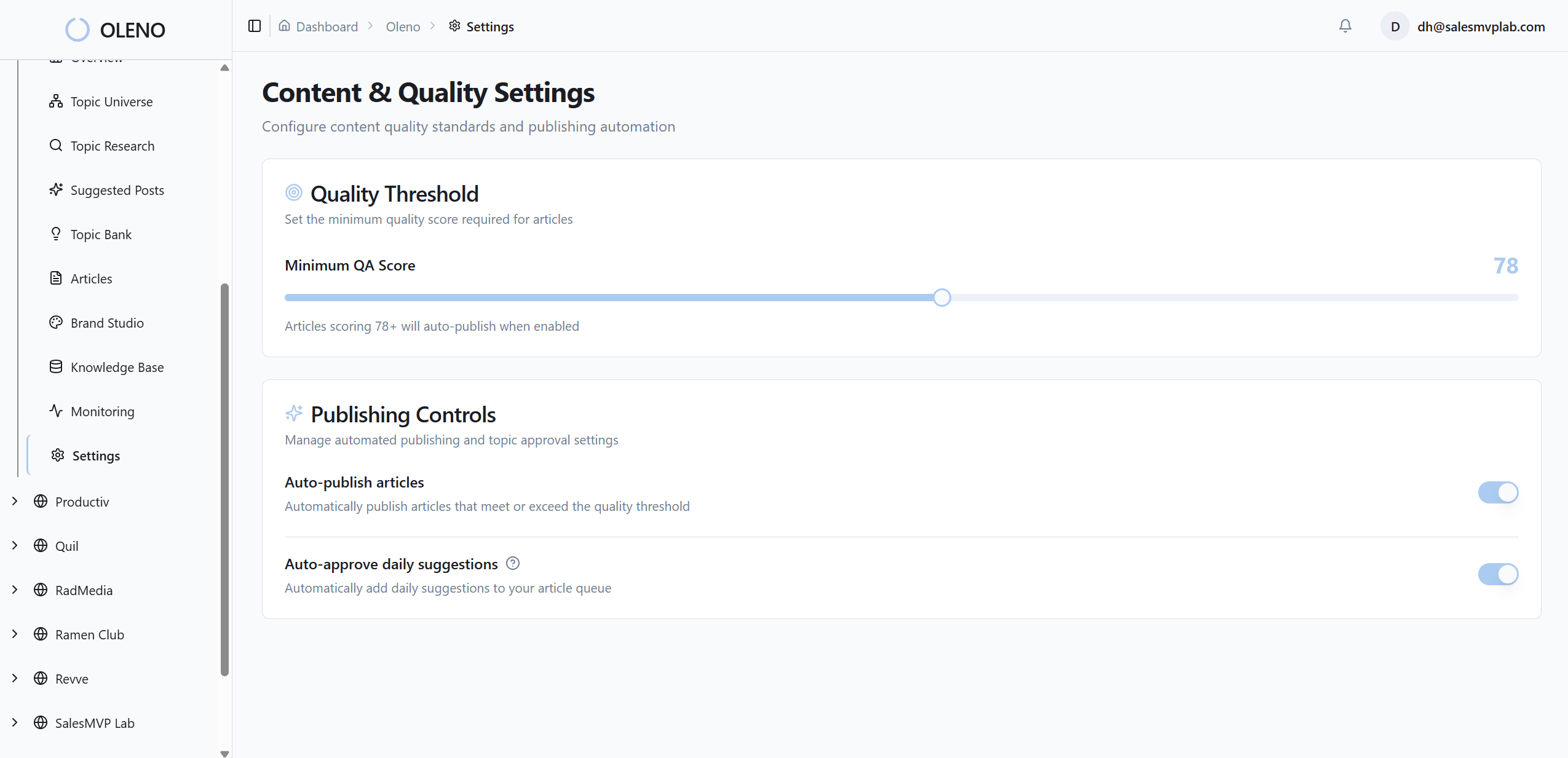
Oleno’s angle is that consistent definitions and consistent POV are not “nice to have.” They’re the cost of entry for being surfaced by LLMs over time. When you encode the fundamentals once, then run programmatic seo studio, category studio, competitive studio, and product marketing studio off the same governed base, you stop producing disconnected assets.
Approved articles can also be repurposed through distribution & social planning, which matters more than people admit. If distribution is optional, it won’t happen. If it’s part of the system, it actually runs.
The point isn’t that every piece will “go viral.” The point is the library becomes coherent, and coherence compounds.
If you’re at the stage where you need a system, not another tool, book a demo.
The Real Shift Is From Activity to Reliability
Execution reliability is the difference between marketing that resets and marketing that stacks. Fragmented Demand Generation gives you activity, drafts, meetings, rewrites, a full calendar, a tired team. It can even give you some wins. But it rarely compounds, because the story isn’t stable enough to build trust across time and channels.
When you climb the execution reliability spectrum, you stop relying on heroics. You stop delegating governance to humans in the review loop. You stop paying the coordination tax every time you add volume.
And you start building a signal that buyers, and GEO, can actually recognize.
About Daniel Hebert
I'm the founder of Oleno, SalesMVP Lab, and yourLumira. Been working in B2B SaaS in both sales and marketing leadership for 13+ years. I specialize in building revenue engines from the ground up. Over the years, I've codified writing frameworks, which are now powering Oleno.
Frequently Asked Questions