Why Brand Voice Consistency Matters for Your Marketing Strategy

Your Head of Content probably spent 3 to 5 hours this week rewriting drafts that were technically fine but didn’t really sound like your company. That’s why brand voice consistency matters more now than it did even two years ago, because humans, Google, and LLMs all punish drift in different ways.
If you’re running a scaling SaaS team, this pain gets weirdly expensive. You add writers, PMM input, SEO input, founder edits, maybe an agency, maybe AI. And somehow your content engine gets slower, not faster.
Key Takeaways:
- Brand voice consistency matters because it reduces rework, protects positioning, and makes content more believable
- The real issue usually isn’t writer quality. It’s context loss across handoffs
- Once you have more than 3 contributors touching content, you need a system, not taste-based review
- In GEO, consistency across dozens or hundreds of pieces matters more than a few standout posts
- The best teams separate strategy definition from execution so voice can persist at scale
- If review cycles regularly hit 3 rounds or more, you’re already paying the Editing Tax
- Content ops, technical SEO, distribution, and analytics still need to work together. Voice consistency alone won’t carry the whole program
If you want to see what governed execution looks like in practice, you can request a demo.
Why Brand Voice Breaks First When Content Teams Scale
Brand voice consistency matters because it’s usually the first thing that cracks when a SaaS content team adds more people, more channels, and more output. The surface problem looks like messy drafts. The deeper problem is that strategy lives in decks, Notion docs, kickoff calls, and founder heads, then leaks out a little more at every handoff.

The Strategy-Execution Gap gets wider with every handoff
Back in 2012-2016 I ran a website that hit 120k unique visitors a month. We got there through depth and breadth at scale. Lots of contributors. Lots of pages. And what made that work wasn’t just volume. It was that every piece had a point of view. That part matters.
Now flip to a typical B2B SaaS team scaling past 200 employees. Monday morning, a Head of Content is in Asana, a PMM sends positioning notes in Slack, the founder drops a few spicy voice notes, SEO adds target terms in a spreadsheet, and a freelancer gets a brief that’s already lost 30% of the nuance. By Thursday, the draft is fine on paper but it sounds like every other SaaS company. The team isn’t failing because they lack ideas. They’re failing because the strategy got diluted before the article was even written.
I call this the Translation Loss Rule. Once a piece of strategy passes through 3 or more human or tool handoffs, you should assume 25% to 40% of the original nuance is gone unless it’s encoded somewhere durable. That’s not a vibe-based opinion. It’s just what happens when language, context, and intent keep getting paraphrased.
Review cycles hide the real cost
Most teams treat editing as quality control. Fair enough. Editing should exist. But there’s a line where editing stops being refinement and starts becoming reconstruction.
A good threshold is the 3-Round Rule. If a draft regularly needs 3 or more review rounds to feel on-brand, your problem isn’t the writer. It’s the system upstream. The brief was weak, the positioning was too abstract, or nobody translated the brand voice into usable rules. So the Head of Content becomes a human middleware layer, constantly fixing what should have been prevented.
When I started at PostBeyond, I could write 3 to 4 strong blog posts a week because I had the context in my head and I was using a structure that worked. As the team grew, output actually got harder. The writer didn’t have the full context I had. I had less time because I was in leadership meetings and managing people. So quality dropped and speed dropped at the same time. That combo stings.
And yeah, it’s exhausting when every draft creates that tiny sinking feeling of “ugh, this is technically correct, but it’s not us.”
GEO makes inconsistency more visible, not less
A lot of teams still think brand voice is mostly a nice-to-have, something that matters for polish after SEO basics are handled. I don’t buy that anymore. In GEO, consistency is part of discoverability.
LLMs don’t just look at one article. They synthesize patterns across many. If your category framing changes every few pages, if your product descriptions wobble, if your point of view sounds different depending on who wrote the draft, you look less authoritative. Google still cares about structure and relevance, of course. But consistency across scale is becoming its own signal. You can see the broader shift in how search is evolving through Google’s own AI Overviews documentation and the market’s move toward AI-mediated discovery.
There’s a case to be made for publishing lots of decent content and cleaning it up later. That can work for a while. But once your brand is trying to define a category, voice drift stops being a style issue. It becomes a credibility issue. Which raises the obvious question: what actually keeps brand voice consistent when the team gets bigger?
What Brand Voice Consistency Actually Depends On
Brand voice consistency matters because it’s not really about adjectives on a style guide. It depends on whether your team has encoded context in a way that survives production. Voice is the output. Governance is the cause.
Voice is a system, not a writing talent
A lot of teams secretly believe the fix is finding better writers. Better writers help. Obviously. But that belief breaks down fast once output scales.
The real problem isn’t that one person used the wrong phrase or one intro felt flat. The real problem is that your company voice is being treated like taste instead of infrastructure. Taste lives in senior people’s heads. Infrastructure survives turnover, growth, freelancers, and AI.
That’s why I use the Voice Stack framework. There are 4 layers:
- Positioning: what you believe and what enemy you’re arguing against
- Audience reality: who you’re talking to and what they care about
- Product truth: what you can actually say without drifting into fiction
- Expression rules: tone, cadence, vocabulary, structure, examples
If one of those layers is missing, voice drifts. If two are missing, every article sounds like generic B2B mush. If three are missing, your Head of Content becomes the only thing holding the whole system together.
A useful gut-check is this: can a new contributor produce a draft that sounds 80% right without a live call? If not, your brand voice isn’t documented deeply enough to scale.
Most style guides are too shallow to be useful
Open up a lot of brand voice docs and you’ll see things like “be human,” “be confident,” “avoid jargon,” “sound smart but approachable.” That’s not nothing. But it’s also not enough to drive consistent execution.
Writers need operational guidance. Not mood boards.
The Vivid Voice Test is simple. Your voice system should answer these 5 questions:
- What do we believe that most of the market gets wrong?
- Which phrases do we naturally use, and which ones do we avoid?
- What kinds of examples fit our buyer’s world?
- How direct are we when we disagree?
- What makes a draft feel like us in the first 2 paragraphs?
If your guide can’t answer those questions clearly, writers will fill the gaps themselves. AI will definitely fill them itself. That’s where drift starts.
This is also why founder-led content often feels strong but doesn’t scale. At LevelJump, we recorded videos with the CEO and turned them into written content. Faster, for sure. But the content often missed the structure needed for search intent and repeatability. Strong raw material. Weak operating system. Different problem than people think.
Audience-specific voice beats one-size-fits-all voice
One mistake I see all the time is teams trying to create one universal brand voice that works the same for every audience. That sounds efficient. It usually isn’t.
A Head of Content at a scaling SaaS company needs different examples, stakes, and framing than a CMO at a later-stage company. Same company voice, different application. If you ignore that, content sounds vaguely polished but oddly unconvincing.
So here’s the rule I’d use: keep the belief system fixed, vary the framing layer. Your point of view should stay stable. The examples, objections, and day-to-day language should shift by persona. If you’re writing for Heads of Content, talk about review cycles, calendar pressure, freelancer coordination, and voice drift across channels. Don’t write like you’re pitching a board deck.
That’s one reason category content works when it lands. It gives the market a stable way to understand your world, while still letting you tune execution for different readers. Voice consistency isn’t sameness. It’s recognizable coherence.
The hidden benchmark is edit distance
This one surprised us a bit. A lot of teams measure content quality by whether a draft gets approved. That’s too blunt. Approval can hide a ton of waste.
A sharper benchmark is edit distance. How far was the first draft from something publishable? If your average draft needs 20% or more of its sentences rewritten for voice and positioning, your system is leaking context. If it needs under 10%, you’re in pretty good shape. Between 10% and 20% is the messy middle most scaling teams live in.
You can track this crudely, even without fancy tooling. Sample 10 recent articles. Count how many intros, product descriptions, and CTA paragraphs had to be meaningfully rewritten. If 6 or more needed major surgery, brand voice consistency matters in your org right now in a very practical way. Not philosophically. Operationally.
That gets us to the next question. If voice drift is a system issue, what does the better system actually look like?
If you want a closer look at how teams are shifting from manual drafting to orchestrated execution, this piece on why AI writing didn't fix the system is worth your time.
How High-Output Teams Keep Content Consistent
Brand voice consistency matters because consistency doesn’t appear at the end of the workflow. It has to be built into the workflow. The teams that ship a lot without sounding fragmented do a few things very differently.
They encode strategy once, then reuse it everywhere
The old way is re-briefing. Every writer, every draft, every project starts from scratch. Maybe there’s a kickoff doc. Maybe some Slack messages. Maybe a Loom. Then everyone hopes the essence survives. It rarely does.
The better approach is what I’d call the Encode Once model. You define your positioning, voice rules, audience realities, product truth, and use-case framing once, then every brief pulls from that governed base. That means the writer isn’t guessing at what “on-brand” means this week.
This matters more than people realize. Because the bottleneck isn’t writing. The bottleneck is re-contextualizing. That is where hours disappear.
The teams that get real leverage usually have these 4 ingredients:
- a stable market point of view
- audience-specific guidance
- product boundaries that prevent drift
- repeatable structures for common content types
Without those, every article is a custom project. With them, every article becomes a governed variation.
They separate diagnostic work from production work
Most content workflows mash diagnosis and production together. The writer is supposed to figure out the angle, understand the audience, choose examples, align the message, and draft the piece. That’s too much uncertainty in one lane.
A better split is Diagnose first, produce second.
That means before a piece gets written, someone or something should already answer:
- Which audience is this for?
- Which persona is primary?
- Which use case or pain pattern are we mapping to?
- What belief are we trying to strengthen or challenge?
- What should never be said because it drifts from product truth?
This sounds obvious. But most teams skip it because they’re busy. Then they pay for it in revisions.
Honestly, this is where a lot of AI workflows go off the rails. The draft comes back quickly, so people assume the system is efficient. But if the prompt is doing all the heavy lifting every single time, you’re not building leverage. You’re renting it.
They optimize for consistency before volume
There’s a common belief that you need to hit huge output first, then tighten quality later. I get why people think that. Sometimes you need momentum. But for category definition and thought leadership, that approach backfires.
Consistency across scale beats raw volume. Especially now.
At Steamfeed, traffic spikes came as the site hit 500 pages, then 1,000, then 2,500, then 5,000, then 10,000. But that growth didn’t come from random output. It came from volume plus depth plus distinct points of view. Breadth alone won’t carry you. Thin repetition definitely won’t.
So I like the 30-Article Threshold here. Before you try to flood a category, get to 30 pieces that clearly express the same worldview, same language patterns, and same product framing. If you can’t stay coherent across 30, you won’t stay coherent across 300. And in LLM-driven search, that consistency gap gets exposed fast. You can see part of that broader market shift in Bain’s work on how generative AI is changing digital discovery and buying behavior here.
They still keep humans on the strategic layer
I don’t think the answer is removing humans from the process. Not even close. The answer is moving humans up the stack.
Humans should define the point of view, set product boundaries, decide what matters, and spot when the narrative should pivot. Humans should not spend their week rewriting intros that drifted because the system had no memory.
That’s an important concession. Some teams genuinely do better with a very hands-on editor in the loop, especially if they’re still refining positioning. That’s fair. If your messaging is changing every month, full automation is premature. But once your positioning is stable, keeping humans stuck in repetitive review work is just expensive indecision.
The move is simple: put people on judgment, not cleanup. That’s how you get output without losing your voice.
So if that’s the operating model, where does Oleno actually fit without pretending it replaces the rest of your stack?
How Oleno Turns Voice Rules Into Content Output
Brand voice consistency matters because strategy only compounds when it gets executed the same way over time. Oleno fits here by turning governance into repeatable content production, not by replacing SEO, analytics, or demand gen strategy.
Why teams use Oleno for narrative control
Oleno starts with governance, which is the right place to start if your problem is brand drift. Brand Studio lets your team define tone, style, vocabulary, structure rules, and exemplars so the system has actual voice constraints to work from. Marketing Studio adds the market point of view, category framing, and key messages, which is how content stops sounding neutral and starts sounding like your company. Product Studio grounds approved claims, boundaries, and product descriptions so the draft doesn’t wander into made-up territory.
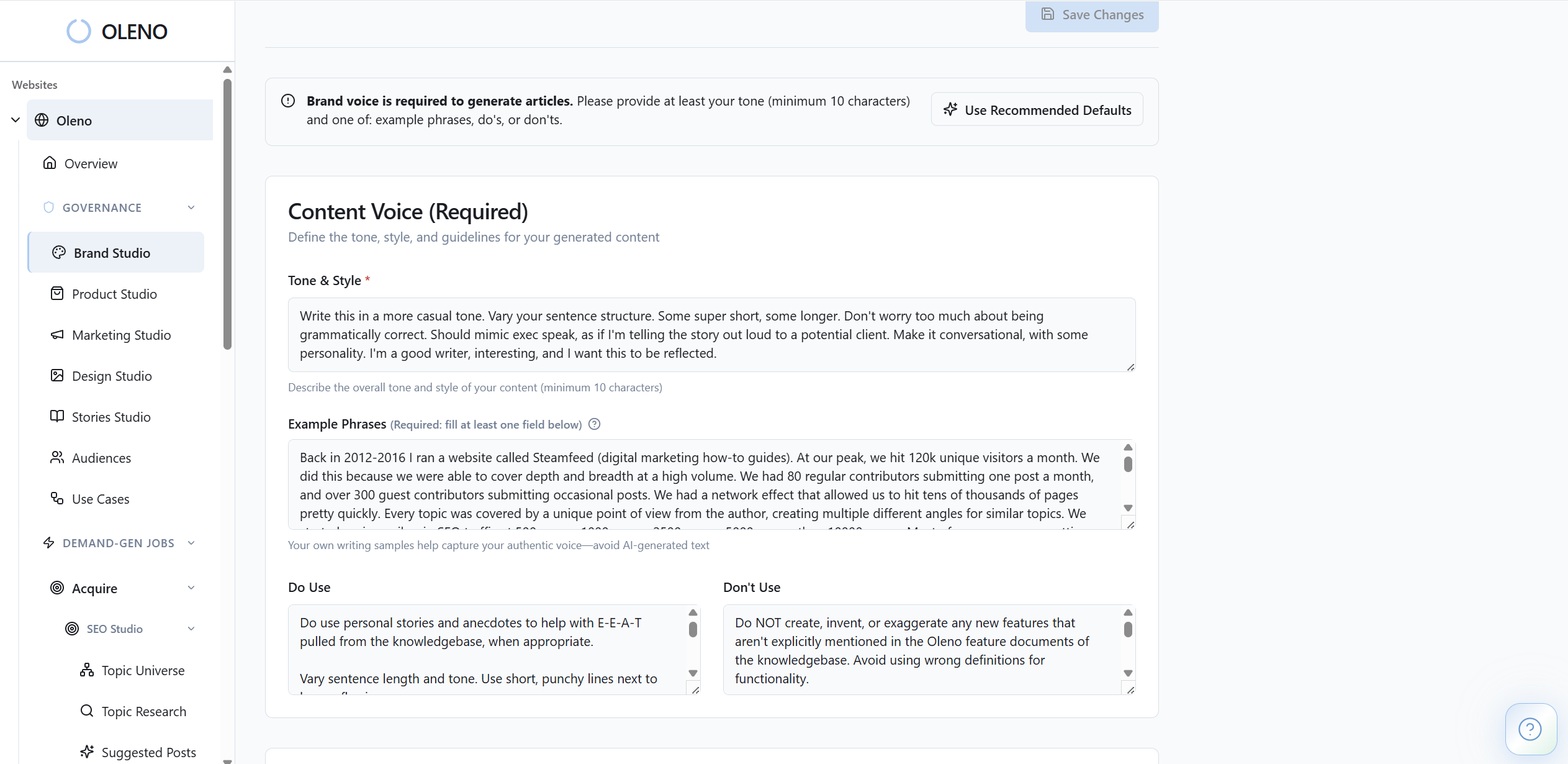
That combination matters because voice problems are rarely just tone problems. They’re usually tone plus positioning plus product truth breaking apart. Oleno keeps those layers connected. And the Quality Gate checks content against voice, structure, grounding, and quality thresholds before it moves forward. That’s how the review burden starts dropping instead of just shifting around.
If you’re dealing with the classic “this draft is decent but doesn’t sound like us” problem, that’s the use case. You can request a demo and see how those governance layers get applied in actual workflows.
Where Oleno adds leverage for lean content leaders
For a Head of Content, the leverage isn’t just that Oleno drafts articles. It’s that it keeps context attached to execution. Audience & Persona Targeting applies audience pains, persona goals, and language preferences so the same topic doesn’t come out generic for every segment. Use Case Studio adds workflow-specific framing, which matters when you want content to reflect what buyers are actually trying to do, not just what your feature list says. Stories Studio brings in founder stories, customer anecdotes, and sales insights so thought leadership feels lived-in.
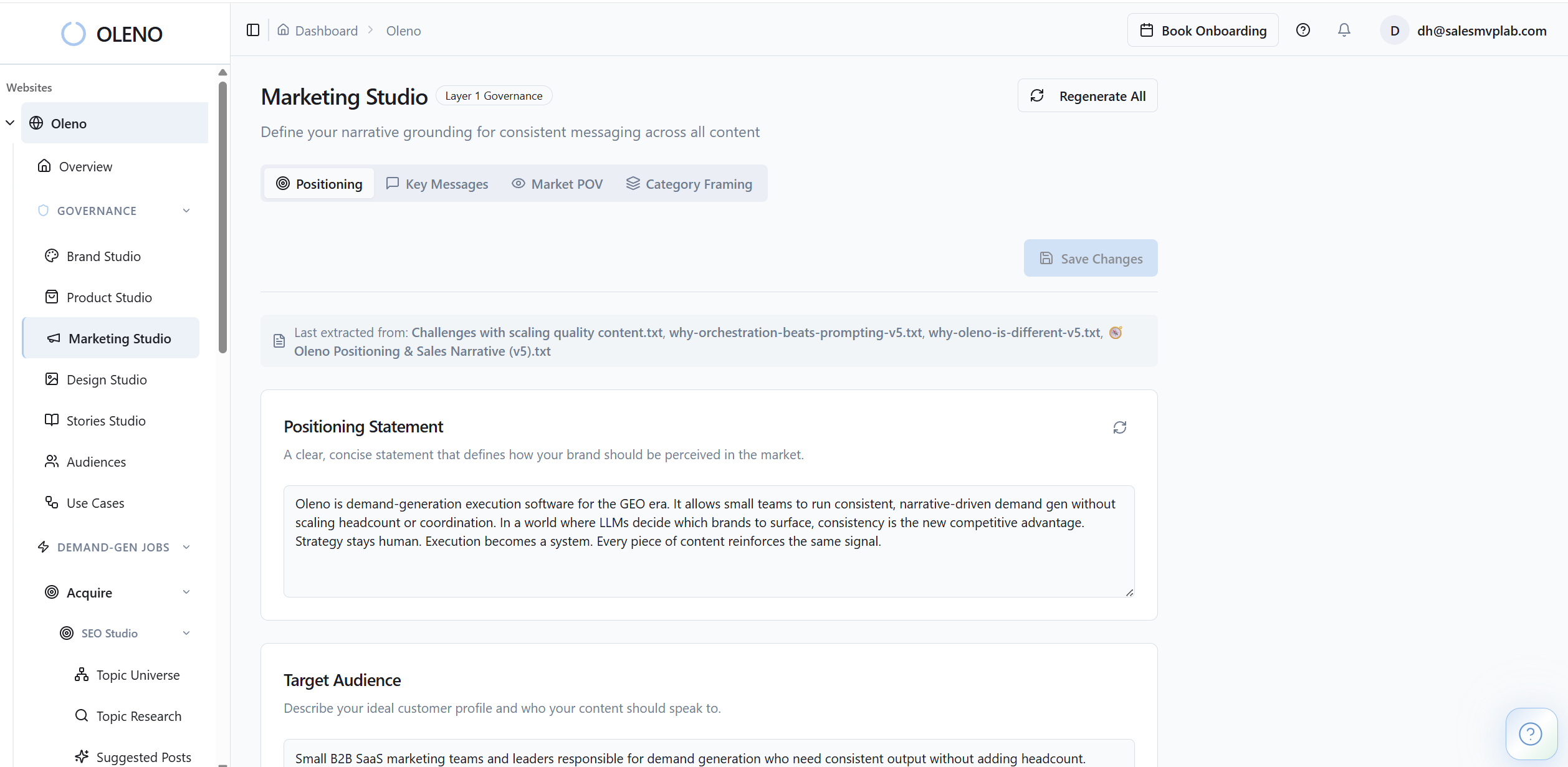
Then the execution layer takes over. Programmatic SEO Studio runs a steady acquisition content pipeline. Category Studio supports long-form category and POV content. Product Marketing Studio handles product-led articles with Product Studio grounding. The Orchestrator manages pipeline execution against quotas, while Content Refresh & Drift Monitoring flags content that has gone stale against current governance.
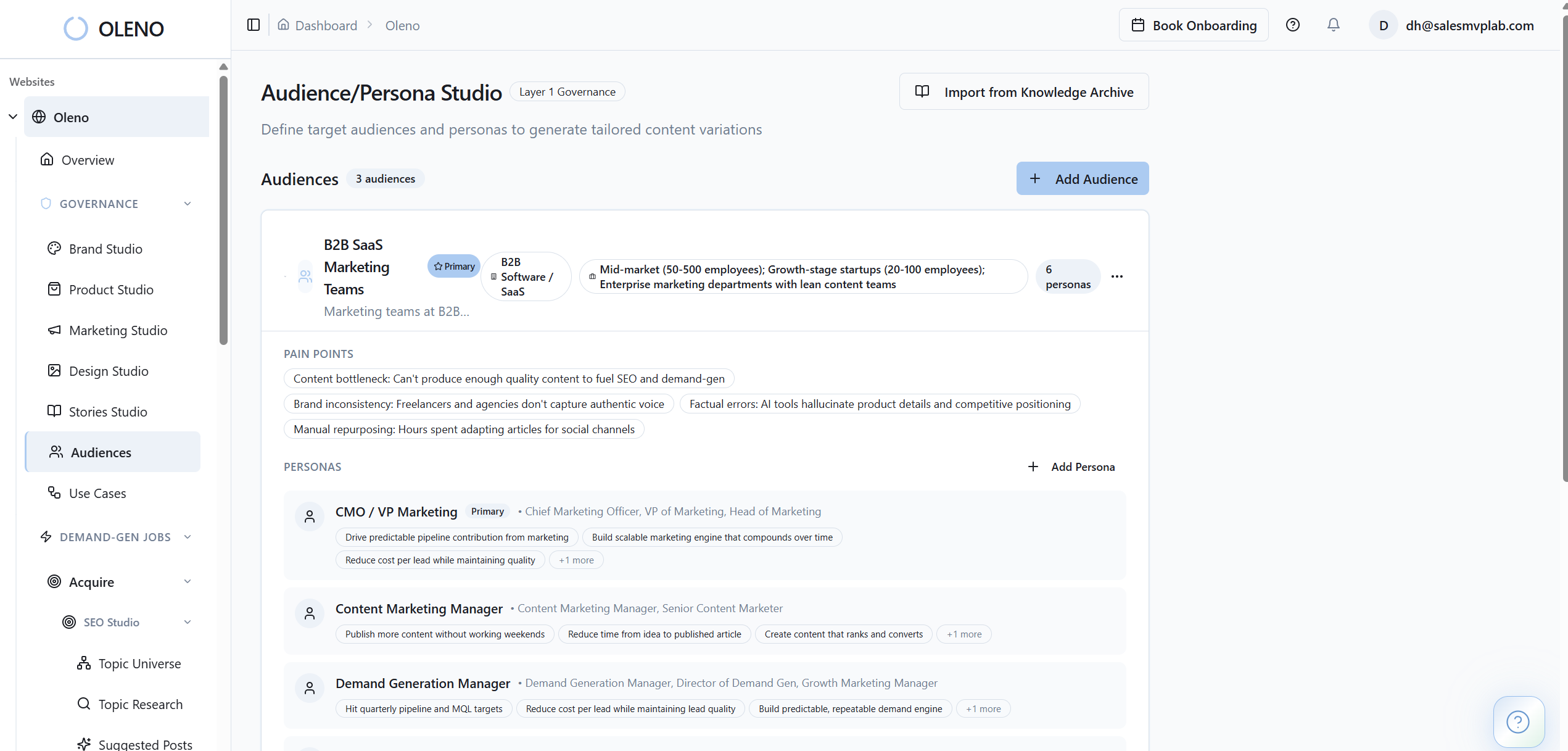
That’s the important distinction. Oleno is the content production and governance engine. It doesn’t do keyword ranking tracking, technical SEO, paid media, or attribution. You still need the rest of your stack. But it does remove the content bottleneck that forces your team to keep translating strategy manually.
And yeah, that’s usually the moment people get it. One of the early reactions to the output was basically, “this is like adding 3 people to my team.” That framing lands because it captures the real value. More capacity, without more coordination debt.
If you’re ready to see how that looks in your own workflow, book a demo.
Why This Matters More Now Than It Used To
Brand voice consistency matters because the market is less forgiving now. Buyers see more content, more channels, more AI-generated sameness, and more half-aligned messaging than ever. The brands that stand out aren’t just publishing more. They’re expressing the same sharp point of view over and over, across formats and across time.
If your strategy still lives in docs and your execution still depends on people reinterpreting it by hand, you’re going to keep paying for that gap. First in edit cycles. Then in slower output. Then in weaker market signal. Fix the system, and the voice gets stronger. Keep patching drafts, and you’ll stay stuck in cleanup mode.
About Daniel Hebert
I'm the founder of Oleno, SalesMVP Lab, and yourLumira. Been working in B2B SaaS in both sales and marketing leadership for 13+ years. I specialize in building revenue engines from the ground up. Over the years, I've codified writing frameworks, which are now powering Oleno.
Frequently Asked Questions