Write for Snippets and Scale: Structuring Content to Win AI Citations When Scaling Content Marketing

You can write twice as much and still get half the results. I’ve done it. The teams were talented, the ideas strong, but the structure wasn’t built for how assistants and search actually find answers. We buried the lede. We wrapped insights in long intros. And then we wondered why mentions didn’t show up and rewrites never stopped.
Here’s the shift. Treat every section like it must earn a standalone citation. Put the answer upfront, make it citable, and make the rest scannable. You’ll feel the difference in your editorial meetings first—less debate about style, more focus on substance. Then you’ll see it in volume, because your packaging works at scale.
Key Takeaways:
- Open every H2 with a three-sentence, 40–60 word direct answer
- Design sections to stand alone so assistants can cite any single block
- Use consistent labels, clean schema, and predictable headings for machine readability
- Quantify the cost of structure debt and stop paying it in rewrites
- Adopt a simple, enforceable pattern—then automate checks upstream
- Use systems (not memory) to keep structure consistent as volume climbs
Snippet-First Structure Compounds Faster Than Long-Form Volume
Snippet-first structure accelerates compounding because it turns each section into a quotable unit. Assistants prioritize short, unambiguous spans, and humans appreciate clarity without the preamble. For example, a “What It Is / Why It Matters / Example” opener gives both parties exactly what they need in under a minute.

What is snippet-first structure and why does it matter?
Snippet-first means every H2 opens with a three-sentence, 40–60 word block that directly answers the implied question. It’s purpose-built for assistants to lift and humans to skim. You don’t hope someone reads to paragraph six. You respect their time and the machine’s constraints.
This matters because compounding doesn’t come from one perfect post. It comes from 200 good, including the shift toward orchestration, citable sections that travel. The openers become portable truths. They anchor the rest of the narrative, reduce “what are we saying here?” edits, and let you scale production without watering down meaning.
Why long intros get ignored by assistants
Assistants parse for clarity, consistency, and brevity. Long intros add noise and bury the core claim, which forces machines to guess and often pass. If you want to be quoted, be quotable. Start with the answer, not the story.
Humans don’t love long intros either. They skim. They hunt for proof, not setup. Put the narrative, analogies, and nuance in the body. Make the opener a locked-in summary that can stand on its own and still be true on its hundredth read.
How section independence drives discovery at scale
Section independence means each H2 opener re-states the entity and the action. You don’t assume upstream context, so a mid-page landing still makes sense. Assistants can pull any single block without fear of misrepresenting the idea.
Practically, you write to be anchorable. Clear subheads. Local definitions. Short examples that stay local to the section. It sounds simple because it is. And simple scales, including the rise of dual-discovery surfaces:, especially when you’re trying to compound citations across a catalog, not just win the headline.
You Are Publishing Into Two Discovery Systems
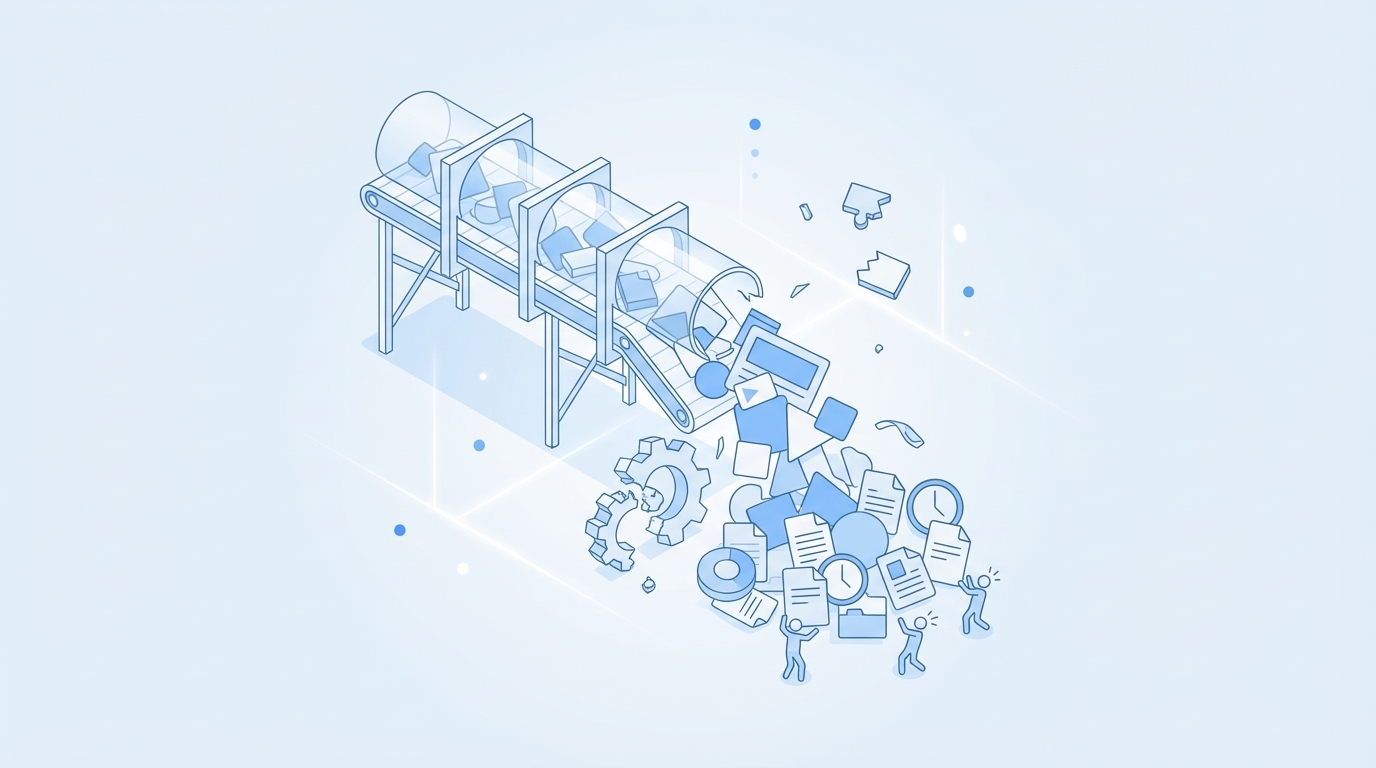
Search engines and assistants reward different signals, but both love structure, clarity, and clean markup. You’re writing for readers and retrieval at the same time. The goal isn’t to hack either system; it’s to package meaning so both can extract the right answer quickly.
How do LLMs evaluate and cite content?
LLMs favor spans that are short, precise, and consistent in terminology. They also like labeled sections, Q&A patterns, and opener sentences that can be lifted without cleanup. You can’t force the citation, but you can be the safest quote to copy.
Think like an editor in a hurry. Make the claim crisp. Reduce hedging in the opener. Use repeatable labels for “Definition,” “Checklist,” or “Example.” For broader context on how teams adapt content ops for AI workflows, the overview from the Marketing AI Institute on content strategy tools is a useful primer.
Clean markup and schema make meaning machine readable
Schema clarifies meaning for machines. JSON-LD for Article, FAQ, and Breadcrumb helps systems understand what’s on the page and how it relates to the rest of your site. Predictable heading hierarchy further reduces guesswork.
I’m not saying markup replaces good writing. It doesn’t. It makes good writing findable and citable. Keep your H2/H3 labels stable, avoid decorative phrases in openers, and use FAQ for question-led sections that mirror how your audience actually asks.
Want to see this discipline translated into drafts without manual shepherding? Try Generating 3 Free Test Articles Now.
Where query harvesting beats single keyword thinking
Stop chasing single keywords. Harvest the real questions from sales, support, and your search console. Group by intent—how someone asks, not just which noun they typed—and write one authoritative section per intent.
Those questions become your anchorable H3s and FAQ entries. Assistants match on phrasing, not just keywords. When your copy mirrors how people ask, your eligibility for being quoted goes up—and you avoid bloated “ultimate guides” that say everything and answer nothing.
The Hidden Costs of Unstructured Articles
Unstructured articles inflate editing time, including why ai writing didn't fix, reduce snippet eligibility, and waste crawl budget. Let’s pretend you publish 20 posts a month and poor structure cuts snippet-ready sections by 30%. Over a quarter, that’s dozens of missed citation opportunities and hundreds of hours lost to fixable rework.
Frustrating rework from vague openings
Editors rewrite meandering intros into direct answers. Writers add context back in because they’re worried about losing nuance. Then someone re-rewrites to meet word count. It’s a loop, not a process.
Standardize the opener. Make it three sentences. Hold the line on sizing. You’ll still debate arguments and examples—those are worth debating. But you won’t waste time asking, “What are we trying to say?” for the tenth time this week.
The compounding traffic you leave on the table
Every clean opener is a potential citation surface. When it’s vague or buried, you forfeit that surface. Multiply that by 200 pages and the opportunity cost isn’t abstract. It’s fewer entry points into your site and fewer chances to earn trust.
If you want a broader look at how AI-driven content programs are evolving, the summary from Sprout Social on AI content marketing trends outlines how clarity and packaging affect discoverability. The point stands: you can’t compound what you don’t clearly expose.
When speed without structure hurts your brand
At PostBeyond and LevelJump, we shipped fast. We used transcripts. We had strong ideas. But without consistent schema and tight openers, good thinking got buried in walls of text. We ranked sometimes, sure, but we left credibility and conversion on the table.
Speed isn’t the villain. Unstructured speed is. When structure lags, you create a tax: more edits, more confusion, more “did we already cover this?” meetings. The fix isn’t heroics. It’s a repeatable pattern enforced early.
When Volume Outruns Structure, Teams Feel It
You can sense it before the metrics show it. Midnight edits. Confused briefs. Worries about whether assistants will credit you. The brand voice frays. People work hard, but the system isn’t compounding. That’s a management problem, not a motivation problem.
That 3am edit marathon
We’ve all been there. Launch week. Twelve drafts in flight. Someone is hand-adding schema, including why content broke before ai, re-labeling headings, and cutting bloated intros. It feels productive because you’re moving words around. It’s also fragile and unscalable.
Move those decisions upstream. Template the openers. Bake schema into the pipeline. Make “Are we citable?” a checkbox, not an afterthought. Your sleep—and your editorial calendar—will thank you.
When your best article gets quoted, but not credited
Sometimes an assistant paraphrases your idea without clear attribution. You can’t control that. What you can do is make the exact sentence you want quoted short, specific, and positioned near the top. Liftable lines get lifted.
If your legal or comms team is asking how to protect credibility in the AI era, this perspective on credible content in the age of AI is helpful context. Practically, you engineer attribution odds by packaging answers the way machines prefer.
You want predictable outputs, not heroics
Heroics are fun stories, not a strategy. Predictable output is what protects quality as volume grows. Writers focus on the argument. Editors validate structure. Publishing stops surprising people.
You don’t need a dashboard to see the difference. You feel it in calmer reviews and fewer “quick fixes.” Predictability isn’t boring. It’s how you preserve voice while increasing throughput.
A Repeatable Way To Make Every Section Citable
Use a four-part pattern you can enforce: three-sentence H2 openers, paragraphs sized for scanning, standalone sections, and automated schema. It’s not clever—it’s durable. Durable is what you need when the catalog crosses hundreds of pages.
Adopt the three sentence H2 opening template
Write the opener as: direct answer, one sentence of context, and one sentence example. Keep it under 60 words. Use the key term early so both readers and assistants lock onto the subject immediately.
Here’s the nuance. Don’t stuff caveats into the opener. Put nuance in the next paragraph. The opener earns the right to be read by being clear, including why content now requires autonomous, not by being exhaustive. That balance is teachable and enforceable across a team.
Still wrestling with manual structure checks across drafts? Try An Autonomous Content Engine For Always-On Publishing.
Make sections standalone with local context and anchorable headings
Assume a reader lands mid-page from an internal link or a snippet. Re-state the subject, define the term locally if needed, and keep examples scoped to that section. Clear subheads like “Template,” “Checklist,” or “Example” help both users and assistants anchor meaning.
This is also a trust play. Clear, consistent labeling and scannable structure signal care and credibility, which supports everything from conversion to sales enablement. The practical guidance from the Content Marketing Institute on building content trust aligns well with this pattern.
Automate JSON LD and FAQ blocks without manual markup
Generate Article, FAQ, and Breadcrumb schema programmatically. Validate as part of your publishing pipeline so you’re not pasting JSON at 3am. Use FAQ for question-led H3s that mirror the exact phrasing customers use.
You’re not chasing every possible rich result. You’re making the core signals reliable. That reliability turns into scale because you don’t re-teach the same rules in every review cycle, and you don’t break markup when teams change.
How Oleno Operationalizes Snippet-Ready Structure At Scale
Oleno turns snippet-first from guideline into pipeline. It writes three-sentence H2 openers, sizes paragraphs, and validates everything against quality gates. Schema and internal links are injected deterministically. For example, a post can publish with Article, FAQ, and Breadcrumb schema without anyone touching code.
Snippet-ready openings generated and QA scored
Oleno generates three-sentence openers for every H2 and runs QA checks for length, clarity, and presence of a concrete example. If a draft fails, it gets refined and re-tested automatically. You don’t hope for consistency—you enforce it without adding headcount.
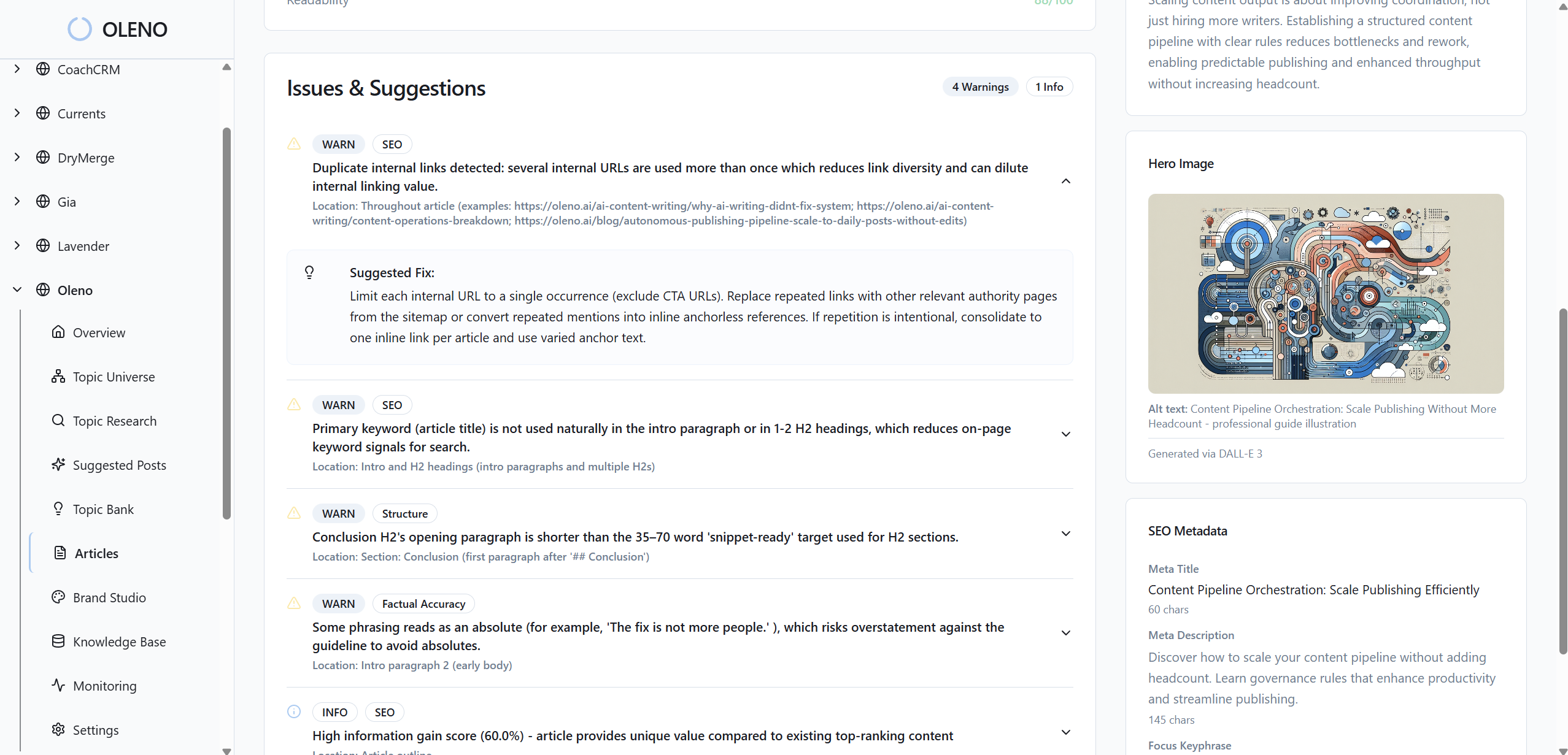
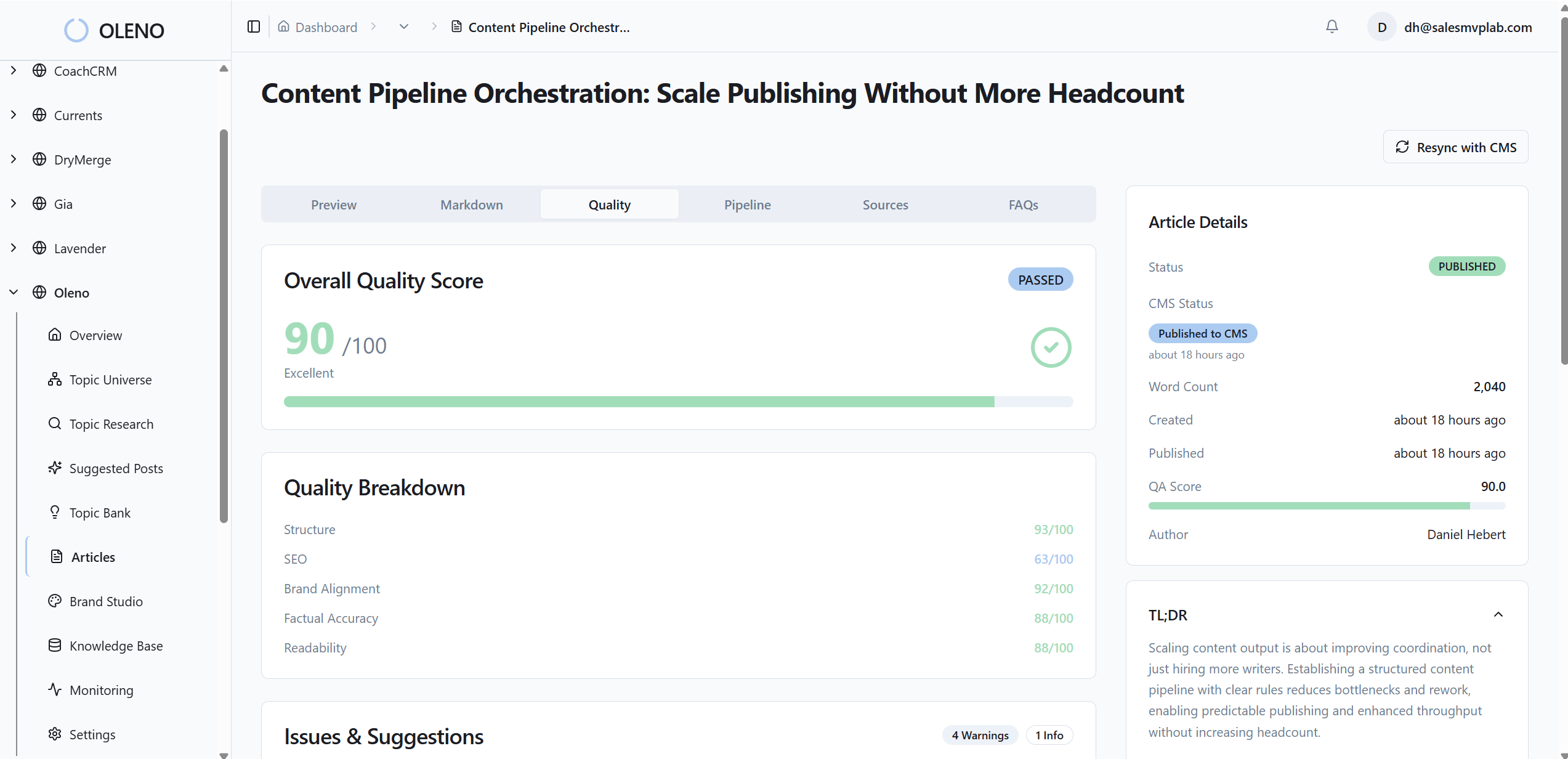
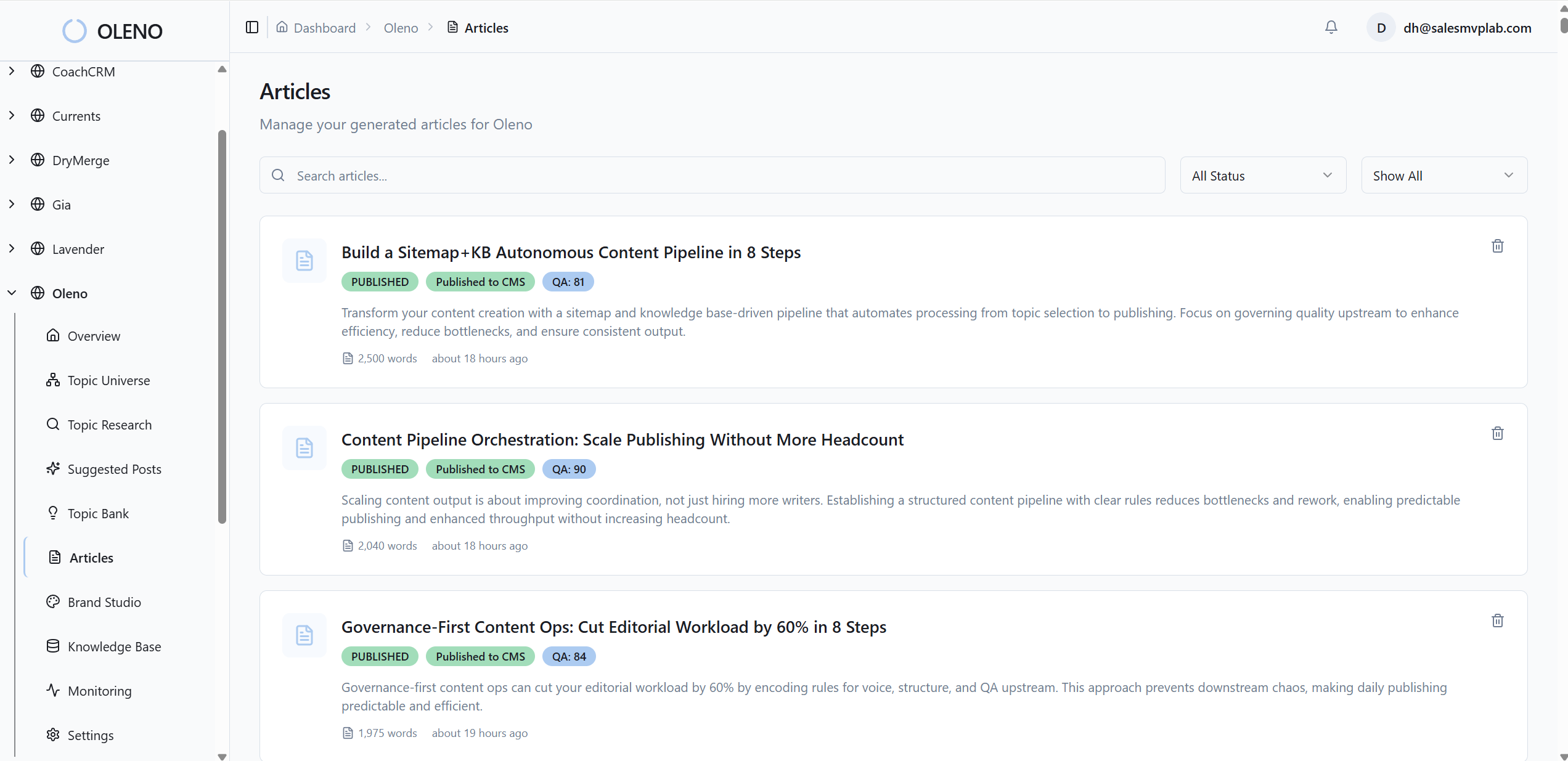
The system doesn’t stop at the opener. Oleno auto-generates JSON-LD for Article, FAQ, and Breadcrumb, and injects internal links from verified sitemaps with anchors that match page titles exactly. Visual Studio adds brand-consistent hero and inline visuals, matching screenshots to relevant sections, and even writes alt text and filenames. Topic Universe prioritizes what to write next, and Information Gain Scoring keeps outlines differentiated before a single paragraph is drafted.
Here’s why that matters. The costs we outlined—rework, missed citations, credibility hits—shrink when structure is deterministic. Your team argues about the story, not the scaffolding. If you want to pressure test this on your domain, you can Try Oleno For Free or, if you prefer a hands-on benchmark, Try Generating 3 Free Test Articles Now.
Conclusion
You don’t need longer articles. You need cleaner openings, standalone sections, and schema you never worry about. That pattern makes your ideas more quotable and your team more predictable. Do it manually if you have to. But if volume is rising, let a system like Oleno enforce the rules so your people can focus on the argument, not the scaffolding.
About Daniel Hebert
I'm the founder of Oleno, SalesMVP Lab, and yourLumira. Been working in B2B SaaS in both sales and marketing leadership for 13+ years. I specialize in building revenue engines from the ground up. Over the years, I've codified writing frameworks, which are now powering Oleno.
Frequently Asked Questions