Reasons Why You Shouldn't Build Your Marketing Process Around Claude skills
Imagine a hypothetical B2B product launch. Your team uses a Claude Skill to draft the launch email. The draft says the product supports real-time syncing.
Product reviews it and corrects the claim: syncing happens daily, not in real time. The email is revised, selected and approved.
Tomorrow, a freelancer starts the landing page. They need the current product source, the selected email, the reason the claim changed, the scope of the email approval and the approvals still pending for the page.
Where does that information live? And who keeps it current?
That’s the real process question. Define your marketing process around the work, responsibilities and decisions the company needs to preserve. Then decide how Claude Skills and your connected tools should support it.
A sophisticated Skill can run a sophisticated workflow. Sharing it does not, by itself, establish a shared record of what happened each time somebody used it.
What Claude Skills can do for marketing
Claude Skills can contain instructions, scripts and supporting resources for a specialized task. They can encode several steps, use connected tools and create tasks in company systems when configured to do so. Anthropic describes Skills as folders of instructions, scripts and resources that Claude loads for relevant work, including workflows that use MCP connectors and other tools (Anthropic’s overview of Skills).
That makes Claude Skills for marketing genuinely useful.
A launch-email Skill might ask for the audience, offer, product evidence and call to action. It could produce subject-line options, draft the email and run a final check against supplied product information.
A content-brief Skill could collect the buyer question, product sources, search research and internal examples before producing a structured brief for a writer.
Skills can also be shared. Team and Enterprise accounts support organization-wide provisioning, allowing owners to distribute approved workflows and manage shared Skills (Anthropic’s guidance on organization-managed Skills).
The Agent Skills specification is an open standard adopted by compatible platforms, so the format is not inherently confined to Claude.
All of that helps you reuse a method. But a method is not the same thing as the record of a particular assignment.
Your launch-email Skill may explain how to produce and review an email. You still need to decide what the company keeps from this launch, who can see it and how the next contributor continues the work.
What your marketing approval workflow needs to keep
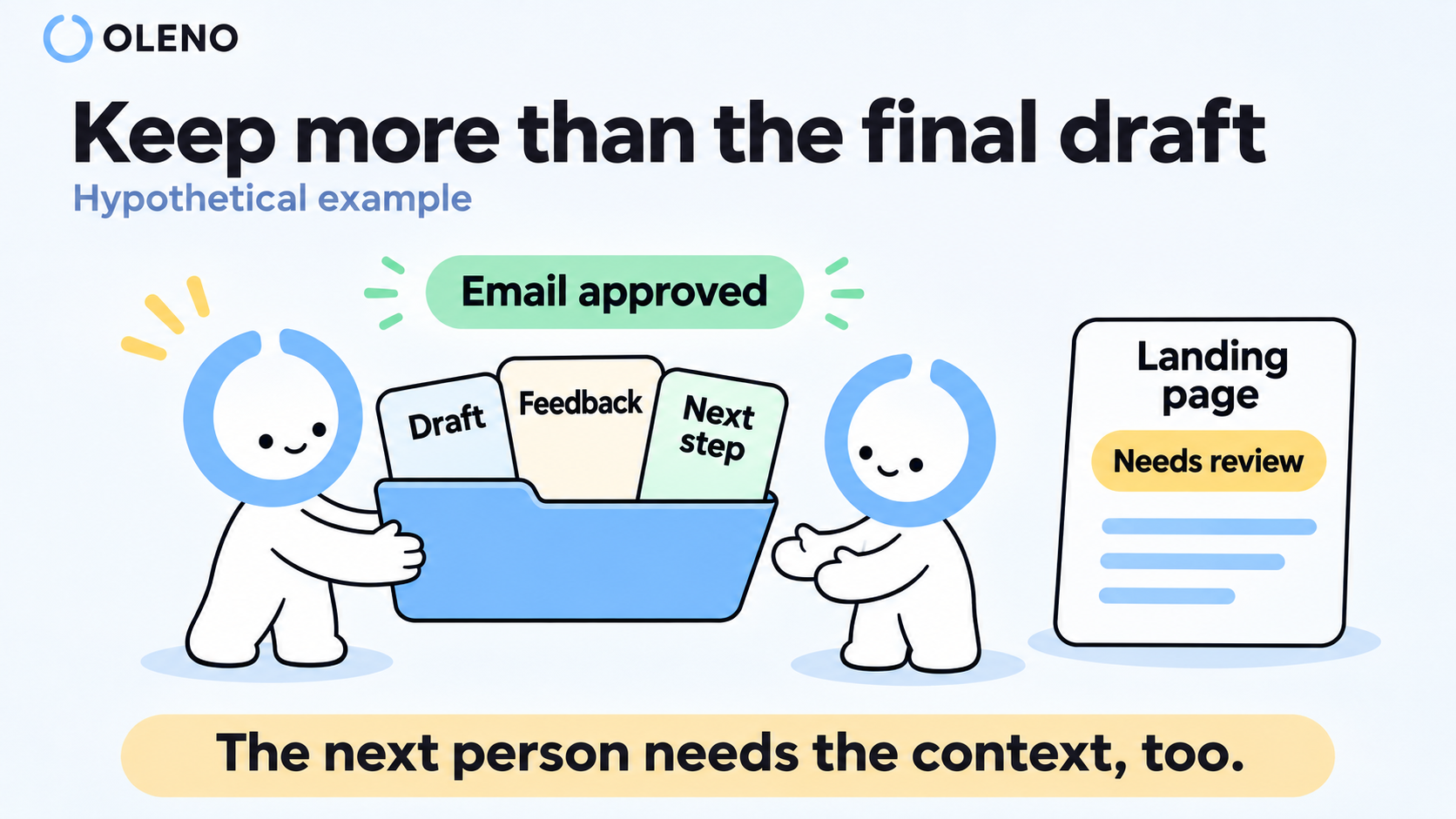
A useful marketing approval workflow should preserve more than the final copy.
Why? Because the approved email alone does not explain which inputs were used, what changed during review or what another contributor is allowed to carry into the next asset.
For the hypothetical launch, the company may need to keep six types of information.
The brief and responsibility
The brief should establish the buyer, offer, channel, owner and expected output.
For example, the launch-email assignment might specify that the email is for existing customers, introduces a new product capability and directs readers to a landing page. It should also identify who owns the draft, who reviews the product claims and who can approve the email.
Without that context, a polished draft can still leave basic questions unanswered. Was this written for prospects or customers? Is it the announcement email or a sales follow-up? Who can accept the final claim?
The relevant source version
The team needs the product source used for the assignment, including its version where relevant.
Suppose the first source was ambiguous about syncing frequency. The email draft then described the feature as real-time. Product corrected the claim and supplied current guidance stating that syncing happens daily.
That distinction matters later. The freelancer writing the landing page should not have to infer product truth from the first draft. They need the current source and the correction.
Keeping a source does not automatically establish that every statement inside it is approved for marketing use. The team still needs accountable owners and clear usage conditions.
The selected draft
AI work often creates several outputs. Keeping all of them without identifying the selected version can create another problem: nobody knows which one the team intends to use.
For this launch, the record should distinguish between:
- The first draft containing the incorrect real-time claim
- The revised draft using the daily-sync claim
- The version selected for review
- The version approved for the launch email
You may retain earlier versions for context, but the current selection should be clear.
The feedback and its reason
“Change real-time to daily” is useful feedback. “Change real-time to daily because the product syncs once every 24 hours” is more useful.
The reason tells the next contributor whether the edit was a stylistic preference, a temporary launch decision or a correction to the underlying product claim.
This is especially important when work moves between employees, agencies and freelancers. If the freelancer only receives the final email, they may notice the word “daily” without understanding that “real-time” is inaccurate across the launch.
The review decision and its scope
The company should record what was reviewed, who made the decision and what that decision covers.
Approval of the launch email does not approve the future landing page.
The landing page is a different deliverable. It may introduce new claims, screenshots, comparisons and calls to action. The freelancer can use the corrected daily-sync claim and the approved email as context, but the page still needs its own review.
The same distinction applies to the Skill. Approving a Skill for team distribution means the team may use that workflow. It does not mean every deliverable produced by the Skill is approved.
The current status and unfinished step
A handoff should make the next action obvious.
In this example, the record might say:
The launch email has been approved for the customer announcement. Use the current product source and the daily-sync claim to draft the landing page. Submit the page for Product and Marketing review before publication.
That gives the freelancer something they can continue. It also keeps four states separate:
- Saved means the material has been retained.
- Reviewed means someone has checked it.
- Approved means an authorized reviewer has accepted it for a stated use.
- Published means it has been released through the relevant publishing destination.
These are not interchangeable. A saved draft may never have been reviewed. An approved email has not necessarily been published. A published asset may later require correction.
Your process needs to preserve those distinctions, regardless of which AI tool helped create the work.
Can shared Claude Skills and your existing tools handle this?
Yes. Claude Skills can be part of a workable team process, and Oleno is not the only way to manage it.
The question is what surrounds the Skill.
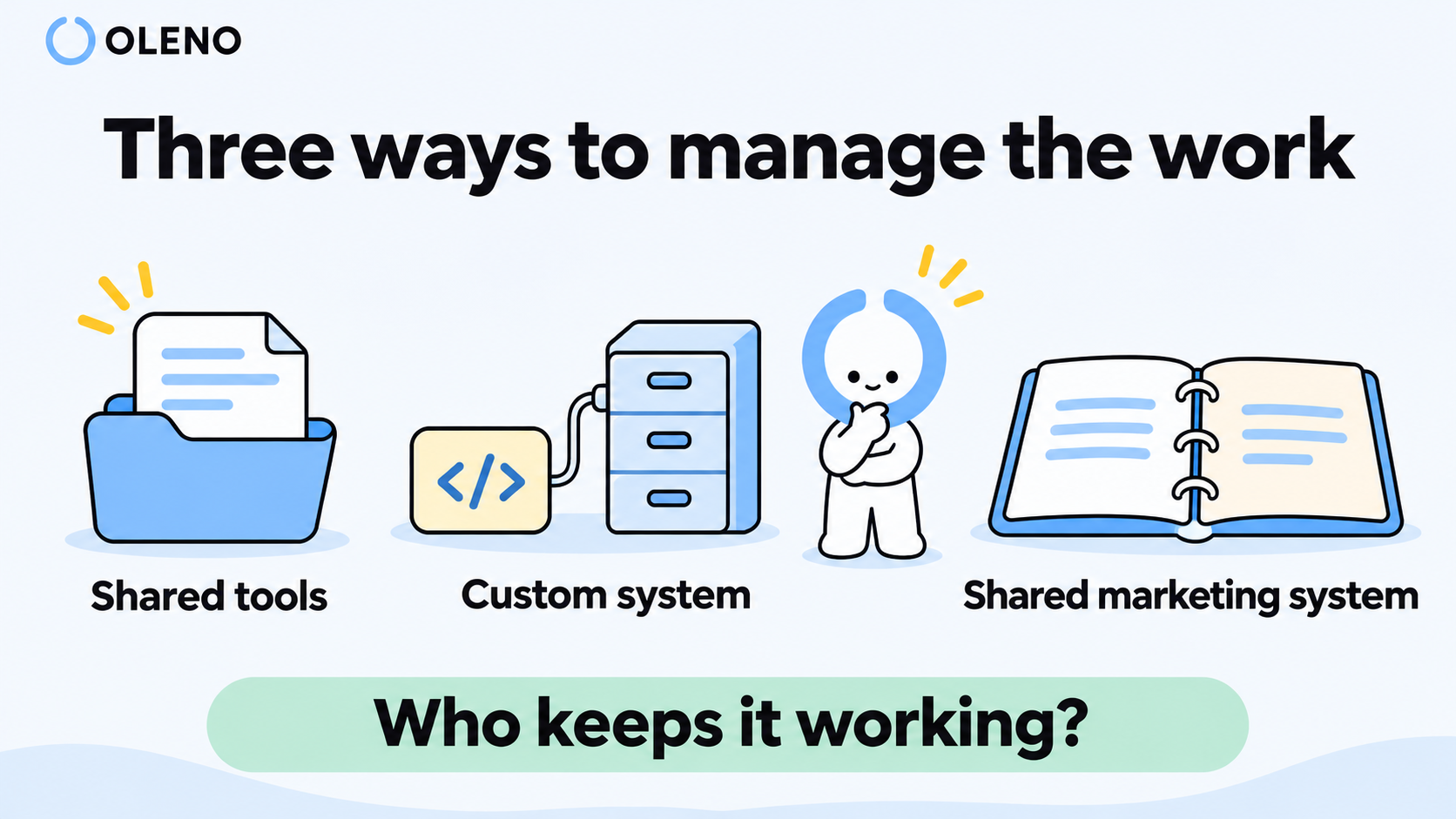
Shared Skills with maintained documents and trackers
You can combine shared Skills with maintained source documents, versioned deliverables and a review tracker.
The product team might own a source document containing current product facts. Marketing could store drafts in Drive or Notion, record approval status in a spreadsheet and manage assignments in a project tool.
This can work well when contributors follow the conventions consistently and somebody owns the setup. You need clear answers to questions such as:
- Who maintains the product facts?
- Where are selected outputs stored?
- How are feedback and approval scope recorded?
- Who controls access?
- How does a new contributor find the current work?
- Who updates the process when the launch workflow changes?
The Skill may encode the drafting method, while the rest of the operating process lives across your existing systems.
A custom connected system
You can also configure Skills, scripts, MCP connections or applications to write work into external systems.
A custom setup may fit your company closely. It can reflect your existing permissions, data model and review stages. It is not automatically a poor choice, and it does not mean developers must handle every process edit.
But you are still designing a system. Somebody has to define the records, connect the tools, handle access, decide what gets written back and maintain the setup as the process changes.
That ownership may sit with a technical marketer, operations lead, internal systems team or engineering. The important thing is to make it explicit.
A shared marketing work system
The third option is to use a system designed to keep reusable marketing processes and selected work together.
This changes the build decision. Rather than designing the entire record structure around each Skill, the team uses a shared system for company knowledge, resources, process guidance and the work people choose to retain.
You still need people to maintain product truth, review the output and approve the deliverable. The system does not remove those responsibilities.
So the comparison is not “Claude Skills versus process software.” Skills can sit inside any of these approaches. The more useful question is: Who keeps the complete marketing process working when the people, tools or review requirements change?
Test the process with someone who did not build it
The original builder is often the least useful person to test a handoff. They already know where everything is and what each step means.
Ask a second contributor to complete a real workflow without informal guidance from the builder. For the hypothetical launch, ask them to:
- Find the current launch brief and product source.
- Use the agreed process to create or continue the work.
- Identify which email draft was selected.
- Confirm whether that draft was reviewed, approved or published.
- Explain why “real-time” changed to “daily.”
- Describe whether that correction applies to the landing page.
- Continue the landing-page assignment.
- Save the new draft, feedback and next step in the agreed place.
Then ask a management question: if the review process changes next month, who updates the Skill, source requirements, tracker and handoff instructions?
Repeated dependence on the original builder is something to investigate. It is not proof that every personal AI setup will fail. But if nobody else can confidently find, understand and continue the work, you have shared a tool without fully sharing the operating process.
How Oleno supports the process alongside Claude
Oleno is designed to sit behind the AI tools your team already uses. It does not replace Claude or turn every AI conversation into a monitored company record.
Return to the hypothetical launch.
The company’s maintained marketing knowledge can hold the current positioning, buyers and product facts. In this case, the current product guidance would state that syncing happens daily.
Resources can hold the relevant source material, templates, examples and screenshots, along with versions and usage conditions. Saving a resource does not itself approve its claims or establish that the company has permission to publish it.
A Play brings the steps, required inputs, expected outputs and review points for the launch workflow together. It might guide the marketer through the email brief, source selection, drafting, product review, marketing approval and handoff to the landing page.
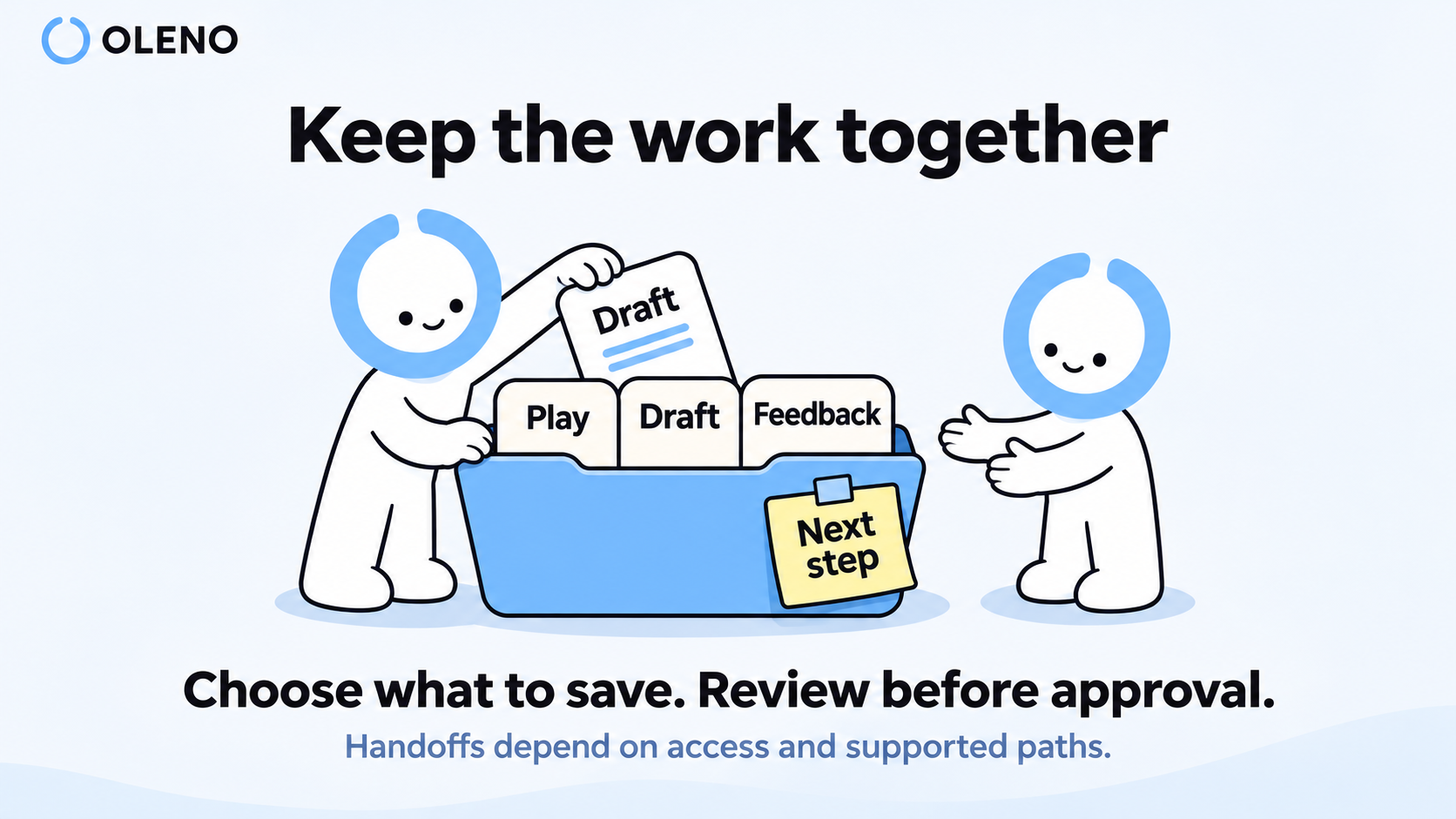
Through supported actions, users choose which outputs, source versions, feedback, decisions and unfinished work to save to the Play run. That could include:
- The launch brief
- The product source version used
- The first email draft
- Product’s daily-sync correction
- The revised and selected email
- The email approval and its scope
- The landing-page assignment
- The next review required
Authorized teammates may inspect and continue recorded work through supported paths. Saving and continuation depend on permissions, the client path and what users choose to save. Complete client-led saving and cross-chat continuation paths are still being qualified across supported clients, and some files may require a separate editing tool.
People remain responsible for strategy, source choices, reviews, approvals and publication. Oleno does not passively capture every chat or treat a saved item as approved.
It also does not automatically learn from Product’s correction. If “daily” should become the current company guidance or change a reusable Play, someone must deliberately update and approve that information. Earlier work remains connected to the version it used.
That is the point of the shared record. It preserves the work worth keeping without pretending every output, correction or conversation should automatically become company policy.
When your existing setup is enough
Keep your existing setup if contributors can use it without constant intervention, leaders can find the selected work and decisions, and handoffs are manageable.
You may already have disciplined source documents, version control, review records and clear ownership. If that system works, adding another tool may not solve a meaningful problem.
Consider Oleno when your team regularly has to reconstruct assignments, ask the original builder what happened or piece together drafts, sources, reviews and next steps from several places.
Evaluate the whole job. Look at briefing, source selection, production, AI content review, approval, saving, handoff and process maintenance.
You do not need to abandon Claude. You need to decide whether the system around Claude gives the company a usable record of the marketing work it is responsible for.
Frequently asked questions
Can Claude Skills be shared with a marketing team?
Yes. Team and Enterprise accounts support organization-wide provisioning, so owners can distribute approved Skills and manage shared workflows. Sharing a Skill makes its method available. It does not automatically create a shared record of every assignment completed with it.
Can Skills save to external systems?
Yes, when configured with connected tools, scripts, MCP connectors or applications. The practical questions are what gets saved, where it goes, who can access it and who maintains the connection and record structure.
How is a reusable Skill different from a marketing job’s record?
A Skill describes how to perform a type of work. A job record preserves what happened during one assignment, including its inputs, selected outputs, source versions, feedback, decisions, approval scope and unfinished steps.
You may need both. The reusable method helps somebody perform the work. The job record helps the company review, understand and continue it.
Do you need Oleno if you already use Claude?
Not necessarily. If your current documents, trackers and connections give the team reliable access to selected work, reviews and handoffs, keep using them.
Oleno is relevant when you want maintained company knowledge, Resources, reusable Plays and selected saved work together behind compatible AI tools. Exact permissions and read, write and continuation paths should be verified for your setup.
Bring one Claude workflow to a demo
Already using Claude Skills? Bring one marketing workflow to a demo. We’ll look at how your team could keep the brief, selected drafts, feedback, decisions and next steps together while continuing to work in the AI tools your contributors already use.
About Daniel Hebert
I'm the founder of Oleno, SalesMVP Lab, and yourLumira. Been working in B2B SaaS in both sales and marketing leadership for 13+ years. I specialize in building revenue engines from the ground up. Over the years, I've codified writing frameworks, which are now powering Oleno.
State of AI in Marketing 2026
Free report · 2026
Your campaign might be the wrong answer.
Read State of AI in Marketing 2026 before writing another campaign.
Get the reportFrequently Asked Questions