Comparison Guide: Choosing Content Automation Tools for Multi-Site SaaS Brands

Back when I was running Steamfeed, we grew to 120k visitors a month with a simple equation: volume plus quality. Not rocket science. But it was a system. We had breadth and depth, and every piece earned its spot. Later, leading sales at Proposify, I watched great content produce leads that didn’t convert because the topics drifted away from the product narrative. Beautiful writing, wrong story.
If you’re running multiple SaaS sites, you’ve probably felt that drift. You publish fast, but fixes pile up—tone, links, schema, publishing glitches. Everyone’s in meetings, not building authority. Speed helps until it doesn’t. The winners don’t write faster. They run better systems.
Key Takeaways:
- Speed-only tools create faster cleanup, not authority across brands
- Systems win: topic mapping, KB grounding, deterministic links/schema/publishing
- Quantify rework across sites to expose hidden costs and time sinks
- Set upstream rules—narrative, visuals, QA—so approvals aren’t re-edits
- Use an RFP checklist that prioritizes determinism over UI niceties
- Pick a platform that enables daily, on-brand publishing without manual stitching
Why Speed-Only Automation Locks You Into Faster Chaos
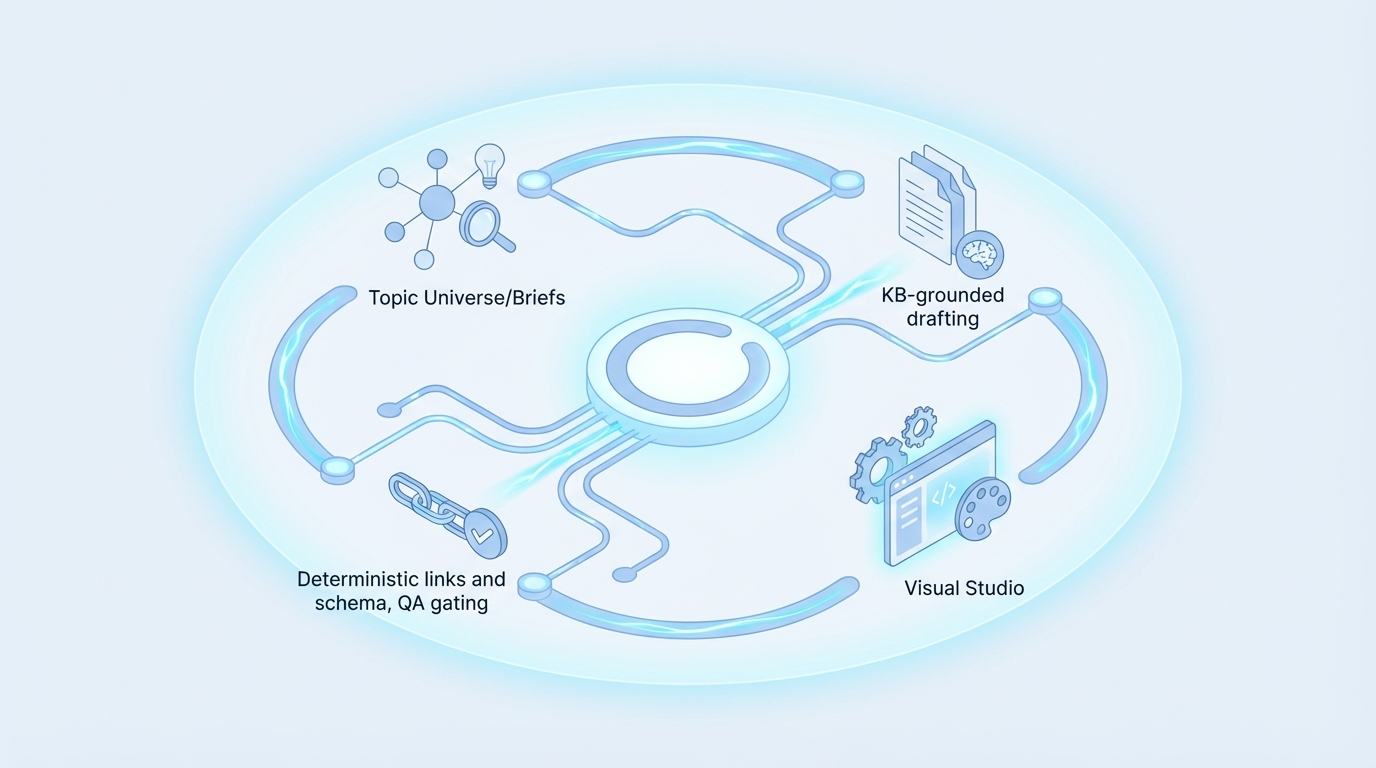
Speed-only automation accelerates drafting but multiplies inconsistency across brands and CMSs. The core miss is coordination: strategy, KB grounding, structure, visuals, links, schema, and publishing must move together. When they don’t, you get quick words and slow outcomes. That’s the trap.
The Difference Between Speed And System
Speed ships drafts. Systems ship outcomes. If your platform can’t tie topic selection to differentiation, structure, visuals, and publishing, you’ll publish fast and still lose authority. That’s how teams end up with high output and flat results. It’s common. It’s avoidable.
Here’s the pattern I’ve seen: prompts create velocity, including publishing pipeline, but not consistency. The tone shifts by writer or run. Headers change shape. Visuals get bolted on at the end. Links and schema are afterthoughts. Multiply that by five brands and a few CMSs and you’ve got recurring incidents dressed up as “process.” You feel busy, not compounding.
When leaders ask for “more,” the instinct is to push throughput. That’s fine for a week or two. But if the execution isn’t deterministic, your wins don’t stack. They wobble. Authority is engineered when the pipeline governs how work moves from topic to publish, every time, without fresh heroics.
What Breaks When Links, Schema, And Publishing Are Probabilistic?
Probabilistic processes break in the same places: internal links vary or fabricate, schema is missed or malformed, and publishing fails inconsistently. At small scale, you can paper over it. Across brands, the failure rate compounds and becomes a tax on your best people.
You’ve seen it. A draft ships with the right story, but the internal links point to old URLs. Or schema never gets added, so your best explainer never qualifies for rich results. Publishing “mostly” works until Webflow treats images differently from WordPress, and HubSpot needs a custom field you didn’t map. None of that is glamorous work. It’s fragile work.
If you evaluate tools, don’t stop at a clever editor. Look for code-based internal linking from verified sitemaps, programmatic JSON-LD, and idempotent publishing. Those are infrastructure decisions. For context on the variety of tools out there, a broad best content marketing tools for SaaS roundup shows how fragmented the market is—great point solutions, few systems.
Who Pays The Cost In A Multi-Site Org?
You do, in rework, meetings, and lost focus. Effective the rise of dual-discovery surfaces: strategies Brand spends cycles fixing tone. SEO patches structure post-publish. Ops de-duplicates posts and cleans up embeds. Sales waits for clean links. It’s invisible in any single ticket. It’s heavy across a quarter.
I’ve lived this from every chair—writer, marketer, sales leader. The cost isn’t the rewrite, it’s the context switching and the “did we fix that everywhere?” uncertainty. Choose platforms that make correctness the default so your team can focus on narrative, not cleanup. Your future self will thank you.
The Capabilities That Decide Outcomes Across Sites
A multi-site content system rises or falls on four capabilities: topic mapping, knowledge grounding, deterministic mechanics, and reliable delivery. Each prevents a different flavor of rework at scale. If one is missing, authority leaks through the gap. You can’t outwrite missing structure.

Topic Universe Belongs In Your RFP
Ask how the platform maps your entire topic landscape, not just keywords. You want cluster awareness, saturation checks, and cooldowns. That prevents over-publishing the same idea and under-investing in gaps that matter for authority.
This matters because multi-site orgs compete with themselves more than competitors. Without topic governance, Site A, B, and C chase the same head term and cannibalize each other. A Topic Universe solves that by prioritizing coverage based on gaps and ensuring intentional re-coverage on a schedule. It’s not fancy. It’s essential.
Good vendors will show you cluster status—underserved, healthy, well-covered, saturated—and explain how suggestions flow into briefs. Ask to see it live on one of your pillars. If they can’t, you’re buying ideas, not a strategy engine. For a broader overview of point tools in the market, a neutral marketing automation tools comparison highlights how often strategy lives outside the tool.
KB-First Drafting And Brand Memory
Prompts forget. Knowledge bases persist. Require KB ingestion, retrieval during brief and draft, and brand voice enforcement at every stage. That’s how claims stay accurate and tone stays consistent when contributors and sites multiply.
I’ve worked on small teams where a single expert kept the quality bar high. That works—until it doesn’t. As soon as you scale, you need a persistent memory of phrasing, banned terms, and source-of-truth facts. Tools that rely on “good prompting” drift. Tools that retrieve from your KB and apply voice rules consistently let you scale without watering down authority.
If a vendor can’t explain how KB retrieval influences the outline and draft, including the shift toward orchestration, assume it doesn’t. And ask how voice rules are enforced—before or after writing. Before is cheaper. After is rework.
Deterministic Mechanics And Connectors That Don’t Flake
Insist on deterministic internal linking from a verified sitemap, programmatic JSON-LD, and an automated QA gate. Pair that with native publishing connectors that map fields, support draft/live modes, and prevent duplicates. Together, these eliminate the most common failure points.
Here’s the rub: even if the writing is great, missing schema and broken links make your best work less discoverable and less trustworthy. A QA gate should catch AI-sounding phrasing, structure issues, and visual placement gaps before anything reaches your CMS. Connectors should deliver CMS-ready HTML, embed media correctly, and retry on failure. No drama. No surprises.
If a vendor shrugs at connectors because “you can copy/paste,” they’ve never operated multiple brands in production. Copy/paste is where mistakes hide. Want to validate what strong connector and QA flows look like? Browse a general roundup of SaaS automation tools to see how rare end-to-end focus really is.
By the way—if you want to pressure-test this approach on your stack, you can always Try Generating 3 Free Test Articles Now.
The Hidden Costs Draining Your Budget And Team Time
The real cost of fragmented content ops is rework amplified by scale. Cleanup tasks look small. Multiplied across sites and weeks, they burn whole sprints. Quantify it. Once you see the bill, speed-only tools stop looking “cheap.”
Running Five Sites With Two Posts A Week
Let’s pretend you publish 40 posts a month across five sites. If 25% need rework for tone, links, or schema, that’s 10 posts. At two hours per fix, you’re burning 20 hours per month on cleanup alone. Double it when a publish fails and you need to recover duplicates.
That’s a month per year of a senior marketer’s time. Not counting the mental load and the “are we sure it’s fixed everywhere?” pings. You could spend that time on pillars and product storytelling. Instead, you’re patching deterministic misses. It’s not dramatic, but it is expensive.
We’ve all made these trades. The question is whether you’ll keep paying the tax or design a system that removes it. A practical lens: a quick guide to tools that eliminate manual marketing work shows how much energy goes to stitching point solutions. You need less stitching, more shipping.
Visual Drift And CMS Failures Multiply
Stock images, random screenshots, mismatched colors—none fatal alone. But across dozens of posts, trust erodes. Then publishing gets cute: WordPress wants one field, Webflow another, HubSpot behaves differently on canonicals. Without mapped connectors, you’ve got recurring incidents.
Visual consistency should be enforced upstream with brand inputs and rules. Publishing should be boring—fields mapped, including why ai writing didn't fix, duplicates prevented, retries baked in. If your designers and ops teams are the safety net, you’re paying premium talent to fix what software should guarantee.
The Pressure And Politics Of Multi-Site Publishing
The technical costs hurt. The organizational pressure hurts more. When launches miss the brief, trust wobbles across Legal, Product, Brand, and Sales. Better drafts won’t fix that. Better systems will. That’s the quiet truth.
When Big Launches Miss The Brief
You launch a new tier. Three sites publish off-brief pages that bury the differentiator. Sales spends a week clarifying. It’s not a writing problem. It’s a system problem. Upstream rules would’ve prevented it.
The fix is to enforce narrative structure, banned terms, and screenshot placement before “content” exists. Tools that make structure and voice optional turn approvals into rewrites. That’s how launches derail. No one’s trying to miss; the process just doesn’t protect the story.
Why Your Team Is Tired Of Rework
Rework looks small in tickets. It feels heavy over time. Fixing links, schema, headers, images, and phrasing after publish creates a sense of fragility. People get careful. Carefully slow.
Give your team a pipeline that catches issues upstream with a QA gate and deterministic mechanics. Not because they can’t do the work—but because they shouldn’t have to. Their time is better spent on narrative and distribution, not cleanup.
A Practical Comparison Framework You Can Use Today
You don’t need a 60-page RFP. You need a clear capability checklist, decision constraints, and a scoring model that weights risk where it actually lives. Keep it simple. Make it testable. Then run the demo like a fire drill.
Capability Checklist For Your RFP
At minimum, include:
- Topic mapping with cluster coverage, saturation labels, and cooldowns
- KB ingestion and retrieval for both briefs and drafts
- Brand voice enforcement with banned terms and phrasing patterns
- Deterministic internal linking from verified sitemap
- Programmatic JSON-LD for Article, FAQ, and breadcrumbs
- Visual generation with brand inputs and screenshot matching
- Automated QA gate with a documented pass threshold
- CMS connectors with field mapping, draft/live modes, duplicate prevention
- Multi-site isolation (KB, voice, assets) with unified billing and quotas
Each item should be demoed live on your content, not slides. Interjection. Ask them to break something and watch how the system handles it.
Scoring, Constraints, And Red Flags
Decide your constraints up front: will analytics live outside this tool? Which CMSs must be supported? Do you require automated publishing with why content broke before ai or will draft mode suffice initially? This shapes vendor fit more than UI preferences.
Score must-haves 0–5 and weight them by risk. Deterministic linking, schema, and publishing deserve more weight than calendars. Use disqualifiers: fabricated URLs, no schema generation, no QA gating, shared KB across sites, or reliance on prompts alone for voice. For extra context, a neutral SaaS marketing automation tools overview can help you spot what’s a feature versus a promise.
If you’re leaning toward a system-led approach and want to see how it feels, you can Try Using An Autonomous Content Engine For Always-On Publishing.
How Oleno Handles Multi-Site Content Automation End To End
Oleno is a system, not a point tool. It runs a closed loop: Topic Universe, brief generation with competitive research, KB-grounded drafting, Visual Studio, deterministic links and schema, QA gating, and connector-based publishing. Across brands, it isolates memory and voice while keeping operations predictable.
Oleno’s System Across Brands
Oleno maps your topic landscape and tracks coverage and saturation by cluster, including why content now requires autonomous, so you know what to write next and when to re-cover. Topic Universe prevents over-publishing and keeps each site from cannibalizing the others. Suggestions flow into briefs that measure information gain before writing starts.
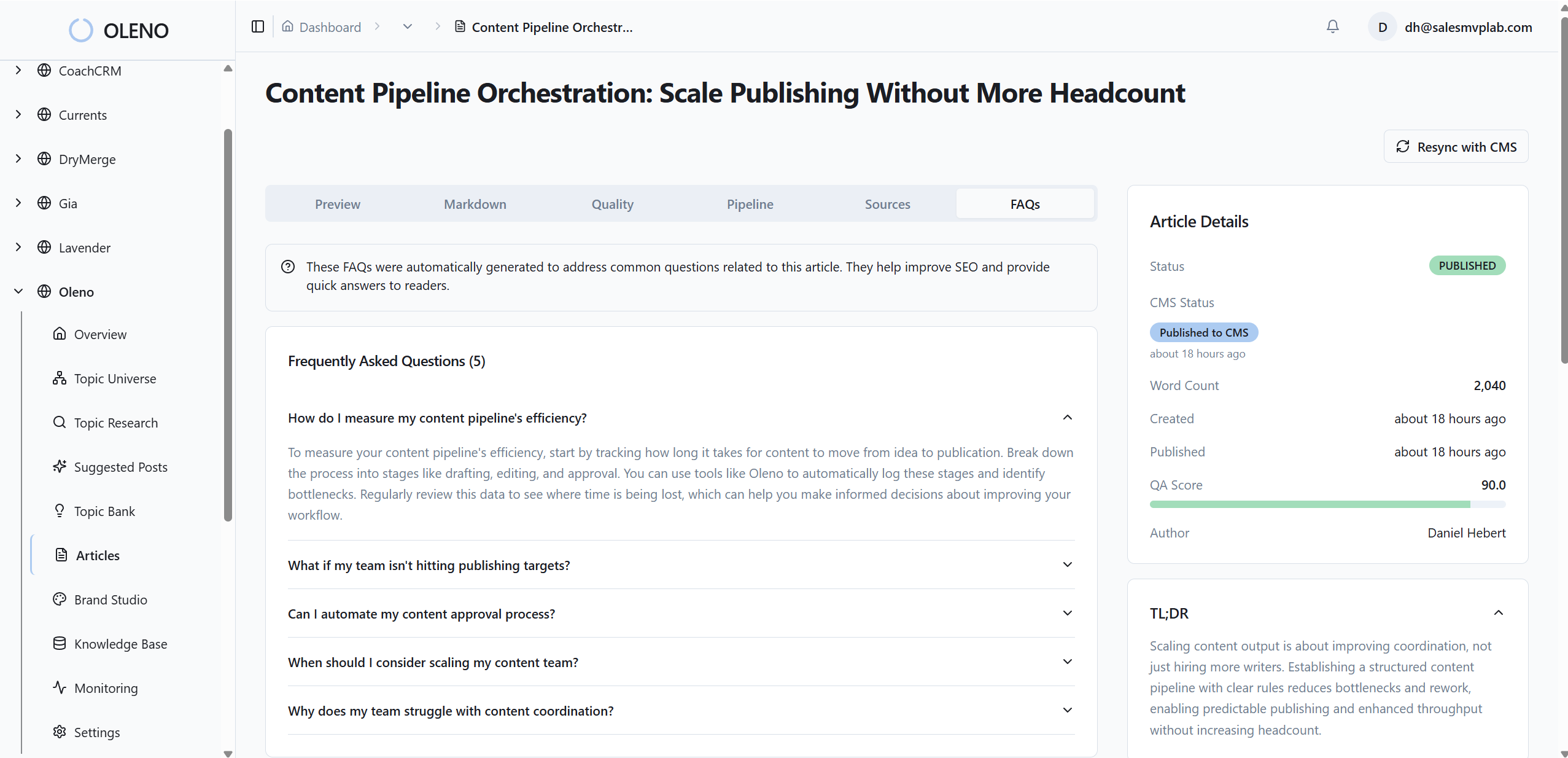
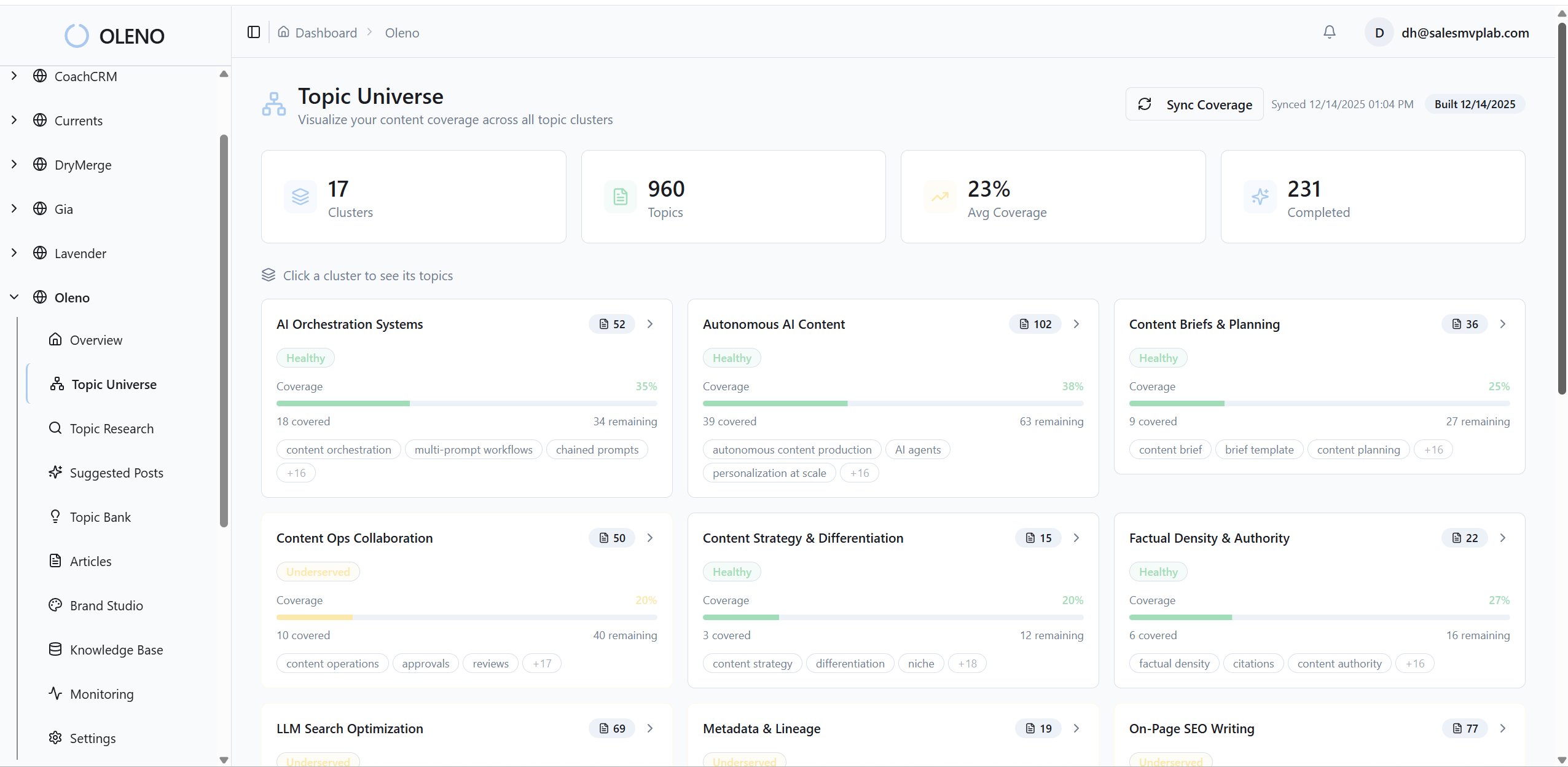
Drafts are grounded in your Knowledge Base and normalized by Brand Studio so voice stays consistent as contributors change. Each site maintains an isolated KB, voice constraints, and asset library—critical for multi-brand portfolios. That separation avoids drift while compounding authority where you choose to invest.
Visual Studio turns brand inputs—colors, marks, including ai content writing, style references, and tagged screenshots—into consistent hero and inline images. Screenshots are matched to the right sections using semantic similarity, with solution areas prioritized. You get visuals that reinforce the narrative, not decoration you scramble to source.
Deterministic Delivery And A De-Risked Rollout
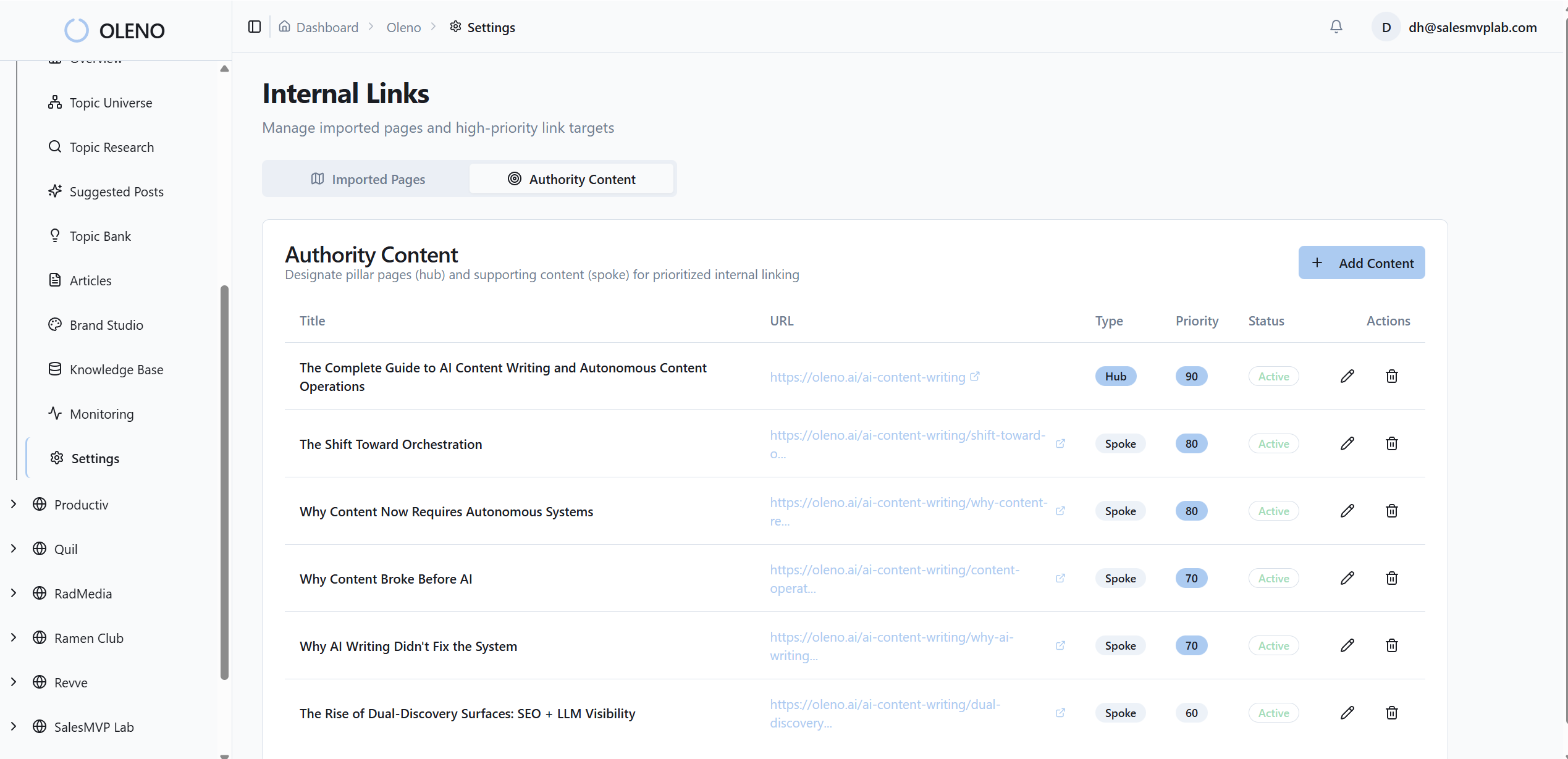
Oleno enforces deterministic mechanics. Internal links are injected from verified sitemaps only; anchor text matches page titles. Schema (Article, FAQ, BreadcrumbList) is generated programmatically and attached as metadata. The QA gate checks 80+ criteria—structure, clarity, information gain, snippet readiness, voice—and removes AI-sounding phrasing before anything ships.
Publishing is handled via connectors to WordPress, Webflow, HubSpot, or Google Sheets. Fields map automatically, assets embed correctly, drafts or publish modes are respected, and duplicate posts are prevented. Multi-site management gives you unified billing with isolated quotas, KBs, and brand assets per site.
Rollout is straightforward: connect sitemaps, initialize KBs, and run Topic Universe in week one; pilot three end-to-end articles in week three; expand across sites by week six. If you want to experience the pipeline, you can Try Oleno For Free.
Conclusion
Speed gets you words. Systems get you outcomes. If you’re operating multiple SaaS sites, the leverage comes from topic mapping, KB-grounded drafts, deterministic links and schema, and connectors that publish without surprises. Put those pieces in your RFP, weight them for risk, and run live demos that stress the pipeline. You’ll feel the difference when cleanup vanishes and authority compounds.
About Daniel Hebert
I'm the founder of Oleno, SalesMVP Lab, and yourLumira. Been working in B2B SaaS in both sales and marketing leadership for 13+ years. I specialize in building revenue engines from the ground up. Over the years, I've codified writing frameworks, which are now powering Oleno.
Frequently Asked Questions