Eliminate AI Content Fabrication in Marketing

Your AI draft doesn't fabricate because the model is evil. It fabricates because you asked a writer to act like your product database. The moment a draft gets generated without approved source context, the marketer ends up doing cleanup instead of making the actual judgment calls. By the time someone catches the made-up claim, the team has already lost the speed it was chasing.
Most teams trying to eliminate AI content fabrication reach for better prompts first. Better prompts help a little. A controlled publishing workflow helps a lot. The model fills gaps because that's what it's built to do. It predicts. It doesn't know your pricing changed last week, your positioning shifted last quarter, or your sales team stopped using that old claim unless your workflow gives it the right inputs.
Key Takeaways:
- AI content fabrication is usually an operations problem, not just a model problem.
- Approved product truth should come before drafting, not after.
- Voice consistency and factual accuracy are separate control problems.
- Human review should validate claims first, then polish language.
- Narrative drift compounds when teams scale AI output without controls.
- Repeatable orchestration beats one-off prompt hacks when quality has to hold.
Why AI Content Fabrication Starts Before Drafting
Fabricated claims start before drafting because the model is often asked to write from incomplete, stale, or unapproved context. Once that happens, the draft can sound confident while carrying made-up product facts, outdated messaging, or unsupported performance claims. The audit trail back to a real source doesn't exist because nobody required one before the words got generated.

The model isn't your source of truth
The model is a writer. Not a product marketer. Not your release notes. Not the founder who remembers why the category changed. That sounds obvious, but a lot of AI content workflows are built as if the model already knows what's true about the company.
Here's where teams get burned. They paste a topic into ChatGPT, add a few voice instructions, maybe mention the ICP, then ask for a long-form article. The output looks fine. It sounds like marketing. Then someone notices a product capability that doesn't exist, or a customer outcome nobody approved, or a claim that used to be true six months ago.
There are usually three fabrication failure modes:
- Invented product facts: features, integrations, workflows, or pricing details the company doesn't actually support.
- Outdated messaging: old positioning or product language that conflicts with the current website, sales deck, or founder narrative.
- Unsupported performance claims: "saves time," "improves conversion," or "increases output" without proof the team can stand behind.
The frustrating part is that none of this feels broken at first. The article reads well. Which makes it more dangerous.
If your current review loop can't show which claims came from approved docs, that's the reason to request a demo and look at a source-grounded content workflow instead of another prompt template.
Voice polish hides factual risk
Voice consistency and factual accuracy are separate control problems. You can make a draft sound exactly like your brand and still have it say something false. Actually, the more on-brand it sounds, the more likely someone is to trust it too quickly.
I've seen this happen with smart teams. They spend time tightening voice. Shorter sentences. Stronger POV. Founder-style phrasing. No generic AI filler. All good work. Voice control is about how the content sounds. Truth control is about whether every claim can be traced back to something approved. Different job.
Google has been clear that AI-generated content should still be useful and reliable, not created to manipulate rankings, in its guidance on AI-generated content. That matters because the bar isn't "does this sound human?" The bar is "can the reader trust the claim?" Those are not the same thing.
Worth separating in your own workflow:
- Voice review: Does this sound like us?
- Claim review: Is every product, customer, and performance claim approved?
- Source review: Can we point to the doc, release note, customer story, or internal proof behind the claim?
Skip the second and third one, and fabricated claims get through with a nicer haircut.
Review breaks when every claim is everyone's job
A content manager opens a draft at 4:40 PM Thursday and sees three claims that feel slightly off. Product is busy. The PMM is in launch planning. The founder has opinions but no time. So the marketer does the normal thing: softens the language, ships the article, and adds it to a mental list of things to circle back on. They never do.
That's the day-in-the-life version of the problem. Nobody is lazy. Nobody is careless. The process just asks the wrong person to validate the wrong thing at the wrong time. By the time a full article exists, every factual issue is tangled inside voice, structure, SEO, and deadline pressure.
The fix starts with assigning review responsibility earlier. A marketer should own polish, positioning, and reader fit. A subject-matter expert should validate the claims that depend on product truth. If the SME says "yes, that's accurate," the marketer can shape the piece without also playing detective.
The next question is where to put those checks so the team doesn't crawl back to fully manual production.
How to Anchor Drafts to Approved Product Truth
The way to eliminate AI content fabrication is to constrain the draft before it exists. Approved docs, product truth, source grounding, and claim validation rules tell the model what it can use and what it has to leave alone. The work happens before the first paragraph, not after.
Diagnose where fabrication enters your workflow
Grab the last five AI-assisted articles your team touched. Not the published versions. The first drafts. Read them with one question in mind: where did the model make a claim that wasn't clearly supported by an approved source?
I like this audit because it gets specific fast. If all the bad claims are product claims, you have a product truth problem. If the facts are right but the angle keeps drifting away from your current POV, you have a narrative drift problem. If the writing sounds generic but the facts are clean, you have a voice control problem. Different problems. Different fixes.
Use a simple sorting pass:
- Green claims: directly supported by approved docs, release notes, customer stories, or internal source material.
- Yellow claims: probably true, but the reviewer has to infer or remember the proof.
- Red claims: invented, outdated, exaggerated, or unsupported.
If more than 10% of the claims in a draft are yellow or red, don't treat that as an editing issue. Treat it as a workflow issue. The draft was allowed to travel too far without retrieval context. And if your red claims are concentrated in the back half of articles, that's a tell that the model ran out of source context and started predicting — the fix is feeding more grounded material into the back half of the outline, not editing harder.
Approved sources beat open-web generation for product claims
Open-web generation is useful for market context, category language, and broad educational material. It's risky for product claims. The open web doesn't know your latest release, your current positioning, or what your team is no longer allowed to say.
I'm not anti-web research. Honestly, web research is great when you're trying to understand how buyers talk. You'll find real phrasing like "What kind of projects/campaigns/tasks do Demand Gen roles do?" or "Got a new job as SEO Lead for an enterprise level company. Any advice?" Those inputs are useful because they show the messy language buyers use before they know the category.
Raw buyer language is not approved truth. Same with Reddit threads, competitor pages, analyst commentary, and old blog posts. A model can use those to understand the conversation. It should not use them to invent what your product does. That line matters.
For product-grounded content, separate sources into two buckets:
- Allowed for market context: search results, forums, social posts, analyst commentary, public category pages.
- Allowed for claims: product docs, release notes, pricing truth, approved customer stories, PMM-approved messaging, first-party research.
If a source can shape the angle but can't support a claim, mark it that way. It prevents a lot of pain later.
Build the claim list before the draft
A claim-first workflow feels slower for about one week. Then it gets faster, because reviewers stop arguing with paragraphs and start approving facts. That's the real shift.
Before drafting, pull out the claims the article is allowed to make. Not every sentence. Just the factual spine. What does the product do? What does it not do? Which customer stories can be used? Which performance claims are approved? Which claims need softer language because proof is thin?
A good pre-draft claim list usually includes:
- Product claims: features, workflows, integrations, use cases, limitations.
- Market claims: what the buyer is struggling with, backed by source context or observable patterns.
- Customer claims: quotes, outcomes, anecdotes, and names that are cleared for use.
- Performance claims: only if the number or outcome is approved.
- Exclusion claims: what the article must not imply.
The hidden benefit is review speed. An SME can scan a 12-bullet claim list in about 10 minutes. Asking that same person to review a 2,000-word article forces them to comment on structure, language, and tone even when you only need factual validation. If your SME review cycle is taking more than 48 hours, the claim list is the lever — not another reminder Slack.
Separate voice control from truth control
Voice control makes content sound like your company. Truth control makes sure it doesn't lie. If you combine them into one review step, the reviewer usually notices voice first because voice is easier to judge.
I've done this myself. You read a draft and think, "This doesn't sound like us." So you rewrite the intro, tighten the language, cut the soft phrasing, and feel like the piece is improving. Meanwhile, the unsupported claim in paragraph seven survives because nobody was reviewing for that specific thing.
A better review order:
- Truth pass: Are the claims accurate, approved, and sourced?
- Narrative pass: Does the article match the current positioning and POV?
- Voice pass: Does it sound like us?
- Publishing pass: Are links, metadata, formatting, and CMS details clean?
If a team has fewer than two reviewers, combine narrative and voice. Don't combine truth and voice. That's where fabricated claims sneak through.
Use buyer language without letting it steer truth
Buyer language is useful. It tells you how people describe the problem before they know your solution. Queries like "What do you do as a Demand Generation Manager", "Demand gen leaders - do you manage SDRs?", and "what is the path to becoming one?" are gold for awareness content because they show how people actually think.
The trap is treating those raw inputs as strategy. A buyer asking "What do they do" or "how did you go about tailoring your resume to competitively position yourself for Product Marketing manager positions?" gives you language, not product truth. Same with internal notes like "CEO acts as CMO" or "either validates or amplifies my ideas." Good signals. Not approved claims.
The rule I'd use is simple. Buyer language can shape the hook, heading, and framing. Approved product and messaging sources shape the claims. If those two collide, approved truth wins.
This is also where NIST's AI Risk Management Framework is useful as a mental model, even for marketers. It pushes teams to map, measure, and manage AI risk instead of treating every error as a random accident. For content teams, that means mapping where claims enter the draft and measuring how often unsupported claims survive review.
Orchestration beats prompt hacks at repeatable quality
Orchestration is more reliable than isolated prompting when teams need repeatable content quality. A prompt is a request. A workflow is a controlled sequence of inputs, checks, review decisions, and publishing constraints.
Prompt hacks work for one article. I'm not pretending they don't. A strong marketer can sit with ChatGPT or Claude, feed it context, push back on the angle, paste product notes, rewrite sections, and get a good draft. I've done that. Lots of us have.
The problem starts when you need multiple pieces per week. Then every article depends on the marketer remembering which context to paste, which claims are approved, which positioning changed, which customer stories are usable, and which review path applies. That's fragile.
A repeatable orchestration flow should answer five questions before drafting:
- What sources can the model use?
- Which claims are allowed?
- Who approves source and claim accuracy?
- Where does voice get applied?
- What blocks publishing if something fails?
If the answer lives in someone's head, the process won't hold at volume. The workflow needs to carry the memory.
How Oleno Keeps Claims Grounded
Oleno keeps claims grounded by storing strategy, voice, product truth, and approved source material in structured places. It pauses the content workflow at research, brief, outline, and draft review so the marketer shapes the work before anything publishes. The model never gets to invent in private.
Product truth before prose
Oleno's Product Truth Library is the part that matters most when you want to eliminate AI content fabrication at scale. It stores the product facts, features, pricing, integrations, and changelog entries the system is allowed to use. The point is boring in the best way: if a claim isn't in the approved product truth layer, it shouldn't show up as if it's real.
Oleno also separates product truth from voice. Brand & Voice Memory controls how the writing sounds. Positioning & Messaging Control tells the system what the company believes, who it sells to, which messages matter, and which audiences to avoid. Those layers work together, but they don't pretend to be the same control.
This matters for sustained cadence. One good article can survive a messy workflow because a strong marketer can brute-force the review. A 50-piece program over three months cannot. If every draft starts from a different prompt, source grounding becomes a memory test.
Oleno's Research, Brief, Outline, and Draft stages put the marketer back into the right decisions:
- Research: review the source list before writing starts.
- Brief: approve the angle, audience, structure, sources, and CTA.
- Outline: catch logic problems before paragraphs exist.
- Draft: edit the finished piece after the factual frame is already constrained.
Quality checks that block bad claims
Oleno's Quality Gate runs after the draft and before the marketer sees the piece. It scores factual grounding, voice match, structure, link health, and SEO density. If the draft fails, a targeted repair pass runs and QA checks the piece again.
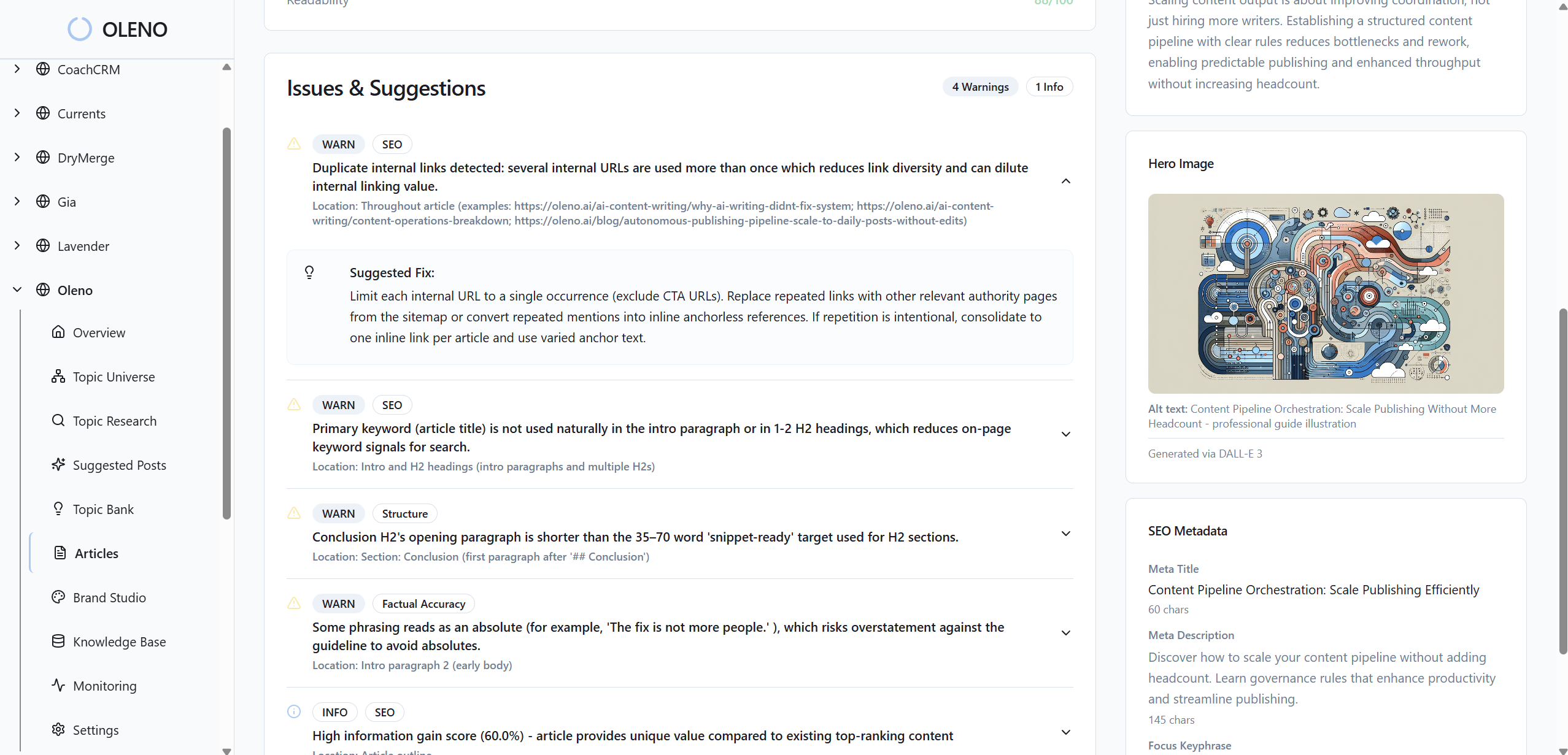
I want to be precise here. Quality Gate doesn't replace the marketer. It also doesn't replace product strategy, positioning work, keyword research, or analytics. Those still live with the team and its existing stack. The useful part is narrower: bad claims, dead links, and off-voice output get caught before publishing becomes a formatting task.
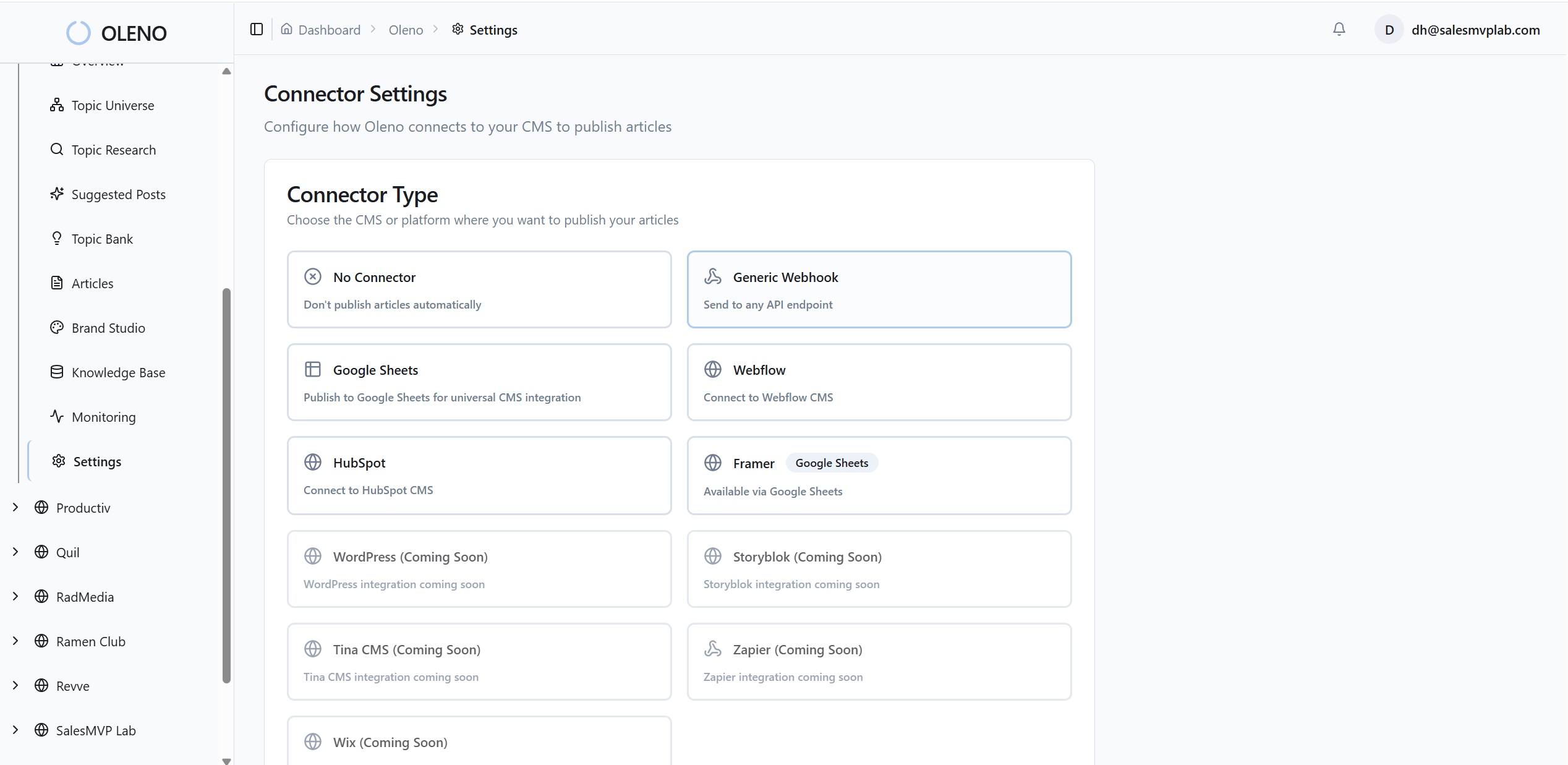
Oleno's Publish step then sends approved content into supported destinations like WordPress, Webflow, Storyblok, HubSpot, Tina, Wix, Framer, Google Sheets, Webhook, and Zapier. That matters because manual CMS copy-paste is another place errors creep in. Not glamorous. Very real.
For teams that want fully hands-off content, this will feel like too much control. That's a fair read. If you don't care about the byline, a lighter tool may be enough. If your brand trust depends on the accuracy of every product claim, the marketer should stay in the editor's seat and the AI should do the production work around those decisions.
That's the operating model Oleno is built around, and if you want to see the handoffs in practice, book a demo after you've mapped where fabrication enters your current workflow.
Build the Workflow Before You Scale
Fabricated claims get worse when teams scale output before they constrain sources, claims, and review responsibility. The practical fix is not returning to fully manual content. It's building a publishing workflow where approved truth enters before drafting, claim validation happens before polish, and publishing can't happen until the right checks pass.
Narrative drift is the long-term version of the same problem. One article gets a little loose. Then the next one inherits that looseness. After 30 pieces, your product messaging has wandered away from what sales says, what the website says, and what the product actually does. The cost isn't just cleanup. It's trust.
Start small. Take the next five AI-assisted pieces and run the audit. Sort claims into green, yellow, and red. Separate voice review from truth review. Decide which sources are allowed for context and which ones are allowed for claims. Give SMEs the claim list before the draft, not a 2,000-word article after the fact.
That's how you keep the speed without accepting faster slop. You don't ask the model to become truthful through vibes. You build the workflow that makes truth hard to skip.
About Daniel Hebert
I'm the founder of Oleno, SalesMVP Lab, and yourLumira. Been working in B2B SaaS in both sales and marketing leadership for 13+ years. I specialize in building revenue engines from the ground up. Over the years, I've codified writing frameworks, which are now powering Oleno.
Frequently Asked Questions