Information-Gain Content Gap Audit: 6-Step Tactical Playbook

Most teams run content audits like they run keyword research. Lots of volume, including the rise of dual-discovery surfaces:, pretty spreadsheets, not much insight. I’ve been guilty of that too. Back when we were cranking out posts weekly, we’d celebrate output and ignore whether any of it added anything new. Traffic rose a bit, then stalled. Familiar story.
The pivot was simple to say and hard to operationalize. We stopped asking “what will rank” and started asking “what will we add.” That change pushed us toward information gain, real differentiation, and content that sales could actually use. You can measure this, enforce it, and make it repeatable across a team without slowing down.
Key Takeaways:
- Replace keyword-first audits with an information-gain audit that rewards net-new insights
- Use a three-part score to triage topics: information gain, business value, and effort
- Build a single sheet that merges sitemap and knowledge base to expose duplication
- Calculate information gain for each topic by comparing against competitor coverage
- Prioritize underserved clusters and design differentiation directly in the brief
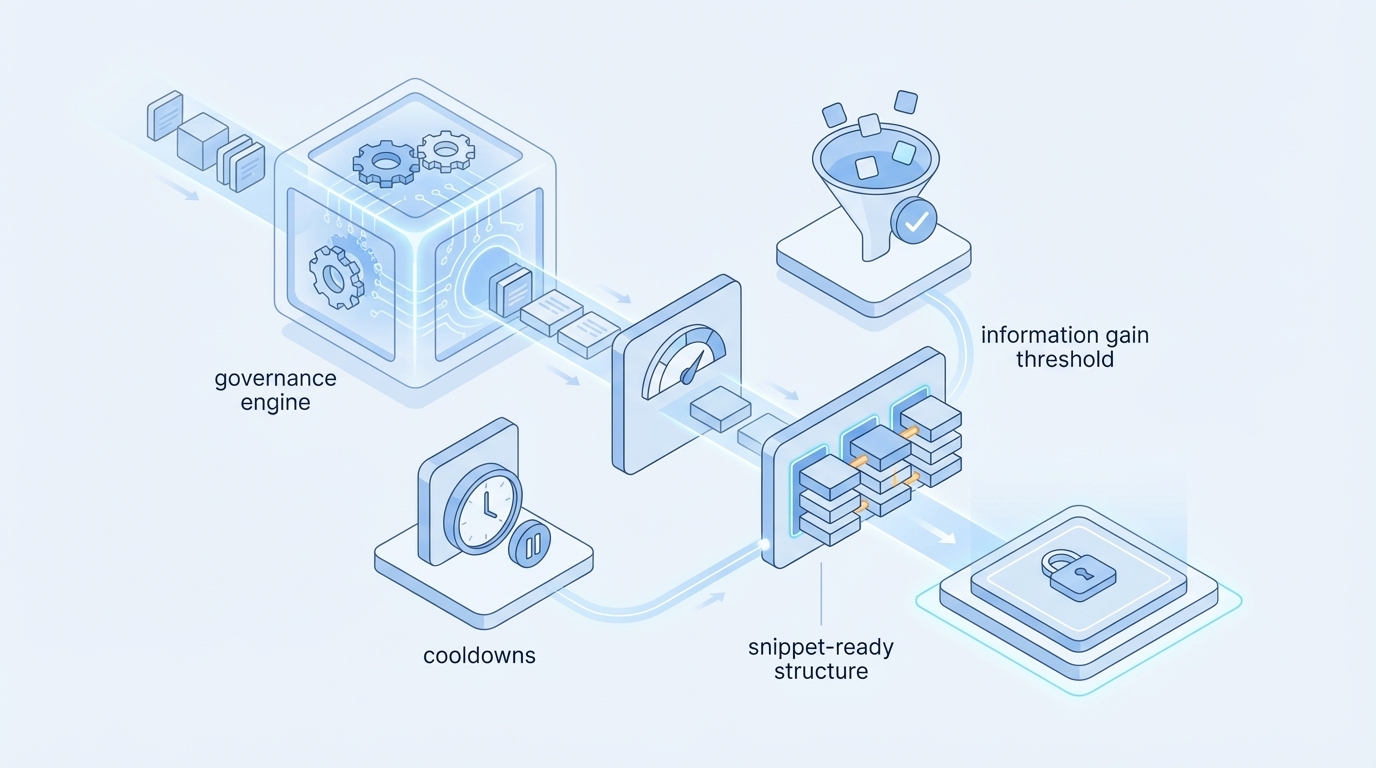
- Enforce governance with cooldowns, IG thresholds, snippet-ready structure, and deterministic internal links
Keyword-First Gap Audits Kill Authority
Keyword-first audits push you toward repeating what is already on page one, including why ai writing didn't fix, which dilutes authority and wastes cycles. Anchor your audit around information gain, the measurable “newness” your content adds. When you make information gain the north star, you curb redundant topics and build trust faster with both humans and machines. See it as the operating rule, not a nice-to-have.
What is information gain and why does it matter?
Information gain is the delta between what exists and what you contribute. Think of it as a 0–100 score that captures new subtopics, proprietary data, decisions, and artifacts your draft introduces. If a brief can’t list three clear differentiators, do not ship. That one-sentence rule alone raises your bar.
Show, don’t tell. Share two drafts internally, one that restates what the SERP already covers and one with a new dataset or decision tree. Ask which builds trust. The difference is obvious. Back it with references like Backlinko’s guide to information gain and the more technical framing in Supple’s information gain SEO overview. Then codify it in your content standards so it survives leadership changes and new writers.
The hidden cost of “more of the same”
Let’s pretend you ship ten derivative posts this quarter. You spend weeks writing, editing, packaging, and promoting. They do not rank, do not earn citations, and cannibalize your own pages. The headache is not the writing time. It is the compounding rework and lost trust.
Run a fast retrospective. Pull five recent posts and list one unique insight each added. If fewer than three delivered real novelty, your backlog is biased toward volume, not gain. Use that baseline to start a two-week audit. Tie this to systems thinking so it sticks. If you want a refresher on why authority compounds inside a system, skim autonomous content systems.
You’re Measuring The Wrong Thing
Measuring content by keyword volume or publication count misses the point. A useful audit replaces those with a three-part score: information gain as a gate, including the shift toward orchestration, business value as intent, and effort as cost. This flips planning from vibes to math, and it makes backlog conversations less subjective. It also removes a lot of rework later.

How do you measure new value, not volume?
Use a simple scoring model. First, information gain 0–100. Enforce a floor, say 50, unless there is a strategic reason. Second, business value, which reflects qualified demand potential. Third, effort, which captures resources and time. Topics below the IG floor do not enter the queue, no matter how attractive the keyword volume looks.
Quantify “newness” explicitly. Count novel subtopics you plan to add, proprietary examples you can cite, and original data you can publish. Penalize overlap with the current SERP and with your own site. A basic model beats gut feel when your backlog is crowded. For B2B angles and programmatic ideas worth exploring, see CXL on B2B content gaps. For an audit process overview you can give to stakeholders, share Stellar Content’s gap analysis primer.
Define your audit success criteria
Create a tight, two-week rubric. Day 1 to 4, generate a topic inventory. Day 5 to 8, compute information gain for the top 100 topics. Day 9 to 14, produce a ranked list of the top 20 and attach briefs with three differentiators each. Success looks like fewer updates, fewer rewrites, and more net-new angles that sales recognizes as helpful.
Tie this measurement back to operations so it becomes muscle memory. If you want the audit to sustain, it needs a system that enforces differentiation by default. A quick primer on that system lives here, autonomous content operations.
Curious what this looks like in practice? Try generating 3 free test articles now.
Redundant Publishing Burns Weeks And Budget
Duplicated coverage is sneaky. It shows up as cannibalization, thin pages, and overlapping intent that confuses both search engines and your buyers. Build a single inventory that merges sitemap and knowledge base content. Then label pillars and clusters, score coverage, and find duplication quickly. You will spot bloat before you ever open a competitor tab.

Step 1: Build the topic inventory from your knowledge base and sitemap
Export your sitemap to CSV. In a single sheet, add columns for url, title, last_modified, template_type, pillar, cluster, and word_count. Create a “canonical_topic” field to normalize duplicate titles and variants. Use COUNTIF to identify overlapping topics. It takes an afternoon, and it is worth it.
Do the same with your knowledge base or docs. A simple query like SELECT id, title, tags, updated_at FROM kb_articles WHERE status='published' brings the essentials. Map tags to your pillars and clusters. Join on canonical_topic to see where marketing, product, and docs all cover the same idea with different depth. Add coverage_count_site and coverage_count_kb columns to make duplicates jump off the page. For a good framing on inventories and audits, share Demand Gen Report on inventories and audits. Then connect the dots on why coordination beats ad-hoc checks with the orchestration shift.
Step 2: Cluster topics and compute baseline coverage metrics
Assign clusters manually for the first pass. You get better labels in less time than clumsy automation. For each canonical_topic, compute three simple metrics: mentions using COUNTIFS, depth as MIN(1, word_count/1500), and recency as TODAY - last_modified. Build a baseline score like 0.4*depth + 0.3*(1/LOG(mentions+1)) + 0.3*(recency<180).
Now mark potential duplicates when canonical_topic matches and depth is low. Summarize by cluster to see total pages, median depth, and median recency. This snapshot shows where you are thin versus bloated. It also sets you up to prioritize intelligently once you calculate information gain.
If It Doesn’t Add Something New, It Hurts Trust
You earn trust when your content introduces decisions, data, or patterns peers have not explained. You lose it when you repeat common sections with new adjectives. Calculate information gain by comparing your prospective outline against top results and true competitors. Subtract points when you overlap. Add points for novelty and proof.
Step 3: Run competitive retrieval and calculate an information gain score
Pull the top 10 results for each topic across three to five real competitors. Use targeted queries like “[topic] site:[competitor.com]”, “[topic] intitle:framework OR intitle:template”, including why content now requires autonomous, or “[topic] filetype:pdf” to surface research-grade assets. Extract H2s and H3s into a sheet. Mark recurring subtopics to see consensus.
Score information gain on a 0–100 rubric:
- Novel subtopics, 0–40
- Unique data or benchmarks, 0–25
- Proprietary frameworks or processes, 0–20
- Actionable assets, 0–15
Then subtract an overlap penalty, up to 30 points, if your outline mirrors the common SERP sections. Use an LLM as a pressure test, not a judge. Ask for missing subtopics a senior buyer would value, then validate manually. For a different perspective, see HikeSEO on content gap analysis. If you are tempted to move faster with drafting alone, a reality check on limits is here, ai writing limits.
What does a “high-gain” draft look like?
It introduces something the market has not seen in that context. Not “What is internal linking.” Try “How to measure crawl equity loss with three log-derived ratios” plus a template. You can point to the delta in 30 seconds, and a skeptical buyer nods. That is the bar.
High-gain drafts usually carry one of three things. A decision tree that turns debate into a repeatable choice. A dataset that changes how someone scopes the problem. Or a pattern that reframes the work completely. Reference Backlinko’s guide to information gain when you need a shared language for this conversation.
Prioritize Underserved Clusters And Design Differentiation Upfront
Once you score topics, start thinking in clusters, not individual URLs. Label saturation levels, add business inputs, and compute a priority score that rewards high information gain with high intent and reasonable effort. Then bake differentiation into the brief so the novelty survives the drafting phase. This is where your backlog turns sharp.
Step 4: Label saturation and assign priority weights
At the cluster level, label saturation using your inventory. Underserved means coverage_count_site is low or median depth is shallow. Healthy means moderate coverage with acceptable information gain. Saturated means lots of overlapping pages and low information gain. Translate those labels into weights that feed a priority formula.
Compute a simple priority: 0.5*IG + 0.3*BusinessValue + 0.2*(3–Effort) + label_weight. Create a cooldown flag for saturated clusters. You can revisit them later when you have stronger angles or new data. This prevents cannibalization and the frustrating rework that follows. Design your brief to serve both SEO and LLM retrieval with the dual discovery model.
Step 5: Produce a prioritized backlog and briefs flagged for differentiation
Sort by priority and pick the top 20. For each topic, create a brief that includes a thesis and point of view, three differentiators mapped to your rubric, the target reader with a job-to-be-done, and an outline with snippet-ready H2s. Add two or three authoritative external sources and internal assets to cite.
Add one hard checkbox: will we add at least one dataset, template, or decision tree. If not, kill the topic or rework the angle. Attach the brief to your quality gates so it is enforced pre-publish, not fixed post-draft. If you need to show how briefs flow into gates, point stakeholders to your qa systems. For another operational take on analysis and prioritization, see SearchStax on content gap analysis.
Ready to eliminate weekly backlog churn? Try using an autonomous content engine for always-on publishing.
How Oleno Operationalizes The Audit With Built-In Governance
Manual audits fade fast without rules. This is where automation helps. Encode cooldowns, enforce an information gain threshold, require snippet-ready structure, and guarantee deterministic internal linking. Then publish directly to your CMS without last-mile cleanup. The goal is consistency that compounds, not heroics from one or two writers.
Step 6: Governance rules and QA acceptance criteria
Turn your rules into gates you can actually enforce. Use a 90-day cooldown before re-covering the same topic. Set a publish gate, information gain at or above 60 with three differentiators checked. Require snippet-ready openings on every H2. Guarantee 5–8 internal links from verified URLs. These rules reduce frustrating rework and protect against low-gain output.
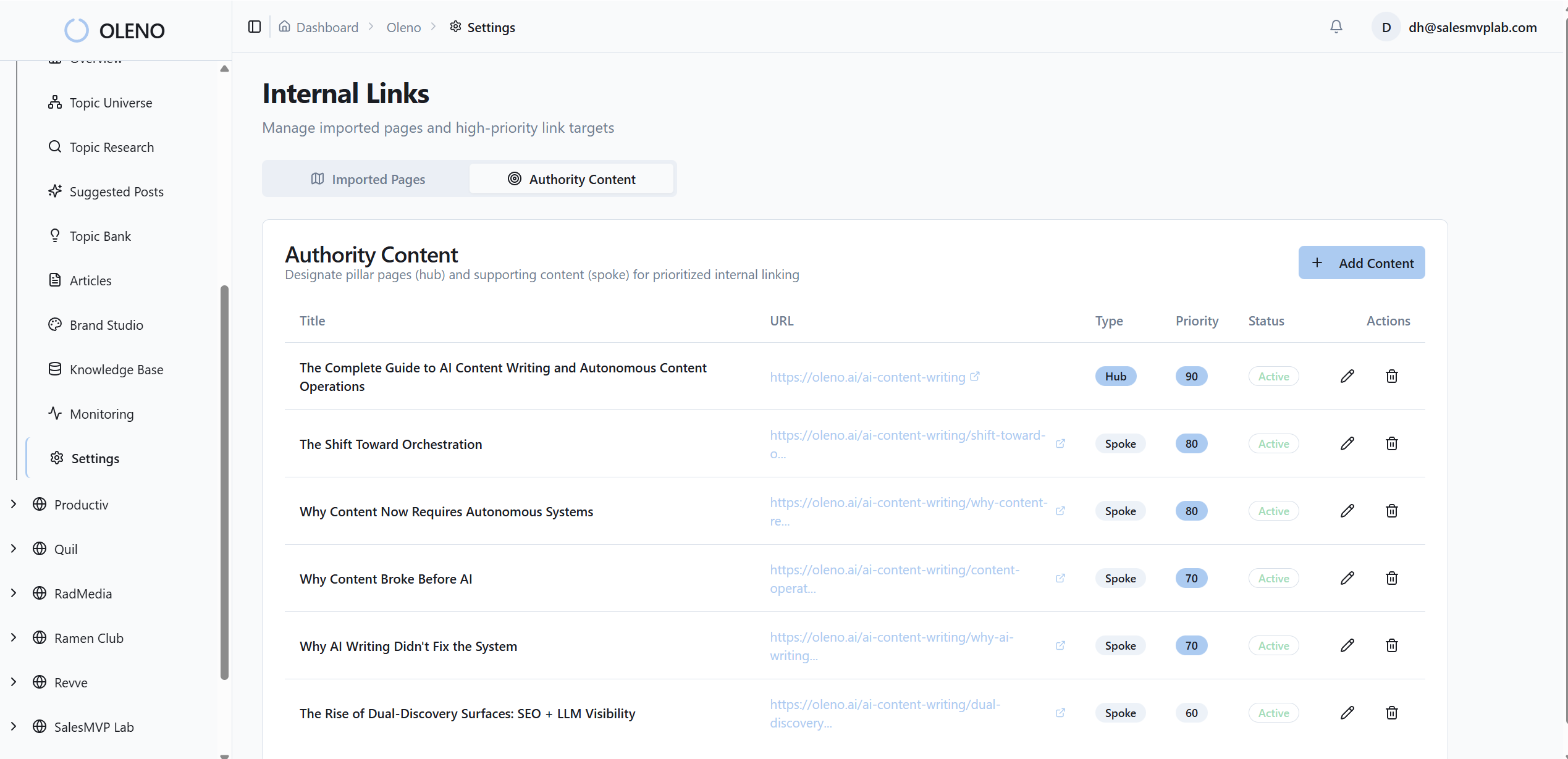
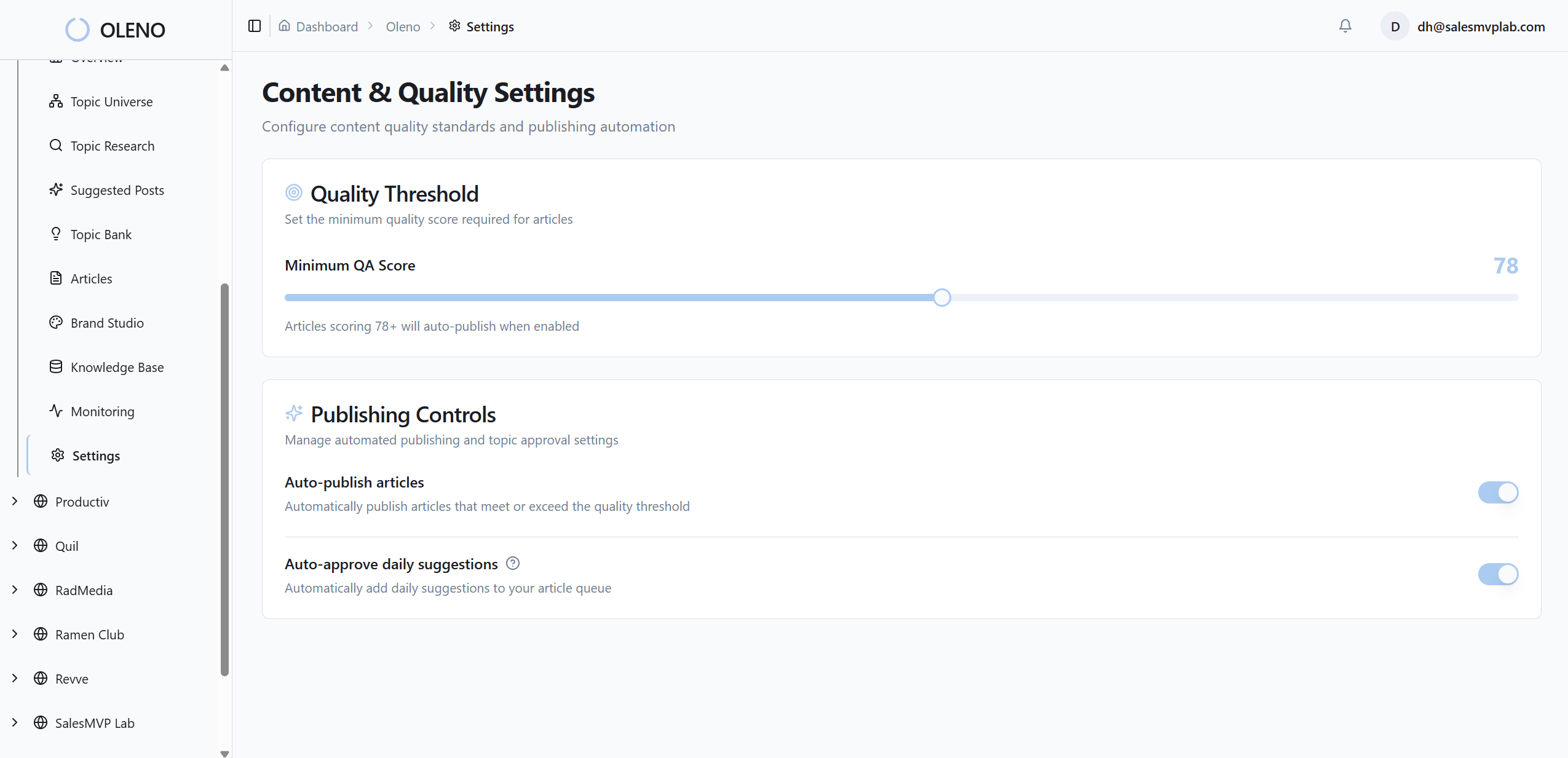
Oleno makes this practical end to end. Topic Universe manages saturation and cooldowns at the cluster level. Brief Generation adds competitive research during planning and calculates an Information Gain Score on every outline. Quality Assurance evaluates drafts against 80 plus criteria, including information gain and snippet readiness, and then injects schema. Publishing connectors push content to your CMS reliably, mapped to the right fields. If you want the delivery mechanics, see the publishing pipeline.
Who benefits most from automating this?
Teams publishing weekly or daily, multi-contributor organizations, and brands with large sitemaps or knowledge bases tend to get the fastest lift. If duplication and cannibalization are regular fires, governance removes ambiguity so writers can focus on adding new value. You still choose the story. The system keeps the standards.
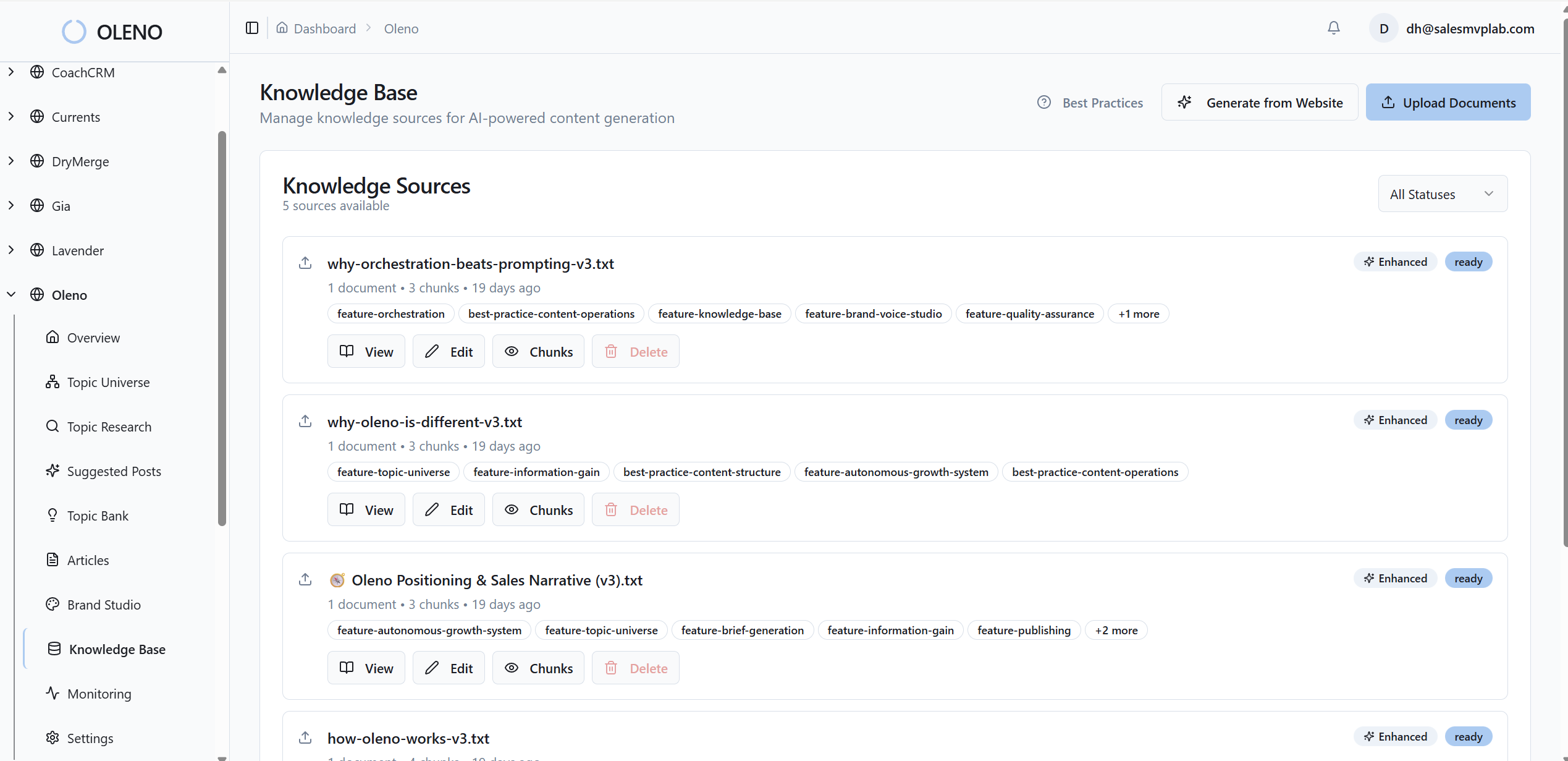
Remember the wasted weeks on redundant posts and the late edits to fix structure? Oleno removes that overhead by encoding your audit into the pipeline. Oleno’s Topic Universe tracks coverage and saturation across clusters and enforces cooldowns. Oleno’s Brief Generation scores information gain and flags low-differentiation outlines before writing starts. Oleno’s QA gate checks 80 plus criteria, including the snippet-ready openings that help with citations. Oleno also adds internal links deterministically from your verified sitemap and generates valid JSON-LD for articles and FAQs, then publishes through connectors to WordPress, Webflow, or HubSpot. Add consistent visuals with Visual Studio and you get complete, on-brand articles that meet the bar you set. If voice consistency is a concern, explore how brand rules apply in brand intelligence.
Want to ship fewer rewrites and more net-new pieces? Try Oleno for free.
Conclusion
The audit is not complicated. It is disciplined. Measure information gain, not volume. Merge your sitemap and knowledge base into one view. Score novelty against the market, then prioritize underserved clusters. Bake differentiation into the brief, and gate everything with rules you can enforce. That is how authority compounds.
You can do this manually for a while. You will feel the edges once publishing picks up or more contributors join. That is when a governed pipeline pays off. You keep the judgment and the voice. The system protects the standard and saves you from rework.
About Daniel Hebert
I'm the founder of Oleno, SalesMVP Lab, and yourLumira. Been working in B2B SaaS in both sales and marketing leadership for 13+ years. I specialize in building revenue engines from the ground up. Over the years, I've codified writing frameworks, which are now powering Oleno.
Frequently Asked Questions