SEO vs GEO vs Brand: What Actually Drives Discoverability Now?

For years, the marketing debate was simple: SEO or brand. Do you chase the keyword, or do you build the category? Most teams picked a side. The SEO teams won traffic. The brand teams won awards. Neither really won the war for discoverability, because they were fighting on the wrong battlefield.
Now there's a third player: AI search. And it's breaking the old playbook entirely. The question isn't SEO vs GEO vs brand anymore. That's a false choice. The real question is whether your content is a coherent system or just a collection of assets. Because in an AI-mediated world, fragmented content makes you invisible.
Key Takeaways:
- Discoverability is now a system that spans SEO, Generative Engine Optimization (GEO), and brand. You can't optimize for one in isolation.
- AI search engines don't just rank content; they retrieve, cite, and synthesize it. This rewards narrative consistency and clear, reusable language.
- Brand is no longer just polish. It's the structured input layer that makes your content citable and your messaging memorable for both humans and machines.
- Fragmented content across your blog, social, and product pages gets ignored by AI because it lacks a confident, repeatable point of view.
- The job of classic SEO is shrinking to capturing explicit, bottom-of-funnel demand. It's less effective at building memory or earning citations in AI answers.
- Your first investment shouldn't be scaling output. It should be codifying your brand narrative so that every piece of content you produce compounds, rather than confuses.
Why the Old Discoverability Playbook Is Broken
A Series B SaaS marketer we spoke with last quarter pulled up her dashboard on a Tuesday morning and watched her best-performing blog post — 14,000 monthly visits, position 3 for a high-intent keyword — get quietly replaced in Google's AI Overview by a competitor with one-tenth her domain authority. The competitor wasn't ranking higher. They were just getting cited. Her traffic dropped 38% in six weeks. The playbook that built her pipeline had just stopped working.

The core problem is that search isn't a list of blue links anymore. It's about getting cited in an AI-generated answer. And the signals AI engines use for citation are completely different from the ones that classic search engines used for ranking. This changes what marketers need to optimize for across the seo geo brand stack.
SEO's job is shrinking to explicit demand
Classic SEO is still good at one thing: capturing explicit demand. When a buyer knows exactly what they're looking for and types it into a search bar, you need to be there. For everything else, its role is getting smaller.
Here's a useful diagnostic. Pull your top 20 organic landing pages and split them into two buckets: (1) pages targeting queries where the buyer already knows what to type, and (2) pages targeting queries where the buyer is still forming the question. Bucket one still works. Bucket two — the educational and category-defining content — is where AI Overviews are eating your clicks. If more than 60% of your traffic comes from bucket two, your SEO program is exposed.
Fair point that some categories still convert well from pure SEO — legal, ecommerce comparison queries, local search. Those will keep working. The exposure is concentrated in B2B SaaS, where buyers ask exploratory questions and now get synthesized answers instead of clicking through. If you're not the source the AI cites, you're invisible. We can help you request a demo to see how this changes resource allocation.
AI search plays by different rules
Perplexity, ChatGPT, and Google's AI Overviews don't rank pages. They retrieve passages, score them for confidence, and stitch together an answer. Bias toward clarity and consistency is built into how they work.
An AI is looking for the most confident, repeatable explanation of a topic. If your website has five articles that describe your product in five slightly different ways, the AI sees that as five low-confidence signals. It will likely ignore all of them and cite your competitor — the one who has said the same thing, in the same way, one hundred times. This is the hidden cost of narrative drift.
The cost of fragmented content is now invisibility
When your messaging is scattered across dozens of disconnected assets, you're creating a real problem for discoverability. A human reader can piece together your point of view. A machine can't. It sees a collection of weak, contradictory signals and moves on.
This isn't theory. We've watched teams with DR 70+ domain authority get completely skipped by AI search because their content library was a layer cake of old positioning, one-off campaign messaging, and inconsistent product descriptions written by four different agencies over three years. Their fragmented content was impossible to cite confidently, so the AI just routed around them. The traffic kept coming for branded queries. The unbranded category questions — the ones that build pipeline — went to the competitor with cleaner signals.
Which raises the obvious question: what does "cleaner signals" actually mean in practice?
How to Build for AI-Mediated Discovery
Winning in this new environment requires a different mental model. Instead of treating SEO, GEO, and brand as separate channels you invest in, you need to see them as layers of a single discoverability system. Brand isn't the output of your marketing. It's the input.
The seo geo brand stack only works when narrative consistency runs through all three layers. Without a stable brand narrative, your SEO efforts won't translate into GEO citations, and your content will just add more noise to a system that already has too much of it.
Understand the new mechanics: ranking, retrieval, and recall
Think of it like a relay race with three legs. Ranking gets you onto the track. Retrieval is whether the AI grabs your baton. Recall is whether the reader remembers who handed it to them after the race ends. Most teams are still training for the first leg and wondering why they keep losing.
- Ranking (SEO): Does your page show up in the top 20 results for a query? Table stakes, driven by classic signals like keywords and backlinks.
- Retrieval (GEO): Can an AI confidently pull a specific passage from your page to answer a question? Depends on clear structure, direct answers, and scannable formatting.
- Recall (Brand): Does the reader remember your name and associate it with the answer? Driven by a consistent point of view, repeated across multiple touchpoints.
If you're winning leg one and losing legs two and three, your traffic numbers will look fine right up until the day they don't.
Write for citation, not just keywords
The unit of success in GEO is the citation. To get cited, your content needs to be written in a way that's easy for a machine to quote. Direct, declarative sentences. Clear definitions before elaboration. One claim per paragraph that could stand alone if pulled out of context.
A practical test: open any article on your site and try to find five 30-to-50-word passages that could be lifted as a standalone answer to a specific question. If you can't find five, the article isn't built for retrieval. It's built for the old world of dwell time and scroll depth. Consistent phrasing across articles also matters more than most teams realize — when the same definition appears in three places with three different wordings, the AI weights each instance lower. This is where brand voice governance becomes a technical advantage, not just a style preference.
Treat narrative consistency as a technical signal
Every piece of content you publish should reinforce the same core message. Same product descriptions. Same value propositions. Same point of view on the market.
This isn't just good branding. It's good engineering for discoverability. When an AI crawler hits your site and finds the same clear, confident statements repeated across dozens of pages, it learns to trust your answer. The threshold we've seen matter most: roughly 8-12 instances of the same core claim, phrased consistently across different page types, before AI engines start treating it as a stable position worth citing. Below that, you're noise. Above it, you're a source. The teams that understand this are building a real moat. To see what this looks like in practice, you can request a demo.
Measure what actually matters now
If discoverability is a system, then measuring just one part of it is a mistake. Pageviews and keyword rankings are incomplete metrics. They tell you if you're getting seen — not if you're getting remembered or cited.
Four metrics that actually matter in the new world: (1) share of voice in AI answers for your top 20 category queries, tracked monthly; (2) unsourced brand mentions in podcasts, newsletters, and Slack communities; (3) the percentage of inbound sales conversations where the prospect repeats your specific phrasing back to you; (4) how often your sales team reuses your published content verbatim in deals. The first two measure machine memory. The last two measure human memory. You need both.
How Oleno Builds a Discoverable Content System
The shift to AI-mediated discovery forces a change in tooling. You can't build a consistent narrative system with a collection of disconnected documents and one-off AI prompts. You need a platform that holds your strategy and enforces it across every single piece of content.
This is what we built Oleno to do. It's not just another AI writer. It's a content platform designed to create the kind of consistent, governed, and citable content that wins in the seo geo brand era.
Centralize your narrative with a strategic brain
Oleno starts by capturing your strategy in a persistent "strategic brain." This includes your Positioning & Messaging Control, your Product Truth Library, and your customer stories. You load this information once.
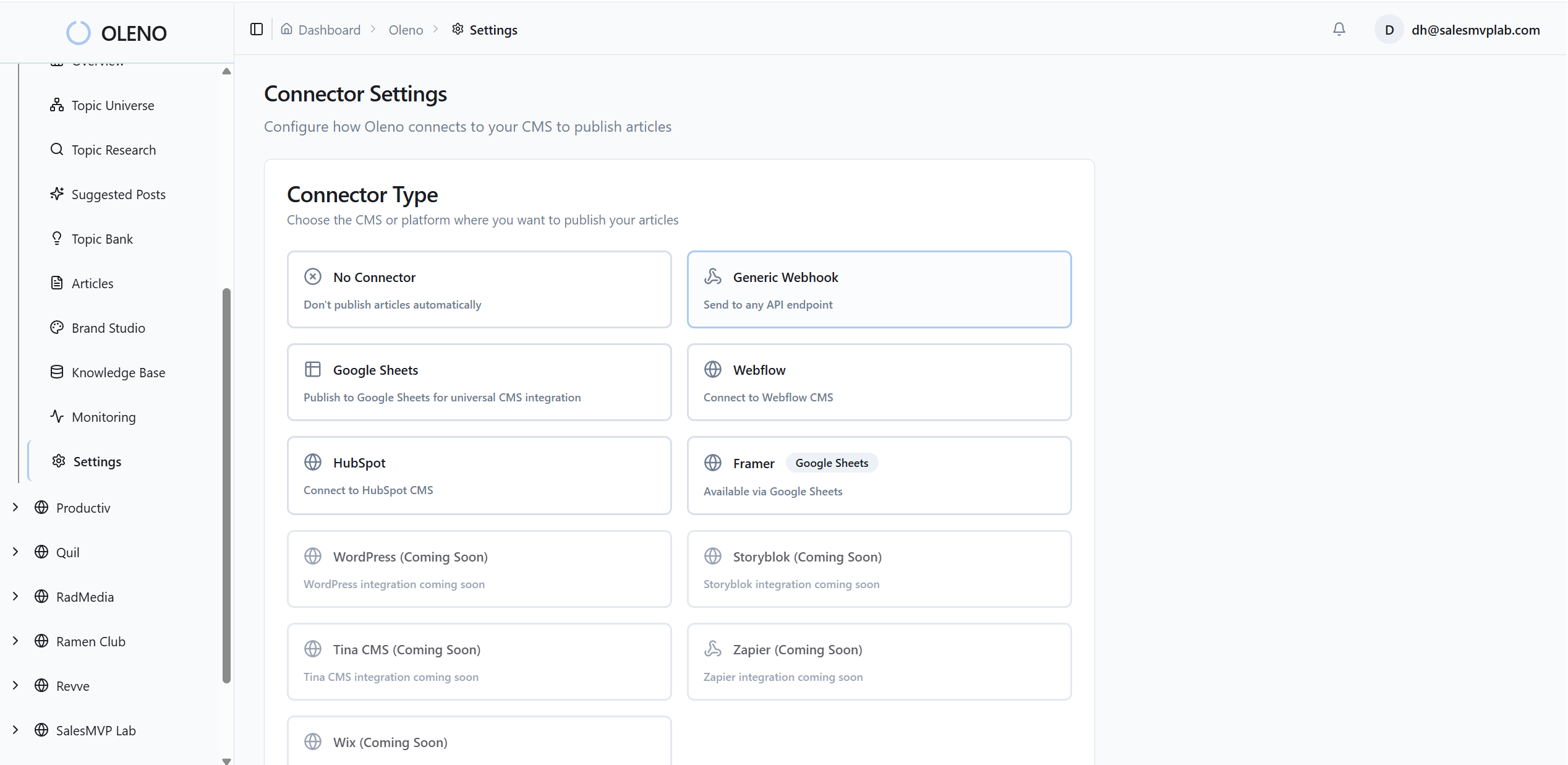
From that point on, every piece of content — from a blog post to a social update — is generated from this single source of truth. The system doesn't need to be re-prompted. It knows who you are, what you sell, and what you stand for. Every asset reinforces the same core narrative, which is exactly what builds confidence with AI engines.
Enforce consistency with Brand & Voice Memory
The other half of the equation is your voice. Oleno's Brand & Voice Memory stores your tone, style guides, and specific phrasing. Not just a prompt — a set of rules the AI has to follow.
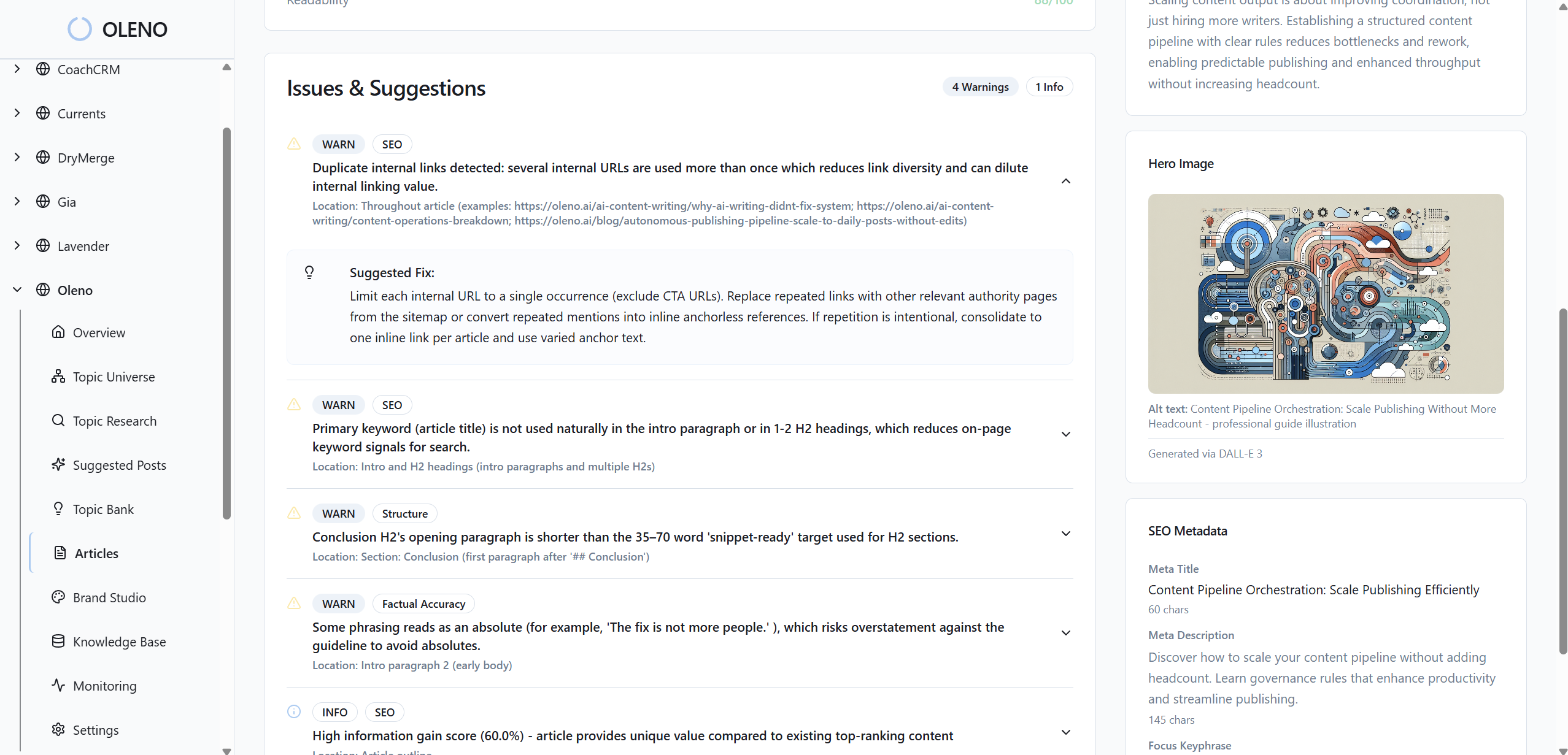
This eliminates voice drift between pieces, which is one of the fastest ways to lose credibility with both humans and machines. When every article sounds like it was written by the same expert, you build the kind of narrative consistency that gets you cited. This is how you scale content without scaling confusion, which is the core job of seo content scaling.
The Path Forward: Invest in Inputs, Not Just Output
If you want to be discoverable in the new era of search, stop asking if you should do SEO or brand. Start asking if you have the inputs right. Your brand narrative, your positioning, and your product truth are no longer just marketing assets. They are the foundational inputs to a system that determines whether you get found.
The leanest teams should prioritize getting these foundational brand inputs right before they try to scale output. A dozen high-conviction, narratively-consistent articles will do more for your discoverability than a hundred generic, fragmented ones. Get the system right first. Then scale. When you're ready to see how a system like this works, you can book a demo with our team.
About Daniel Hebert
I'm the founder of Oleno, SalesMVP Lab, and yourLumira. Been working in B2B SaaS in both sales and marketing leadership for 13+ years. I specialize in building revenue engines from the ground up. Over the years, I've codified writing frameworks, which are now powering Oleno.
Frequently Asked Questions