AI tools keep making up facts for our marketing

You caught 3 bad claims in a draft this week, and none of them looked obviously fake at first. That’s why ai marketing hallucinations are so dangerous for B2B SaaS teams: the draft reads clean, the structure looks right, and then buried in paragraph seven is a product claim your company has never made.
The usual instinct is to blame the model. I think that’s the wrong fight. Generic AI doesn’t know your product truth, your latest positioning, or what claims are safe to publish, so when you ask it to act like a finished writer, it fills the gaps confidently.
Key Takeaways:
- AI marketing hallucinations usually come from missing source grounding, stale prompts, vague briefs, or weak review steps.
- Prompting harder won’t fix a workflow where the model has no approved knowledge to pull from.
- Editorial control matters more for trust-sensitive marketing than full automation.
- Knowledge grounding needs approved docs, source freshness rules, and clear citation expectations.
- Content quality at scale needs review criteria before publish, not just faster generation.
- Narrative drift compounds when reused assets aren’t checked against current brand and product truth.
Why AI Marketing Hallucinations Start in Operations
AI marketing hallucinations usually start when a team gives the model responsibility for facts it was never given. The model can write a plausible sentence, but it can’t know whether your pricing changed last week, your ICP shifted, or a feature is still in beta unless that truth is supplied and checked.

The model is guessing because your system is under-specified
A vague prompt is basically a blank space with a deadline. If you ask for “a product-led growth article for SaaS CMOs” and don’t attach approved product docs, source URLs, positioning, customer proof, and claims boundaries, the model still has to finish the job. So it does what models do. It predicts the next likely sentence.
That’s how invented market details sneak in. Not because the AI is malicious. Because the task asked it to sound complete even where the inputs were incomplete. Ungrounded AI outputs are more likely to introduce invented product and market details, especially when the article asks for specifics like integrations, pricing, customer outcomes, feature mechanics, or category claims. If your team needs the first failure point to inspect, start with the source layer, not the wording of the prompt. We’ve written more on factual AI writing because this is usually where the whole thing breaks.
I get why teams start here. It’s fast. You paste a decent prompt, get a decent draft, and for a while it feels like progress. But if the draft is going into a trust-sensitive channel, “sounds right” isn’t the bar. If you want to see what a source-grounded content process looks like in practice, the cleanest next move is to request a demo and walk through how the facts get loaded before the draft exists.
Hallucination triggers show up before the draft
The biggest hallucination triggers are usually visible before anyone writes a sentence. Missing source grounding is the obvious one. Stale prompts are the sneakier one. Vague briefs are the one marketers underestimate because vague briefs still look professional.
Picture a content manager at 4:47 PM trying to finish a near-ready launch post. The prompt references last quarter’s positioning. The brief says “mention enterprise readiness” but doesn’t say which features prove it. The model adds a line about advanced admin controls, the editor skims past it, and now sales is sending a claim product never approved. Painful. Also predictable.
A practical diagnostic is simple. Before approving any AI-assisted draft, ask 4 questions:
- Where did each product claim come from? If the answer is “the prompt,” treat it as unverified.
- Which source is freshest? If the source is older than the product change, the source loses.
- Which audience is the draft actually speaking to? If the persona is fuzzy, the claims will drift.
- What claims would legal, product, or sales object to? Put those on a review list before drafting.
That last question matters because AI doesn’t know your internal politics. Honestly, neither do many freelancers on day one. The difference is that a freelancer usually asks clarifying questions when the brief is thin. AI just keeps going.
Wrong-context leakage is a real signal
Wrong-context leakage is when a draft pulls in language, examples, or assumptions from a totally different business problem. It’s one of the easiest ways to spot that your AI system is grabbing from the wrong memory, the wrong chat history, or a broad internet pattern instead of approved source truth.
You’ll see lines that technically make sense but don’t belong. A SaaS article about content governance suddenly says, “For many companies, customers and users are two different things.” Then it wanders into “Likely the donors I'd reckon.” A paragraph later, it adds, “Finding and motivating donors is a whole other kettle of fish...” None of that belongs in a B2B SaaS marketing article unless the piece is literally about nonprofit positioning. The sentence may be coherent. The context is broken.
The same thing happens with strategy language. A draft might ask, “For positioning and marketing mix do you think I should focus on potential donors or the homeless?” or say “the homeless are the company product's users, the donors are the customer (i.e., who's paying for it).” Again, coherent. Also completely wrong for most SaaS content. If you see that kind of cross-domain contamination, don’t edit the sentence. Fix the retrieval layer, the brief inputs, or the asset library it pulled from.
Bad context doesn’t stay in one paragraph. It becomes the seed for the next mistake.
How to Diagnose the Failure Point
The fastest way to reduce AI marketing hallucinations is to diagnose whether the failure came from inputs, workflow, or review. If the inputs are thin, ground the model. If the workflow skips approval, add review steps. If review is vague, define pass/fail criteria before publish.
Start with the source test
3 source checks catch a surprising amount of bad AI content before an editor has to line-edit anything. First, check whether the draft cites or references approved sources. Second, check whether those sources are current. Third, check whether the claim is inside the source, not merely adjacent to it.
That third one catches people. A source may mention your enterprise plan, but it may not support the draft’s claim that enterprise buyers choose you for governance. A source may list an integration, but it may not support a workflow claim about how that integration behaves. Retrieval augmented generation can help here because the model is pulling from a knowledge layer instead of guessing from memory, but retrieval only works if the docs are approved, fresh, and specific enough to answer the question.
I like a basic threshold: every product claim, customer claim, competitor claim, pricing claim, and market trend claim needs a source. Not every sentence. That would be overkill. But if a claim could embarrass sales, product, or the founder in a customer call, it needs a source before publish. If that sounds strict, good. Trust breaks one specific claim at a time.
Separate writing quality from factual quality
A polished draft can still be factually dangerous. That’s the annoying part. The model can nail the tone, structure the argument, and still invent a feature because the brief implied a capability without naming the approved source.
I’ve seen marketers fall into the “good writing equals good draft” trap. Makes sense. We’re trained to react to flow, voice, structure, and whether the piece sounds like something we’d publish. But hallucinated marketing facts often hide inside otherwise solid prose. The better the writing gets, the harder the factual errors are to spot because the sentence doesn’t feel broken.
Run two separate passes:
- Editorial pass: voice, argument, flow, structure, reader fit.
- Factual pass: product truth, source links, claim boundaries, freshness.
- Brand pass: positioning, POV, approved language, excluded claims.
Don’t combine them. If one person tries to evaluate all 3 at once, they’ll miss things. That’s not a character flaw. It’s load. The fix is workflow design, not asking editors to become superhuman.
Watch for narrative drift across reused assets
Narrative drift happens when old language keeps getting reused after the company has moved on. One draft says the old category. A refreshed article keeps last year’s ICP. A sales enablement page repeats a feature name that product retired. Then the AI learns from those assets and repeats the drift in new content.
Brand and product drift compound because content gets reused everywhere. Blog posts feed social. Social feeds sales snippets. Sales snippets feed onboarding decks. Onboarding decks get pasted into prompts. By the third reuse, nobody remembers where the claim started. The AI didn’t create the original mistake, but it scaled it.
A good drift check looks for 5 things:
- Old positioning: category, ICP, use case, or pain language that changed.
- Stale product claims: features, integrations, packaging, or pricing that moved.
- Unsupported proof: customer outcomes that aren’t approved for public use.
- Voice drift: content that sounds like the old brand or a generic AI assistant.
- Channel drift: claims copied from a sales doc into a public article without review.
Narrative drift is boring until it costs you credibility. Then everyone cares.
Replace prompt-only work with an editorial workflow
Prompt-only workflows break down when marketing teams need consistent, factual output at scale. The reason is simple. A prompt is an instruction. A workflow is a control system. Once you’re producing more than a few pieces per month, you need repeatable decisions, not better vibes in a chat window.
A prompt-only process depends on whoever wrote the prompt that day. Maybe they remembered the positioning. Maybe they pasted the latest product notes. Maybe they forgot the anti-persona, the pricing change, or the founder’s new POV. At 1 or 2 drafts a month, a sharp marketer can hold it together manually. Past about 5 articles a month, the context tax starts to show up everywhere.
The better pattern is an orchestrated editorial workflow. Not complicated. Just explicit. Topic gets approved. Research gets checked. Brief gets shaped. Outline gets reviewed. Draft gets QA’d against sources and voice. Human review stays in the loop, but the human isn’t babysitting every sentence from scratch. That distinction matters. If your current workflow is still prompt-first, the shift from orchestration vs prompting is the process change worth making.
Use review thresholds before publish
Content quality at scale requires explicit review criteria, not just faster generation. Without a threshold, “good enough” becomes whatever the busiest person can tolerate that day. That’s how factual mistakes get through.
Set a pass/fail bar before the draft is generated. For example, a draft can’t move to publish unless every product claim is sourced, every external citation opens correctly, every internal claim matches approved positioning, and every section has a clear reader outcome. You don’t need a 40-point rubric to start. You need criteria that catch the mistakes you actually make.
One useful starting point:
- Factual grounding: every risky claim has an approved source.
- Freshness: claims about product, market, or competitors use the newest approved source.
- Voice match: the piece sounds like your brand, not a generic assistant.
- Citation quality: links support the claim they sit beside.
- Editorial fit: the piece answers the buyer’s real question.
- Publish risk: no unsupported numbers, customer names, or product capabilities.
The content quality checklist is useful because it turns quality from a feeling into a decision. I’d argue every AI content workflow needs that. Otherwise you’re just moving faster into the same review mess.
If your review process is already catching the same AI errors every week, don’t add another editor. Fix the system those editors are compensating for, then request a demo if you want to see how a controlled content workflow handles the research, brief, outline, and draft stages without making marketing act like engineering.
How Oleno Grounds Content Production
Oleno reduces AI marketing hallucinations by grounding content in approved company knowledge before the draft is written. The marketer shapes research, brief, outline, and draft decisions, while the platform pulls from stored voice, positioning, product truth, IP, and source material instead of treating every article like a fresh prompt.
Product truth before prose
Oleno’s Product Truth Library is the first thing that matters for this problem. It stores the products, features, integrations, pricing, help-center sources, and changelog entries the system is allowed to use. That means a draft can’t casually cite a feature that isn’t present in the product truth layer. For B2B SaaS teams, that’s the expensive hallucination category.
The workflow is also built around human shaping. In Oleno, Compose sets the angle and must-cover direction. Research pulls relevant source material before the brief. Brief and Outline pause for the marketer to review before the draft exists. Draft then generates against the approved structure and loaded governance context. It’s not full automation pretending to be strategy. It’s the AI doing production work around decisions the marketer already made.
Worth the caveat: if your positioning isn’t settled, a system like this won’t magically invent it for you. Fair tradeoff. The stronger point is that once positioning, voice, and product truth are written down, Oleno can apply them across pieces without asking you to re-paste the same context every Monday.
Quality checks before publishing
Oleno’s Quality Gate scores each draft before the marketer sees it. The checks cover factual grounding, voice match, structure, link health, and SEO density. If the draft falls short, the system runs a targeted repair pass and checks it again. That’s the part that matters for hallucinations: the draft isn’t treated as ready just because it exists.
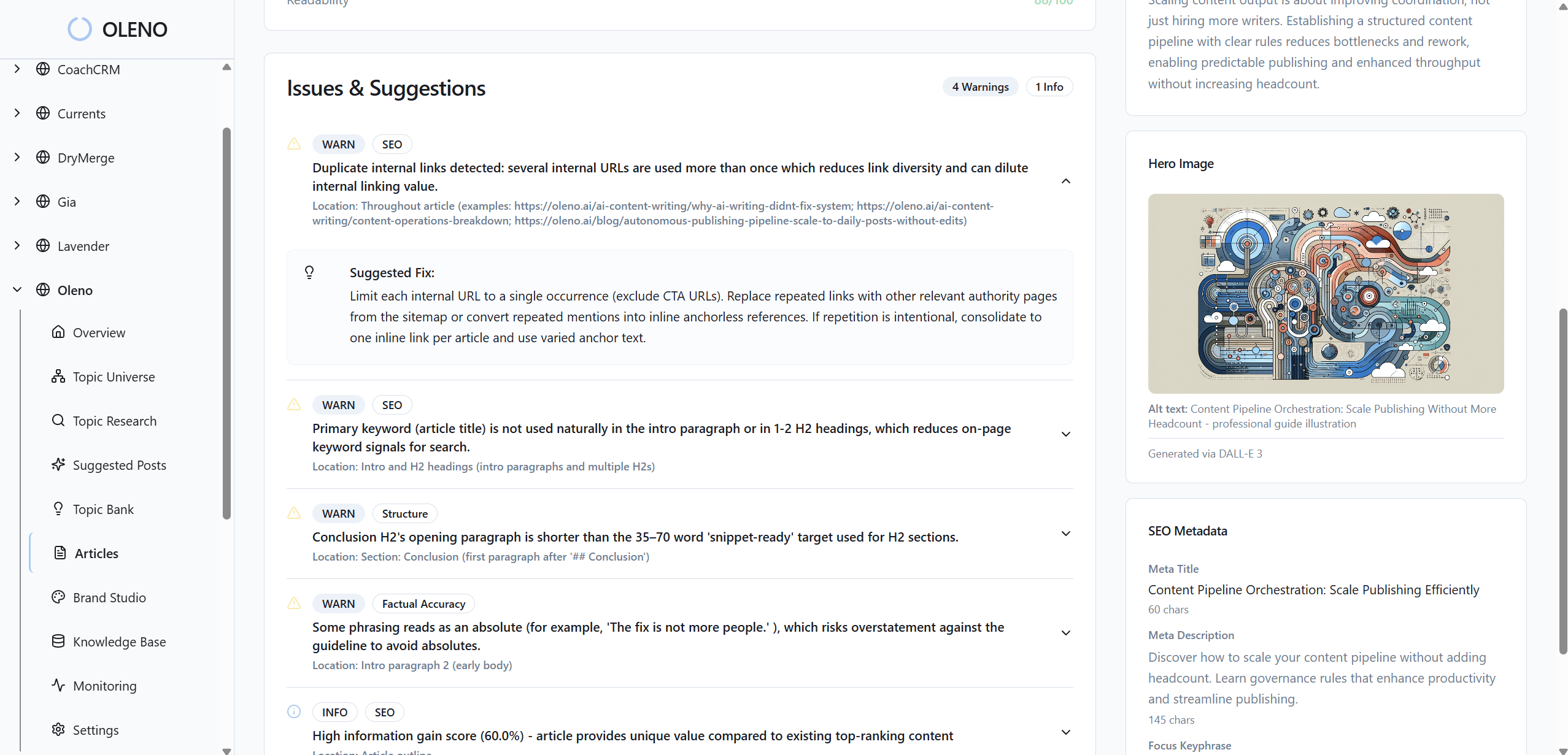
The product also keeps the marketer in control at the places where mistakes are cheapest to fix. Research sources can be dropped or changed before the brief. Brief sections can be rewritten before the outline. Outline logic can be fixed before paragraphs are drafted. Final edits happen in the draft surface with the same governance context loaded, so the edit doesn’t drift away from approved product truth.
Oleno also publishes into WordPress, Webflow, Storyblok, HubSpot, Tina, Wix, Framer, Google Sheets, Webhook, and Zapier. That matters because manual CMS copying is another place errors creep in. If you want to see how the product truth layer, shaping points, and QA pass work together, book a demo and bring a draft that’s already given your team trouble.
Fix the System Before the Draft
AI marketing hallucinations aren’t mainly a model problem. They’re an operating problem. If the model doesn’t have approved sources, current positioning, clear review steps, and a human making the real calls, it will keep inventing believable details because that’s what the task rewards.
Start with the failure point. If the facts are missing, build the knowledge layer. If the workflow is prompt-only, add staged review. If the review is fuzzy, define the threshold. Oleno is built for the version of this where marketing wants AI speed without handing over the byline. The marketer stays in control. The AI does the production.
About Daniel Hebert
I'm the founder of Oleno, SalesMVP Lab, and yourLumira. Been working in B2B SaaS in both sales and marketing leadership for 13+ years. I specialize in building revenue engines from the ground up. Over the years, I've codified writing frameworks, which are now powering Oleno.
Frequently Asked Questions