How to Optimize AI Content Marketing for SEO and AI Search

Most AI content marketing fails after five articles a month because the prompt becomes the strategy, the brief becomes optional, and the marketer becomes a cleanup crew. If you felt that this week, rewriting the prompt again probably won't fix it.
The issue isn't AI quality. The issue is the operating model around the AI. Search is now split across traditional rankings and AI answers, which means your content has to work for both humans scanning SERPs and machines deciding which sources deserve citation.
If you want to see what a judgment-led AI content workflow looks like before rebuilding your own, you can request a demo.
Key Takeaways:
- AI content marketing now has to optimize for dual discovery: rankings in search and being surfaced in AI answers.
- Structured briefs beat one-shot prompts because they lock in angle, audience, sources, and fact grounding before drafting starts.
- Content cadence is an optimization lever, not a nice content ops habit.
- Clear angles increase the odds that LLMs understand and cite your work.
- Brand voice consistency breaks when every piece starts from a fresh prompt.
- Traffic-only reporting misses AI citations, brand mentions, and answer visibility.
- The practical fix is simple: better briefs, stronger judgment checkpoints, and a cadence the team can actually sustain.
Why Prompts Aren't Enough for AI Content Marketing
AI content marketing breaks when the team treats the prompt as the strategy instead of treating the workflow as the strategy, because better wording can't rescue weak angles, thin source grounding, inconsistent cadence, or missing editorial judgment.

Most marketers we talk to already use ChatGPT, Claude, or Perplexity every week. They know how to get a decent draft. That isn't the hard part anymore. The hard part is making sure the tenth article still sounds like the first, the product claims stay true, the angle is worth reading, and the content cadence doesn't collapse once the campaign sprint ends.
The Prompt Is Usually Carrying Too Much
A prompt is like handing a writer a sticky note before a major product launch. You can cram the ICP, positioning, competitor context, voice notes, forbidden claims, SEO terms, CTA, and angle onto it. Technically, the information is there. But nobody should trust a sticky note to carry the whole launch narrative.
The same thing happens in AI content marketing. The prompt gets longer because the system around it is weak. The SEO lead adds keyword notes. The PMM adds product caveats. The CMO adds positioning edits. The content marketer adds voice examples. By the time the draft comes back, everyone is surprised that it followed some of the instructions and ignored the ones that mattered.
The diagnostic is pretty simple. Pull your last 10 AI-assisted articles and ask three questions:
- Did every article start from a structured brief, not just a prompt?
- Can you trace every product claim back to a real source?
- Would a buyer recognize the same point of view across all 10 pieces?
If the answer is no twice, the problem isn't your model. It's your workflow.
The Cost Shows Up as Drift Before It Shows Up as Failure
Narrative drift is usually the first warning sign. One article says the product is for growth teams. The next says it's for RevOps. A third explains the category in a slightly different way. None of the pieces are obviously wrong, which is why the mistake keeps compounding.
Picture an SEO lead on Thursday afternoon. They have a content calendar, a topic cluster, three AI drafts, and a Slack thread from PMM saying one section overclaims a feature. The draft is almost usable, but now they need to re-check positioning, rewrite the intro, verify product language, and paste the final HTML into the CMS. It feels like progress. It also feels weirdly manual for a process that was supposed to save time.
Google's own guidance says AI-generated content isn't automatically a problem if the content is useful, original, and trustworthy, which is a useful bar to keep in mind when you're using AI in production. The risk isn't that AI touched the article. The risk is that nobody shaped the article before the draft existed.
That distinction matters because search and LLM discovery are converging fast, and weak operating models don't survive convergence.
How to Optimize AI Content for Search and AI Answers
Optimizing AI content for search and AI answers means designing each piece for dual discovery: traditional ranking systems need crawlable relevance, while AI engines need clear answers, specific angles, and source-grounded passages they can confidently surface.
Winning AI search requires writing for AI engines, not only traditional SERPs. Traditional SEO still matters. Keywords, internal links, crawlability, technical health, and topical coverage still do real work. But AI engines read differently. They retrieve passages, compare answers, look for source clarity, and decide whether your framing is useful enough to cite.
Audit the Workflow Before Rewriting Prompts
Start the audit at the handoff points, not inside the prompt. Most weak AI content workflows have the same pattern: topic selected in one place, source research in another, brief half-written in a doc, draft generated in a chat window, edits made in Google Docs, final copy pasted into the CMS. Every handoff creates a place for context to leak.
Ask a sharper question: where does the marketer make the judgment call? If the only real decision happens after the draft is written, you're paying the highest cost to fix the cheapest mistake. Angles should be judged before writing. Source quality should be judged before the brief. Structure should be judged before the draft. Final edits should be about sharpness, not rescuing the whole piece.
Run this 20-minute audit on your current AI content marketing workflow:
- Pick three recently published AI-assisted articles.
- Mark where the angle was chosen.
- Mark where sources were approved or rejected.
- Mark where product claims were checked.
- Mark where brand voice was reviewed.
- Mark how the piece moved into the CMS.
If two or more steps are vague, you don't have an AI content workflow yet. You have a collection of smart people catching mistakes late.
Build Briefs for Dual Discovery
Structured briefs improve SEO and LLM visibility more reliably than ad hoc prompting because they force the team to decide the article's job before the model starts producing paragraphs. A good brief isn't long for the sake of being long. It answers the few questions that decide whether the piece can rank, get cited, and still sound like you.
A dual-discovery brief should name the search intent, the AI-answer intent, the angle, the audience, the sources, the factual boundaries, and the structure. The SEO part asks, "What query does this deserve to rank for?" The AI visibility part asks, "What answer could a model lift from this page without flattening the argument?" Different question. Better output.
A working brief for AI content marketing should include:
- Primary query: the phrase or cluster the page should compete for.
- AI-answer target: the question a buyer might ask ChatGPT, Perplexity, or Google AI Overviews.
- Angle: the specific point of view that separates the piece from generic coverage.
- Source set: the approved internal and external sources the draft can use.
- Fact boundaries: claims the article can make, can't make, or must qualify.
- Snippet blocks: sections that answer likely buyer questions in one clean paragraph.
We see this with content briefs all the time. The team thinks the brief slows them down. Fair point, if you're writing one article. But if you're publishing every week for months, brief discipline is what stops the whole content system from turning into a pile of disconnected drafts.
Choose Angles LLMs Can Recognize and Cite
Generic topic coverage is easy to produce and hard to cite. "AI content marketing best practices" gives an AI engine nothing specific to grab. "AI content marketing fails when prompts replace operating models" gives it a claim, a frame, and a reason to connect your page to a future answer.
Clear content angles increase the odds that LLMs surface and cite your work because models need distinguishable passages. They don't cite sameness well. They cite definitions, mechanisms, contrasts, and specific claims. If your article says the same thing as every other result, a model can answer the user without you.
Use a simple test before approving an angle:
- Can the angle be stated in one sentence?
- Would a smart peer disagree with it or at least pause on it?
- Does the angle change what sections belong in the article?
- Can the article prove the angle with sources or examples?
- Would the page still be useful if traffic never came from Google?
The last one matters. Search traffic is great. But AI citations often come from content that has a clean answer shape and a distinct point of view. We wrote more about why content angles matter for LLM visibility, because this is where a lot of technically sound content still falls flat.
If your team wants to pressure-test this kind of workflow with your own topics and content standards, request a demo.
Put Brand and Fact Checks Before Drafting
Brand consistency at scale is mostly a sequencing problem. If voice, positioning, and product truth only get checked after the draft, the editor becomes the memory layer for the whole company. That works for a while. Then the editor gets busy, the team adds freelancers, priorities shift, and the content starts sounding like a different company every month.
Fact grounding has the same failure mode. AI copy can be plausible and wrong at the same time. In B2B SaaS, that usually means invented integrations, overstated feature depth, old pricing language, or vague category claims that sales would never say on a call. The scary part is that these errors often read fine. They only fail when a buyer or product leader looks closely.
Put these checks before drafting:
- Voice check: which writing samples should the piece sound like?
- Positioning check: which message leads, and which message stays out?
- Product truth check: which claims are allowed?
- Audience check: who is this for, and who is it not for?
- Source check: which URLs or documents can the draft use?
Some teams prefer speed over structure, and I get why. If you're testing a new topic or writing a founder POV post, too much process can sand the edge off the piece. The exception is real. But once you're using AI to publish at a steady cadence under a brand people trust, skipping fact grounding isn't speed. It's debt.
Treat Publishing Cadence as an SEO Lever
Consistent publishing cadence is a core optimization lever, not a content ops nice-to-have. Search engines need repeated signals of topical depth. AI engines need enough coverage to understand what you know, what you sell, and how your point of view connects across related questions.
Campaign bursts feel productive because they create a visible spike of work. Twelve posts in three weeks. A launch cluster. A big content push before an event. Then the calendar goes cold for six weeks while everyone catches up. The pattern looks normal inside the company, but outside the company it creates uneven topical coverage and weak compounding.
At Steamfeed, we saw the opposite pattern work. We had depth and breadth at high volume, with 80 regular contributors and over 300 occasional contributors. Most pages got fewer than 100 views per month. But the library compounded because we covered many long-tail angles consistently, and traffic started jumping at 500 pages, 1000 pages, 2500 pages, 5000 pages, then 10000 pages.
You don't need that kind of contributor network. Different era. Different model. But the mechanism still matters: steady, quality-controlled output builds a surface area that sporadic publishing can't match.
Set cadence by editorial capacity, not ambition:
- If one marketer owns content, start with one strong article per week.
- If a small team can review briefs and drafts, move to two or three.
- If product and legal review slow everything down, fix approval latency before increasing volume.
- If quality drops for two cycles in a row, reduce cadence before trust erodes.
Volume without quality becomes faster slop. Quality without cadence becomes a collection of nice essays nobody discovers.
Measure AI Visibility Beside Search Traffic
Traffic-only reporting misses the new discovery layer. An article can influence buyers through Google rankings, AI answers, branded searches, sales conversations, social reuse, and internal enablement long before it becomes a clean attribution story in GA4.
Performance measurement needs to expand. Keep reporting rankings, clicks, impressions, conversions, and pipeline influence. Those still matter. Then add visibility checks for AI touchpoints. Ask whether your core pages are being surfaced in ChatGPT, Perplexity, Gemini, and Google AI Overviews for the questions your buyers actually ask.
A practical scorecard can stay simple:
- SERP visibility: rankings, impressions, clicks, and featured snippets.
- AI answer visibility: whether your brand or content appears in answers for priority questions.
- Citation quality: whether AI tools cite the page or only mention the brand.
- Message consistency: whether answers describe your category and product correctly.
- Content reuse: whether sales, lifecycle, and social teams actually use the piece.
Search and LLM discovery are converging, so content optimization has to account for both systems. We call that dual discovery because the buyer journey now moves between blue links and AI-generated answers without asking your marketing dashboard for permission.
How Oleno Grounds the Content Pipeline
Oleno gives B2B SaaS marketers a governed AI content pipeline where strategy, sources, briefs, outlines, drafts, QA, and publishing live in one process, so the marketer shapes the work while AI handles production between decisions.
Oleno is built around a simple belief: full autonomy is the wrong goal for serious B2B content. The marketer should keep the judgment work. The AI should do the production work. That split matters when you're trying to protect brand trust, publish consistently, and write for both search and AI engines.
Strategy Memory Replaces Weekly Re-Prompting
Oleno stores brand voice, positioning, product truth, audience personas, ICP, IP, customer stories, and writing samples in dedicated studios. Every brief, outline, and draft pulls from that stored strategy. The system doesn't re-ask the marketer to paste the same context into a chat window every Monday.
That changes the workflow. Compose lets the marketer set the angle, target persona, key points, sources, and CTA placement before research starts. Research then surfaces sources before writing begins, so the marketer can remove weak sources or add better ones. Brief and Outline give the marketer two more places to shape the structure before Draft produces the article.
Oleno isn't trying to replace the senior marketer's taste. It gives that taste a place to show up before the draft exists.
QA and Publishing Remove the Manual Tax
Oleno's Product Truth Library is the guardrail against plausible but wrong AI copy. It stores the product, features, integrations, pricing, help-center sources, and changelog entries the content system is allowed to cite. If a capability isn't in the library, the draft shouldn't claim it.
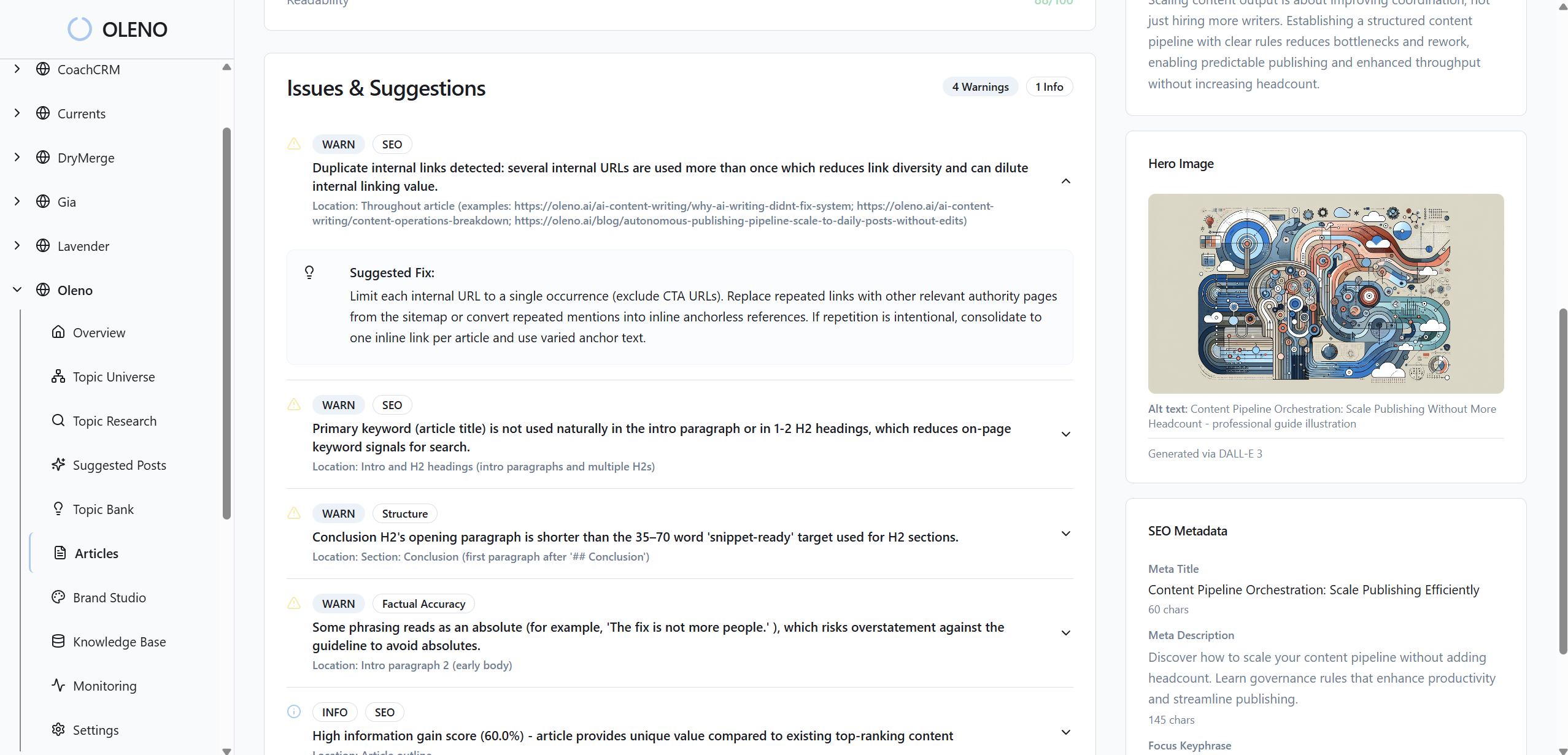
The Quality Gate then scores each draft for factual grounding, voice match, structure, link health, and SEO density before the marketer opens the piece. Publish pushes approved content directly into WordPress, Webflow, Storyblok, HubSpot, Tina, Wix, Framer, Google Sheets, Webhook, or Zapier, with destination-specific handling like image rehosting and WordPress metadata mapping where supported.
For the SEO lead, the important part is the operating model. Oleno doesn't replace keyword research, technical SEO, analytics, or distribution. You still need those. It replaces the messy middle where AI drafts, briefs, sources, product truth, edits, and CMS publishing are scattered across tools.
If your AI content marketing process is already producing drafts but still creating cleanup work everywhere else, book a demo.
Fix the System Before You Fix the Prompt
AI content marketing improves when you fix the system around the model: better briefs for dual discovery, clearer content angles, stronger fact grounding, protected brand voice, steadier cadence, and measurement that includes AI answers.
The next audit doesn't need to be complicated. Take your next article and rewrite the brief for both search and AI citation. Add judgment checkpoints before the draft, not only after it. Then set a publishing cadence your team can sustain without letting narrative drift creep into the library.
Better prompts are useful. Better operating models compound.
About Daniel Hebert
I'm the founder of Oleno, SalesMVP Lab, and yourLumira. Been working in B2B SaaS in both sales and marketing leadership for 13+ years. I specialize in building revenue engines from the ground up. Over the years, I've codified writing frameworks, which are now powering Oleno.
Frequently Asked Questions