Three facts every AI content brief needs

How does a polished draft come back with the product fit wrong? The writing can sound finished. But you still have to correct who the product serves, what it supports, and where the limits are.
The easy response is to improve the prompt. Add more context. Add the positioning document. Add another paragraph explaining what the writer missed last time. But if the assignment never fixed the buyer question, proof source, or answer format, a longer prompt gives the model more material without resolving the important decisions.
So take one live brief and check those three inputs. If any are missing, stop before generation. The wording can wait.
Draft rework starts upstream
Draft rework usually begins with decisions the brief left open. The model still has to produce something, so it fills those gaps with plausible defaults. Those defaults can read well and still create a lot of work for the PMM.
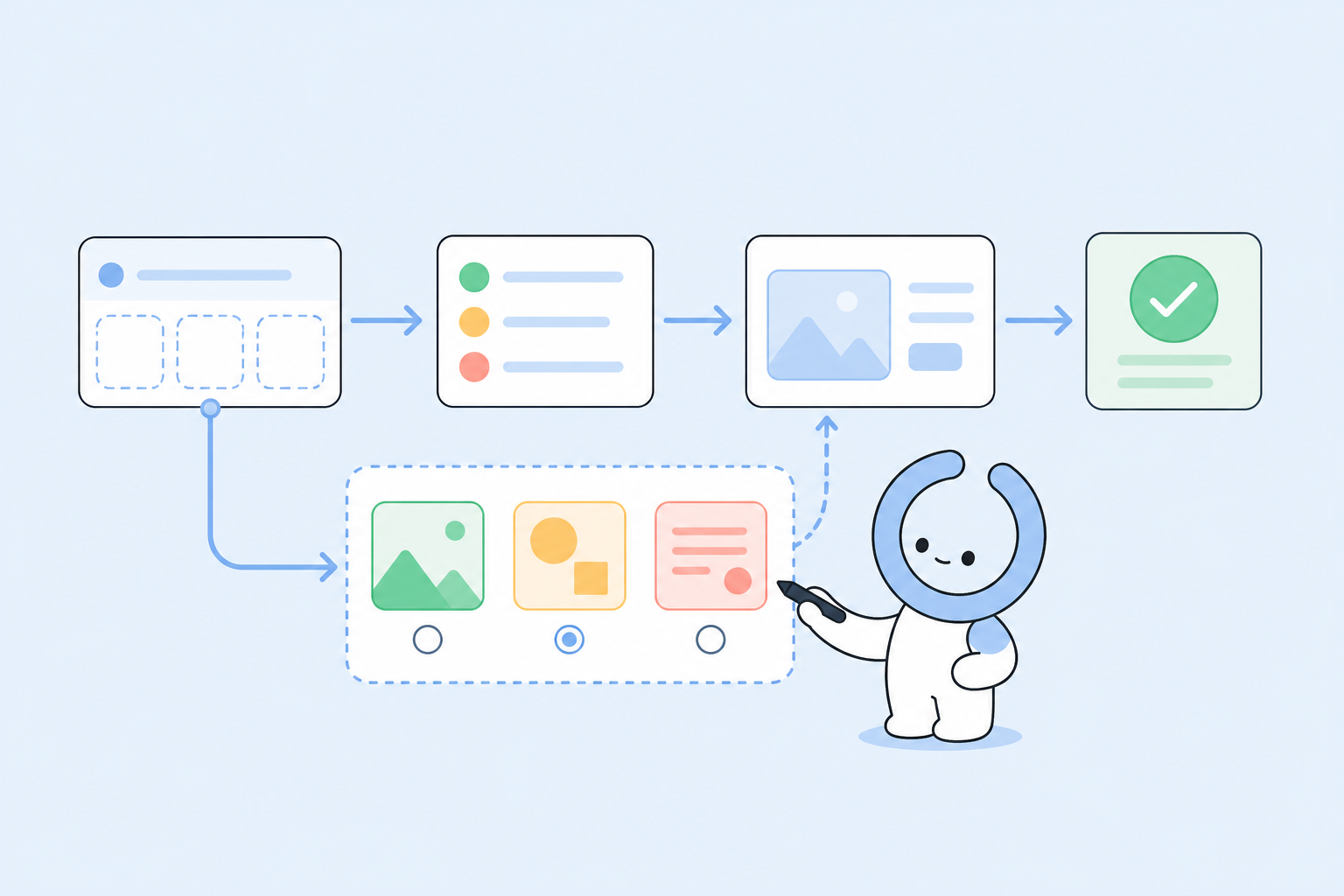
Missing decisions become plausible defaults
Let’s say the brief says, “Write an article about our new reporting feature.” Who is the buyer? What are they trying to understand? Which current product records support the claims? The model can guess, but each guess changes the article.
One CMO told us he had avoided programmatic content automation because he saw no value in producing a mountain of mediocre content. Quality over quantity was the thing he cared about. That’s one buyer’s view, not a benchmark, but it gets at the issue. Fast output doesn’t help when the PMM has to rebuild the product explanation afterward.
Longer prompts move the problem
A longer prompt is not a safer content system. Prompt wording can explain tone and provide context, but it can’t make a missing positioning decision for you. When different contributors keep receiving the same corrections, look at what the assignment leaves them to decide.
The point of structured brief quality is to settle the consequential choices before prose exists. If you want to see how Oleno carries those choices from the brief into supported drafting and editing, you can request a demo.
The brief carries PMM judgment
The brief should fix the decisions that would change the meaning of the piece. Wording can move downstream. Buyer intent, product truth, and proof requirements shouldn’t.
Judgment moves before generation
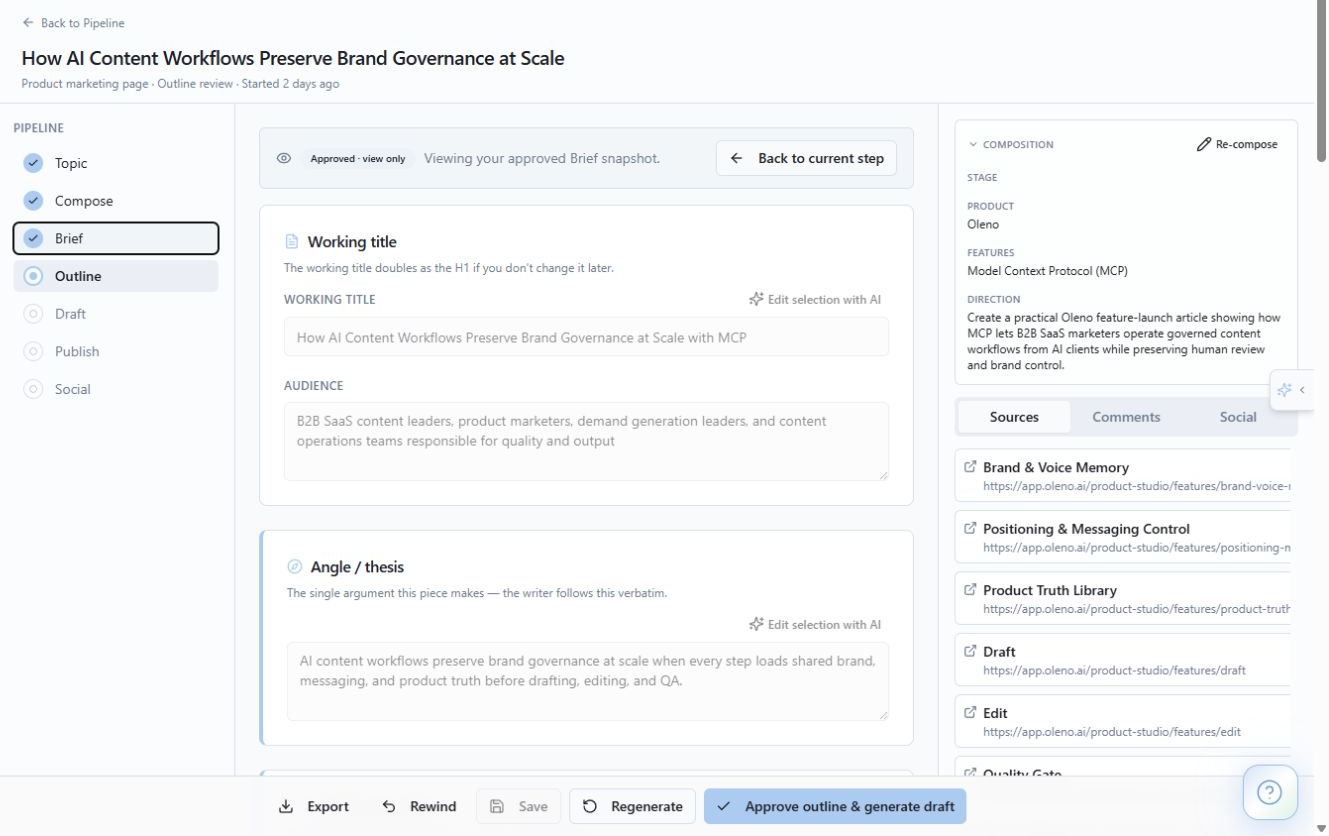
A useful AI content brief locks three inputs: one buyer question, a proof source for every consequential claim, and the required answer format. The PMM decides those things because they define whether the draft is accurate and useful. The writer or AI can decide how to explain them.
That doesn’t mean making the brief as long as possible. More fields can create more review without making the assignment clearer. Use enough structure to make the decisions visible, then leave sentence choices, transitions, and supported examples to the writing stage.
The broader AI-ready brief components can help when the assignment needs more detail. But those extra fields don’t replace the three inputs here.
Product boundaries stay upstream
Fit and limits belong beside the product claim before drafting starts. If a feature supports one workflow but not another, say that in the brief. If availability depends on the current release or plan, name the source that confirms it.
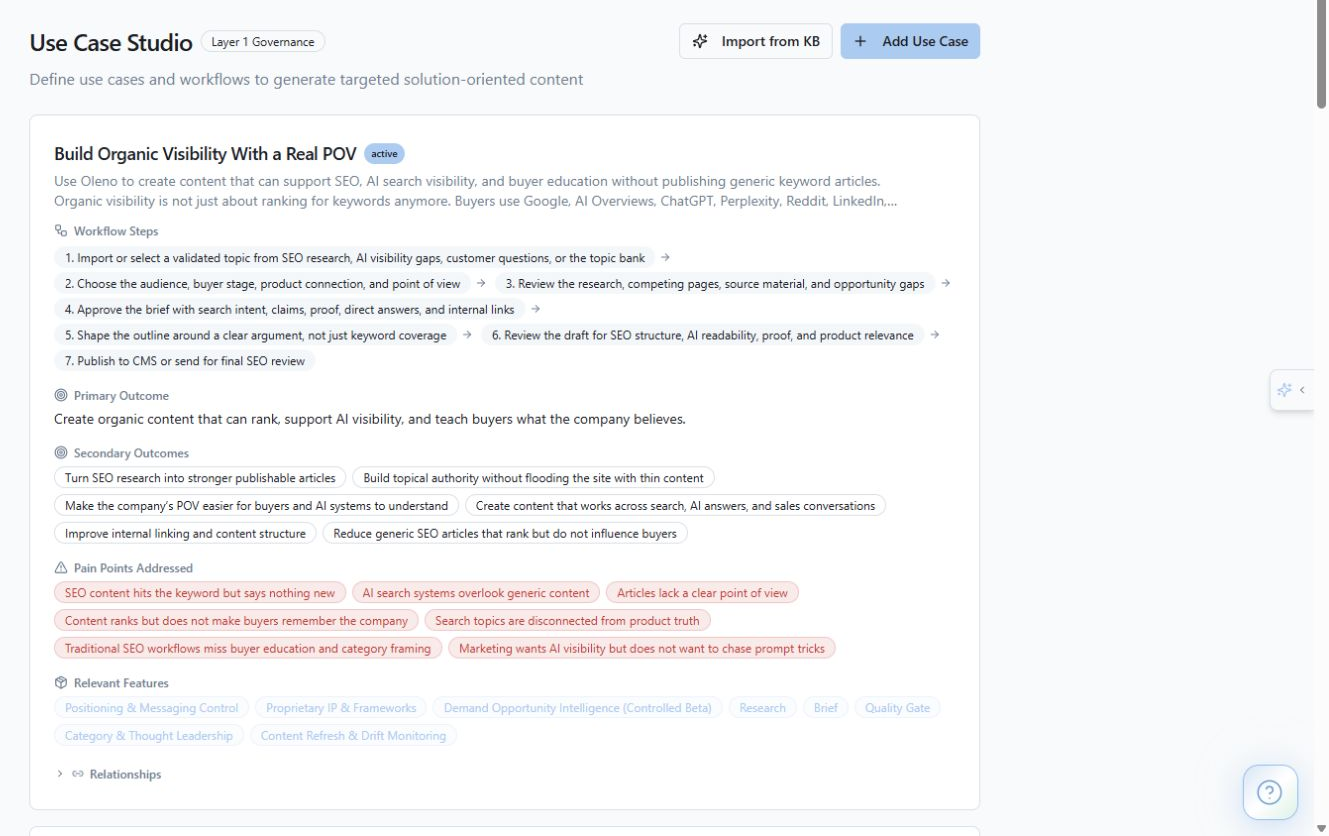
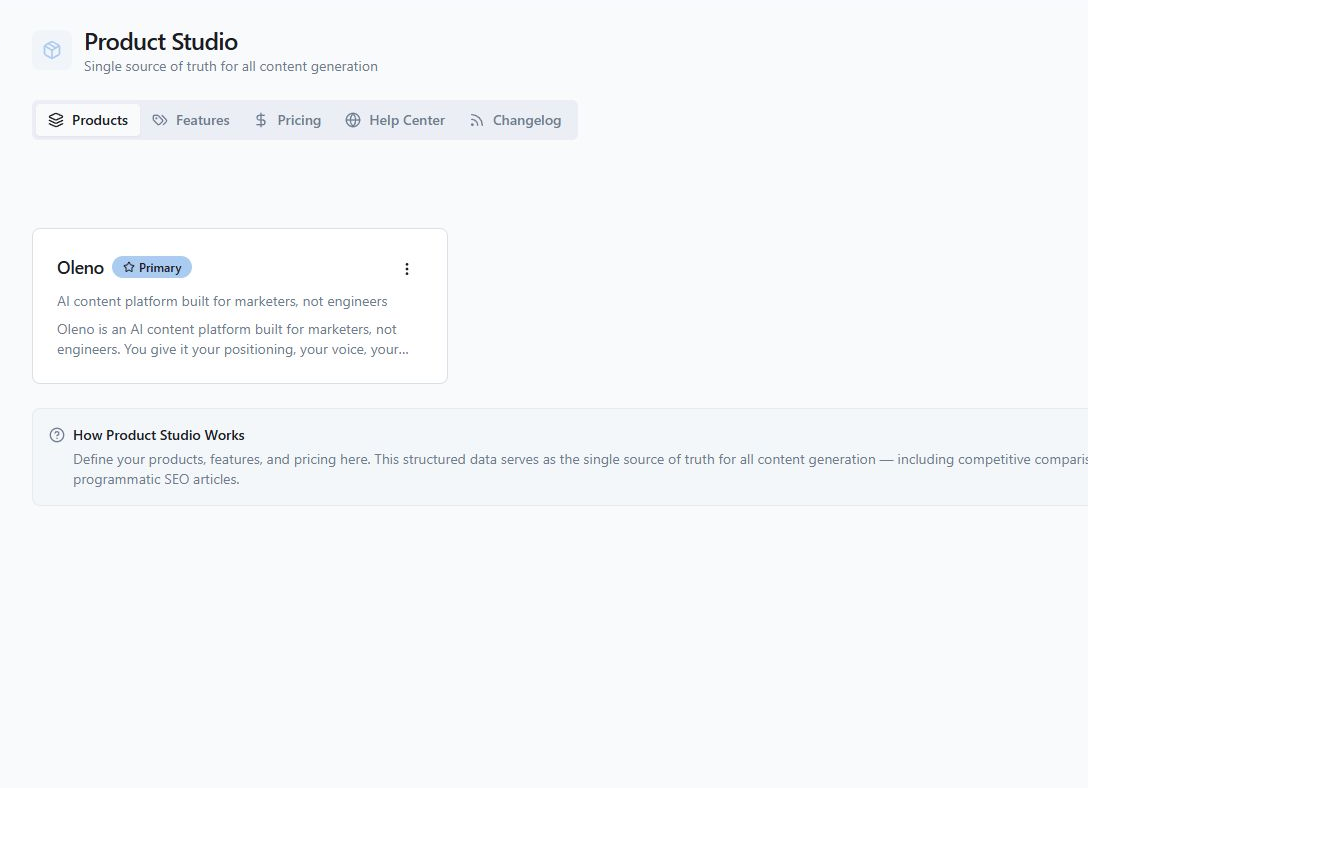
Oleno’s Positioning & Messaging Control and Product Truth Library keep maintained positioning, features, mechanics, and limits available during supported research, briefing, drafting, and editing. The team still decides the message and keeps those records current. Stored context reduces repeated setup, but it doesn’t guarantee that every sentence will be correct.
One buyer question sets direction
One buyer question gives the draft one audience and one job. Follow-up questions can deepen the answer. They shouldn’t replace or change the main problem halfway through the piece.
Start with real buyer prompts
An AI content brief should record real buyer prompts and relevant follow-up questions before drafting. Real language makes the buyer intent inspectable. It also gives the PMM something more useful than a guessed keyword or broad persona label.
“What do you do as a Demand Generation Manager” asks for a role explanation. “Anyone made the transition from product manager to product marketing manager?” asks about a career change. Those topics overlap, but they are different assignments with different readers and different useful answers.
The same distinction shows up when the product has users and economic buyers. “For many companies, customers and users are two different things.” A brief that only says “write for customers” leaves a basic audience decision open.
Separate primary and follow-up questions
Pick one primary prompt that the draft must answer. Then add follow-up questions that make the answer useful. For the career-transition example, “How is the actual day to day different from PM?” works as a follow-up because it develops the original question instead of replacing it.
Sometimes the source language exposes a bigger ambiguity. “What's the non-profit core challenge? Getting more money or getting more homeless to use their services. This will inform which audience is your core audience for the plan.” That is really a choice between two different audiences and jobs. “Finding and motivating donors is a whole other kettle of fish.” reinforces why the brief has to make that choice.
The test is simple. Can the PMM repeat the one question the draft must answer without adding a paragraph of explanation? If not, the assignment is still open.
Named sources protect product truth
Consequential product claims need named, maintainable sources rather than unsourced model synthesis. Naming the source changes review from “does this sound right?” to “does the current source support this exact statement?” That’s a much better PMM decision.
Assign sources claim by claim
A source list at the bottom of the brief isn’t enough when nobody knows which source supports which claim. Put the source beside the claim it qualifies. That claim provenance should cover product fit, feature behavior, limitations, pricing, availability, and any comparison that could change a buyer’s decision.
Generic model synthesis can help find language or questions to investigate. It shouldn’t become the authority for a product claim. If you can’t trace a consequential statement, narrow it or leave it out.
Prefer maintained authority
The right source is the one your team treats as current. That might be an approved product record, help documentation, a pricing record, or another maintained source with a clear owner. A slide from an old launch deck may be specific, but specificity doesn’t make it current.
Maintenance matters because product truth changes. When the source changes, the team needs a way to find and review the claims that depend on it. If nobody owns the source, the brief should not present the claim as settled.
If you want to inspect how maintained positioning and product records are used during production, you can request a demo.
Source fit and limits together
Proof should include the boundary, not just the positive claim. A feature can support a use case under certain conditions without supporting every version of that use case. Keep those conditions beside the statement so they survive drafting and editing.
Traceability still isn’t an accuracy guarantee. A maintained source can be wrong or out of date. But a named source gives the reviewer somewhere to check and someone to ask.
Answer structure makes evidence usable
The answer format tells the writer what the evidence must become. A definition needs a clear meaning. A comparison needs relevant criteria. A process needs a real sequence.
Choose the response shape
Start with the buyer question, then choose the shape that answers it. Common options include:
- A definition for “What does this mean?”
- A comparison for “How is this different?”
- Steps for “How do I do this?”
- A short extractable claim for a direct factual question
A broad topic doesn’t tell the writer which one to use. “Product marketing manager” could become a definition, career guide, job comparison, or list of responsibilities. The brief has to choose.
Make direct answers extractable
The brief should specify an extractable answer structure when the reader needs a direct response. If someone asks what a feature does, the section should answer that question before moving into background or examples. If the answer is conditional, the condition stays in the answer.
Clear answer structure can also make a passage easier to use in search and AI-generated responses. But it doesn’t guarantee rankings or AI search citations. Source quality, accuracy, and the usefulness of the explanation still matter.
Keep limitations with the answer
Shortening an answer can remove the detail that keeps it true. So tell the writer which limitation must stay attached to the claim. Don’t bury it several paragraphs later as a general disclaimer.
A direct answer might say the product supports an enabled publishing connector, then explain that destination behavior varies by connector and release. Removing the second part makes the first sentence easier to extract and easier to misread.
Approval requires three checks
Brief approval should be pass or fail on the three inputs that control meaning. If the buyer question, claim sources, or response shape are missing, reject the assignment before generation. Fixing them later means fixing the draft too.
Apply the pass-fail review
Use three questions on one live brief:
- Can I repeat the buyer’s primary question?
- Can I trace every consequential claim to a named, current source?
- Can I identify the required answer shape?
A practical brief checklist can cover the wider assignment. But these three questions decide whether the writer has enough direction to begin.
Separate fixed and flexible choices
Fix the audience, buyer question, product boundaries, proof requirements, and answer structure before drafting. Leave wording, transitions, and supported examples open unless the assignment truly depends on them. Over-specifying every sentence turns the brief into a draft the PMM has to write first.
Oleno’s Brief step develops the audience, angle, sections, and sources before drafting. Approved direction then carries into the outline and draft, alongside maintained positioning and product information. The PMM still reviews the result, and the checks don’t make errors impossible.
If you want to walk through one live brief and see where Oleno keeps those inputs attached to the work, you can request a demo.
Match the workflow to risk
A one-off prompt brief can be fine for low-consequence work. If the piece doesn’t make product claims and the cost of a wrong interpretation is low, a lightweight setup may be enough. Not every assignment needs a maintained production process.
Recurring product-led work is different. The same positioning, limits, and evidence have to survive across contributors and articles. A maintained process becomes useful when it carries those records through briefing, drafting, checks, and editing, as shown in the brief-to-publish workflow.
Open one brief you’re about to approve. Write the primary buyer question at the top. Put a source beside every consequential claim. Name the response shape. If you can’t complete one of those steps, send the assignment back before anyone generates the draft.
About Daniel Hebert
I'm the founder of Oleno, SalesMVP Lab, and yourLumira. Been working in B2B SaaS in both sales and marketing leadership for 13+ years. I specialize in building revenue engines from the ground up. Over the years, I've codified writing frameworks, which are now powering Oleno.
Frequently Asked Questions