Why More Content Rarely Fixes a Messaging Problem

If your last 10 articles all sounded fine but none of them changed how buyers talk about you, you probably don't have a content problem. You have a messaging problem. And more content rarely fixes that — it just funds the confusion.
I see this a lot with B2B SaaS teams. The team is publishing. The calendar is full. The CEO wants more output because more output feels like the safest move. The real issue is that every new article inherits the same fuzzy story, weak category frame, and loose product claims that made the last batch underperform.
More content cannot compensate for unclear narrative or weak strategic messaging. It just spreads the confusion faster.
Key Takeaways:
- More output scales confusion when the core story is still fuzzy.
- A messaging problem usually shows up first as content rework, weak conversion, and generic positioning.
- Narrative rules need to exist before AI-assisted production scales.
- Content governance keeps product truth and brand voice consistency intact as more assets ship.
- Clear messaging lowers repurposing cost across blog, social, email, and sales enablement.
- Small teams should pause publishing when rewrites repeat for the same strategic reason.
When Output Masks the Real Problem
High publishing volume can hide a messaging problem because activity makes the team feel productive while the market stays confused. The content backlog looks healthy, but the story underneath still doesn't make buyers understand why you matter. That's where marketing teams lose weeks without seeing pipeline impact.

The Backlog Looks Productive, But the Story Repeats
A content manager opens Asana at 8:47 AM Monday and sees 14 pieces in motion. Two blogs are waiting on SME review, three LinkedIn posts need edits, one comparison page is stuck with product marketing, and the newsletter draft got rewritten twice because the hook felt wrong. Everyone is busy. Nobody is lazy.
Read the drafts side by side and they all make the same soft claim. The product is useful, flexible, easy to adopt, built for growing teams, and different in some way that never gets sharp. That's not a production gap. That's the content backlog exposing a messaging problem.
The diagnostic is blunt. Pull your last 10 published pieces and highlight the one sentence in each that explains why your company matters. If 7 or more of those sentences could describe three competitors with the logo swapped, stop adding topics. Your next move is narrative clarity, not another assignment in the queue.
A team that wants to catch this before another month disappears can request a demo and map where the story breaks before it turns into another queue of rewrites.
The Rewrites Are Telling You Where Strategy Is Missing
Repeated rewrites are rarely an editing issue. They are a signal that the team doesn't have reusable language for the idea it keeps trying to explain. Writers are guessing. Reviewers are reacting. Leadership is correcting the same angle over and over.
I've seen teams call this a writer quality problem when it wasn't. The writer was doing the best possible version of the assignment they received. The brief said "write about AI content operations for B2B SaaS," but it didn't say what enemy the piece was fighting, what product truth could be claimed, what buyer belief needed to shift, or which proof point mattered most.
If the same type of edit shows up three times in a month, codify it. Don't just fix the draft. Turn the correction into a rule:
- What do we always say about the category?
- What claim do we avoid because it overpromises?
- What buyer problem do we lead with before mentioning the product?
- Which phrases sound like us, and which ones sound generic?
That's how content rework becomes operational learning instead of recurring pain.
Why More Volume Worsens Clarity
Publishing more content worsens clarity when the core message is weak because every asset multiplies the same vague story. More blogs, social posts, email sequences, and sales pages don't create strategic alignment by default. Without rules, operational scale creates more rework, not better content performance.
Volume Turns Fuzzy Positioning Into a Library Problem
One fuzzy article is annoying. Fifty fuzzy articles become a library problem. Buyers find old angles in search, sales reps send posts that describe the product differently, and new hires learn the wrong story from whatever content happens to rank that quarter.
That's why narrative frameworks matter before scale. A narrative framework isn't a cute messaging doc that sits in a folder. It's the reusable operating logic behind the content: the enemy, the buyer tension, the category belief, the proof, the claims, and the language you want repeated until the market starts repeating it back.
Here's a test I trust more than most positioning audits. Ask three people on the team to explain the product in one paragraph without checking the website. If all three lead with different problems, you don't have a production issue yet. You have a strategic language issue. More publishing will just create three versions of the company in public.
There is a fair counterpoint. Sometimes volume really is the gap. If your positioning is sharp, your win themes are obvious, and your sales team already hears buyers repeat your language back, then yes — publishing more can expand reach. Most teams asking this question aren't there yet. They are asking for volume because the message hasn't landed.
Weak Conversion Is Often a Message Lag
Traffic can make a messaging problem harder to spot. A page ranks. A post gets shared. The dashboard shows growth. Then demo requests stay flat, sales says the leads don't understand the product, and leadership asks why content isn't creating pipeline impact.
The mistake is assuming the answer is more pages. The better question is whether the content is creating the right belief before the CTA. Google's guidance on helpful content has moved in the same direction: useful content needs to satisfy the reader's actual need, not just match a query shape.
Run a conversion review on the five pages with the most traffic and the five pages sales sends most often. Look for three things: whether the buyer problem is named in their words, whether the product claim is specific enough to believe, and whether the next action follows from the argument. If traffic is healthy but buyers still need a 20-minute explanation on sales calls, the message isn't doing enough work on the page.
Marketers don't talk about message lag enough. The content shipped on time. Search caught it. Buyers read it. The belief didn't move, so the pipeline didn't move either.
Make the Message Reusable First
A reusable message turns positioning into rules that writers, AI systems, and channel owners can apply without re-deciding the story every time. The goal isn't to freeze creativity. The goal is to make the core argument repeatable enough that every asset strengthens the same market memory.
Codify the Narrative Before Drafting at Scale
AI content systems work best when teams define narrative rules before drafting at scale. Prompts are not enough. A prompt can remind the model what to say in one session, but it doesn't create a durable system for brand voice consistency, product truth, or argument structure.
The sequence should be message first, rules second, scale third. Not because strategy sounds nice. Because every downstream asset inherits the upstream narrative quality. If the upstream story is vague, AI will produce vague content faster. If the upstream story is sharp, AI has something worth carrying across the library.
Before scaling production, write down the smallest useful set of narrative rules:
- The buyer symptom: the problem they already feel this week.
- The wrong assumption: the belief your content needs to challenge.
- The category enemy: the old way you're arguing against.
- The product truth: the specific claims your team can prove.
- The language bank: the phrases you want repeated across assets.
That list isn't a full positioning workshop. It's the minimum operating layer a content team needs before asking AI to produce more.
Repurposing Gets Cheaper When the Core Claim Is Stable
Repurposing economics change the moment the message is clear. A blog post becomes easier to turn into LinkedIn posts, email copy, sales follow-up, webinar talking points, and landing page sections because the core claim doesn't need to be reinvented in every format.
Without a stable claim, repurposing becomes translation by committee. Someone cuts the article into social posts, then the CMO rewrites the hook. Demand gen changes the email angle. Sales asks for a sharper version. PMM corrects the product language. By Friday, the "repurposed" campaign has taken almost as much effort as the original asset.
A clear message lowers adaptation cost because each channel is just changing the packaging. Same belief shift. Same proof. Same product truth. Different length and format.
If your team spends more than 30 minutes adapting one approved article into a short LinkedIn post, a newsletter intro, and a sales email, look at the message before blaming the workflow. The adaptation cost is usually a clarity tax in disguise.
Protect Truth With Governance
Content governance is required to keep scaled content aligned with product truth and brand claims. As more assets ship faster, the risk shifts from "can we publish enough?" to "can we keep every claim accurate, consistent, and defensible?" That requires an operating model, not more editing heroics.
Product Truth Needs a Source of Record
Product truth is where scaled content gets risky. A writer says the product integrates with something it doesn't. AI describes a feature that sounds plausible but isn't real. A comparison page overstates a competitor gap. A sales enablement page uses old pricing language.
Nobody meant to create the problem. The system made it easy.
That's why content governance has to sit between strategy and production. Governance is the structured layer that says what the company is allowed to claim, what language is off limits, what proof exists, and which product details need review before publishing.
The practical test is blunt. If a new freelancer, a junior marketer, and an AI model all wrote about the same feature tomorrow, would the product claims match? If not, your content operation is depending on memory. Memory breaks when output increases.
Governance doesn't make content boring. Bad governance does. Good governance protects the facts so the writer can spend their energy on the angle, the argument, and the reader.
Small Teams Need Rules More Than Big Teams
A solo marketer or two-person team can get away with undocumented rules for a while. The same person writes the brief, edits the draft, posts on LinkedIn, builds the nurture email, and talks to sales. Context lives in their head, which works until the workload grows.
Then the founder wants three posts a week. Sales wants battlecards. Product wants launch content. The board wants category POV. Suddenly the marketer's brain is the bottleneck for every asset in the company.
That is the moment to pause publishing. Not forever. Just long enough to get the core story out of your head and into a reusable operating model. A one-week pause can save a quarter of repeated rewrites if the team uses it to define message rules, product truth, and review ownership.
The rule I like is this: if the same senior person has to rewrite the same strategic point twice, document the rule before the third draft starts. If the third draft still needs the same fix, the rule wasn't clear enough.
Content Marketing Institute's B2B research has shown for years that documented strategy separates more mature content programs from reactive ones. The same logic applies even harder once AI enters the production process.
How Oleno Keeps Strategy Attached to Production
Oleno keeps strategy attached to production by storing positioning, voice, product truth, and narrative inputs once, then pulling them into every research run, brief, outline, and draft. The marketer still shapes the work. The AI does the production around those decisions, so scale doesn't detach from the story.
Strategy Memory Replaces Re-Prompting
Oleno is built for teams that already know raw AI output isn't the finish line. The point isn't to skip the marketer. The point is to stop making the marketer re-explain the company every Monday before anything useful can be drafted.
Brand & Voice Memory stores how the team sounds. Positioning & Messaging Control stores the strategic layer: the category frame, key messages, audiences, use cases, market POV, and anti-personas. Product Truth Library stores the claims and feature facts the system is allowed to use. Those inputs get loaded into the content process instead of being pasted into a chat window over and over.
Anders Uhl, CMO at ClickPoint Software, put the buyer concern well when he said he never saw the value in "spitting out a mountain of mediocre-to-terrible content en masse." The thing that got his attention was quality over quantity. Better thinking and better writing. That's exactly the split this article is making.
Oleno doesn't invent positioning if the strategy isn't there. That's an honest limitation. If your company is still pre-positioning, fix that first. The platform works when you have a strategy worth applying across hundreds of pieces.
The Marketer Shapes the Work Before the Draft Exists
Oleno has four shaping points: Compose, Research, Brief, and Outline before the draft becomes the full article. At Compose, the marketer sets the angle, persona, key points, and CTA direction. At Research, the marketer sees sources before writing begins and can remove weak sources or add better ones.
Brief and Outline are where a lot of content quality gets saved. The marketer can edit the argument before 1,900 words exist. Structural problems are cheap at the brief stage and expensive after the draft. We learned that the hard way ourselves. Once a draft exists, everyone starts wordsmithing instead of asking whether the angle was right in the first place.
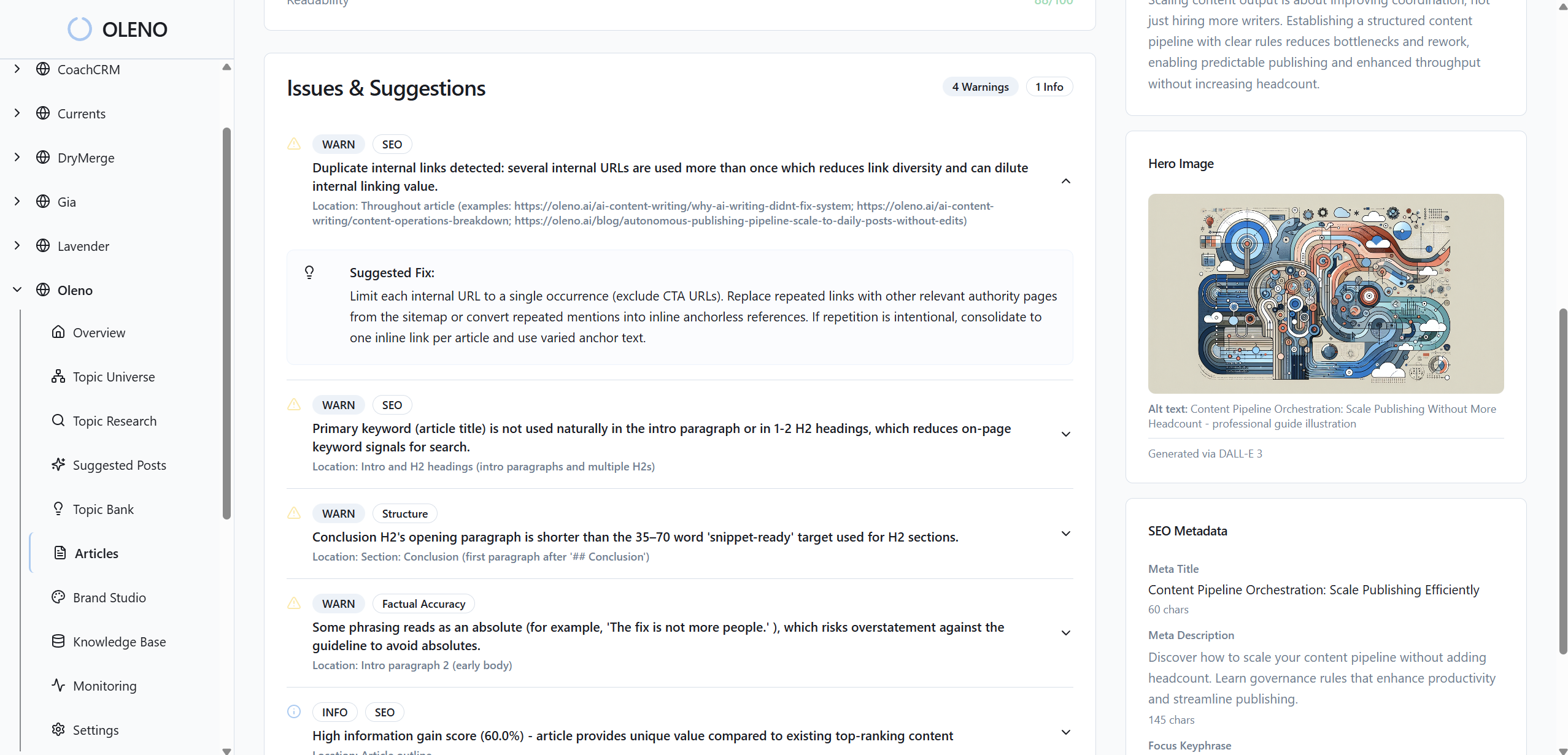
Oleno also runs drafts through a Quality Gate that checks factual grounding, voice match, structure, link health, and SEO density before the marketer sees the piece. It doesn't replace a senior editor. It catches avoidable problems before a human spends time on them.
If your current process creates more rework every time publishing volume increases, book a demo once you've identified which rules should travel from strategy into production.
Decide Your Team's Next Move
The next move depends on whether your team has a volume gap, a messaging clarity gap, or a governance gap. Those are different problems. Treating all three as "we need more content" is how small teams burn capacity while the market still doesn't understand the story.
Use the Three-Bucket Diagnosis
Put your content operation into one of three buckets before you ask for more budget, more writers, or more AI output. Bucket one is volume gap. Your story is clear, sales repeats it, buyers understand it, but you don't have enough content coverage. Scale production.
Bucket two is messaging gap. Your assets sound generic, the CEO keeps rewriting the same lines, and buyers don't repeat your language back. Pause publishing and codify the narrative. Bucket three is governance gap. The message is mostly clear, but claims drift across channels. Add content governance before increasing velocity.
A simple leadership explanation works: "We don't know yet if the constraint is output, clarity, or control. If it's output, we publish more. If it's clarity, more content spreads the problem. If it's control, more content increases risk."
That sentence usually changes the meeting.
Pause Only Long Enough to Fix the Constraint
Pausing publishing can feel scary when the calendar is already thin. That's a fair concern. Organic growth needs consistency, and going dark for a quarter creates its own problem. The answer isn't a giant strategy retreat. It's a short operational reset.
Take one week. Audit the last 10 pieces. Find the repeated rewrites. Write the core narrative rules. Define product truth. Decide which claims need review and who owns them. Then restart production with a better system.
The right sequence is message first, rules second, scale third. Once those are in place, publishing more content becomes a multiplier instead of a confusion machine. More content rarely fixes the underlying story — but a clear story makes more content finally pay back.
About Daniel Hebert
I'm the founder of Oleno, SalesMVP Lab, and yourLumira. Been working in B2B SaaS in both sales and marketing leadership for 13+ years. I specialize in building revenue engines from the ground up. Over the years, I've codified writing frameworks, which are now powering Oleno.
Frequently Asked Questions