AI Generating Inaccurate Content Is a Huge Problem

You approved an AI draft this week, then spent 45 minutes checking whether the product claims were even true. That is the real cost of AI generating inaccurate content at scale.
Most B2B SaaS marketers don't have an AI writing problem. They have an operating problem. The model is being asked to act like a writer, a strategist, a product marketer, and a fact-checker in one shot. Then leadership wonders why the output sounds bland, misses the actual product, and produces content nobody wants to put their name on.
Learn more about request a demo.
Key Takeaways:
- Inaccurate AI content usually starts before drafting, when the system has no product source of truth.
- Better prompts won't fix a workflow that lets the model guess at facts.
- B2B SaaS marketing teams need AI to amplify judgement, not replace it.
- Editors should shape the research direction, brief, outline, and draft before content reaches publish.
- Product truth maintenance matters because SaaS products change faster than old content workflows can track.
- Pre-publish validation protects brand voice, factual accuracy, and discovery performance across search and AI answer surfaces.
Why AI Drafts Go Wrong Before the Model Writes
AI drafts go wrong when the workflow gives the model too much room to guess. A prompt-only process forces the AI to fill gaps with generic language, old assumptions, or plausible product claims. That is how AI generating inaccurate content enters the draft before the editor ever sees it.

The model gets blamed for a missing system
Blame the model first. That is the default move, and sometimes it earns its keep, some models really do produce flatter prose than others, and anyone who reads AI drafts all day can feel the difference inside a paragraph. We saw this ourselves when we switched a default writing model under pressure from what people said was working elsewhere, then watched quality slip within four days.
The bigger issue is usually the process around the model. If the AI doesn't know your positioning, product truth, audience, approved language, and proof points before it writes, the draft becomes a guessing game. Better prompts might rescue the first article. They won't protect the tenth, the fiftieth, or the post about a feature that shipped last week.
Generic copy erodes trust faster than teams expect
Think of it like a hotel chain that uses the same lobby art in every city. Each lobby looks fine on its own. Walk through three of them in a week and the brand stops feeling like a place at all. Generic AI tools do the same thing to a content library, every article has the same smooth cadence, the same safe claims, the same lack of edge.
Here is the moment in practice. A content lead opens Google Docs at 4:40 PM on a Thursday before a launch post is due Friday morning. The AI draft says the product integrates with a workflow that hasn't shipped yet. Legal won't catch it because it sounds harmless. Product won't see it because they aren't in the review cycle. The marketer catches it, fixes it, then starts wondering how many older posts have the same kind of factual drift sitting live on the site.
Better prompts fail when facts keep changing
A prompt is a snapshot. A SaaS product is not. Pricing changes, feature names change, integrations move from beta to GA, and positioning shifts the month after the company learns which use case actually converts. If the AI content workflow doesn't refresh against the current product source of truth, AI generating inaccurate content becomes the baseline, not the exception.
Leadership doesn't evaluate content by publish counts. They care whether content supports pipeline, sales conversations, and trust in the category. If your AI draft gets facts wrong, it doesn't matter that it was published faster. Faster slop is still slop. If you want to see what an editor-led AI content workflow looks like in practice, you can request a demo.
The real fix starts when you move accuracy upstream of the draft.
How Editor-Led Workflows Keep AI Content Accurate
Editor-led workflows keep AI content accurate by placing human judgement where the draft can still be shaped. The editor shouldn't only clean up sentences after generation. They should control the inputs, the structure, the proof, and the final claims before publish.
Diagnose where the factual drift enters
Where did the model first get permission to invent? Run this audit on your last five AI-assisted articles before doing anything else. Find every product claim, every customer claim, every integration mention, every metric, and every statement about your category. Then mark each one as sourced, assumed, outdated, or unverifiable.
The threshold is concrete: if more than 10 claims across those five pieces land in the last three buckets, the process is producing AI generating inaccurate content by design, not by accident. Below 10, you have a draft-stage editing problem. Above 10, you have a source control problem at the start of the workflow, and no amount of polish at the end will close it.
Put human judgement before the draft exists
Fair point on the cost of slowing down: every extra approval step is real friction, and marketers already drown in cycles. Granted. The reason to still move the editor earlier is that late-stage editing is the most expensive place to fix a broken angle. Once the draft exists, people negotiate with the text instead of asking whether the text should exist in that form at all.
The stronger pattern is sequenced: choose the research direction first, approve the brief second, approve the outline third, edit the draft last. That sequence gives the marketer control where it matters and turns editor governance from a vague idea into a practical workflow. The AI does the production work around those calls. The marketer stays in the editor's seat.
Separate the customer from the user in the brief
A homeless shelter nonprofit asked us once who their content should target, donors or the people they served. Both groups read the site. Only one paid. That distinction, which sounds obvious written down, gets collapsed in 80% of AI briefs we audit because the prompt says "For many companies, customers and users are two different things" and never resolves which one this piece talks to.
Force the choice in the brief: name the buyer, the user, the approver, and the beneficiary as four separate rows, and mark which one this specific piece is written for. "Likely the donors I'd reckon" beats no decision at all. The AI needs that call made before it writes, otherwise it talks to all four and persuades none.
Use structured briefs to constrain the output
Could a new writer produce a decent draft from your brief without asking five follow-up questions? If no, the AI won't do better. A good brief includes the source documents, the approved product language, the claims the piece is allowed to make, and the claims it must avoid. Strong structured briefs don't make writers less creative. They stop the wrong kind of creativity, the kind that invents an integration to fill a paragraph.
Without that structure, the model turns a loose topic into a plausible article and the editor has to reverse-engineer every decision afterward. That reverse-engineering is where the hours go.
Maintain product truth like a living asset
Product truth maintenance is boring until the draft gets a feature wrong. Then it becomes the whole problem. SaaS teams ship too quickly for content accuracy to live in old docs, Slack threads, and whatever the last PMM pasted into a prompt three weeks ago.
The rule that holds up: if a claim affects how a buyer understands the product, it needs a source dated after the last major product change. If the source is older than that, treat it as suspect until someone in product confirms it. A sentence can sound confident and still be wrong, and confidence is exactly what AI drafts produce by default.
Validate for two discovery systems
Search engines forgive weak content if the keyword structure is solid. AI answer systems don't. They retrieve passages and synthesize answers from what looks clear, sourced, and consistent across the web, which means contradiction across your own site becomes a ranking signal in the wrong direction.
Google's own guidance on AI-generated content focuses on usefulness and quality rather than whether AI was involved. NIST's AI Risk Management Framework points teams toward governance, measurement, and risk controls instead of blind trust in model output. Same lesson for marketers. If your content says one thing in a blog post, another in a comparison page, and a third in sales enablement, retrieval surfaces have no reason to trust the pattern. The stakes are bigger than rankings.
Accuracy gets cheaper when validation is designed into the workflow instead of bolted on at the end.
How Oleno Keeps Product Truth Inside Every Draft
Ready to get started? request a demo.
Oleno keeps product truth inside every draft by making the marketer shape the work at four points and grounding generation against stored strategy, voice, product facts, and approved source material. The platform is built for B2B SaaS marketers who want speed without letting the AI decide what is true.
Four shaping points replace the writer myth
Oleno is not built around the myth that AI should be the writer and the marketer should accept or reject the finished draft. That split is backwards. B2B SaaS marketing teams need AI to amplify judgement, not replace it.
In Oleno, the marketer shapes the research direction, brief, outline, and draft edits. The platform pauses at those four points so the marketer can decide what matters before the next production step runs. That matters because AI generating inaccurate content usually starts as an unchecked assumption, not as a typo. The Product Truth Library gives the system a structured place to pull product facts, feature boundaries, pricing context, help-center sources, and changelog entries that the marketer maintains as the product ships.
Governance lives in the platform, not the prompt
Oleno stores Brand & Voice Memory, Positioning & Messaging Control, Product Truth Library, Customer Stories Library, and Proprietary IP & Frameworks as reusable context for every piece. The marketer doesn't re-explain the company every Monday. The system reads from the same strategic layer when it researches, briefs, outlines, drafts, edits, and publishes.
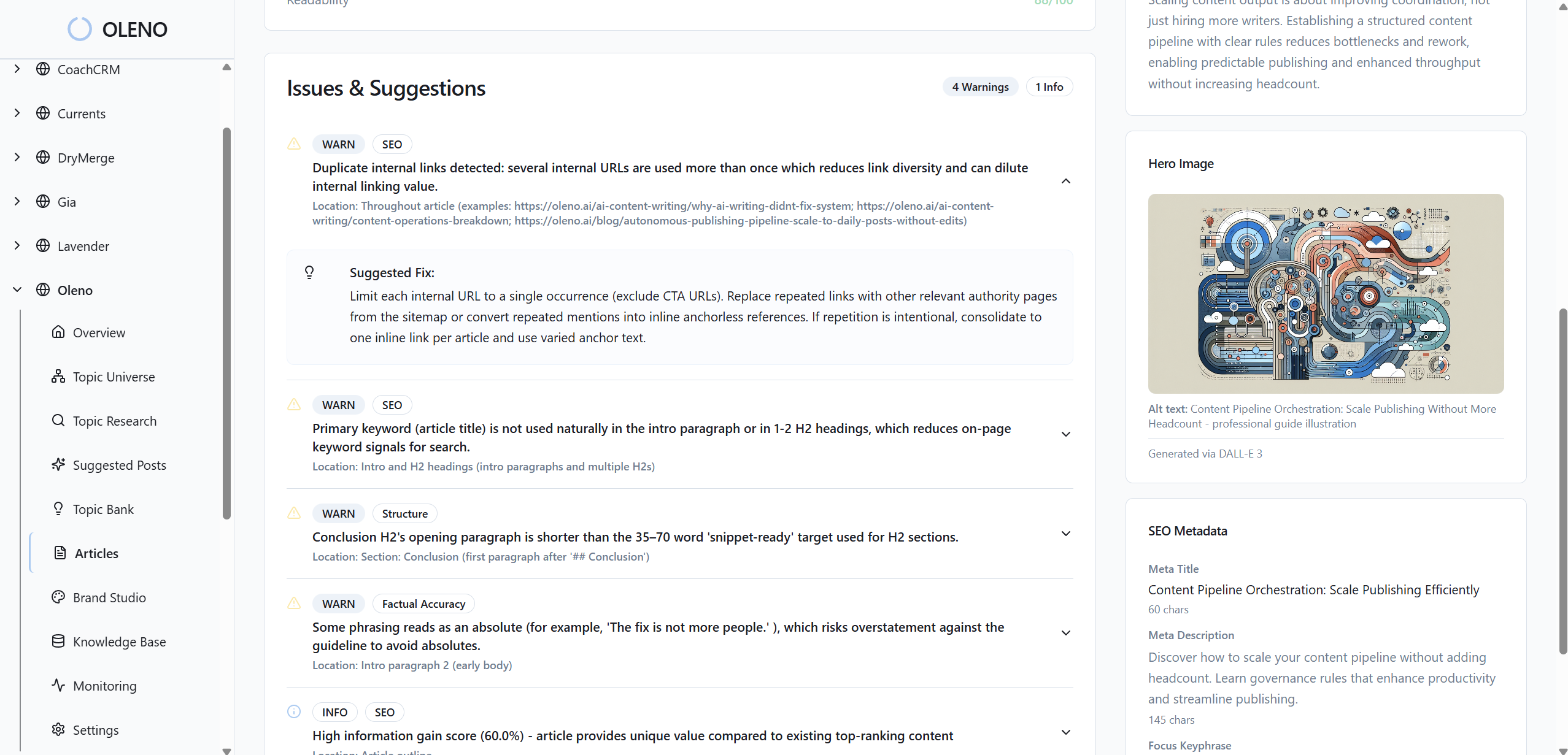
The Quality Gate then scores drafts for factual grounding, voice match, structure, link health, and SEO density before the marketer sees the piece. It doesn't replace editorial judgement. It gives the editor a cleaner draft to review and catches the obvious failures before they turn into publish risks. Pre-publish validation becomes part of the production system, not a checklist someone remembers when they have time. For a deeper version of that control layer, the same logic shows up in practical pre-publish checks.
The platform framing matters
A writing tool generates text from a prompt. A platform holds strategy, product truth, voice, proof, workflow state, and publishing context across pieces. Oleno is the second thing, not the first, and that distinction shows up in every draft.
Anders Uhl, CMO at ClickPoint Software, put the buying logic well when he told us he never saw value in "spitting out a mountain of mediocre-to-terrible content en masse." What got his attention was the quality-first stance. Better thinking and better writing matter more when content has to perform across two discovery systems: search engines and AI answer surfaces.
Oleno fits teams that care about the byline. If you want content running with no human review, the pauses will feel like friction. The pauses are the product, they are how we keep AI generating inaccurate content from reaching publish in the first place.
Build a Content System Your Editor Can Trust
A trustworthy AI content system constrains inputs, assigns editors real control, and validates factual claims before publishing. That system can still move quickly. It just stops pretending speed and accuracy come from the same one-shot prompt.
Start with a simple audit. Pull five recent AI-assisted drafts and mark where product facts entered the workflow. Then mark where an editor had a real chance to change the angle, sources, brief, outline, and claims. If those control points only appear after the draft is written, you have found the source of the problem.
The practical playbook is not complicated:
- Store product truth in one place: feature names, boundaries, pricing context, integrations, and approved claims need a current home.
- Shape the brief before drafting: no draft should begin until audience, angle, sources, and forbidden claims are clear.
- Review the outline before prose: structure errors are cheaper to fix before 1,900 words exist.
- Run pre-publish validation: check factual grounding, brand voice control, links, and discovery formatting before anything goes live.
- Refresh old content when product truth changes: AI generating inaccurate content can come from old pages as easily as new drafts.
For many teams, the fastest path is not another writing assistant. It is content workflow orchestration where the marketer makes the judgement calls and the AI does the production work around them.
AI inaccurate content is fixable. Not by hoping the next model behaves better, and not by asking marketers to spend their week cleaning up invented claims. Fix the workflow, give the editor control before the draft hardens, and keep product truth close enough that the AI has less room to guess.
About Daniel Hebert
I'm the founder of Oleno, SalesMVP Lab, and yourLumira. Been working in B2B SaaS in both sales and marketing leadership for 13+ years. I specialize in building revenue engines from the ground up. Over the years, I've codified writing frameworks, which are now powering Oleno.
Frequently Asked Questions