Ensuring AI Generated Content Remains Factually Accurate

You approved 3 AI drafts this week and still had that weird feeling before publishing. Not because the writing was bad — because ai content accuracy breaks in the small stuff: the feature name, the pricing line, the proof point, the positioning sentence that stopped being true 6 months ago.
Most teams try to fix this with better prompts. Longer instructions, more examples, a stricter final edit. Fair instinct, but it has a ceiling. If the model doesn't have clean, current source material to work from, you're asking it to remember your business from vibes.
The fix is less dramatic than people want. Build a small source system. Decide which claims need human review. Keep the inputs fresh. Let AI do the production work around those decisions.
Key Takeaways:
- Prompt quality can't fix missing, stale, or scattered source material.
- AI content accuracy depends on what the model is allowed to retrieve, not just what you tell it to do.
- The riskiest claims are usually features, numbers, positioning, compliance language, and customer proof.
- Human review should focus on claim risk, not line-by-line polishing.
- Accuracy tiers let you move faster on education content and slow down on bottom-funnel or compliance-sensitive copy.
- Freshness matters. Release notes, pricing changes, and product messaging need a place to live before the next draft runs.
- A repeatable review workflow beats heroic editing every time.
Why AI Content Accuracy Breaks Before the Draft
AI content accuracy usually fails before the model writes a sentence. The failure starts when product docs, release notes, proof points, and positioning live in different places. Once the source material is messy, the draft becomes a confidence test for your editor instead of a useful starting point.

Better prompts don't fix missing inputs
Prompts get all the attention because they're the visible knob. You tweak instructions, paste in a product page, add tone guidance, and the draft improves a little. Feels like progress.
Prompting has a ceiling. If the model doesn't know your onboarding feature was renamed last month, no amount of "be accurate" language will fix that. If your pricing page changed but the prompt still references the old package, the model carries the old claim forward. If your positioning shifted from "AI writer" to "AI content platform," the draft splits the difference and sounds like neither.
A content model is like a new marketer joining your team halfway through a launch. Hand them one Slack thread, two stale docs, and a sales deck from last quarter, and they're going to make confident mistakes. Not because they're careless. Because you handed them a broken briefing folder.
That's why product-grounded content matters more than another clever prompt. The instruction tells the model how to behave. The source system tells it what is true. If you want review to stop feeling like detective work, the truth has to be available before the draft exists.
If your biggest concern is whether the next article misstates the product, it's worth seeing how a controlled content process works in practice through a short demo.
The common failures are boring and expensive
The scariest AI mistakes usually aren't wild hallucinations. They're boring. A feature gets described like it already exists. A customer proof point gets rounded into a stronger claim. An old market category sneaks back into the article. A paraphrase changes the meaning of a quote or compliance statement.
That's the stuff that gets through because it sounds normal. A senior marketer reads the paragraph and thinks, "close enough." Product reads it two weeks later and says, "we don't actually do that." Legal reads the same line and says, "why did we imply that?" Now the article isn't just late. Trust took a hit.
Four buckets cover most of the damage:
- Feature drift: the article describes a capability that changed, got renamed, or hasn't shipped.
- Invented statistics: the draft adds a number because the sentence felt stronger with one.
- Outdated positioning: the content repeats an old category, ICP, pain, or product story.
- Meaning drift: the article paraphrases a source but changes what the source actually said.
The fix isn't reviewing every sentence like it's a contract. Too slow. The fix is knowing which kinds of sentences can break trust if they're wrong.
Accuracy work feels like cleanup when ownership is unclear
It's 4:40 PM on a Tuesday. A Demand Generation Manager opens the draft in Google Docs. Tomorrow's the deadline. Intro reads fine, headings read fine, product section sounds confident. Then one line claims the platform "automatically validates every claim," and now she's pinging product in Slack, waiting on a reply from PMM, and wondering if legal needs a look. It's now 6:15 PM, the draft is half-edited, and she hasn't touched the next two pieces in the queue.
That's the real pain. Not the typo. The uncertainty. You start reading every paragraph like a trap, because nobody defined who owns which claim type. Once that happens, AI content stops saving time. It just moves the work to the end of the process.
A fair counterpoint: some teams should move slowly. Compliance-sensitive copy, security pages, legal-adjacent claims, enterprise procurement content — speed shouldn't be the first goal there. But most blog education content doesn't need that same review weight. Treating all content like it has the same risk level is where teams lose the week.
So what should actually live in the source folder before the next draft runs?
How to Build a Source System for Accurate AI Content
Accurate AI content needs a defined source of truth for product, proof, positioning, and claims. The system doesn't need to be complex at first. It needs to answer one question clearly: what is the model allowed to use when it makes a factual statement?
Start by diagnosing which claims drift fastest
Before you build any folder, run a short diagnostic on your last 5 published pieces. Five questions:
- Did any sentence describe a feature that changed, got renamed, or hasn't shipped?
- Did the article use a number you can't trace back to a specific source?
- Did the positioning match what sales is currently saying in calls?
- Did a customer proof point get rounded up from its original quote?
- Did compliance or legal language get paraphrased into something looser?
If two or more of those came back yes, your accuracy problem is a source problem, not a prompt problem. That's your starting list — features, numbers, positioning, proof, compliance — ranked by how often they trip.
A lightweight version of the source system fits in a 5-column table:
- Claim type: feature, pricing, proof, positioning, compliance, competitor, customer language.
- Approved source: product doc, release note, pricing page, case study, sales note, PMM doc.
- Owner: marketer, PMM, product, legal, founder.
- Freshness rule: update after launch, monthly, quarterly, or before major campaign.
- Review rule: automated edit allowed, marketer review, PMM review, product review, legal review.
The threshold I like: if a claim would make you Slack someone before publishing, it belongs in the source system. Not someday. Now.
Separate source truth from buyer language
Buyer language is not the same as product truth. Both matter, but they shouldn't live in the same bucket. Product truth says what you actually do. Buyer language says how the market describes the problem.
A content system might store messy buyer questions like "What do you do as a Demand Generation Manager," "Demand gen leaders — do you manage SDRs?", "What kind of projects/campaigns/tasks do Demand Gen roles do?", and "Got a new job as SEO Lead for an enterprise level company. Any advice?" Those phrases are useful because they show how real people talk. They shouldn't be treated as verified product claims.
Same with career-transition language like "I am looking to transition into a Product Marketing Manager role as I see a lot more job opportunities in that." Great raw material for audience research. Bad source material for product proof.
Teams mix these together all the time. Then the model writes content that sounds market-aware but factually loose. Not ideal. Keep source types separate so the model knows whether it's using language as signal, proof, or truth.
Tier the risk before you assign reviewers
Not every AI-generated page carries the same hallucination risk. A top-of-funnel blog post explaining a general category can move faster. A bottom-funnel comparison page needs tighter product checks. A compliance-sensitive page needs a different review path entirely.
A 3-tier setup works well:
- Tier 1, education content: blog posts, explainers, thought leadership, light SEO content. Marketer review is usually enough unless product claims appear.
- Tier 2, bottom-funnel content: comparison pages, product-led pages, pricing-adjacent pages, buyer enablement. PMM or product should verify claim-heavy sections.
- Tier 3, sensitive content: security, legal, compliance, regulated claims, procurement claims. Route to the right specialist before publishing.
The conditional rule: if the content can influence a buying decision with a factual product claim, don't leave the claim to a general editor. If the content could create legal, security, or compliance risk, don't let marketing be the only reviewer. That's not bureaucracy. That's basic content governance.
For teams building this into AI content pipelines, the tier should be chosen before the brief. Wait until the draft, and you're already asking the wrong person to catch the wrong thing.
Build freshness into the workflow
Operational freshness is where accuracy systems usually break. The team sets up a good source folder once. Everyone feels good. Then the product ships, pricing changes, messaging shifts, and the AI keeps writing from old inputs.
Freshness needs a trigger, not a quarterly "we should clean up the docs" project. When release notes go out, update the product source. When pricing changes, update the pricing source. When positioning changes, update the messaging source before the next campaign draft runs.
The practical rule: no source should be trusted forever. Give each source type a freshness window. Product docs need review after every launch. Positioning needs review monthly while the company is changing. Customer proof can stay valid longer, but only if the numbers and permissions are still safe to use.
A good source system has expiry dates in spirit, even if no software is enforcing them yet.
Ground drafts before asking for polish
Grounding means the model can retrieve approved source material while it writes. Prompting means you ask the model to follow instructions. Both matter, but grounding does more for ai content accuracy because it reduces the blank spaces where the model guesses.
The order matters: define the source, retrieve the right source, generate the brief, draft, then review. Plenty of teams do the opposite. They draft first, then paste in sources during cleanup. That creates a weird problem — the draft has already formed its argument before the facts arrive.
Structured briefs help here because they force the article to declare its claims before prose makes everything feel finished. A good brief lists the approved sources, the claims the piece is allowed to make, and the claims that need review. That's why structured briefs are an accuracy tool, not just a writing tool.
I might be wrong on the exact sequence for every team, especially if you already have a heavy PMM process. I wouldn't skip the brief, though. The brief is where factual problems are still cheap.
Decide which edits can stay automated
Fact checking shouldn't turn every edit into a human meeting. Some edits are safe for automation. Grammar cleanup, formatting, heading clarity, repetitive wording, meta descriptions, and internal consistency checks can usually stay automated.
Claim edits need a different rule. If an edit changes what a product does, who it's for, how pricing works, what a customer achieved, what a regulation requires, or what a competitor offers, send it to a human owner. Not because AI can't improve the sentence. Because the meaning changed.
A useful test: if the edit changes style, automate it. If the edit changes meaning, review it. If the edit adds specificity, review it twice.
That last one matters. Specificity is where AI content sounds better and gets riskier at the same time. A sentence with a number, a named feature, or a strong guarantee feels more credible. It can also be wrong in a way a vague sentence wasn't.
If your current review process treats every edit the same, tighten it around meaning changes. That one change removes a lot of wasted human review without lowering confidence. For higher-risk pages, pair this with compliance QA so sensitive language doesn't get treated like a blog intro rewrite.
How Oleno Keeps Product Claims Grounded
Oleno is built around the idea that marketers should shape the facts before AI writes the draft. The platform stores product truth, positioning, voice, proof, and source material so every article starts from approved inputs. The marketer still reviews the important calls, but the blank-page guessing goes away.
Product Truth and source control
Oleno's Product Truth Library stores the product, features, integrations, pricing, help-center sources, and changelog entries the system is allowed to cite. That matters because the most expensive AI content accuracy failures usually come from invented features or outdated product claims. The model shouldn't be deciding what your product does from memory.
The same principle applies to positioning and voice. Oleno's Positioning & Messaging Control stores the company's market point of view, key messages, category framing, audiences, use cases, and anti-personas. Brand & Voice Memory stores how the content should sound and which phrases to avoid. Those inputs are loaded into the content process instead of being retyped into a prompt every Monday.
Oleno doesn't invent positioning if you haven't given it any. That's a limitation, and it's a healthy one. If the company doesn't know what it believes yet, AI shouldn't pretend otherwise. For teams with real product truth and source material, that constraint is exactly what keeps content from drifting into generic claims.
Review points before publishing
Oleno pauses at the places where human judgment changes the article: Compose, Research, Brief, Outline, and Draft. The marketer sets the angle, reviews the source list, edits the brief, shapes the outline, and reviews the draft before publishing. AI does the production work around those decisions.
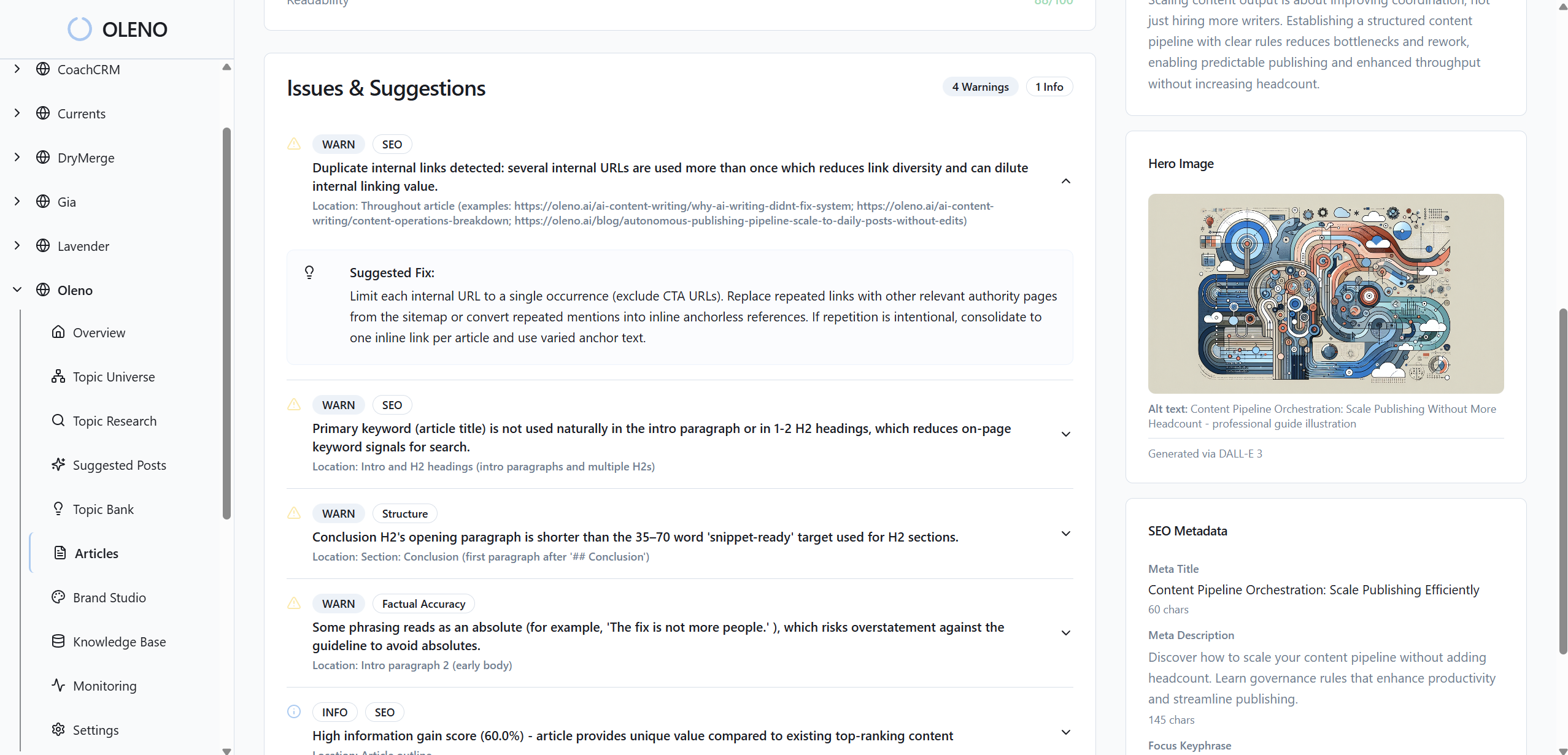
The Quality Gate then scores the draft for factual grounding, voice match, structure, link health, and SEO density before the marketer sees the piece. If the draft fails, a targeted repair pass runs and QA checks it again. That doesn't remove human review. It makes the review smaller and more focused.
Oleno also supports direct publishing to supported CMS destinations after the piece passes the required checks or receives an explicit override. That keeps the content path from turning into a separate formatting job at the end.
Ship Accurate AI Content With Less Cleanup
AI content accuracy gets easier when you stop treating every draft like a mystery. Define the approved sources. Tier the risk. Route claim-heavy copy to the right owner. Keep the inputs fresh. Let automated edits handle style, structure, and formatting while humans review meaning.
That doesn't mean a giant governance project. Start with the 10 claim types that scare you most: product features, pricing, proof, positioning, compliance language, customer outcomes, competitor claims, release notes, market definitions, and buyer promises.
Once those have owners and sources, review changes shape. The editor isn't hunting for every possible mistake. They're checking the claims that actually break trust. That is how you shorten manual QA without publishing fabricated or outdated statements.
About Daniel Hebert
I'm the founder of Oleno, SalesMVP Lab, and yourLumira. Been working in B2B SaaS in both sales and marketing leadership for 13+ years. I specialize in building revenue engines from the ground up. Over the years, I've codified writing frameworks, which are now powering Oleno.
Frequently Asked Questions