How to Automate Blog Post Creation for SaaS

You can get a decent AI draft by Friday and still create a content mess by Monday. The mistake is treating the blog post as the unit of work, when the real work is the workflow around it. If you want to automate blog post creation in SaaS, the draft has to inherit product truth, brand voice, approvals, distribution plans, and pipeline measurement before anyone calls it done. Otherwise the model just gives your team a faster cleanup job.
I've seen this go sideways a bunch of times. A marketer plugs a topic into an AI writer, gets 1,500 words back, and then spends the rest of the afternoon fixing product claims, rewriting the intro, checking whether the CTA makes sense, and turning the post into something sales can actually use. So yes, they automated the draft. They didn't automate blog post creation.
For SaaS teams, the better approach is to automate the workflow around the writing. Inputs, research, brief, outline, claim validation, review, CMS handoff, distribution, and measurement. That's where the real lift is. Not because writing doesn't matter. Because writing only works when the system around it is strong.
Key Takeaways:
- Automating briefs and reviews usually matters more than automating first drafts.
- SaaS blog automation fails when product knowledge lives outside the content workflow.
- Humans should stay on positioning, claims, product accuracy, and final approval.
- Distribution automation is often the highest-value step after drafting.
- Content teams still need pipeline attribution, not just publish count.
- A solo marketer needs a lighter process than a small demand gen team.
- The goal is quality at cadence, not faster generic content.
Why Drafting Alone Breaks SaaS Blog Automation
Drafting alone breaks SaaS blog automation because the draft is not the real unit of work. The real unit is the governed content workflow, from inputs to approval to distribution to measurement. If those pieces are weak, better writing models just help you publish bad content faster.

The draft is where problems show up, not where they start
A VP Marketing opens the Google Doc at 5:47 PM on a Thursday and sees the problem immediately. The intro sounds fine, but it could have been written by any company in the category. The product section describes a feature that shipped three months ago using the old positioning. The proof is generic, the CTA points to the wrong offer, and now the marketer isn't reviewing. They're rebuilding. Two hours of cleanup on a draft that took the AI 90 seconds to generate.
That's the pattern most teams hit. They look for a tool that can take a keyword, generate a post, and save the writer a few hours. Fair enough. If you're publishing simple educational posts with low product risk, that can work for a while.
SaaS content has a different burden. The article has to reflect the product accurately, use the right category language, and match the company's current positioning. It has to avoid making claims sales or legal would hate. And it has to connect to some business goal beyond "we shipped a blog post." That's a lot to ask from a blank writing assistant.
That's why isolated writing assistants start losing usefulness at scale. The issue isn't that they can't write sentences. They can. The issue is that they don't know enough about the business unless someone keeps feeding them the context.
If you want to compare where your current process is leaking context before the draft even exists, request a demo and walk through the handoffs piece by piece.
SaaS teams need a system before they need speed
Scaling content for SaaS requires a content operations system, not isolated AI writing tools. A real content ops system defines who chooses the topic, what source material gets used, who approves the angle, how claims are checked, how the content gets published, and how impact gets measured.
A single AI writer can still be useful. To be fair, I'd use one myself for rough ideation, rewrites, outlines, and quick summarization. The mistake is making that tool the center of the content operation. It becomes one more tab in the stack, not the system that keeps the work together.
The better mental model is closer to a product release process. You wouldn't let a feature ship because one engineer wrote code quickly. You'd want requirements, review, QA, release notes, rollout, and measurement. Blog content is not code, obviously. For a SaaS company, a bad product claim in a blog post can still create real mess downstream.
The question changes. Not "how do we automate the article?" The better question is "which parts of the blog creation workflow can machines handle without taking judgment away from the marketer?"
How to Build a Governed Blog Creation Workflow
That question gets answered through the workflow itself. A governed blog creation workflow starts with stable inputs, clear human decision points, and automation around the repetitive work. The marketer should shape the argument, proof, and product accuracy. The system should carry those decisions through research, drafting, review, distribution, and measurement.
Define the source of truth before you generate anything
Before you generate a single sentence, answer six questions. What do we sell, and what do we never claim? Who is the article for, and who is it not for? What product truth must appear in the piece? What customer proof can support the argument? What words, phrases, or claims should never be published? What CTA or next step fits the buyer stage? If any of those answers live in someone's head instead of a document, you don't have a source of truth yet. You have tribal knowledge waiting to leak.
Your source of truth is the difference between useful automation and faster slop. It should include positioning, product docs, messaging, approved claims, customer evidence, brand voice examples, and the audience language your buyers actually use. Without that, the model defaults to the average internet answer.
I'd start with a simple audit. Pull the 10 things a writer would normally ask you for before writing a good SaaS post. The current positioning doc, the product page, the release note, the sales-call notes, the customer proof, and the competitor angle. The old blog posts that still sound like you.
The raw buyer language matters more than teams think. Don't only store polished persona labels. Store the messy phrases buyers use in forums, sales calls, search queries, and internal notes. Stuff like "What do you do as a Demand Generation Manager", "Demand gen leaders - do you manage SDRs?", "What kind of projects/campaigns/tasks do Demand Gen roles do?", "I am looking to transition into a Product Marketing Manager role as I see a lot more job opportunities in that." Looks ugly in a planning doc. But that language tells you how buyers frame problems before they know your category vocabulary.
Small thing, big difference. If those answers are stable, you can automate blog post creation with far less cleanup. If they change every week, automation will only expose the confusion faster.
Keep humans on workflow boundaries that change the outcome
Draw the line like this. If the decision requires taste, positioning, product nuance, or risk tolerance, keep a marketer in the loop. If the work is repeatable, rules-based, or formatting-heavy, automate it. That's not anti-AI. That's how you stop AI from doing the one thing it's worst at, pretending it understands your market when it only has partial context.
The highest-value workflow boundary is the moment where a human decision changes the article's direction. Topic choice, angle, audience, product claim, proof, and final approval should stay human-owned. Research gathering, brief assembly, formatting, QA checks, metadata, and CMS prep can often be handled by the system.
A solo marketer might only need 3 required handoffs: topic approval, outline approval, and final review. A small demand gen team might need more: product marketing review for product claims, SEO review for intent fit, and founder review for point-of-view pieces. More review is not automatically better. Past 3 reviewers, the process often becomes consensus writing. And consensus writing is where strong angles go to die.
A practical boundary map looks like this:
- Human owns topic and angle: The system can suggest options, but a marketer picks the fight.
- System gathers research: Pull product docs, sales notes, customer proof, and competitive context.
- Human approves the brief: Catch weak positioning before prose exists.
- System drafts and formats: Let the machine do production work.
- System checks claims: Flag risky statements before review.
- Human gives final approval: The byline still belongs to the company.
There's a real downside here. You won't get the thrill of pressing one button and watching posts appear. If you care about brand voice and product marketing alignment, that thrill is usually the trap.
Build claim validation into the workflow, not the cleanup pass
If your reviewer is catching product claims in the final draft, your workflow is broken. Claim validation should happen before publishing, not after someone gets nervous in the Google Doc. SaaS blog posts often include product details, integration claims, pricing notes, customer proof, and category comparisons. If those aren't checked against approved sources, the content risk goes up with every post you ship.
I've seen teams treat governance like a final polish step. Bad idea. By the time the draft is finished, everyone is tired and the publish date is close. The reviewer sees a claim that sounds wrong, leaves a comment, waits for the writer, then pulls in product marketing, then someone checks a help doc, then the post slips. Not because the team is lazy. Because the workflow put claim validation too late.
Governance and claim checks are part of safe content automation, not optional cleanup. At minimum, your system should flag claims in 4 buckets: product capabilities, customer outcomes, competitor comparisons, and numbers. If a claim can't be traced to a source, it should be rewritten or removed.
A simple rule works well. Every product claim needs a home. Either it maps to product docs, a changelog, a sales-approved note, or a customer story your team is allowed to use. If it maps nowhere, it doesn't publish. Not dramatic, just sane.
Automate distribution beyond the blog post
Most teams treat the publish date as the finish line. The post goes live, everyone shares it once, and then the team moves on to the next draft. A week later, sales asks for a short version. The founder wants a LinkedIn post. Demand gen needs email copy, and product marketing wants a campaign angle. Suddenly the "finished" blog post created five more tasks for the team that thought they were done with it.
Automation should cover workflow stages beyond drafting, including distribution and measurement. A blog post is usually the source asset, not the final asset. Once the article is approved, the system should help turn it into email copy, LinkedIn posts, sales blurbs, campaign snippets, and internal launch notes.
A good workflow template treats distribution as part of creation. The article should produce assets for the channels that matter before the team forgets why the post was written. Not fully automated social-only workflows. Not a random pile of snippets. Just enough planned reuse to make the original thinking travel.
The simple version:
- Blog article for search and buyer education.
- Email summary for nurture or customer list.
- LinkedIn post from the strongest opinion.
- Sales enablement blurb for reps.
- Campaign excerpt for the landing page or webinar follow-up.
One caution. Repurposing should not mean summarizing the article five different ways. Pull the sharpest points, preserve the angle, adapt the hook to the channel. Otherwise you're just distributing beige.
Connect throughput metrics to pipeline metrics
Content teams are judged on downstream business impact, so automation has to connect to pipeline measurement. Publish count matters, but only as an operating metric. If the team optimizes for output without pipeline attribution, they'll eventually produce a lot of content nobody can defend in a budget conversation.
There are two scoreboards here. The first is throughput: topics approved, briefs created, drafts completed, posts published, days from topic to publish, review time, and distribution assets created. Useful. The second is business impact: organic signups, assisted pipeline, influenced opportunities, sales usage, demo page visits, and content touched before conversion.
Most teams overbuild the first scoreboard and ignore the second. It feels good because throughput moves quickly. You can show that the team shipped 12 posts instead of 4. If those 12 posts don't influence qualified traffic, demo intent, sales conversations, or pipeline, the automation story falls apart in the next budget review.
You don't need a perfect attribution model to start. A basic pipeline attribution dashboard can connect blog URLs to conversions, CRM activity, and assisted touchpoints. Imperfect measurement beats no measurement. The key is to avoid treating publish count as the goal.
Match process complexity to team size
A solo marketer should not copy the content workflow of a 12-person marketing team. That sounds obvious, but it happens all the time. Someone reads about content operations, builds a giant process in Notion, adds approval stages, creates templates, and then becomes the only person maintaining the system.
If you're solo, keep it tight. One source-of-truth doc, one content calendar, one review checklist, one distribution checklist, one monthly measurement view. Automate the painful parts first: research gathering, brief creation, formatting, CMS prep, and repurposing. Don't build a maze. You'll resent it by week three.
A small demand gen team has a different problem. More people means more context loss. The SEO lead cares about search intent, product marketing cares about accuracy, and demand gen cares about campaigns and pipeline. The founder or CEO acts as CMO in some companies and either validates or amplifies ideas in others, which can be useful, but it can also create last-minute rewrites if the process doesn't define when that input happens.
I'd use this decision rule:
- If one person owns content, automate production steps and keep approvals light.
- If 2-4 people touch content, define ownership by stage.
- If product marketing reviews claims, bring them in at brief or outline, not final draft.
- If leadership review is required, show them the angle before writing.
- If the team expects you to keep quality and motivation up with department, reduce manual coordination first.
Process should remove drag. If the process creates more status meetings, it's broken. Which raises the obvious question, what does a system look like when it's actually built around those rules?
How Oleno Turns Workflow Into CMS-Ready Content
Oleno fits when a SaaS marketing team needs the whole blog creation workflow controlled, not just a faster draft. It starts with research and source material, carries approved strategy into the brief and outline, checks quality before review, and prepares structured long-form content for CMS handoff.
Research, brief, and outline come before the draft
Oleno is built around the belief that the draft is not the hard part anymore. The hard part is shaping the work before the draft exists. So the platform starts with Compose and Research, then moves into Brief and Outline before Draft. That sequence matters because it forces the angle, proof, product truth, and structure to get handled early.
Oleno's Brand & Voice Memory stores how the team sounds, and Positioning & Messaging Control stores the strategic layer the content should write from. Product Truth Library keeps product claims bounded to approved product facts. Customer Stories Library gives the draft proof it's allowed to use, without making up outcomes. Those pieces work together so the article doesn't start from a blank prompt every time.
The workflow is useful because it mirrors how strong marketers already think. First, decide what the piece is really saying, then gather the right proof, then shape the brief, then approve the structure, then draft. Oleno does the production work around those calls, but the marketer still owns the calls that affect trust.
For the cleanup problem from earlier, that's the real shift. Instead of finding product mistakes at the end, the workflow makes product truth part of the input. Instead of hoping the voice feels right, the draft reads against stored voice examples. Instead of turning a finished post into CMS work, Oleno produces structured long-form content with headings, metadata, CTAs, proof, and formatting that can move toward publishing without the usual rebuild.
Quality review and publishing stay in the same path
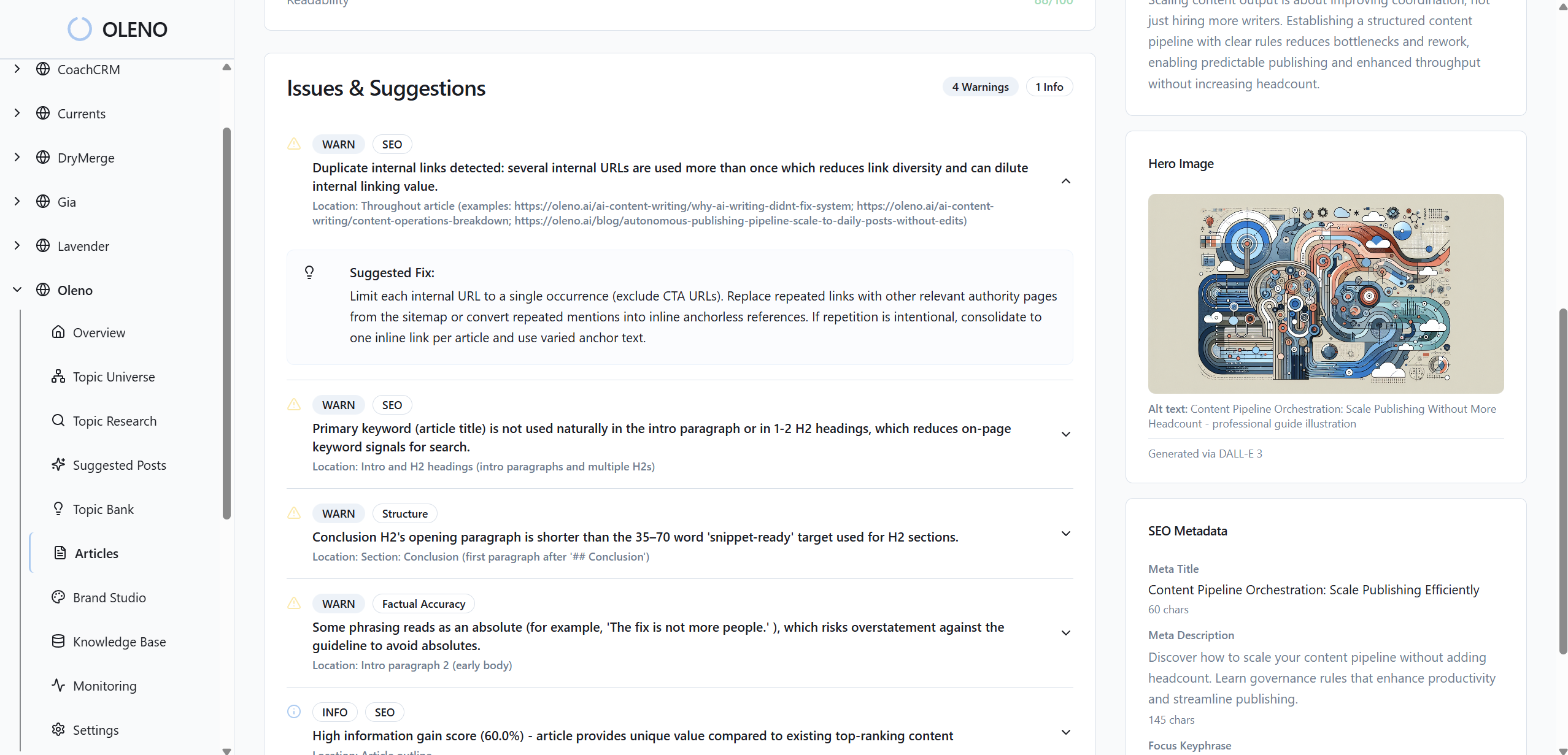
Oleno also keeps review and publishing connected to the content workflow. The Draft stage runs against the approved brief and outline, then passes through sanitize and Quality Gate before the marketer opens it. Quality Gate checks factual grounding, voice match, structure, link health, and SEO density. If the draft falls short, the system runs a targeted repair pass before review.
That doesn't replace a marketer, and it shouldn't. Oleno is for teams that care what gets published under their name. The marketer still reviews the draft, edits what needs to change, and approves the piece before it moves forward. The difference is that they're not starting from a draft that ignored half the company context.
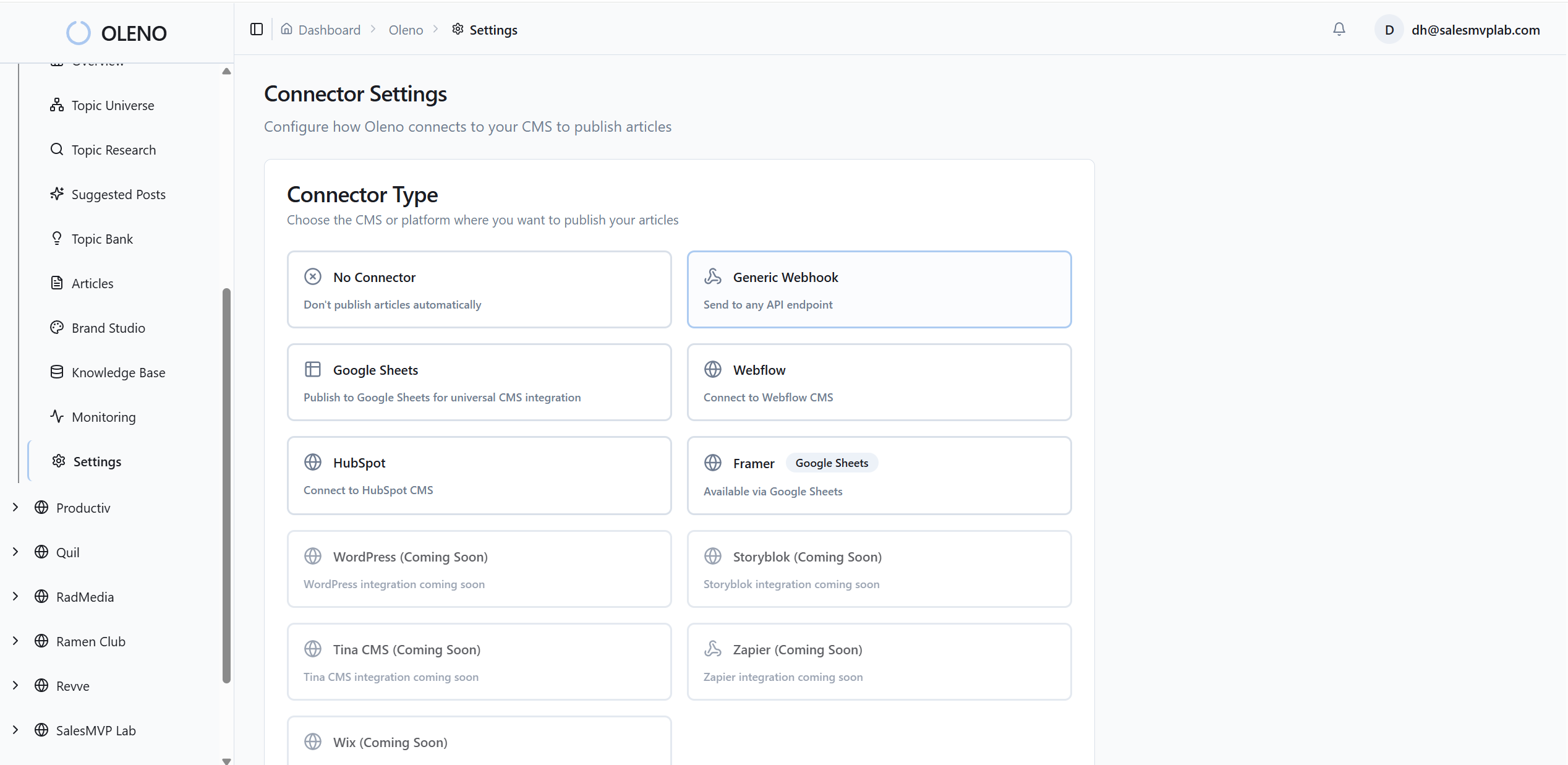
Publish is the handoff layer. Oleno can push to supported destinations like WordPress, Webflow, Storyblok, HubSpot, Tina, Wix, Framer, Google Sheets, Webhook, and Zapier. It handles CMS formatting details that marketers usually waste time fixing after the writing is done. Not the entire marketing stack. Not attribution. Not technical SEO. Just the hard middle between approved strategy and a publishable article.
If you want to see how research, brief, outline, draft, quality review, and CMS handoff work in one controlled path, book a demo and use one of your real blog topics as the walkthrough.
Build the Workflow Before You Automate the Draft
The safest way to automate blog post creation is to build the workflow first, then automate the stages that create the most repeatable drag. Start with source-of-truth design, keep humans on high-judgment decisions, add claim validation before publishing, and connect distribution to measurement.
The trap is thinking automation means removing the marketer. For serious SaaS content, that's backwards. The marketer's judgment is where the differentiation lives. The system should make that judgment easier to apply across more pieces, not bury it under faster output.
If you're just starting, don't overbuild. Pick one blog workflow. Define the inputs. Decide who approves the brief. Create a claim checklist. Add one distribution asset per post. Track one throughput metric and one pipeline metric. Run that for a month before adding complexity.
Mission is pretty simple. Publish more without losing trust. Everything else is mechanics.
About Daniel Hebert
I'm the founder of Oleno, SalesMVP Lab, and yourLumira. Been working in B2B SaaS in both sales and marketing leadership for 13+ years. I specialize in building revenue engines from the ground up. Over the years, I've codified writing frameworks, which are now powering Oleno.
Frequently Asked Questions