AI SEO Content Governance for B2B SaaS Teams Scaling Beyond One Writer

Your second AI writer changes the job from content production to AI content governance. The work stops living in one editor’s head and starts needing rules the system can apply before a draft exists. Otherwise every contributor brings their own version of the product into the same editorial workflow. That feels like more capacity at first, then the rewrite load comes back twice as annoying.
AI SEO content governance matters because scale changes the job. You don't just need more drafts. You need a way to keep product messaging, brand voice consistency, approval rules, content QA, and human in the loop decisions from becoming writer-by-writer judgment calls.
The reader wants AI to amplify judgment, not replace it. And honestly, that's the right instinct. The win isn't handing the keys to a generic AI writer. The win is building a governance layer that lets more people contribute without making every article feel like it came from a different company.
Key Takeaways:
- Governance becomes critical once a team scales beyond one writer.
- Product truth needs to be captured before AI starts generating claims at volume.
- Editorial control belongs upstream, in the brief and outline, not just in the final cleanup pass.
- A platform approach beats isolated writer workflows when traceability and repeatability matter.
- Quality governance should protect brand voice consistency while still letting contributors move fast.
- Tool evaluation should focus on governance, traceability, and system extensibility, not just writer features.
Why AI Content Governance Breaks After the Second Writer
AI content governance breaks after the second writer because the team moves from one person's taste and memory to a shared operating system that either exists or doesn't.

The second writer exposes what was living in your head
When one senior marketer owns content, governance feels invisible. You know the positioning. You know which claims are safe. You know which customer stories are approved, which product language is outdated, and which phrases make the brand sound like everyone else. So the workflow feels simple. Pick a topic, shape the angle, draft, edit, publish.
Then you add another writer.
I saw this back when I was the sole marketer at PostBeyond. I could crank out 3-4 high quality posts per week because I had all the context in my head. Once the team grew, our content writer didn't have the same context, so every draft took longer and still came back weaker. Not because they were bad. Because the system depended on me remembering everything.
That is the first real governance diagnostic. If a new writer needs three calls, four docs, and a long Slack thread before they can write one article, you don't have a repeatable editorial workflow. You have a person acting as the system. If that person gets pulled into executive meetings, product launches, or sales support, quality starts to drift fast.
The marketer's early instinct is usually right: "outsource to find what works." That can work when you're still figuring out the angle and buyer language. But once the pattern is clear, the next move is usually "Bring it in-house to scale." And the second you do that, governance stops being optional because you now have multiple people interpreting the same strategy.
Speed compounds inconsistency faster than quality
More AI writers don't automatically create more useful content. Past a certain point, they create more places for inconsistency to hide. One contributor writes "sales onboarding." Another writes "revenue enablement ramp." A freelancer describes a feature you retired last quarter. Someone else uses a customer segment you don't actually sell to anymore.
Small gaps become big gaps at content cadence.
The analogy I like is a sales team using five different pitch decks. One deck says you're for mid-market SaaS. Another says enterprise. Another still has last year's category language. Nobody notices during one sales call. Across 50 calls, the market gets a blurry version of your company. Content works the same way. One off-message article is annoying. Fifty off-message articles become a positioning problem.
Google's guidance on creating helpful content still comes back to whether the work demonstrates real expertise and serves the reader. AI search raises that bar because answer engines pull from passages that sound specific, grounded, and internally consistent. Generic scale can fill a blog. It won't build authority.
If your team is already feeling that tension, don't add another writer before you define the operating model. Use request a demo as the next step after you've mapped where the drift is happening, because the useful conversation is about the system underneath the drafts.
Risk appears before legal ever sees it
Risk management in AI content starts with boring mistakes. A product claim gets stretched. A pricing detail gets copied from an old page. A competitor statement loses its source. A compliance phrase gets softened because the model thinks softer sounds nicer. None of those mistakes feel dramatic when they happen one at a time.
At scale, they become expensive.
The scary part isn't that AI lies in some cartoon way. The real issue is that AI writes plausible sentences with confidence. If your product truth isn't encoded before generation, the model fills the blank with whatever sounds reasonable. That might pass a quick skim. It might even sound better than the accurate version. That's exactly why it's dangerous.
A simple threshold helps here: once more than one person can publish or approve AI-assisted content, every claim type needs an owner. Product owns feature accuracy. Marketing owns positioning. Legal or compliance owns restricted language where needed. Content owns voice and structure. If nobody owns a claim type, the editor becomes the final firewall on every sentence.
That doesn't scale. Not really.
How to Build Editor-Led Governance for AI SEO Content
Editor-led governance gives AI clear boundaries before it writes, then keeps the marketer making the calls that determine angle, claims, structure, and final taste.
Diagnose the failure mode before changing tools
Start by figuring out where quality actually breaks. A lot of teams blame the writer or the model too early. Fair enough, sometimes the draft is just bad. But if three different writers make the same kind of mistake, the failure is usually upstream.
Run a quick audit on your last 10 AI-assisted articles. Don't score them by whether you liked the writing. Score them by where the editor had to intervene. If rewrites cluster around product claims, you need product truth capture. If rewrites cluster around voice, you need stronger brand standards. If rewrites cluster around structure, you need better brief and outline review before drafting.
A useful red flag list:
- Same correction repeated 3+ times: The rule belongs in governance, not in comments.
- Product claims require manual checking every draft: Your source of truth isn't being loaded before generation.
- Voice changes by contributor: Your style guide isn't specific enough for production.
- Review comments ask strategic questions late: The brief was approved too loosely.
- No audit trail for claim changes: You can't explain why the final version says what it says.
The diagnostic matters because the fix changes by failure mode. If the issue is brand voice consistency, hiring another writer won't solve it. If the issue is product messaging, a stronger prompt won't hold forever. If the issue is approval rules, a faster AI model just gets you to the same bottleneck sooner.
Capture product truth before generation starts
Product truth capture is the part most teams skip because it feels like admin work. It isn't. It is the difference between AI writing from your actual company and AI writing from the average SaaS website it has seen online. Claims, terminology, exclusions, personas, use cases, integrations, pricing boundaries, and approved customer proof all need a home.
The rule I like is simple. If you wouldn't want a junior writer deciding it alone, don't leave it inside a prompt. Put it in a structured source the system can reuse. That includes the words you use, the words you avoid, and the claims you never make because they sound good but aren't true.
For many companies, customers and users are two different things. That one sentence can change the entire article if you're writing for a buyer who signs the contract but doesn't live in the product every day. It affects the pain you lead with, the proof you use, and the CTA. If AI doesn't know that split, it will write for the wrong audience and still sound polished.
A practical product truth layer should include:
- Approved product claims: What the product does, with the exact boundaries.
- Forbidden claims: What the product doesn't do, even if prospects ask for it.
- Terms of art: Category language, product names, and phrases to avoid.
- Persona rules: Who the article speaks to and who it should not target.
- Proof sources: Customer stories, public references, and approved examples.
If you want a deeper version of that operating layer, the idea behind product truth governance is worth studying because false claims don't usually come from bad intent. They come from missing boundaries.
Move editorial judgment upstream
The editor should shape the work before the draft exists. Waiting until the final draft to apply judgment is the expensive version of control. By then, the structure is set, the wrong claims are woven into paragraphs, and the writer or model has already made a hundred small decisions you now need to unwind.
I prefer four decision points: research direction, brief, outline, and draft edits. Research direction decides what sources and angles are allowed. The brief decides the audience, argument, proof, and exclusions. The outline decides the flow. Draft edits decide taste, nuance, and final sharpness.
That split keeps the marketer in the editor's seat without making them rewrite every paragraph by hand. It also changes how contributors behave. Writers stop guessing what "good" means because the rules are visible earlier. AI stops filling blanks with plausible nonsense because the blanks have been reduced before drafting.
The status quo has one real advantage. A loose workflow feels fast. You can open ChatGPT, paste a prompt, and get 1,500 words in a minute. That is useful for rough thinking and one-off drafts. The tradeoff is that every missing decision comes back as review load, and review load is where content teams lose weeks.
If a draft needs more than two major structural rewrites, don't fix the draft first. Fix the brief and outline process. The mistake happened earlier.
Turn workflow orchestration into reusable decisions
Workflow orchestration is the difference between a single prompt and a reusable system with approvals, source records, and an audit trail. The word sounds bigger than the job. Really, it means the same decisions happen in the same order every time, and the system remembers what was approved.
Single prompts are fine for solo work. They break when multiple contributors need to follow the same editorial workflow. One person prompts for research. Another skips research. One person asks for citations. Another trusts the model. One person checks the outline. Another drafts straight from the topic. Suddenly, every article has a different production path.
Reusable systems fix that by making the path explicit:
- Define the topic and angle.
- Approve or reject sources.
- Shape the brief.
- Approve the outline.
- Draft against approved context.
- Run content QA before publish.
- Preserve an audit trail of what changed.
A platform approach matters here because it turns judgment into repeatable behavior. Not generic automation. Not a black box. A content system should make it obvious what the human approved and what the AI produced around that approval.
That is the core difference in orchestration vs prompting. Prompting is a moment. Orchestration is an operating model.
Set quality rules that protect speed from itself
Quality governance isn't the opposite of speed. Done right, it prevents the rework that makes speed fake. The trick is choosing rules that catch the failures you actually see, not building a committee around every sentence.
Set a threshold for what must be reviewed manually and what can be checked by the system. Product claims need traceability. Voice can be scored against examples and prohibited phrases. Links can be checked. Keyword coverage can be measured. Structure can be evaluated against the approved outline. The editor should spend time on argument, taste, and judgment, not hunting for dead links or guessing if a claim is still true.
NIST's AI Risk Management Framework uses the language of mapping, measuring, managing, and governing AI risk. That sounds formal, but the content version is very practical. Know where the risk enters. Decide how to detect it. Assign ownership. Keep records.
The conditional rule is simple: if an error could damage trust, it needs a pre-publish safeguard. If an error is just style preference, put it in the voice guide and coach it over time. Don't treat every comma like compliance. Don't treat product truth like taste.
For teams already comparing options, pre-publish governance is the practical lens. The point isn't to slow content down. The point is to catch the wrong mistakes before the public does.
Design the team model before adding capacity
The second writer changes ownership. The third changes process. The fourth changes management. A lot of teams miss that because headcount feels like a volume decision, but in content it is really an operating design decision.
Before adding another contributor, write down who owns what. One person owns content strategy. One owns product truth. One owns final editorial approval. One owns the calendar. In a small team, the same human may own several of these. That's fine. The point is not perfect separation. The point is that ownership is explicit.
A useful maturity check:
- One writer: Governance can live partly in the editor's head, though it shouldn't stay there.
- Two writers: Shared briefs, product truth, and voice rules become mandatory.
- Three to five contributors: Approval rules and audit trails matter because edits multiply.
- Six or more contributors: You need platform-level memory, content QA, and clear publishing controls.
A freelancer model can still work. So can an agency. So can in-house. The exception is when you're still pre-positioning. If you don't know who you serve, what you believe, or what claims are true, governance won't save the program. You'll just encode confusion more efficiently.
If you're at the point where adding contributors increases review load instead of useful output, use request a demo after you map the ownership gaps, because that map makes the platform conversation much more concrete.
How Oleno Keeps Marketers in Control
Oleno keeps marketers in control by storing strategy, product truth, and voice once, then pausing at the points where human judgment should shape the work.
Strategy memory beats writer-by-writer prompting
Oleno is built around the idea that AI should do the production work and the marketer should keep the judgment work. Brand & Voice Memory stores how the content should sound. Positioning & Messaging Control stores who the team sells to, what the company believes, what messages matter, and which audiences to avoid. Product Truth Library stores the claims, features, integrations, pricing, and boundaries the system is allowed to use.
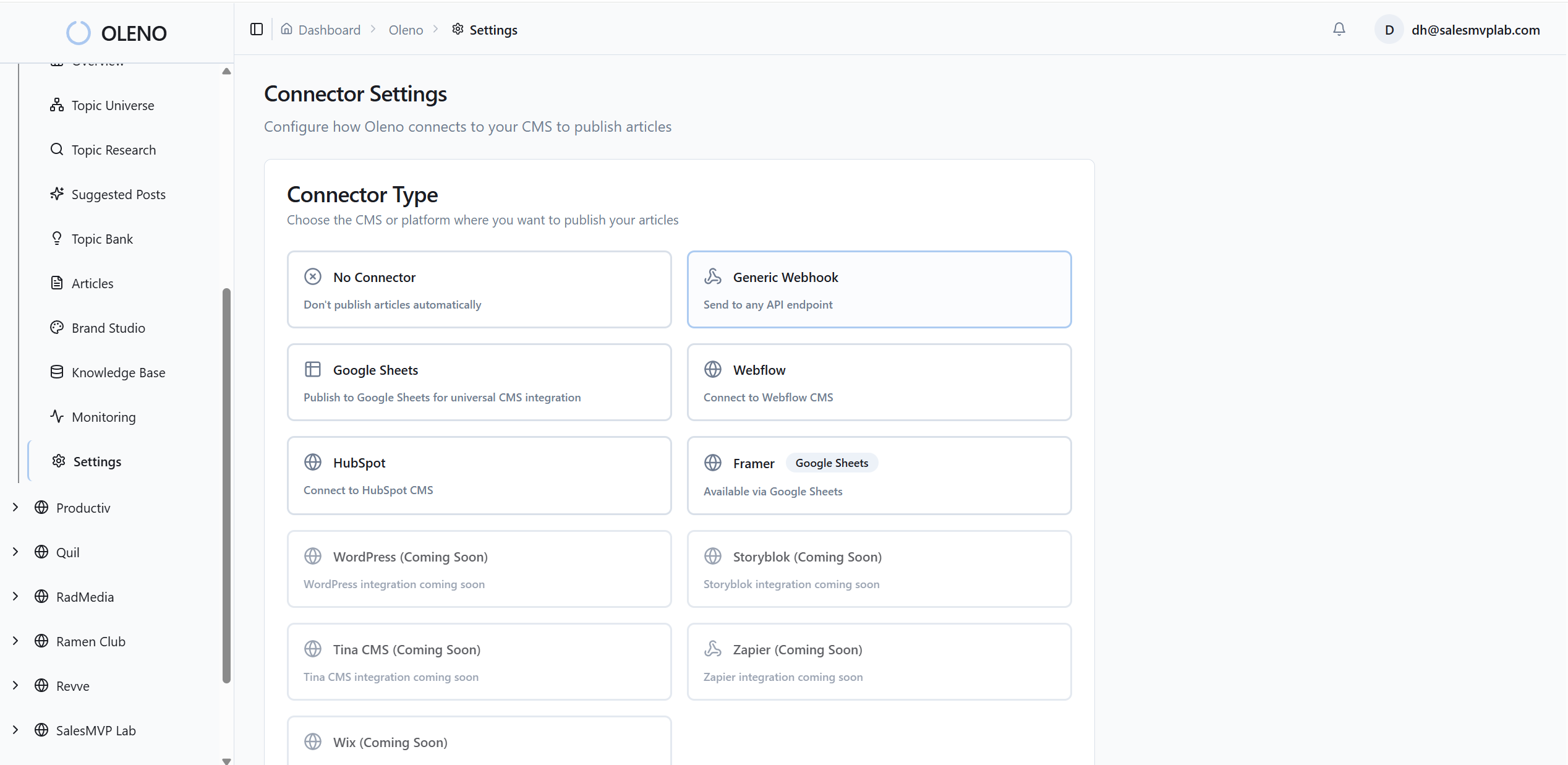
That matters because isolated writer workflows make every contributor rebuild context from scratch. One writer has the latest positioning doc. Another has an old enablement deck. A third prompts from memory. The platform approach gives the system the same strategic base every time, so the marketer isn't re-explaining the company every Monday.
Oleno's workflow also keeps the human decisions in the right places: Compose, Research, Brief, Outline, Draft, and Edit. The marketer shapes the research direction, the brief, the outline, and the draft edits. The AI does the production work between those choices. Nothing publishes that the marketer didn't help shape.
That is the part buyers often care about most. Not because they hate AI. Because they know the difference between a draft and a publishable argument.
QA and publishing close the governance loop
Oleno's Quality Gate checks every draft for factual grounding, voice match, structure, link health, and SEO keyword density before the marketer sees the piece. It doesn't replace editorial taste. It handles the repeatable checks that drain time when content scales across multiple contributors.
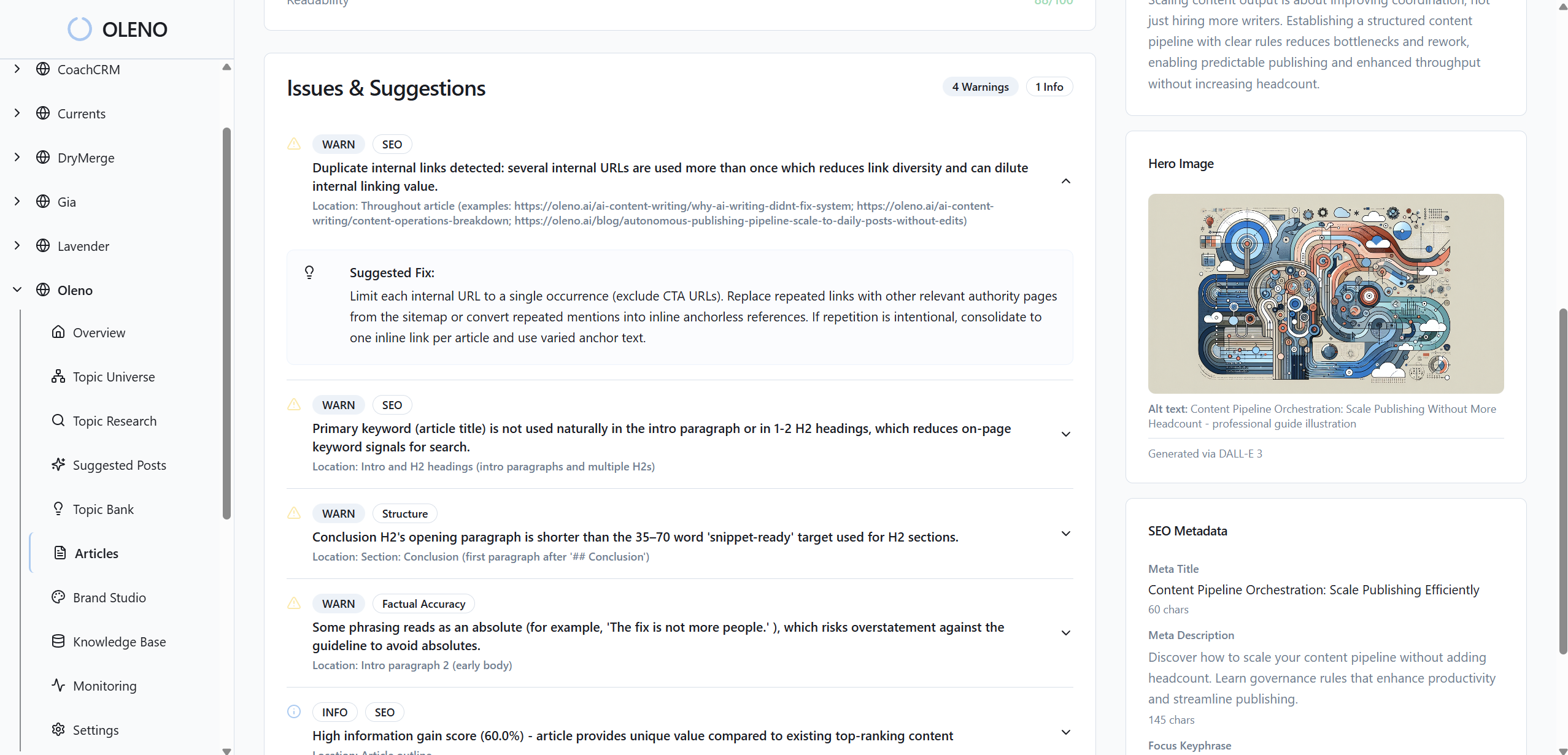
That connects back to the earlier risk problem. Product claims are checked against the Product Truth Library. Voice is checked against Brand & Voice Memory. Structure is checked against the approved outline. Link health is checked before publishing. If the draft falls short, a targeted repair pass runs before the marketer opens the piece, rather than pushing the mess into manual review.
Publishing is part of governance too. Oleno publishes into WordPress, Webflow, Storyblok, HubSpot, Tina, Wix, Framer, Google Sheets, Webhook, and Zapier, with verified publishing mechanics like image rehosting, Yoast metadata mapping for WordPress, Gutenberg figure blocks, and idempotent updates by external_id. The marketer isn't also acting as the integration layer between AI and the CMS.
For teams evaluating auditable content systems, the test is not "can it write?" Most tools can write. The better question is whether the platform can preserve strategy, trace claims, enforce quality rules, and publish without turning the marketer into a part-time operations person.
If that is the operating model you want to see in practice, book a demo after you compare your current review steps against the governance loop above.
Build the Governance Layer Before You Add More Writers
AI content governance is the layer that turns more contributors into more useful output instead of more review load, more risk, and more brand drift.
The practical move is not complicated. Capture product truth. Write down voice rules that are specific enough to use. Move editorial judgment into research, brief, and outline review. Define approval rules by risk level. Keep an audit trail for claims and source decisions. Then evaluate tools by whether they support that operating model, not by whether they generate a decent first draft.
The old path feels tempting because it gets words on the page fast. Add a writer. Add an AI tool. Add another freelancer. Keep pushing. But once the team scales beyond one writer, speed without governance starts creating the work it was supposed to remove.
Build the system first. Then scale the output.
About Daniel Hebert
I'm the founder of Oleno, SalesMVP Lab, and yourLumira. Been working in B2B SaaS in both sales and marketing leadership for 13+ years. I specialize in building revenue engines from the ground up. Over the years, I've codified writing frameworks, which are now powering Oleno.
Frequently Asked Questions